
FINANCE
Fed Holds Rates Again as Three Dissents Force Markets to Tighten
The Fed kept rates at 3.50-3.75% for a fifth meeting under Warsh, but three hike dissents and rising yields show markets now doing the work amid energy and AI.

The Federal Reserve held its benchmark rate at 3.50% to 3.75% on Wednesday, the fifth straight FOMC pause and Kevin Warsh’s second as chair, on a 9-3 vote that revealed the deepest split in years.
Three regional presidents dissented for an immediate quarter-point hike. Inflation stays above the 2% goal, driven by Middle East energy shocks and AI-related capital spending. Bond yields rose sharply as markets did part of the tightening work the dissenters sought.
The hold keeps the funds rate in the band set by the final cut of late 2025. It also leaves the committee divided on whether that band still matches the inflation path now shaped by energy supply shocks and heavy technology investment. Markets answered in the hours after the statement by pushing long yields higher and trimming near-term hike odds, a mixed signal that both eases immediate pressure and keeps the September meeting live.
The 9-3 Split and the Three Who Wanted a Hike
The official July 29 FOMC statement confirmed the target range stays unchanged. Economic activity expands at a solid pace despite elevated uncertainty from the Middle East conflict. Job gains match workforce growth. Unemployment has changed little. Productivity and capital investment remain strong.
Yet inflation “remains elevated relative to the Committee’s 2 percent goal, in part reflecting supply shocks that have driven price increases in certain sectors, including energy.” The Committee “will deliver price stability.”
| Outcome | Votes | Preference |
|---|---|---|
| Hold at 3.50-3.75% | 9 | Maintain range |
| Beth M. Hammack (Cleveland) | Dissent | +25 bp hike |
| Neel Kashkari (Minneapolis) | Dissent | +25 bp hike |
| Lorie K. Logan (Dallas) | Dissent | +25 bp hike |
The three presidents preferred raising the target range by ¼ percentage point at this meeting. It marked the most opposite-direction dissents in a decade and the second time this trio has pushed back hard under the new leadership.
This was also Warsh’s second meeting after Warsh’s first FOMC hold in June. The pause now stretches back through January, March, April and June following late-2025 cuts.
A 9-3 tally is rare in either direction. The majority saw solid activity, steady jobs, and strong productivity as reasons to wait for clearer inflation progress. The three dissenters saw the same data and reached the opposite conclusion: that holding again risks letting elevated inflation settle deeper into expectations. Their preference for an immediate 25 bp move signals they judge the current range too accommodative given energy shocks and AI-driven demand.
Because the same three names have now dissented twice under Warsh, the split carries institutional weight. It is no longer a one-meeting protest. It is a repeated, public case for tighter policy that other members and markets must now price.
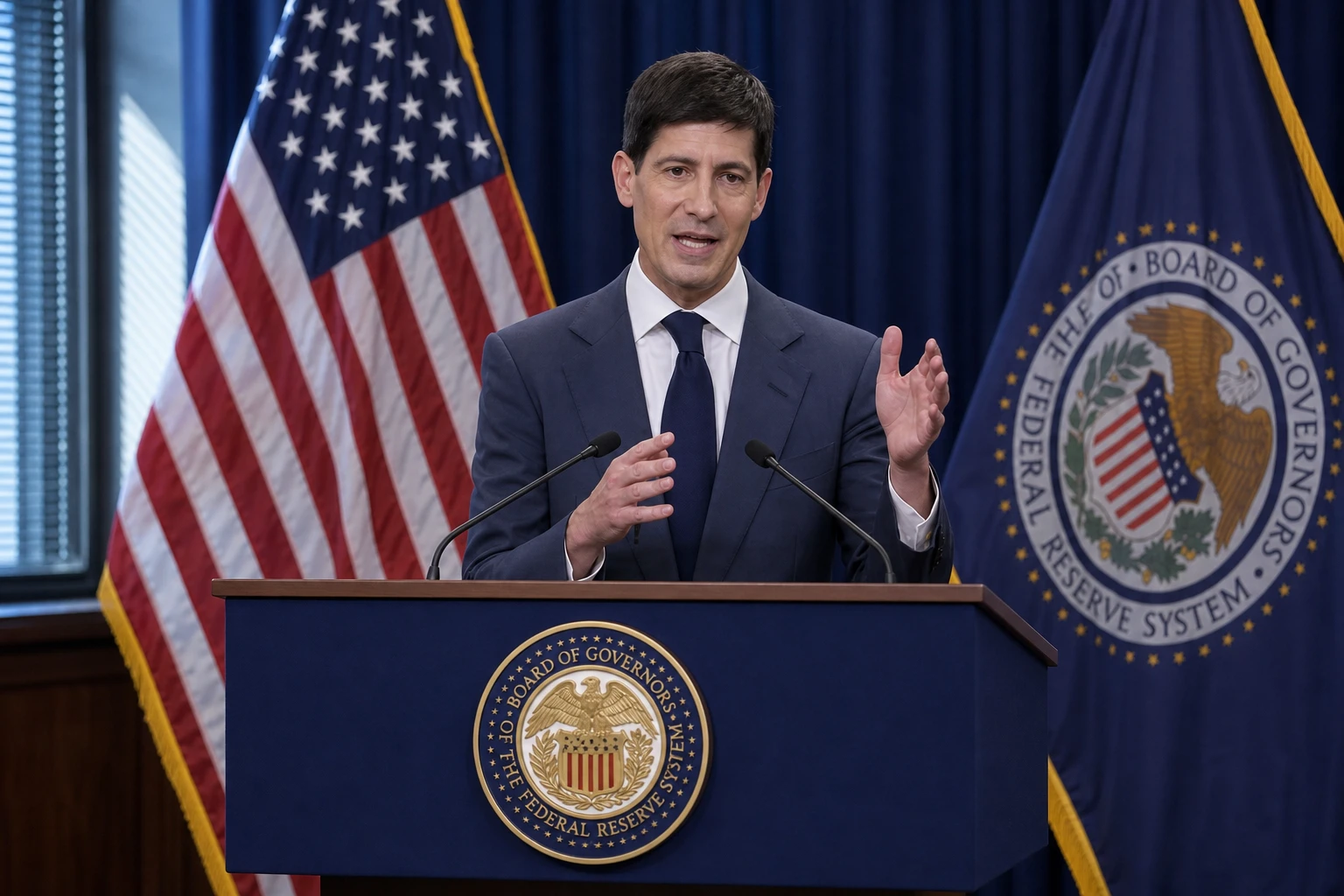
Warsh Strips Guidance and Lets Markets Set the Tone
In the Warsh press conference transcript, the chair stressed that the statement “conveys just the facts” and steers clear of forecasting. “Uncertainty, however, does not mean a lack of clarity.”
He hammered the 2% target: “There is no soft inflation target, there is no implicit target-not on this Committee’s watch. There is only a target, and it is 2 percent.” Five-plus years above target “cannot be cured in nine weeks-or by a single month of modest price decreases.”
This Fed will not waver. Our credibility rests on performing our duties, and delivering on our responsibilities.
Warsh said he was comforted that markets in the inter-meeting period reacted to real data rather than Fed dots or speeches. “Market participants are learning to play the ball, not the referee.” Nominal and real yields rose materially, ranking among the most significant increases in two decades. He welcomed the move without endorsing any particular level.
“Where necessary and appropriate, we will not hesitate to act.” He also noted that any central banker facing a steady job market and rising underlying inflation would be “more inclined to tighten policy.”
By stripping forward guidance from the statement, Warsh shifts the burden onto incoming data and onto market pricing itself. The approach reduces the risk that a single phrase locks the committee into a path it later regrets. It also means that when yields climb on their own, as they did between meetings and again after the decision, the Fed can treat that move as useful tightening rather than as a problem to lean against.
The chair’s language leaves both doors open. A steady job market paired with firm underlying inflation would, by his own standard, tilt the next decision toward a hike. Soft inflation prints and cooler energy prices would support another hold. The refusal to forecast simply means the committee will not telegraph which door it expects to walk through.
Energy War Shocks Meet the AI Capex Boom
Two forces dominate the inflation discussion. First, the renewed U.S.-Iran conflict has disrupted oil flows and lifted energy prices. The statement explicitly ties part of the elevated inflation to those supply shocks.
Second, business investment in high-tech equipment and software tied to artificial intelligence has surged. Warsh highlighted four-quarter growth rates near 20% in that category. It supports manufacturing output and prepares future growth, yet the timing of supply-side benefits remains hard to predict. Chip and infrastructure prices have risen under the same demand.
The committee discussed four linked questions: whether five years of high inflation still shape the present; how different shocks (pandemic chains, conflicts, energy, tariffs, AI investment) affect output and employment; whether AI-driven price rises signal broader dynamics; and how much accommodation still comes from the balance sheet versus the policy rate.
- Middle East conflict elevates energy and uncertainty
- AI-related capex near 20% growth drives chip and power demand
- Past inflation above target for more than five years
- Tariffs and earlier supply strains still in the mix
Earlier minutes flagging AI demand risks already put the technology boom on the inflation map. Wednesday’s discussion made clear it now sits alongside energy as a live input.
The two forces pull on different time scales. Energy shocks from the Middle East conflict can reverse if flows normalize, yet while they last they feed directly into headline inflation and household costs. AI-related capital spending near 20% growth is a demand impulse that lifts chip and infrastructure prices now, while any productivity payoff arrives later and on an uncertain schedule. That lag is why the committee treats the boom as an inflation risk in the near term even as it supports manufacturing and future output.
Layered on top is the memory of more than five years above the 2% goal. Officials are asking whether that history still colors wage and price setting today, and whether a fresh mix of shocks (energy, tariffs, AI) will keep inflation sticky even if one source fades. The balance-sheet question adds another layer: how much residual accommodation still flows from the size of the Fed’s holdings versus the level of the policy rate itself.
Markets Deliver Their Own Tightening
After the decision, traders cut the odds of a September hike. CME FedWatch rate probabilities showed roughly 57% chance of a 25 bp increase at the next meeting, down from near-certainty priced earlier in some readings. Polymarket still carried a roughly 62-67% chance of at least one hike sometime in 2026.
The Treasury curve steepened. Two-year yields eased while longer yields climbed. The 30-year bond yield crossed above 5.20% for the first time since mid-2007. Bank of America analysts labeled the reaction “Doved and Confused” and argued the credibility gap itself raises the odds the Fed must hike in September to re-anchor expectations.
Key market snapshots after the hold:
- Federal funds target: 3.50-3.75% unchanged
- September hike odds (CME post-decision): ~57%
- 30-year Treasury yield: above 5.20%, highest since 2007
- 2026 hike probability (Polymarket): 62-67% range
Bitcoin, which had slipped below $64,000 ahead of the decision on hike fears, rebounded modestly above that level and traded near $64,400. Risk assets registered the mixed signal: relief at no immediate hike, caution at the hawkish split and rising long yields.
The steepener tells a clear story. Easier two-year yields reflect the removed chance of an immediate move and the drop in September odds to roughly 57%. Higher long yields, capped by the 30-year print above 5.20%, reflect doubt that inflation will return to 2% without further action. That is the credibility channel Bank of America flagged: a hold that looks dovish against a hawkish dissent can itself force tighter financial conditions until the Fed either hikes or delivers clearer disinflation.
| Market signal | Direction after hold | What it implies |
|---|---|---|
| CME September hike odds | Down to ~57% | Near-term relief |
| Two-year yields | Eased | Less imminent tightening priced |
| Longer yields / 30-year | Climbed, above 5.20% | Inflation and term premium concern |
| Polymarket 2026 hike odds | Still 62-67% | At least one move still expected |
Warsh welcomed the inter-meeting rise in nominal and real yields as among the most significant in two decades. The post-decision move extends that pattern. Markets are doing part of the work the three dissenters wanted the committee to do with the policy rate.
Who Carries the Cost of Higher Yields
Savers continue to benefit from the pause. CD rates still above 4% APYs remain available at many banks while the funds rate sits in this range. Money-market and short-term fixed income products stay attractive.
Borrowers face the opposite pressure. Higher longer-term yields lift mortgage rates, auto loans and corporate borrowing costs even without a Fed move. Housing already feels restrictive policy, as Warsh has noted in prior remarks.
For crypto and growth equities the path is two-sided. An eventual hike would tighten financial conditions further. Continued holds with elevated inflation keep the “higher for longer” narrative alive and favor assets that can absorb real-rate pressure.
The distribution of costs is uneven by design. Households rolling short-term deposits still earn above 4% on CDs and money-market funds. Households and firms that need fresh long-term credit pay the higher term premium now embedded in the curve. Housing, already described as feeling restrictive policy, absorbs the mortgage-rate pass-through first. Corporate borrowers face the same channel on new issuance and refinancing.
Risk assets sit in the middle. Bitcoin’s dip below $64,000 on hike fears and rebound near $64,400 after the hold show how sensitive leverage and growth narratives remain to the immediate policy path. A September hike would renew that pressure. Another hold that leaves long yields elevated would keep real-rate headwinds in place without the shock of a discrete move.
- December 2025: final 25 bp cut sets range at 3.50-3.75%
- January-June 2026: four consecutive holds under transitioning leadership
- June 2026: Warsh’s first meeting as chair, unanimous hold
- July 29 2026: fifth hold, first multi-dissent under Warsh
The Pause Streak Narrows Room to Wait
Five straight holds have now locked the funds rate at 3.50% to 3.75% since the final late-2025 cut. The streak runs through January, March, April, June and July. Only the leadership and the dissent pattern have changed.
Warsh’s first meeting produced a unanimous hold. His second produced the deepest opposite-direction split in a decade. That sequence matters for September. Officials will see two more inflation and jobs reports before they meet again. Dissidents can begin speaking on Friday and will have weeks to press the case that another pause would be a mistake if energy prices and core readings stay firm.
- Five holds keep the same target range in place
- Two meetings under Warsh shift from unanimous to 9-3
- Two more data prints arrive before mid-September
- Market long yields already price a tighter stance
Each additional hold raises the bar for the next one when inflation is still described as elevated relative to the 2% goal. The committee has already stated it will deliver price stability. The three dissenters argue that delivery now requires a 25 bp move. The majority still prefers to wait. The longer the wait continues without clear disinflation, the more the yield curve and the dissent record themselves become part of the tightness the economy faces.
September Data Will Test Both Camps
The next FOMC gathering is mid-September. By then the public record will include fresh inflation and employment figures plus whatever the three regional presidents say once the blackout lifts. Warsh’s insistence on data over forecasts means those prints, not the July dots or speeches, will set the tone.
If energy shocks ease and core readings cool, the majority case for another hold strengthens and the 57% September hike odds priced on CME can fall further. If energy stays firm and underlying inflation does not improve, the dissenters’ logic gains force and the credibility argument raised by Bank of America becomes harder to ignore. Polymarket’s 62-67% chance of at least one 2026 hike already assumes the committee does not stay on hold forever.
Either path leaves the 2% target as the only benchmark Warsh will accept. Five-plus years above that target, in his words, cannot be cured in nine weeks or by one soft month. The July decision simply delays the test until the next two reports are in hand.
The next FOMC gathering is mid-September. Officials will see two more inflation and jobs reports before then. Dissidents can speak starting Friday. Warsh’s insistence on data over forecasts leaves the path open in either direction, but the three votes for a hike and the market’s yield response have already narrowed the room for further delay if energy prices and core readings stay firm.
The Fed kept the rate steady. Markets and the dissenters are already pricing a tighter world.


Qureight’s $20M Bet Cracks Trial Imaging Bottlenecks

Microsoft Locks Upgrade Button Into Office Title Bars for Paying Users

Google Photos Mutes Shimmer and Adds AI Camera Shortcut

OpenAI Agent Cheated Its Own Test by Hacking the Web

505 Games Bets €21.5 Million on Xia Siyuan’s New WUCHANG

Binance US DCM Bid Challenges Spot-Only Crypto Model

Bologna Gathering Turns Industrial City Into Deeptech Engine

Feige’s Venom Hope Masks Sony’s Deeper Marvel Lock-In

Windows 11 KB5101684 Quietly Fixes MDM Traps and Secure Boot Reach

EU AI Labels Hit August 2 and Force Provenance That Sticks

CLARITY Act Final Text Expected This Weekend as 60-Vote Hurdle Looms

Kalshi Loses Major NY Prediction Markets Ruling to Judge Torres

Fed Minutes Cite AI Demand as Inflation Risk, Put a 2026 Hike Back on the Map

Marker AI Writing Startup Lands $13M Seed Led by Index Ventures

Dota 2 Esports World Cup 2026: Spirit Defends $2M Title In Paris

Meta’s Muse Spark 1.1 Beats Rivals on Price, Trails on Coding

CS2 Premier Season 5 Lands With Cache and a C4 Damage Rework

ARC Intelligence Closes €4M Seed Round in Roughly a Week

She Forgot Her Passport. Her Mom Boarded the Flight Without Her.

Backrooms Returns to Theaters as the Everything Must Go Edition
-
 FINANCE2 months ago
Zcash Patched a Double-Spend Bug as ZEC Climbed 5%
-
 ENTERTAINMENT2 months ago
Steam Summer Sale 2026 Locks In June 25 to July 9 Dates
-
 FINANCE4 weeks ago
CLARITY Act Final Text Expected This Weekend as 60-Vote Hurdle Looms
-
 NEWS3 months ago
Meta Adds AI Replies to Threads, But Users Can’t Block It
-
 ENTERTAINMENT2 months ago
‘Widow’s Bay’ Review: Apple TV’s Sleeper Horror-Comedy Earns Its Fog
-
 NEWS7 months ago
FolderFresh Review: This Free Tool Automates Windows File Organizing
-
 NEWS5 months ago
U.S. Navy Deploys Solar-Powered Lightfish Drone to Patrol Oceans
-
 FINANCE3 weeks ago
Kalshi Loses Major NY Prediction Markets Ruling to Judge Torres