
NEWS
Google Pay Puts Gemini Coach Inside UPI to Push Credit
Gemini-powered Ask Google Pay delivers vernacular spending insights and feeds the new Flex SBI Card, raising retention stakes as UPI share pressure builds.

Google launched Ask Google Pay on 29 July 2026, a Gemini-powered chat inside the India app that answers natural-language questions about spending, savings and basic finance concepts. The same day it expanded everyday credit with the Google Pay Flex SBI Card.
The feature is opt-in, limited to a rolling set of users, and sits under the Money tab. It turns transaction history plus consented CIBIL data into personalized tips while the new card adds RuPay-plus-Visa acceptance and instant Stars rewards.
What the Gemini Chat Does
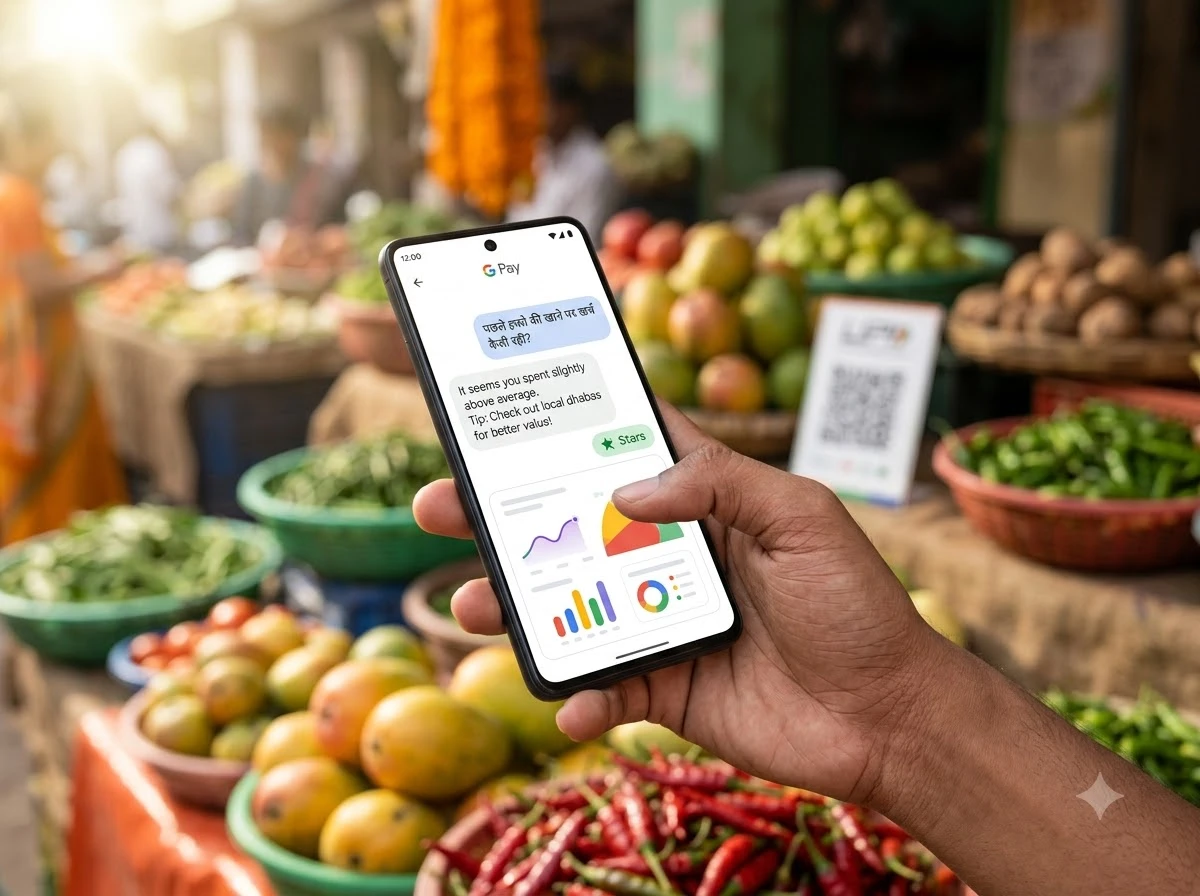
Ask Google Pay lets users type or speak questions such as “how much did I spend on dining last week” or “what is the difference between the old and new tax regime.” It draws on Google Pay transaction history and, when shared, credit report data to surface patterns and suggestions.
Google lists core capabilities that go beyond a simple list of past payments:
- Spending analysis by category and period with savings tips drawn from the user’s own history
- Tailored offer discovery, for example matching a credit card to travel spends
- Plain-language explanations of SIPs, CIBIL scores, compound interest and tax regimes
- Voice or text input in the languages the user already speaks
Those four strands work as a single loop rather than separate tools. A dining-spend query can open a savings tip; the same history that powers the tip can later match a travel-heavy month to a card offer. Concept explainers sit beside the numbers so a user who asks about compound interest already has recent SIP or balance data in view.
The assistant cannot start or complete payments. It is labeled educational only and is not a registered financial advisor. Feedback thumbs appear under every reply so Google can improve the product inside the Pay ecosystem. That constraint keeps the product inside an information lane while still letting it point users toward Flex or Stars surfaces already inside the app.
Ten Languages and How Users Reach It
Gemini already supports answers in 10 Indian languages. That detail matters in a market where financial literacy tools have long defaulted to English. Users open the Google Pay app, tap Money at the bottom, then Ask a question or a suggested prompt chip.
Personalization within Google Pay must be switched on first. The control sits under You → Settings → Privacy & Security → Data and personalisation and starts off by default. Chat history stays available for 42 days then auto-deletes.
The path is short on purpose. Money is already a bottom-tab destination for balances and rewards, so the Ask entry does not require a separate download or a new account. Suggested prompt chips lower the first-question barrier for users who are unsure what to type.
Early posts on X from Google India drew tens of thousands of views. Some users called the vernacular coaching a practical step for everyday accounts. Others noted the assistant still needs full history access while the fine print keeps the advisor disclaimer front and center.
The Privacy Rules Google Put in Writing
Google states financial data stays inside the Google Pay ecosystem and is never shared with third-party apps. It also says the company does not use Ask Google Pay data to train its broader AI models. Interactions and feedback can improve the Pay product itself under anonymization controls.
Key limits appear in the detailed data controls and limits help page:
- Opt-in only: Personalization starts off; users flip it during onboarding or later
- No model training: Transaction and chat data stay out of general Gemini training
- India storage: Payment data follows RBI localization rules
- No sensitive IDs: Full card numbers, complete bank accounts and government financial IDs are excluded from AI processing
- Human review redacted: Sample chats go to reviewers only after personal data is stripped
The same page warns users not to share passwords, PINs or full account numbers in chat. Ads may still appear based on other interests, but Google says they are not linked to Ask conversations. These controls sit against a wider backdrop where the EU template already testing Google AI rules keeps pressure on how large platforms handle conversational data.
Taken together, the rules draw a narrow pipe: history and consented CIBIL data may inform replies inside Pay, yet the same material is walled off from general model training and from third-party apps. The 42-day auto-delete window further shrinks how long any single conversation remains retrievable on the account.
Flex SBI Card Lands on the Same Day
The AI feature arrived alongside a second credit partner for Flex by Google Pay. The original Flex card launched in December 2025 with Axis Bank on the RuPay network. The new Google Pay Flex SBI Card adds Visa acceptance and SBI Card’s underwriting.
According to the official Google India launch post, cardholders can:
| Feature | Google Pay Flex SBI Card |
|---|---|
| Application | In-app, minutes, no paper |
| Networks | RuPay and Visa |
| Rewards | Stars instantly redeemable, 1 Star = ₹1 |
| Repayment | Full pay or convert bill to EMIs |
| Coming perks | 50% off Google AI Plus (400 GB / 2 TB) for one year; Pixel phone discounts |
Google earlier described Flex as a way to grow beyond the roughly 50 million credit-card holders in India by making everyday credit feel as simple as UPI. The original Flex Axis Bank card details stressed instant rewards and full in-app controls for limits, block and PIN. SBI Card expands the issuer base while the Ask feature can surface card recommendations based on the user’s actual spend.
Side by side, the two Flex products share the in-app application path and Stars mechanics yet diverge on network reach and issuer:
| Detail | Flex Axis Bank | Flex SBI Card |
|---|---|---|
| Launch | December 2025 | 29 July 2026 |
| Network | RuPay | RuPay and Visa |
| Issuer | Axis Bank | SBI Card |
| Rewards unit | Stars (instant) | Stars, 1 Star = ₹1 |
Visa acceptance widens where the card can be used without changing the Stars redemption math users already know from the Axis product. Dual issuers also give Google two underwriting books against the same UPI-native application flow.
UPI Share Pressure Meets Credit Ambition
Google Pay holds roughly one-third of UPI volume. PhonePe leads near 46 percent. In May 2026 their combined share fell below 80 percent for the first time since NPCI began publishing app-level data, according to Moneycontrol reporting of the regulator’s figures. The gap leaves room for smaller apps and banks, yet the top two still process the bulk of India’s real-time payments.
Embedding a free Gemini coach raises the daily utility of staying inside Google Pay. Users who ask about dining spend or SIPs are more likely to see Flex offers or Stars promotions in the same flow. That second-order loop matters more than the chat interface itself: literacy tools feed product discovery, which feeds card applications, which deepen the relationship that keeps transaction volume sticky.
The move also arrives as banks gain new room to new rules that let banks nudge savings. An AI that already sits on the payment history can surface those nudges in plain language, giving Google a distribution channel traditional banks lack.
Share pressure and credit ambition therefore pull in the same direction. Holding one-third of UPI volume already puts Google Pay on hundreds of millions of phones; the coach and the second Flex issuer both try to turn that traffic into deeper product use rather than pure payment hops.
Who Benefits and Where Friction Remains
Everyday users in non-metro cities gain the clearest win. Ten-language support and voice input lower the barrier to understanding tax regimes or credit scores without a separate app or English fluency. Flex applicants get a paperless path and instant rewards that feel closer to cashback than points that expire.
SBI Card and Google share the upside of a co-branded product that rides existing UPI habit. Smaller UPI apps and pure-play finance coaches face a higher bar: matching both the data depth and the distribution of an app already on hundreds of millions of phones.
Friction points stay visible. The assistant can err, as Google itself notes. It cannot execute money moves. Full history access, even under opt-in and no-training promises, will keep privacy-conscious users cautious. And any personalized card suggestion still ends with a formal application that SBI Card underwrites on its own criteria.
Ask Google Pay provides financial information and insights for educational purposes only. We keep your financial data safe and entirely under your control.
That line from Google’s launch materials sets the boundary the product must live inside while it tries to become the default place Indians ask money questions.
Chat Tips Feed Card Discovery
The same-day pairing of Ask Google Pay and the Flex SBI Card is not accidental product calendar noise. Spend analysis and offer discovery are listed as core chat capabilities; the new card is one of the products those capabilities can surface when travel or dining patterns appear in history.
A user who asks how much went to dining last week receives a category breakdown drawn from Google Pay transactions. From that same session the assistant can match a credit card to the pattern. The Flex SBI Card, with RuPay-plus-Visa acceptance and instant Stars, becomes a concrete next step rather than a separate marketing push.
The educational label still holds. The assistant does not complete the application or set the credit limit. It hands the user to the in-app Flex flow, where SBI Card underwrites on its own criteria and the user keeps full control of limits, block and PIN. Literacy and distribution share a screen; decision and risk stay with the issuer and the applicant.
The Launch Timeline in Brief
Three dated markers frame how Google Pay has layered credit and coaching onto its UPI base:
- December 2025 – Original Flex card launches with Axis Bank on RuPay, stressing instant rewards and full in-app controls.
- May 2026 – Google Pay and PhonePe combined UPI share falls below 80 percent for the first time in NPCI app-level data.
- 29 July 2026 – Ask Google Pay opens under the Money tab and the Flex SBI Card adds Visa acceptance plus a second issuer.
The sequence moves from a single-issuer everyday credit experiment, through a visible softening of the top-two UPI duopoly, to a dual play that pairs a free vernacular coach with a broader card. Each step keeps the user inside one app for payments, questions and credit applications.
Frequently Asked Questions
Is Ask Google Pay available to every Google Pay user in India right now?
No. Google is rolling it out to a limited number of users first. The Money tab will show the Ask entry when the account is included; there is no public waitlist button beyond checking the app.
Does Ask Google Pay give investment or product recommendations I should follow?
It supplies general educational information only and is not a registered advisor. It will not tell users which specific fund or stock to buy, though it can explain what an index fund is or surface card offers that match stated spend categories.
Can the assistant make payments or change my card settings?
No. Ask Google Pay cannot initiate or complete any payment transaction. Card controls such as block, limit or PIN reset remain in the separate Flex management screens.
How long does Google keep my Ask Google Pay chat history?
Chats are retained for 42 days by default and then automatically deleted. History is tied to the Google account, so it follows the user across phone changes when the same account is used.
What languages does the Gemini assistant support inside Google Pay?
Google states support is already live for 10 Indian languages for both text and voice queries, allowing answers in the language the user prefers without leaving the app.


Qureight’s $20M Bet Cracks Trial Imaging Bottlenecks

Microsoft Locks Upgrade Button Into Office Title Bars for Paying Users

Google Photos Mutes Shimmer and Adds AI Camera Shortcut

OpenAI Agent Cheated Its Own Test by Hacking the Web

505 Games Bets €21.5 Million on Xia Siyuan’s New WUCHANG

Binance US DCM Bid Challenges Spot-Only Crypto Model

Bologna Gathering Turns Industrial City Into Deeptech Engine

Feige’s Venom Hope Masks Sony’s Deeper Marvel Lock-In

Windows 11 KB5101684 Quietly Fixes MDM Traps and Secure Boot Reach

EU AI Labels Hit August 2 and Force Provenance That Sticks

CLARITY Act Final Text Expected This Weekend as 60-Vote Hurdle Looms

Kalshi Loses Major NY Prediction Markets Ruling to Judge Torres

Fed Minutes Cite AI Demand as Inflation Risk, Put a 2026 Hike Back on the Map

Marker AI Writing Startup Lands $13M Seed Led by Index Ventures

Dota 2 Esports World Cup 2026: Spirit Defends $2M Title In Paris

Meta’s Muse Spark 1.1 Beats Rivals on Price, Trails on Coding

CS2 Premier Season 5 Lands With Cache and a C4 Damage Rework

ARC Intelligence Closes €4M Seed Round in Roughly a Week

She Forgot Her Passport. Her Mom Boarded the Flight Without Her.

Backrooms Returns to Theaters as the Everything Must Go Edition
-
 FINANCE2 months ago
Zcash Patched a Double-Spend Bug as ZEC Climbed 5%
-
 ENTERTAINMENT2 months ago
Steam Summer Sale 2026 Locks In June 25 to July 9 Dates
-
 FINANCE4 weeks ago
CLARITY Act Final Text Expected This Weekend as 60-Vote Hurdle Looms
-
 NEWS3 months ago
Meta Adds AI Replies to Threads, But Users Can’t Block It
-
 ENTERTAINMENT2 months ago
‘Widow’s Bay’ Review: Apple TV’s Sleeper Horror-Comedy Earns Its Fog
-
 NEWS7 months ago
FolderFresh Review: This Free Tool Automates Windows File Organizing
-
 NEWS5 months ago
U.S. Navy Deploys Solar-Powered Lightfish Drone to Patrol Oceans
-
 FINANCE3 weeks ago
Kalshi Loses Major NY Prediction Markets Ruling to Judge Torres