
NEWS
Sony Holds Firm on 2028 Disc End as Ownership Costs Mount
Lin Tao says backlash has not hit business as Sony keeps the January 2028 end to new physical PlayStation games, shifting real costs to collectors and preservation.

Sony will not reverse its plan to stop producing physical discs for new PlayStation games after January 2028. CFO Lin Tao told investors on the July 31 earnings call that the company put “a lot of thought and time” into the choice and will “cautiously move this forward,” even as player backlash continues.
The decision, first detailed in early July, already matches how most games sell. The second-order effects reach further: true ownership shrinks, used markets thin out, and retailers lean harder on code-in-a-box packages that look physical but deliver only a download.
The January 2028 Line Holds
The official PlayStation Blog announcement set a clean boundary. New titles releasing on or after January 1, 2028 ship only as digital downloads on the PlayStation Store and through retailers in digital formats. Games already out or launching before that date keep their discs.
Sony gave no separate timeline for the current PS5 versus a future console. The cutoff applies to “all new games releasing on PlayStation consoles.” Existing disc libraries and the ability to play them remain untouched.
| Category | Status after January 2028 |
|---|---|
| New game releases | Digital only (Store + retailer codes) |
| Pre-2028 disc titles | Still playable and available used |
| Existing physical inventory | Unaffected |
| Retail “physical” boxes | Likely code-in-box only |
That table captures the hard edge. Everything after the date moves fully online for new software.
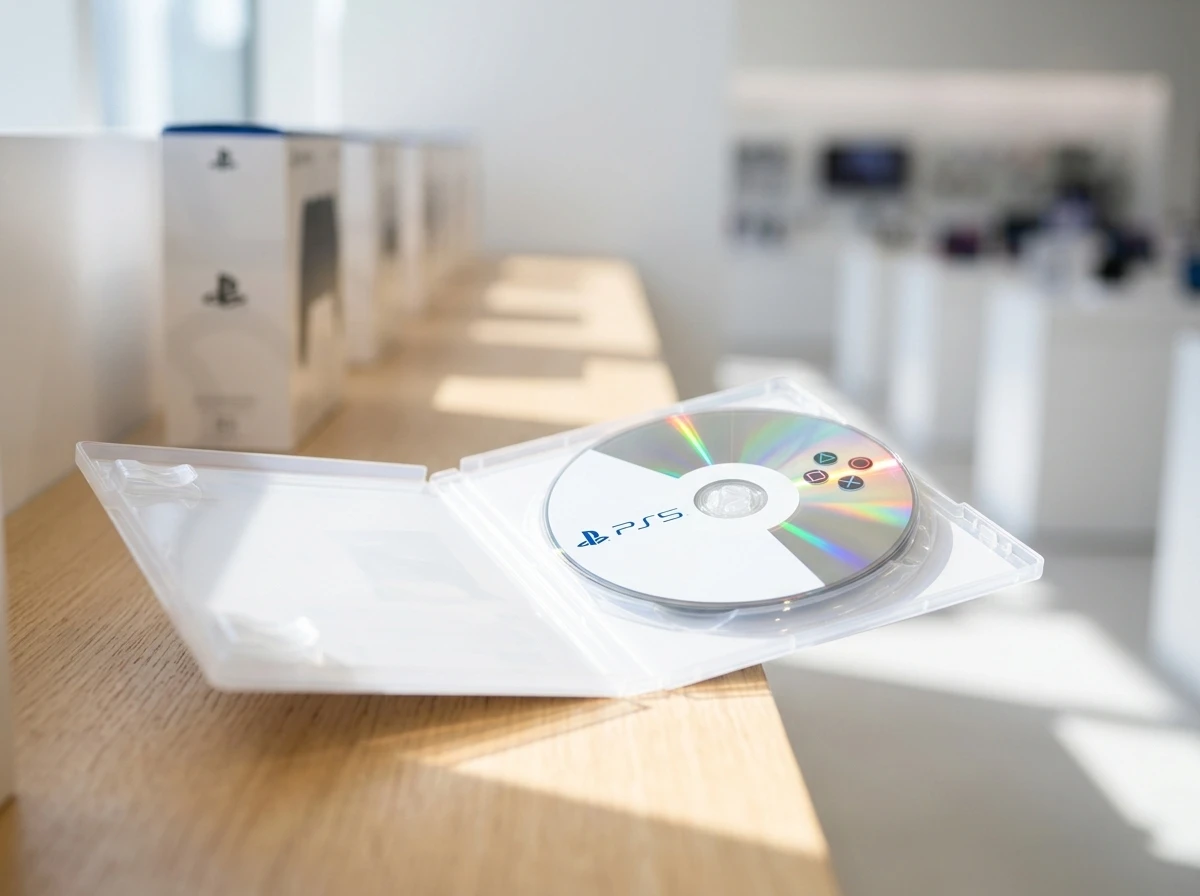
Digital Already Commands the Register
PlayStation software sales sit at roughly 82 percent digital, according to figures cited around the earnings discussion. Physical still moves units, especially for big first-party launches and collectors, yet the volume no longer justifies the manufacturing and logistics chain in Sony’s view.
- 82% of PlayStation game sales now digital
- Physical share continues to shrink year over year
- Disc production and distribution carry fixed costs digital avoids
- Tao: no negative business impact expected from the cutoff
In the Q&A, Tao linked the move to broader content digitization across entertainment, not a PlayStation-only quirk. She told analysts the company sees no current hit to revenue or hardware demand from the protests.
Readers can review the full set of figures and segment notes in the Sony Group earnings materials library.
What Tao Said and What Fans Heard
We put in a lot of thought and time, and we cautiously considered this, and we came to this conclusion, and we’re going to cautiously move this forward. … Games are loved by many people. It’s a form of entertainment that’s loved by people, and it’s connected to people’s fond memories in many cases. And so we understand those emotions.
That is Lin Tao, Sony’s CFO, speaking on the July 31 call. She added that “at this point in time, we are not seeing any impact on our business” and that most content sales are already digitized.
A detailed English transcription of the same remarks, posted by Japan-based reporter @Genki_JPN, drew more than 1.8 million views and thousands of quote-tweets within hours. The replies zeroed less on nostalgia and more on control: once the disc disappears, resale, lending, and offline permanence go with it.
The Don’t Kill the Disc petition page has climbed past 350,000 verified signatures. Organizers frame the ask around ownership, collecting, lending, and long-term preservation. Sony has not altered course.
Ownership Leaves the Shelf
A physical disc still lets a player lend a finished game to a friend, sell it used, or keep a playable copy if a storefront account vanishes. Digital licenses usually bind to the account and the platform’s terms. Servers go dark; licenses can be revoked; regions lock codes.
That shift is the quiet second-order change. Sony once highlighted disc sharing as a feature. The new policy ends the hardware that made casual sharing simple.
- No more easy friend loans without account sharing workarounds
- Used-game market for new titles collapses after 2028
- Collectors lose shelf value and future rarities for new releases
- Preservationists face higher barriers when physical masters stop
- Offline play remains only for titles that ship complete data on disc before the cutoff
Some players have said they will move more spending to Steam or wait for Nintendo. Others treat the change as inevitable and simply pre-order digital. The business data so far backs Sony’s calm tone: no measurable sales dent yet.
This builds on the company’s earlier report on the January 2028 cutoff, which first laid out the same hard date.
Retail Already Ships Empty Boxes
The transition is not waiting for 2028. Rockstar’s Grand Theft Auto VI “physical” editions ship as boxes containing only a download code. Pre-load windows open a week early so buyers can redeem and install before launch day. Several specialty retailers dropped those SKUs, citing policies against pure code products.
Expect more of the same for late-2026 and 2027 titles. A cardboard case with artwork and a slip of paper becomes the retail compromise: it satisfies shelf display and gift-giving while the actual bits live on Sony’s servers. The packaging cost stays; the disc pressing cost disappears.
Third-party publishers gain the same margin upside. First-party PlayStation titles will follow the same digital-first path once the calendar turns.
Nintendo Sits in the Last Physical Slot
Xbox has already leaned hard into incomplete discs that require large day-one downloads and account logins. Industry chatter treats Microsoft’s next hardware generation as likely all-digital or drive-optional. That leaves Nintendo as the clearest remaining platform still treating cartridges as complete, offline-capable products for a large share of its catalog.
Switch and Switch 2 Game Key Cards already blur the line for some multiplatform releases, yet full cartridges remain common. If Sony’s move holds and Xbox follows, physical console games become a Nintendo specialty rather than an industry standard. Collectors and preservation groups will watch that market share closely.
Sony’s own digital infrastructure continues to evolve in parallel. The phased PS3 and PS Vita Store closure timeline already shows how older digital storefronts get retired once the hardware base shrinks. New games after 2028 will live entirely inside the current-generation ecosystem.
Frequently Asked Questions
When exactly does Sony stop making physical PlayStation game discs?
Production of physical discs for all new games releasing on PlayStation consoles ends starting January 2028. Titles that launch before that date can still receive discs; anything dated on or after the cutoff is digital-only.
Will existing PlayStation disc games still work after 2028?
Yes. The policy leaves previously released and pre-2028 discs fully playable on compatible hardware. No forced digital conversion or delisting of physical libraries has been announced.
Does the cutoff apply to both PS5 and the next PlayStation console?
Sony’s language covers “all new games releasing on PlayStation consoles” without separating generations. Given the 2028 timing, both the late PS5 cycle and any successor hardware fall under the same rule.
What happens to physical retail stores and used game shops?
New-release disc inventory disappears after the cutoff. Retailers can still sell pre-2028 stock and code-in-box packages. The secondary market for brand-new titles effectively ends, while classic and mid-generation discs retain trade-in and collector value.
Sony has drawn the line. The discs stop. The licenses stay. The costs of that trade settle on the players who valued the plastic most.


Capital Clusters and the Dual Tracks of European Tech Finance

Microsoft Shrinks Windows 11 Memory for 8GB PCs

XRP Ledger Brings Back Bugged Features Fixed for Institutions

The Shards Trailer Turns Ellis Nightmare Into Murphy Glamour

WhatsApp Folder Hides Business Messages After Hours

Mova LiDAX Ultra 3000 AWD Cracks the Robot Mower Moat

Urban Arrow FamilyNext Turns Costco Runs Into Bike Trips

Reddit Builds Spoken Video Layer to Reclaim Its Own Viral Stories

Nuggit £5m Fund Treats YouTube Channels as Real Businesses

Galaxy Z Fold 8 Makes Foldables Daily Drivers but Drops Flex Mode

CLARITY Act Final Text Expected This Weekend as 60-Vote Hurdle Looms

Kalshi Loses Major NY Prediction Markets Ruling to Judge Torres

Fed Minutes Cite AI Demand as Inflation Risk, Put a 2026 Hike Back on the Map

Marker AI Writing Startup Lands $13M Seed Led by Index Ventures

Dota 2 Esports World Cup 2026: Spirit Defends $2M Title In Paris

Meta’s Muse Spark 1.1 Beats Rivals on Price, Trails on Coding

CS2 Premier Season 5 Lands With Cache and a C4 Damage Rework

Finto Picks Munich Over Silicon Valley After YC, Raises $3.4M

Backrooms Returns to Theaters as the Everything Must Go Edition

ARC Intelligence Closes €4M Seed Round in Roughly a Week
-
 FINANCE2 months ago
Zcash Patched a Double-Spend Bug as ZEC Climbed 5%
-
 ENTERTAINMENT2 months ago
Steam Summer Sale 2026 Locks In June 25 to July 9 Dates
-
 NEWS3 months ago
Meta Adds AI Replies to Threads, But Users Can’t Block It
-
 FINANCE4 weeks ago
CLARITY Act Final Text Expected This Weekend as 60-Vote Hurdle Looms
-
 ENTERTAINMENT2 months ago
‘Widow’s Bay’ Review: Apple TV’s Sleeper Horror-Comedy Earns Its Fog
-
 NEWS5 months ago
U.S. Navy Deploys Solar-Powered Lightfish Drone to Patrol Oceans
-
 NEWS8 months ago
FolderFresh Review: This Free Tool Automates Windows File Organizing
-
 FINANCE3 weeks ago
Kalshi Loses Major NY Prediction Markets Ruling to Judge Torres