
NEWS
2026 Charger R/T Sixpack Turns Muscle Nostalgia Against Itself
The 2026 Dodge Charger R/T Sixpack packs 420 hp and retro bulk yet lands heavier, slower and pricier than Mustangs and M340i rivals that actually deliver thrills.

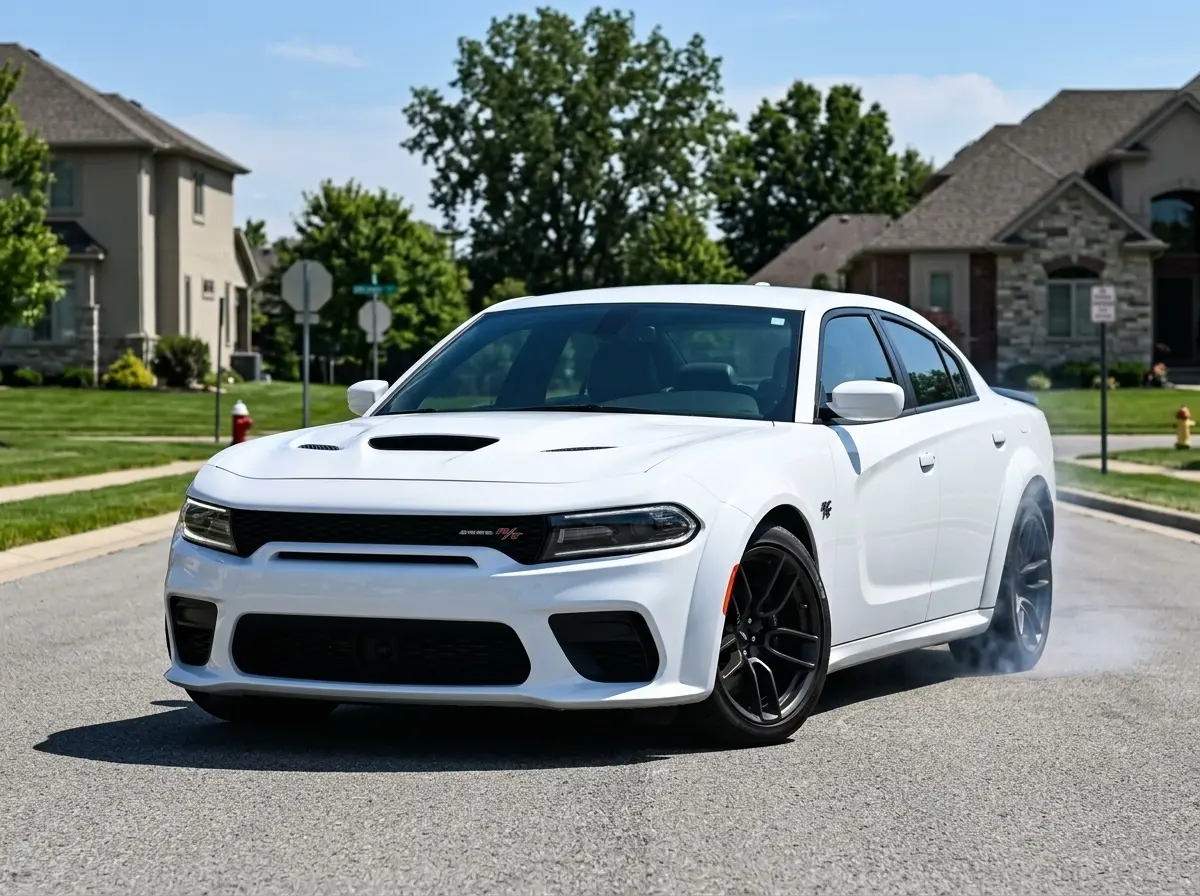
The 2026 Dodge Charger R/T Sixpack sedan arrives with 420 horsepower, a twin-turbo inline-six, and enough retro bulk to stop traffic, yet it weighs over 4,700 pounds and needs 4.6 seconds to hit 60 mph. That combination turns the muscle-car promise into an expensive exercise in irony.
Alex Hevesy’s SlashGear test drive of a loaded Knuckle White four-door summed it up as peak nostalgia done wrong. The car looks the part. The driving experience and the final bill do not.
What the Sixpack Delivers
Dodge markets the gas Charger as the world’s most powerful muscle car in Scat Pack form and a more approachable R/T below it. Both use the 3.0-liter twin-turbo “Hurricane” inline-six rebadged Sixpack. The R/T’s standard-output version makes 420 hp and 468 lb-ft of torque. The Scat Pack jumps to 550 hp and 531 lb-ft.
- Drivetrain: standard all-wheel drive with a driver-selectable full rear-drive mode
- Transmission: eight-speed automatic only
- Claimed 0-60: 4.6 seconds for the R/T
- EPA: 17 city / 26 highway / 20 combined mpg
Official pages list the lineup starting at MSRP $49,995 for the coupe, with the four-door R/T a couple thousand higher before options. The Hurricane already powers Jeeps and Rams; here it carries the muscle badge after the HEMI V8’s exit.
On paper the split looks tidy. The R/T is the volume play with enough torque to move the big shell. The Scat Pack is the halo with the bigger numbers. Both share the same basic architecture, the same eight-speed, and the same need to drag several thousand pounds of steel, glass, and AWD hardware down the road.
That shared hardware is the point. Dodge is not building a light two-door specialist. It is building one platform that must wear coupe and sedan bodies, accept gas and electric powertrains, and clear modern crash rules. The Sixpack badge is the marketing layer on top of that brief.
The Heft That Swallows the Torque
Hevesy recorded a curb weight of 4,741 pounds, roughly 500 pounds up on the prior V8 Charger. Car and Driver’s R/T four-door test car tipped the scales at 4,921 pounds. Official curb weight figures near 4,800 pounds for gas models put the new car in the same league as older Hellcat widebodies while making far less peak power than those cars.
| Source | Weight recorded | Context |
|---|---|---|
| Hevesy test car | 4,741 lb | Loaded Knuckle White four-door |
| Official figures | near 4,800 lb | Gas models, varies by equipment |
| Car and Driver | 4,921 lb | Instrumented R/T four-door |
| Prior V8 Charger | ~500 lb lighter | Previous generation baseline |
That mass changes everything. The Hurricane feels strong in lighter trucks. In the Charger it struggles to create drama. The eight-speed shifts without urgency. Steering feels remote. The car plows through corners once the pace rises past sedate. Switching to rear-drive mode restores some attitude for parking-lot smokiness, yet the front tires’ grip vanishes and the weight remains.
Hevesy called the result miserable. It feels more like a loud crossover than a muscle sedan. Even the claimed 4.6-second sprint lands behind many mainstream hot hatches and far behind contemporary EVs. Car and Driver’s instrumented R/T run of 4.7 seconds confirmed the modest pace.
The torque figure on the window sticker still looks healthy. The problem is simple physics. Four hundred sixty-eight pound-feet must accelerate nearly two and a half tons before the driver feels any surge. In a lighter shell that same engine would feel sharper. Here the first impression is effort, not drama.
Paper Numbers Against the Field
The R/T’s on-paper rivals expose the problem. A base Ford Mustang GT undercuts it on price and weight while matching or beating the launch. Entry German performance sedans match the money and deliver sharper dynamics.
| Model | Power | 0-60 (claimed/tested) | Base MSRP (approx.) | Curb weight (approx.) |
|---|---|---|---|---|
| 2026 Charger R/T Sixpack | 420 hp / 468 lb-ft | 4.6 s / 4.7 s | $52,000 four-door | 4,741-4,921 lb |
| Ford Mustang GT | ~480-486 hp | ~3.7-4.2 s | $46,800 | ~3,975 lb |
| Mustang Dark Horse | 500 hp | ~4.1 s | mid-$60k | similar to GT |
| BMW M340i xDrive | ~386 hp hybrid | 4.1 s | $64,300 | ~4,000 lb |
| Mercedes-AMG C43 | ~416 hp | ~3.9 s | $64,150-$67,120 | lighter sedan |
The Ford Mustang GT and Dark Horse lineup still offers a manual option on some trims. Both cars feel lighter and more responsive. The Germans trade the Charger’s cartoon presence for chassis precision and interior quality that match the price.
Even the joke Hevesy repeated holds: modern family sedans and hatches have closed the gap on old muscle so thoroughly that a 2026 Charger R/T can lose a stoplight drag to a Toyota GR Corolla.
Look at the gaps side by side. The Mustang GT undercuts the four-door R/T on base price, undercuts it by roughly 700 to 900 pounds, and still posts a quicker claimed launch. The M340i and C43 land near the loaded Charger’s money yet bring tested times in the low fours and curb weights closer to 4,000 pounds. The Charger’s answer is space, stance, and standard AWD. Those matter to some buyers. They do not erase the stopwatch.
Option Stack That Pushes Past $67,000
Base pricing already sits above many Mustangs and near entry luxury sedans. The test car piled on packages until the window sticker hit $67,160 including destination.
- Customer Preferred Package 21A: $4,995 (heated/ventilated seats, HUD, wireless charging, bigger screens, Performance Pages)
- Blacktop package: $1,295 (blacked exhaust tips and badging)
- Performance Handling group: $2,995 (Brembos, launch control, extra modes, power buckets)
- Full-length glass roof: $1,395
- 18-speaker Alpine audio: $1,795
- Knuckle White paint: $695
- Destination: $1,995
The Uconnect screen needed multiple resets during the week. Ambient lighting and leather accents sit next to hard plastics that feel out of place at this price. Ergonomics suffer from the vast cabin and aggressively raked windshield. The Alpine system is the one clear interior win.
A few years ago a nearly 500-hp V8 Charger could be had for under $60,000. That comparison stings.
Add the packages and the four-door R/T leaves the realm of approachable muscle and enters the same bracket as the Dark Horse, the M340i, and the C43. At that point the buyer is no longer choosing on badge alone. The cabin has to feel worth the money. Hard plastics and a glitchy screen make that case harder to close.
Heritage Badge Meets Hurricane Reality
Dodge kept the Charger name, the wide stance, the fish-mouth grille, and the ability to smoke the rear tires. It also kept the attitude in marketing. What it did not keep is the free-revving V8 character that defined the last generation’s Hellcat era.
It’s loud, goofy, and brash, but if that doesn’t get you anywhere, it’s all sound and fury signifying nothing.
Hevesy wrote that line after a week with the car. Crowd reaction on X tracks the same tension. Some owners and dealers push the torque figure and the RWD-mode burnout button as proof the spirit lives. Others call the new car a styling caricature that is too expensive and too far from the HEMI cars that built the modern cult. One widely shared take framed the Scat Pack itself as having the mid-life crisis: legendary badge, borrowed heart.
The platform has to support coupe and sedan, gas and electric Daytona variants, plus AWD hardware and modern crash structures. The result is a car that looks like a muscle car yet drives like a heavy grand tourer with a good engine fighting its own mass.
The tension is baked into the product brief. Keep the visual theater. Keep the burnout button. Accept the weight that comes with multi-powertrain hardware and crash structures. Then ask the Hurricane to paper over the difference. Some drivers will accept the trade. Others will hear the exhaust note, feel the remote steering, and decide the badge is doing more work than the chassis.
How Rear-Drive Mode Changes Almost Nothing
Standard all-wheel drive is the safe default for a car this heavy and this wide. Dodge still offers a driver-selectable full rear-drive mode so the R/T can smoke the rear tires and look the part in a parking lot. That button is the clearest link to the old muscle script.
In practice the mode is a party trick more than a dynamic reset. The front tires lose their share of the work. Grip at the nose disappears once the driver leans on the throttle. The curb weight does not shrink. The eight-speed still shifts without urgency. The steering still feels remote. The car still plows once the pace rises past sedate.
What the mode does deliver is theater. Exhaust note, tire smoke, and the wide body in the mirror still photograph like a Charger. For buyers who want that image and rarely push past seven-tenths, the button may be enough. For anyone chasing the old HEMI sensation of a light tail and a free-revving top end, the mode only underlines how much mass the Hurricane is dragging.
- Rear-drive mode restores burnout capability and visual attitude
- Front-axle grip drops away under throttle
- Curb weight and transmission behavior stay unchanged
- Cornering still trends toward plow once speeds rise
The feature is honest about its job. It is not a chassis transformation. It is a selectable soundtrack and smoke machine on a car that remains a heavy grand tourer underneath.
The Buyers Who Walk Away
Anyone chasing pure acceleration and involvement can buy a Mustang GT, save money, and gain a manual. Anyone wanting a polished performance sedan can step into an M340i or C43 for similar money and get better seats, better plastics, and a chassis that actually turns. Used C8 Corvettes sit in the same price band and deliver mid-engine drama the Charger never approaches.
The Charger still offers interior space the pony cars cannot match and a liftback that swallows gear. For some families that practicality plus the looks will be enough. For the classic muscle-car buyer who wants the car to feel as loud as it looks, the Sixpack R/T is a compromise that keeps advertising the thrills it no longer delivers.
Dodge’s bet was that size, tech, AWD security, and retro theater would replace the old V8 formula. Early hands-on verdicts on the R/T show the downside of that bet arriving first.
Where the Four-Door Still Makes a Case
Not every shopper is cross-shopping a Mustang GT or an M340i. Some want the wide body, the fish-mouth grille, and a cabin that can take adults in the back seat without complaint. The Charger’s liftback and interior volume remain real advantages the pony cars cannot touch.
For those buyers the checklist looks different:
- Standard AWD for wet-weather security without an extra option box
- Rear-seat and cargo space that suits family duty
- Retro bulk and presence that still stops traffic
- A torque-rich turbo six that works fine at everyday speeds
That list does not fix the 4.6-second claim, the 4,700-plus-pound curb weight, or the option math that pushes a loaded car past $67,000. It does explain why some households will still sign. They are buying theater and space first, stopwatch bragging rights second. The R/T can serve that brief. It simply cannot also serve the classic muscle brief without the weight, the pace, and the price getting in the way.
Early verdicts already sort the audience along those lines. Drivers who wanted the old HEMI feeling leave disappointed. Drivers who wanted a loud, roomy, retro-styled hauler find enough to like. Dodge built the car for the second group and dressed it for the first. The gap between those two jobs is the story of the Sixpack R/T.
Frequently Asked Questions
What engine does the 2026 Dodge Charger R/T Sixpack use?
It uses a 3.0-liter twin-turbocharged inline-six known as the Hurricane and badged Sixpack by Dodge, producing 420 horsepower and 468 pound-feet of torque in R/T form. The same basic engine appears in higher output in the Scat Pack and in various Jeep and Ram models.
How much does the 2026 Charger R/T Sixpack weigh?
Test weights have ranged from 4,741 pounds in one reviewer’s car to 4,921 pounds in an instrumented four-door example, with official figures clustering near 4,800 pounds depending on body style and equipment. That is several hundred pounds heavier than the previous generation’s V8 Chargers.
What is the starting price of the 2026 Dodge Charger R/T?
Dodge lists the gas Charger lineup beginning at $49,995 for the coupe, with the four-door R/T starting higher before destination and options. Fully loaded examples commonly climb into the mid-$60,000s.
How does the Charger R/T Sixpack compare with a Mustang GT on paper?
The Mustang GT offers more peak horsepower from its V8, a lower base price around $46,800, significantly less weight, and available manual transmission, while the Charger counters with standard AWD, more rear-seat and cargo space, and higher torque from the turbo six.
Is the 2026 Charger R/T available with a V8?
No. At launch the gas models use only the twin-turbo inline-six. The electric Daytona variants use dual motors. Dodge has not confirmed a HEMI return for this generation.


Capital Clusters and the Dual Tracks of European Tech Finance

Microsoft Shrinks Windows 11 Memory for 8GB PCs

XRP Ledger Brings Back Bugged Features Fixed for Institutions

The Shards Trailer Turns Ellis Nightmare Into Murphy Glamour

WhatsApp Folder Hides Business Messages After Hours

Mova LiDAX Ultra 3000 AWD Cracks the Robot Mower Moat

Urban Arrow FamilyNext Turns Costco Runs Into Bike Trips

Reddit Builds Spoken Video Layer to Reclaim Its Own Viral Stories

Nuggit £5m Fund Treats YouTube Channels as Real Businesses

Galaxy Z Fold 8 Makes Foldables Daily Drivers but Drops Flex Mode

CLARITY Act Final Text Expected This Weekend as 60-Vote Hurdle Looms

Kalshi Loses Major NY Prediction Markets Ruling to Judge Torres

Fed Minutes Cite AI Demand as Inflation Risk, Put a 2026 Hike Back on the Map

Marker AI Writing Startup Lands $13M Seed Led by Index Ventures

Dota 2 Esports World Cup 2026: Spirit Defends $2M Title In Paris

Meta’s Muse Spark 1.1 Beats Rivals on Price, Trails on Coding

CS2 Premier Season 5 Lands With Cache and a C4 Damage Rework

Finto Picks Munich Over Silicon Valley After YC, Raises $3.4M

Backrooms Returns to Theaters as the Everything Must Go Edition

ARC Intelligence Closes €4M Seed Round in Roughly a Week
-
 FINANCE2 months ago
Zcash Patched a Double-Spend Bug as ZEC Climbed 5%
-
 ENTERTAINMENT2 months ago
Steam Summer Sale 2026 Locks In June 25 to July 9 Dates
-
 NEWS3 months ago
Meta Adds AI Replies to Threads, But Users Can’t Block It
-
 FINANCE4 weeks ago
CLARITY Act Final Text Expected This Weekend as 60-Vote Hurdle Looms
-
 ENTERTAINMENT2 months ago
‘Widow’s Bay’ Review: Apple TV’s Sleeper Horror-Comedy Earns Its Fog
-
 NEWS5 months ago
U.S. Navy Deploys Solar-Powered Lightfish Drone to Patrol Oceans
-
 NEWS8 months ago
FolderFresh Review: This Free Tool Automates Windows File Organizing
-
 FINANCE3 weeks ago
Kalshi Loses Major NY Prediction Markets Ruling to Judge Torres