
NEWS
RugOne’s Detachable Camera Phone Revives a Failed Modular Bet
RugOne’s Xsnap 7 Pro pops a 39-gram action camera off a rugged phone, a modular bet Motorola already buried, and Kickstarter opens at €799.

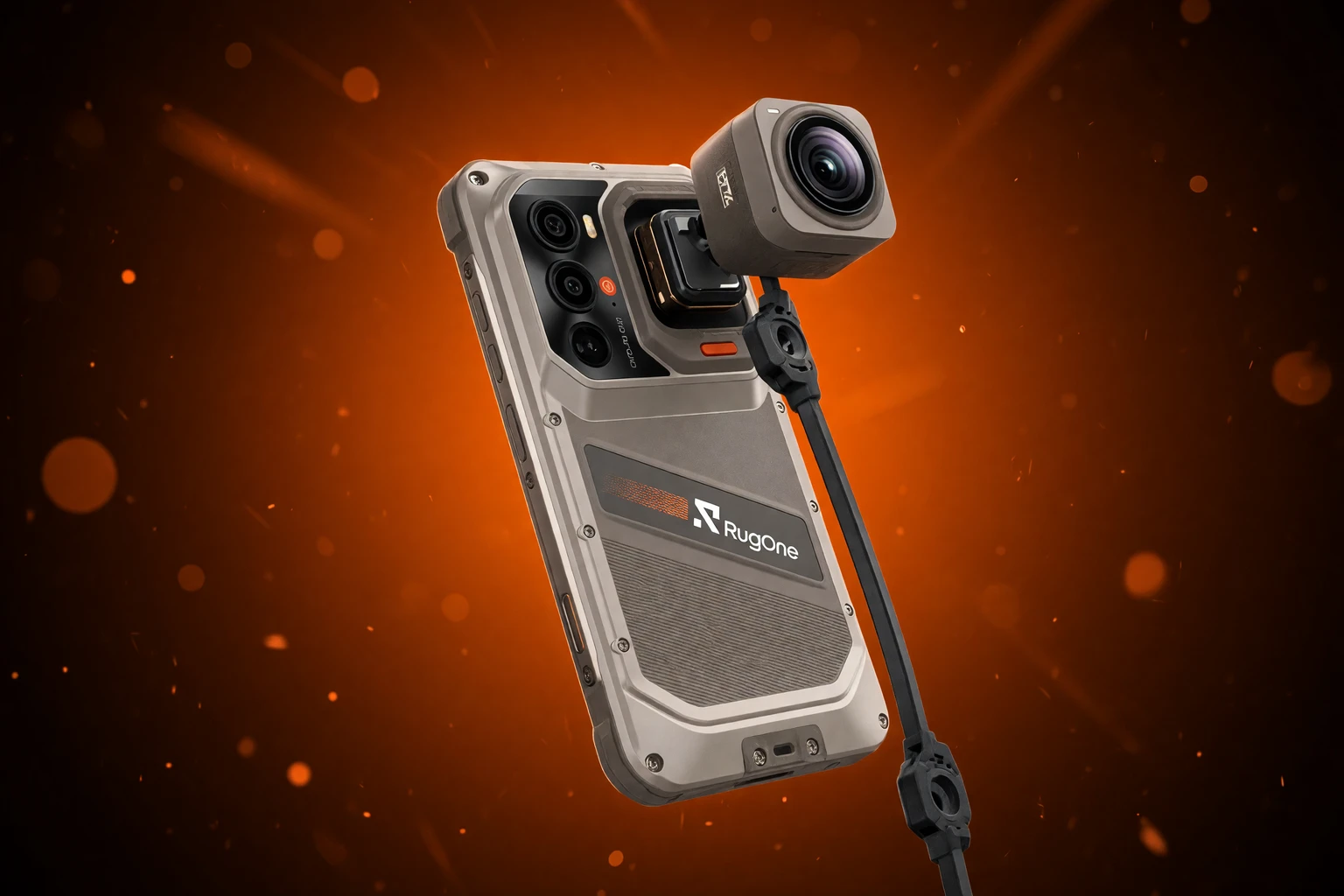
RugOne opened Kickstarter on September 7 for the Xsnap 7 Pro, a rugged phone whose 39-gram action camera pops off the back. Super Early Bird units are €799 in limited numbers, with U.S. retail set at $999 in October.
The cube is the pitch. Motorola and LG already sold snap-on camera phones, and both lines died.
A 39-Gram Camera Rides in the Phone’s Back
RugOne’s IFA Berlin briefing describes a 39-gram detachable action camera that sits in the rear of the handset until you pull it free. The module mounts on a helmet, a handlebar, a strap, or a pendant, and it records on its own cell with 64GB of memory inside the cube.
On paper the cam shoots 2.7K at 30fps through a 133-degree ultra-wide lens, with distortion correction, FreeFrame capture, time-lapse, slow motion, pre-recording, loop recording, and HDR stills. SteadyX stabilization and 360-degree Horizon Lock are the software net under that wide glass.
THE MODULE AT A GLANCE
- Weight: The cube is 39 grams, light enough to wear as a pendant or clip to a helmet.
- Clip length: Standalone recording is rated at 40 minutes per charge.
- Storage: 64GB on the module holds up to 8 hours of 1080p video before you dock and dump.
- Water: The bare cube is rated to 5 meters with no extra housing.
When the module is off the phone it runs on its own imaging chip and throws a live preview back to the 6.67-inch display over a low-latency wireless link. Booth demos put that preview at about 50 meters. Dock it, and pogo pins refill the cube from the handset’s 9,300mAh cell for up to 20 full recharges.
Motorola and LG Already Buried This Idea
A camera that leaves the phone is an old dare. LG’s 2016 G5 used slide-off “Friends,” including a Cam Plus grip, and you had to power the phone down to swap them. Extra modules ran about €100 to €150, the catalog stayed thin, and owners reported dead Cam Plus units on replacements.
Motorola’s Moto Mods were the smoother take. Magnets held a whole backplate on a Moto Z, and Hasselblad’s True Zoom sold as a $300 10x point-and-shoot slab in 2016, complete with a shutter button and xenon flash. Mods stayed compatible across four Moto Z generations from 2016 to 2019, then the line ended and the accessory bet went with it.
Google’s Project Ara never shipped. The shared failure was simple: the add-on was weaker than a real camera, the phone was weirder than a normal phone, and nobody wanted to replace both at once.
THE LAST DECADE OF SNAP-ON CAMERAS
- 2016: LG ships the G5 with Cam Plus modules that need a power-down to swap.
- 2016: Motorola launches Moto Mods, including Hasselblad’s $300 True Zoom camera plate.
- 2019: The Moto Z family ends after four generations and the Mod catalog stops with it.
- September 6, 2025: RugOne, Ulefone’s outdoor sub-brand, debuts at IFA Berlin with the Xever 7 series.
- March 2026: RugOne teases the Xsnap 7 Pro’s magnetic camera cube at MWC Barcelona.
- September 4, 2026: The company collects its IFA Innovation Award trophy at 14:30 CEST.
- September 5, 2026: RugOne unveils the finished Xsnap 7 Pro at Hall 3.2, Stand 137.
- September 7, 2026: Kickstarter Super Early Bird pledges open at €799.
RugOne is not hiding the rhyme. It calls the Xsnap 7 Pro the world’s first rugged smartphone with a detachable modular action camera, which is a narrower claim than “first modular camera phone,” and it is the claim that has to survive contact with a DJI or Insta360 in the same backpack.
Dual Latches and a 9,300mAh Charging Dock
The part that is new is how tightly the cube is tied to one job. There is no speaker plate, no projector, no zoom brick. One module films, stores, and comes home to charge.
Physical latches sit on top of the magnets, a dual lock meant to keep the cube on a bike or a helmet. That is the lesson from a decade of magnetic backs that looked fine on a desk and felt loose on a trail. The phone is the battery pack, the preview screen, and the offload drive, which is why the 9,300mAh cell is doing as much work as the lens.
Instead of carrying separate, bulky equipment into the wild, the Xsnap 7 Pro combines an ultra-durable phone pod with a snap-and-go magnetic camera module.
RugOne, IFA Berlin launch note, September 5, 2026
That sentence is the whole wager. You still pop the camera off the moment you need it, so the “one device” setup is a docked pair until the ride starts. The gain is that the spare cam is already charged, already paired, and already in the same IP69K brick you would have carried anyway.
How the Xsnap 7 Pro Compares With a Dedicated Action Cam
Buyers will not compare this cube with a 2016 Hasselblad plate. They will compare it with the tiny 4K wearables that already live on helmets, and those cameras are ahead on the spec sheet.
THE CUBE VERSUS TWO WEARABLE CAMS
| Camera | Top video | Solo runtime | Waterproof | Weight |
|---|---|---|---|---|
| Xsnap 7 Pro module | 2.7K at 30fps | 40 minutes | 5 m | 39 g |
| DJI Osmo Nano | 4K at 60fps | About 90 minutes | 10 m | 52 g |
| Insta360 GO Ultra | 4K at 60fps | About 70 minutes | 10 m | 53 g |
The louder problem is clip length. Forty minutes is a short trail, a short dive, or one long ski run, and then the cube wants the phone. A Nano-class wearable is built to keep rolling closer to an hour and a half, at 4K, in deeper water.
RugOne’s answer is the dock math, not the sensor. Twenty full top-ups from the phone turn a short cell into a full day of bursts if you keep seating the cube between clips, and 512GB in the handset is the dump drive those 64GB fills need. That only works if you still have the phone on you, which is the same two-device habit the pitch said it would kill.
IFA’s own top prizes on September 4 went to Anker, Insta360, and LG, listed among the IFA Innovation Awards 2026 master honors. RugOne’s category trophy landed the same week Insta360 took a main stage prize, which is a blunt reminder of who still owns dedicated capture.
The Slab Around the Cube Still Has to Be a Phone
Strip the cube out and you still have a thick outdoor Android handset, which is the product most RugOne buyers already know. The panel is a 6.67-inch 1.5K AMOLED at 120Hz, peaking at 1,700 nits, under Corning Gorilla Glass Victus. Inside is MediaTek’s All Big Core Dimensity 8400, an eight-core Cortex-A725 premium 5G chip, with 12GB of LPDDR5X and 512GB of UFS 4.0.
The cameras that stay on the body are a 50MP Samsung GN9 with optical and electronic stabilization, rated for 4K, and a 64MP infrared night-vision shooter with its own IR LEDs. Up front is a 32MP selfie sensor. An underwater stills mode is listed for the main system, separate from the cube’s 5-meter rating.
Power is the 9,300mAh pack with 45W wired charging, 50W wireless, and 10W reverse wireless. Software is Android 16, with a promise of updates through Android 20, plus Gemini, ChatGPT and Grok hooks, Circle to Search, live translation, call summary, a writing helper, and math recognition. eSIM, an in-display fingerprint reader, two custom shortcut keys, and an Aura Pulse rear logo light round out the extras.
THE TOUGHNESS RATINGS
- Water and dust: IP68 and IP69K, with the phone body rated to 2 meters for 30 minutes and to high-pressure, high-temperature jets.
- Drops: MIL-STD-810H, including a 1.5-meter drop onto concrete.
- Colors: Sand Dune and Black, with the booth at Hall 3.2, Stand 137 open through September 8.
That is not flagship-thin, and none of it needs to be. The Dimensity 8400 is a premium mid chip, not a Snapdragon 8-class part, which is the right read if the buyer wanted a tool that lives in a wet bag rather than a pocket flagship that films 4K60 from a gimbal.
Why RugOne, Not Ulefone, Is on the Badge
Ulefone is the parent. RugOne is the year-old outdoor badge it stood up at IFA 2025, and the Xsnap 7 Pro is that badge’s third major line after the Xever phones. Senior staff from both names spoke at the Berlin launch, and Ulefone’s own account posted the demo under the line “Detach. Snap. Go.”
https://x.com/UlefoneMobile/status/2096215252442509718
The split is not cosmetic. Ulefone already sells Armor bricks to trades; RugOne is the cleaner, younger cut of the same factory, aimed at people who ski and vlog rather than people who need a loud speaker on a job site. The brand already tried letting a piece of the phone come off, with a hot-swap battery on the Xever 8, so a pop-off camera is the next module in a line that treats the chassis as a dock.
Honor spent the same year on the other answer. Its Robot Phone, on sale in China from 9,999 yuan, parks a 200MP camera on a motorized gimbal that stays attached, in a 9.59 mm body rated IP54. That phone is a vlog flagship that will not go in a river. The Xsnap 7 Pro is the river phone whose camera can leave. Both are 2026 bets that a camera should move, and they refuse each other’s tradeoffs.
Oddball hardware like this used to come from Japanese feature-phone labs. The experimental energy now sits in Shenzhen rugged brands that still ship thick slabs with night-vision LEDs and cubes that unclip. That is why the booth stopped people. It is also why the next test is a Kickstarter, not a carrier deal.
Kickstarter Opens September 7 at €799
RugOne collected its IFA Innovation Award trophy on September 4, launched the phone on September 5, and opened Super Early Bird pledges on September 7 at €799, limited quantity. U.S. retail is $999. European retail is €1,099.99. Global store and Amazon availability is listed for October 2026, in Sand Dune and Black.
A $5 Super Early Bird pass sold ahead of the campaign, unlocking $50 off that first tier. Ulefone’s post was clear that the pass is not a phone preorder. A Kickstarter slot is still a pledge, with shipping, warranty, and country lists that have to be read on the campaign page before anyone treats €799 as a checkout price.
WHAT WE KNOW
- The prices: €799 Super Early Bird, $999 U.S. retail, €1,099.99 in Europe, with October 2026 listed for global sale.
- The hardware sheet: 2.7K cube, 40-minute solo runtime, 9,300mAh dock, Dimensity 8400, IP68/IP69K, Android 16 with a path to Android 20.
- The show: Hall 3.2, Stand 137 at Messe Berlin through September 8.
WHAT IS UNCONFIRMED
- Real clip length: The 40-minute rating is a manufacturer figure from booth units, not a third-party drain test at 2.7K.
- Regions and freight: Kickstarter delivery windows, duties, and which countries can back the campaign are still campaign-page terms.
- The lock in the wild: Dual latches and 5-meter cube waterproofing have not been through a winter of helmet mounts and salt water.
The modular graveyard is full of clever docks that never left the show floor as daily tools. RugOne put a 39-gram camera on pogo pins, priced the Super Early Bird at €799, and asked outdoor buyers to fund the next attempt. October retail at $999 is the number that has to look fair once the cube has filmed more than a Berlin demo reel.


Holland’s Franz Treats Kafka as a Prague Souvenir

Bad Bunny’s Super Bowl Show Now Rules the Live Variety Emmys

Liquid Pause Follows 4,000 Bitcoin Peg-Out With Keys Intact

HONOR’s Sold-Out Robot Phone Still Cannot Leave China

Ascentiz Bets Hikers Will Buy a €3,999 Modular Kit

GPT-6 Astra Passes Safety Tests With a Dimmer Audit Trail
Google Translate Keeps Running After Android Locks the Screen

RayNeo Bets Shoppers Will Buy Two Smart Glasses

RugOne’s Detachable Camera Phone Revives a Failed Modular Bet

Riot’s New Challenger Worlds Still Runs on Asia’s Clock

Walter’s TWG Insists No Fraud as Insurer Probes Force Cleanup

30-Year Yield Hits 5.32% Highest Since 2007 as Debt Supply Locks In Costs

Evernorth S-4 Clears Path for Active XRP Treasury on Nasdaq

PCE Stays at 3.7% as Gas and Tariffs Outrun Coming Revisions

Astute’s $1.2M bet makes B2B creator deals feed AI discovery

Strategy Parks $1.59B Cash While Bitcoin Stack Stays Flat

Instinct Hits $2.5 Billion as AI Agent Access Sparks Trust Fights

Amber’s €7M locks Mittelstand knowledge inside Europe

CLARITY Act Cloture Opens a Door Ethics Still Blocks

Monzo chair Gary Hoffman exits after board revolt fallout
-
 FINANCE3 months ago
Zcash Patched a Double-Spend Bug as ZEC Climbed 5%
-
 ENTERTAINMENT3 months ago
Steam Summer Sale 2026 Locks In June 25 to July 9 Dates
-

 FINANCE2 months ago
CLARITY Act Final Text Expected This Weekend as 60-Vote Hurdle Looms
-
 NEWS4 months ago
Meta Adds AI Replies to Threads, But Users Can’t Block It
-
 ENTERTAINMENT5 months ago
Extraction 3 Is Officially Coming to Netflix in 2027
-

 NEWS3 months ago
YouTube Shorts is testing a heart in place of the thumbs-up
-

 NEWS1 month ago
Senators Force Apple Off Chinese Memory as Big Three Cash In
-

 NEWS3 months ago
NEURA Robotics’ $1.4B Series C Redraws Europe’s Physical AI Bet