
AUTO
Triumph Bonneville 400 Puts Its Badge on a 349cc Tax Cut
Triumph’s Bonneville 400, due October 6, is a 349cc GST-band classic built with Bajaj to take on Royal Enfield’s Classic 350.

Triumph will show the Bonneville 400 on October 6, 2026, at 4:30 p.m. IST, with three other new bikes. The India model is expected to use the 349 cc single already fitted to Triumph’s Bajaj-built range, which sits in the 18 percent GST band.
That is the same tax line that forced Triumph to shrink its India 400s in April 2026, and it points the new classic at Royal Enfield’s Classic 350, which sold 43,428 units in August 2026, not at Honda’s CB500.
Four Bikes, One Teaser and a Tuesday Slot
Triumph has not posted a full spec sheet. It has posted a four-bike teaser and a clock. The event is listed for 4:30 p.m. IST on October 6, 2026, and the silhouettes are being read as a small Bonneville plus new Street and Tiger family models.
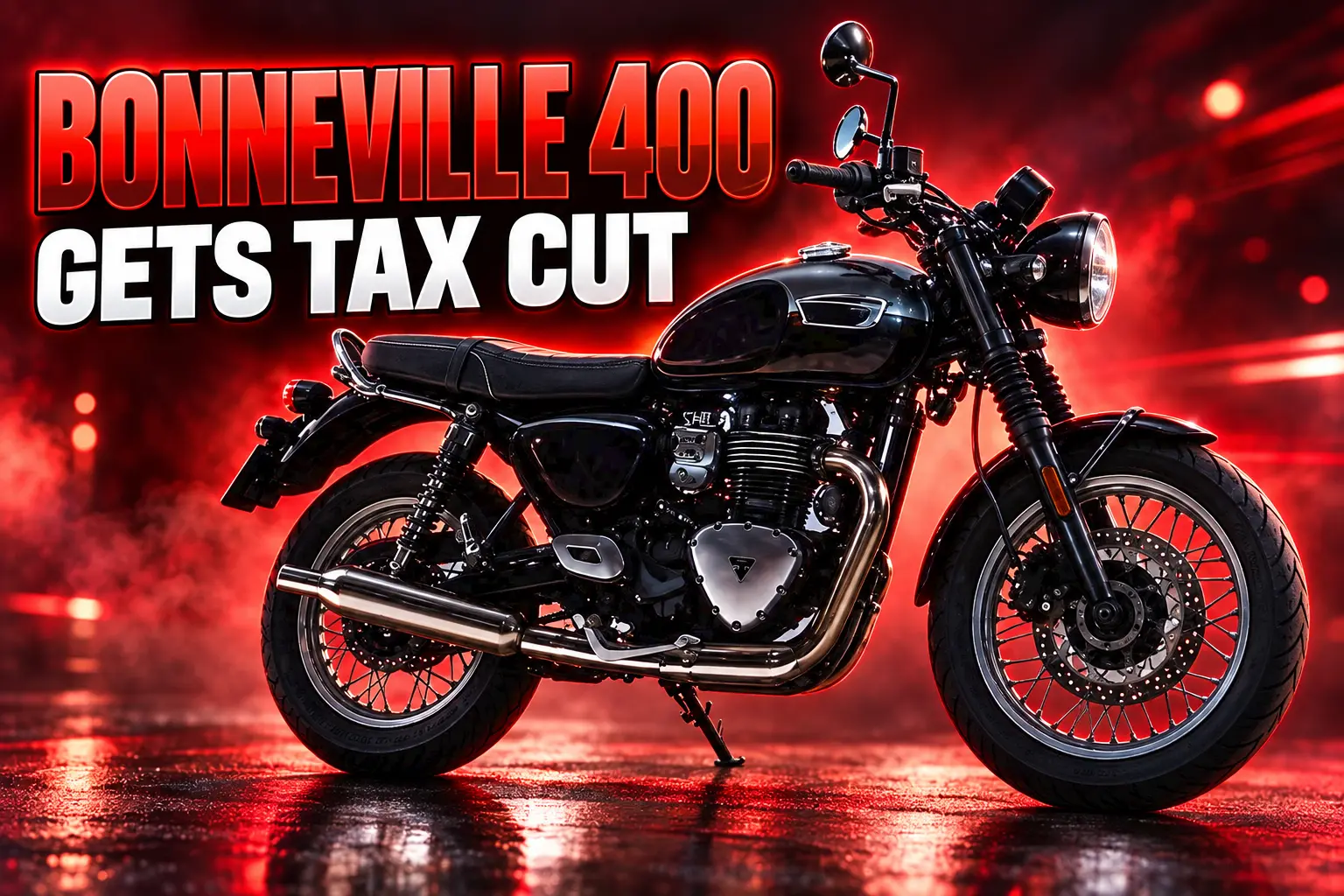
The Bonneville 400 would be the seventh motorcycle on the India 400 family, after the Speed T4, Speed 400, Scrambler 400 X, Scrambler 400 XC, Thruxton 400 and Tracker 400. Spy bikes already running in India show production paint, a teardrop tank, a flat bench seat, wire-spoke wheels and a peashooter exhaust, so the reveal is less about whether the bike exists than about the badge, the tune and the price.
WHAT WE KNOW
- The date: Triumph has set the four-bike reveal for October 6, 2026, at 4:30 p.m. IST.
- The platform: The roadster sits on the single-cylinder 400 family Triumph developed with Bajaj Auto and builds in India.
- The look: Test mules use telescopic forks with gaiters, twin rear shocks, a longer flat subframe and a round instrument pod.
WHAT IS UNCONFIRMED
- India power: Triumph has not said whether the Bonnie gets the Speed 400’s 37.0 PS tune, the Speed T4’s 29 hp tune, or a third map.
- Export engine: Some briefings still put a 398 cc motor on bikes sold outside India; that split is not official.
- Showroom timing: A festive-season India launch is expected, but Triumph has not named an on-sale date or an ex-showroom price.
Until those three items land, the teaser is a costume fitting. The tax math underneath it is already finished.
Why India Gets a 349cc Bonneville
The 56th GST Council cut GST on motorcycles equal to or below 350cc from 28 percent to 18 percent, with the new rates in force from September 22, 2025. Bikes over that line moved to a special 40 percent slab. A Council FAQ later made the cut-off plain: 350 cc itself stays in the 18 percent band; only engines above 350 cc take the higher rate.
Triumph’s global 400 family still uses a 398.15 cc Speed 400 engine rated at 40 PS and 37.5 Nm. That motor is 48 cc on the wrong side of the Indian line. In April 2026 Triumph and Bajaj replaced it, on India bikes, with a 349 cc version of the same single, and they kept calling the range “400.”
FROM THE TAX CUT TO THE 349CC RANGE
- September 22, 2025: New GST rates take effect, with 18 percent on petrol two-wheelers up to 350 cc and 40 percent above that.
- April 6, 2026: Triumph’s India 400 range switches to a 349 cc TR-series single after the stroke is cut from 64 mm to 56.1 mm, bore held at 89 mm.
- April 2026: Published India figures put the Speed 400 at 37.0 PS and 32.0 Nm, and the softer Speed T4 at 29 hp and 31 Nm.
- October 6, 2026: Triumph stages the Bonneville 400 as the classic body on that tax-cut engine.
The name on the tank is British. The cubic centimetres are a Finance Ministry number. A 398 cc Bonnie would have sat in the same 40 percent GST above 350cc band that now covers Honda’s CB500, which is why the India bike is expected to stay at 349 cc even if export bikes do not.
Bajaj’s Chakan Line Already Builds the Badge
Bajaj Auto’s tie-up with Triumph is a non-equity deal covering design, engineering and making of the mid-size bikes in India, with production at Bajaj’s Chakan plant near Pune. The Speed 400 and Scrambler 400 X were the first two, shown in 2023. The Bonneville 400 is the same factory putting a longer bench and more chrome on the platform.
Manik Nangia, president of Probiking at Bajaj Auto, said the 349 cc conversion was a sprint against the new slabs.
The main constraint was the time we have done it in the record time of six months since the inception of this taxation.
Manik Nangia, President, Probiking, Bajaj Auto
Bajaj kept the bore and shortened the stroke, which is a cheap way to drop 49 cc without throwing away the crankcases. Nangia said 0-60 km/h times moved by 0.1 to 0.2 seconds and top speed by about 1 to 2.5 km/h, and that the change did not add cost for the company. The Bonneville 400 inherits that work. Hinckley still owns the tank badge. Chakan owns the tooling that makes a small Bonnie possible at Classic 350 money.
Classic 350 Still Sells 43,428 a Month
August 2026 sales in the 350 cc to 500 cc class were 1,31,956 units, up 19.79 percent from 1,10,158 a year earlier. Royal Enfield took 1,10,259 of those, an 83.56 percent share. The Classic 350 alone did 43,428, up 20.55 percent year on year, and 32.91 percent of the whole class. Bullet 350 added 27,533 and Hunter 350 23,869.
AUGUST 2026, 350CC TO 500CC CLASS
| Model | Units | Note |
|---|---|---|
| Royal Enfield Classic 350 | 43,428 | 32.91 percent of the class |
| Royal Enfield Bullet 350 | 27,533 | Second in the class |
| Triumph 350 range | 4,723 | GST-cut 349 cc bikes |
| Honda CB350 range | 9,052 | Up 132.52 percent year on year |
| Triumph 400 leftover | 116 | Old 398 cc stock running out |
| Honda CB500 | 31 | First dealer dispatches |
Triumph’s combined 4,839 units were a rounding error next to one Enfield model. Honda’s CB350 range, at 9,052, already outsold every Triumph 350 and 400 put together. The CB500, priced from Rs 2.75 lakh and taxed as a bike above 350 cc, barely registered. Bajaj, KTM, Husqvarna and Triumph together still only held 8.33 percent of the class, at 10,993 units.
The Bonneville 400 is already being shopped as a chrome stand-in for the Classic and the Bullet, which is the comparison that matters once the covers come off. Honda’s smaller CB bikes get mentioned as the smoother alternative, but they are not the 43,428-unit hole Triumph is trying to open.
Twin Shocks, Gaiters and a Bench Seat
The Speed 400 is the sporty sibling: upside-down forks, a rear monoshock, cast wheels, a short saddle. The Bonneville 400 throws that hardware out so the bike reads as a classic from ten feet away. Spy shots and the teaser agree on the costume.
HOW THE BONNIE PARTS COMPANY WITH THE SPEED 400
- Front end: Right-way-up telescopic forks with rubber gaiters replace the Speed 400’s upside-down Big Piston forks.
- Rear end: Twin shock absorbers sit on a longer, flatter subframe and a different swingarm, built to carry a bench seat.
- Wheels and brakes: Wire-spoke wheels replace alloys, with discs at both ends and dual-channel ABS.
- Body: Teardrop tank, long fenders, peashooter exhaust, round headlamp, round mirrors and a circular instrument pod instead of the Speed 400’s semi-circular unit.
- Ride: Centre-set pegs, a wide bar and a centre stand point to a heavier, more upright motorcycle than the Speed 400 family.
Triumph’s own Speed 400 copy still traces the family to the 1959 Bonneville. The new bike borrows the tank and the pipes from that line and the engine from a GST filing. Low-end punch is the tune everyone expects, because a 349 cc single with Classic 350 manners is the product Enfield buyers will cross-shop, not a 40 PS roadster.
Street and Tiger Share the Same Stage
The teaser is a four-bike card, and the Bonneville is only one silhouette. The other three are being read as Street and Tiger family models, which would give Triumph a same-day hit in roadster, middleweight street and adventure, not only in retro chrome.
Those three matter for dealers who need floor traffic beyond one classic. They do not change the India volume problem. Street Triple and Tiger buyers are not the 43,428 people who took a Classic 350 home in August. The Bonneville 400 is the one on that stage built to stand next to a bench-seat Enfield in a festive showroom.
The Price Has to Clear a Crowded Showroom
Triumph has already been shuffling 400-family stickers. In September 2026 it cut the Speed 400 by Rs 6,000 to Rs 2.34 lakh and the Tracker 400 by Rs 7,000 to Rs 2.42 lakh, after a July hike. The Speed T4 sat at Rs 2.09 lakh, the Scrambler 400 X at Rs 2.65 lakh, the Thruxton 400 at Rs 2.75 lakh and the Scrambler 400 XC at Rs 2.99 lakh.
Early street estimates put the Bonneville 400 at Rs 2.5 lakh to Rs 2.7 lakh, which would park it above the Speed 400 and in Thruxton country. That is still a guess. The bikes it has to beat already have printed cards.
THE SHOWROOM IT WALKS INTO
| Bike | Ex-showroom | GST band |
|---|---|---|
| Royal Enfield Classic 350 | From Rs 1.87 lakh (Redditch Red Rs 1,87,434) | 18 percent |
| Honda CB350 STD | Rs 1,95,200 (Bengaluru) | 18 percent |
| Triumph Speed 400 | Rs 2.34 lakh | 18 percent |
| Honda CB500 alloy | Rs 2.75 lakh | 40 percent |
Classic 350 colours run up to Rs 2.24 lakh for Emerald and Signature White, so a Bonnie priced near Rs 2.5 lakh is not stealing the base Redditch Red buyer on money alone. It has to sell the tank badge, the liquid-cooled single and the bench against a bike that already owns a third of the class. Honda’s CB500, the rival some launch notes reached for, starts at Rs 2.75 lakh in a dearer tax band and had 31 units in August. It is a different purchase.
October 6 will settle the name, the sister bikes and, if Triumph is ready, the India tune. The GST line that made a 349 cc Bonneville the rational bike is already in force, and the Classic 350’s 43,428 monthly sales are the figure the new tank badge has to live with.

Triumph Bonneville 400 Puts Its Badge on a 349cc Tax Cut

Verstappen Takes First 2026 Pole at a Relocated Bahrain GP

FDA Closes Taylor Farms Lettuce Probe Without a Cause

Ford Cuts 2027 F-150 Raptor Prices by Stripping Gear

Samsung’s Home Up Patch Catches the Fold 8 Icon Drift

The Orchard Bug Forced Zcash to Open an Empty Pool

The $5.99 Game That Won Steam’s 2026 Summer Sale

Don Lee Joins Hemsworth as Extraction 3 Starts Shooting

YouTube Shorts Retires Dislikes and Swaps Likes for Hearts

NEURA Robotics Is Spending Its $1.4B on a Machine Stack
-
 NEWS4 months ago
The Orchard Bug Forced Zcash to Open an Empty Pool
-
 GAMING4 months ago
The $5.99 Game That Won Steam’s 2026 Summer Sale
-
 ENTERTAINMENT6 months ago
Don Lee Joins Hemsworth as Extraction 3 Starts Shooting
-
 NEWS4 months ago
YouTube Shorts Retires Dislikes and Swaps Likes for Hearts
-
 NEWS4 months ago
NEURA Robotics Is Spending Its $1.4B on a Machine Stack
-
 AUTO6 months ago
Kawasaki Bets the New Z1100 Against Its Own Supercharger
-

 BUSINESS5 months ago
Norway’s Export Bank Backs Nscale’s $790 Million Narvik Loan
-

 GAMING4 months ago
Game of Thrones Dragonfire Follows Boston’s Conquest Playbook