
BUSINESS
FDA Closes Taylor Farms Lettuce Probe Without a Cause
FDA closed the record Taylor Farms Cyclospora outbreak at 12,883 cases after finding the parasite in Mexico, repeating 2013’s unsolved contamination gap.

The FDA closed its Cyclospora investigation on October 2, 2026, tying 12,883 illnesses to Taylor Farms shredded iceberg. Two people died in Michigan. Inspectors found the parasite in a wastewater tank and a farm ditch, then said they still could not tell how it reached the lettuce.
That unfinished “how” is not new for this processor. In 2013, Taylor Farms de Mexico in Guanajuato was already in a summer Cyclospora file that ended without a named contamination route.
The Same Guanajuato Plant, 13 Years Later
CDC’s final 2013 count was 631 Cyclospora infections from 25 states, with 8 percent of patients hospitalized and no deaths. That season was not a single outbreak. Texas cases later traced to cilantro from Puebla. Restaurant clusters in the Midwest did not.
Iowa and Nebraska health departments, working with CDC and FDA, linked those restaurant illnesses to a salad mix in Iowa and Nebraska that held iceberg lettuce, romaine, red cabbage, and carrots. FDA traceback found the mix had been supplied by Taylor Farms de Mexico, S. de R.L. de C.V., a foodservice processor, to Olive Garden and Red Lobster restaurants owned by Darden Restaurants.
An FDA-led environmental assessment ran August 12 through 19, 2013, at leafy green ranches, a red cabbage ranch, and the plant in Doctor Mora, Guanajuato. The team wrote that it did not identify any significant source of the parasite or any significant route onto the salad mix. Taylor Farms de Mexico had already halted production and U.S. shipments of salad mix and leafy greens from Mexico as of August 9, 2013.
The 2026 vehicle was narrower, shredded iceberg, and the human toll was not. CDC called the Taylor Farms de Mexico iceberg outbreak a major driver of this year’s case surge and the largest recorded U.S. cyclosporiasis outbreak on the federal books.
Inspectors Found Cyclospora in a Waste Tank and a Ditch
FDA and CDC first announced the 2026 iceberg investigation on July 16. Traceback converged the next day on Taylor Farms de Mexico, which started a voluntary recall of iceberg sourced from central Mexico. CDC declared that outbreak over on September 11. FDA posted its last sample results on October 2 and closed the outbreak file.
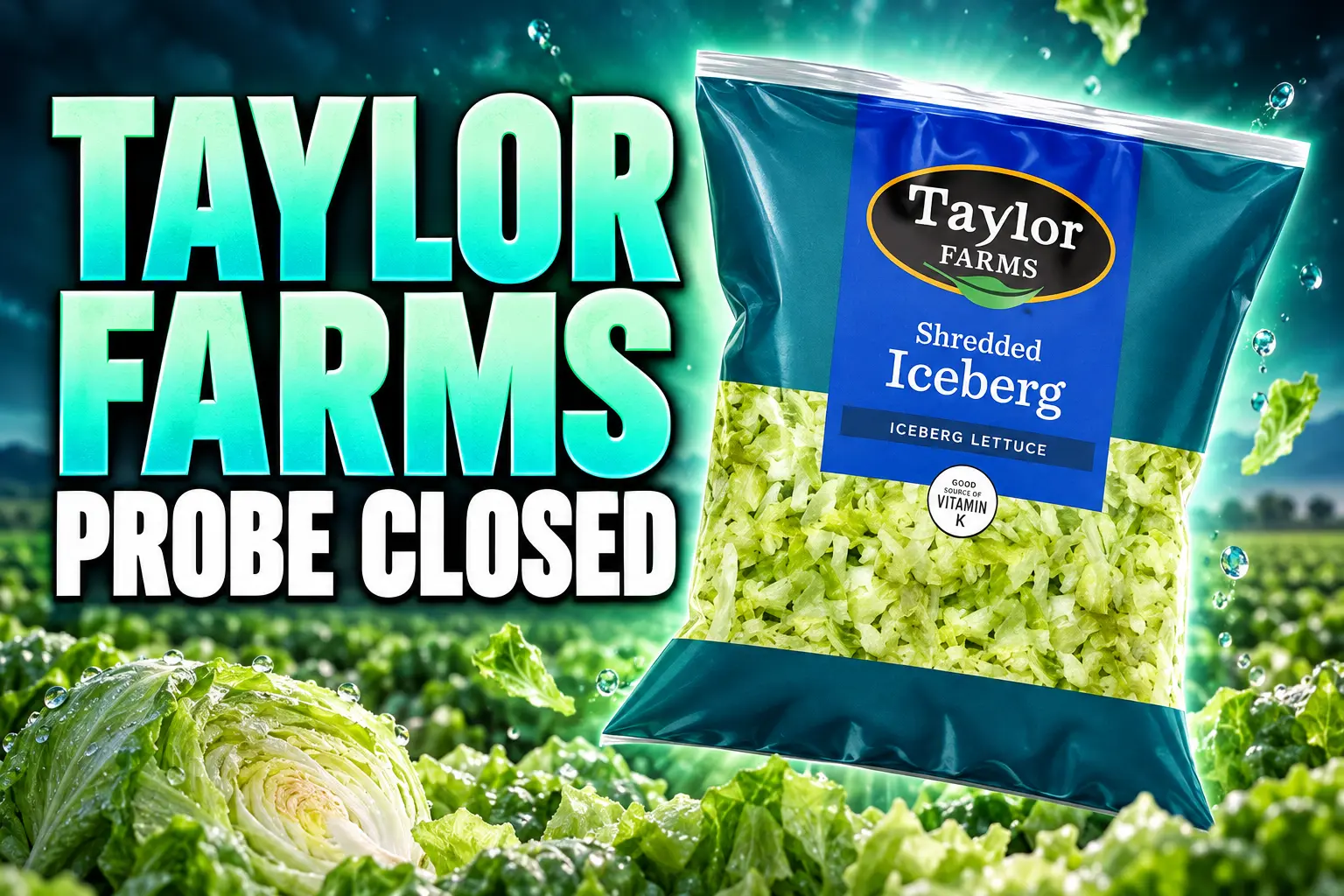
Traceback had pointed to several farms and one processing plant in Mexico that supplied the recalled shreds, distributed in the United States by Taylor Fresh Foods. Inspectors, working with Mexican officials, collected water, soil, sediment, and lettuce. Two samples tested positive for Cyclospora. One came from a tank holding outgoing wastewater at the Taylor Farms de Mexico plant. The other came from a drainage ditch at an iceberg grower in the traceback. No lettuce sample tested positive.
While there is currently not enough evidence to conclusively determine how contamination occurred in this outbreak, the positive samples show that Cyclospora was present in the environment where lettuce was grown and processed.
U.S. Food and Drug Administration, outbreak close, October 2, 2026
The agency said those results add to the epidemiology and the traceback that already pointed at the recalled shreds. Genetic work on the two environmental samples is done. FDA is still comparing those results with genotyping of samples from patients. CDC had already reported that parasites from sick people in this outbreak are genetically related to one another, which supports a shared source even without a proven farm-to-bag path.
WHAT WE KNOW
- The vehicle: Recalled shredded iceberg from Taylor Farms de Mexico, a central Mexico processor, is the product CDC and FDA tie to the outbreak.
- The lab hits: Cyclospora turned up in outgoing plant wastewater and in a grower’s drainage ditch, not on a finished lettuce sample.
- The market: CDC says the recalled product’s best-by dates have passed and it is no longer in stores or restaurants.
WHAT IS UNCONFIRMED
- The route: FDA says there is not enough evidence to say how the parasite got onto the lettuce.
- The match: It is not yet public whether the environmental positives genetically match the patient cluster.
- Farm versus plant: Dropping one grower does not, on the published record, explain the wastewater tank at the processor.
A July 18 import sample that FDA first described as positive was withdrawn the next day as a false positive. That reversal did not undo the traceback or the recall.
The Lettuce Most People Ate Had No Grocery Label
Taco Bell does not grow lettuce. The early Midwest cluster that put this outbreak on the map was shredded iceberg moving through restaurants, the same foodservice channel that carried the 2013 salad mix. Michigan’s health department reviewed food histories from 190 patients who reported eating at Taco Bell and found that 90 percent of those interviewed had eaten iceberg lettuce.
CDC later folded those diners into a wider outbreak of people who ate processed iceberg from Taylor Farms de Mexico at restaurants and other locations. Taylor Farms said no Taylor Farms branded retail bags were in the recall. The company’s own list is almost all foodservice cuts and blends, sold under short packer codes, plus a smaller retail line packed as iceberg salad and shredded lettuce.
The shredded iceberg sent to 27 states moved June 29 through July 16, 2026. Best-if-used-by dates ran as late as August 3. Illness states and ship-to states were not the same list. CDC counted outbreak cases in 21 states. The recall notice named a 27-state distribution footprint that included several states that never entered the federal illness tally.
FDA later classified the recall as Class I, meaning it judged a reasonable probability that exposure could cause serious harm or death. Most illnesses began before the July 17 recall, which is the usual lag for a parasite that can take days to announce itself and weeks to land in a national count.
THE 2026 LETTUCE CALENDAR
- June 14, 2026: First illness onsets CDC later places in the lettuce outbreak.
- June 29, 2026: Recalled shredded iceberg begins moving into the 27-state distribution window.
- July 16, 2026: FDA and CDC announce a multistate iceberg investigation.
- July 17, 2026: Taylor Farms de Mexico starts a voluntary recall of iceberg from central Mexico.
- July 18, 2026: The company halts production of all products at the central Mexico plant; FDA later withdraws a border sample as a false positive.
- August 17, 2026: Last illness onset in the federal outbreak curve.
- August 20, 2026: FDA says onsite inspections and sampling have begun at lettuce growers in Mexico.
- September 11, 2026: CDC declares the lettuce outbreak over.
- October 2, 2026: FDA releases the two environmental positives and closes the outbreak investigation.
At the peak, before the recall, more than 1,000 infections occurred in a single day. In August the curve averaged fewer than 2 infections per day. CDC warns that it can take up to 6 weeks after symptoms start for a case to be reported, and that this season’s volume may stretch that lag even further.
How 2026 Compares With Earlier Cyclospora Seasons
CDC’s outbreak page records 12,883 illnesses in 21 states, at least 570 hospitalizations, and two deaths in Michigan. Onsets ran from June 14 through August 17, 2026. Virginia was the last state added. The count includes people who got sick after traveling to one of those 21 states but live elsewhere. CDC says the true number is likely higher because some people recover without a Cyclospora test.
Those outbreak figures sit inside a much larger summer. As of September 15, CDC had 19,883 laboratory-confirmed cyclosporiasis cases acquired in the United States with onsets from May 1 through August 31, 2026, including this lettuce cluster and other cases. The same May-through-August window in 2025 produced 1,180 cases, nearly 17 times fewer. Season-wide, CDC counted 1,064 hospitalizations and the same two deaths, from 49 states plus the District of Columbia. Median age was 46. About 56 percent of patients were female.
THE LETTUCE OUTBREAK INSIDE THE 2026 SEASON
| Measure | Lettuce outbreak | U.S. season, May 1-Aug. 31, 2026 |
|---|---|---|
| Lab-confirmed illnesses | 12,883 | 19,883 |
| Hospitalizations | 570 | 1,064 |
| Deaths | 2 | 2 |
| Geography | 21 states | 49 states plus D.C. |
Both deaths were in Michigan. State health officials said both people had significant underlying health conditions that may have been affected by cyclosporiasis and dehydration, and that both became ill before the July 17 recall. John Guzewich, who worked foodborne outbreaks at FDA from 1997 to 2011, said he was not aware of other U.S. deaths CDC had linked to this parasite. CDC notes that state dashboards can read higher than the federal outbreak table because states may count probable cases or update on a different clock.
Taylor Farms Dropped a Grower and Left the Plant Idle
Taylor Farms de Mexico is based in Guanajuato. Parent Taylor Fresh Foods says it spends more than $200 million a year on food safety and that it uses an FDA-validated Cyclospora test. On its recall hub the company said that, as of July 18, 2026, it had suspended production of all products at the central Mexico plant and hired outside experts for a full review.
After FDA posted the two environmental positives, a Taylor Fresh Foods spokesperson said the independent grower where a positive sample was found is no longer in the company’s supplier program, and that the plant sample came from discharged waste and sewer water outside the processing facility. The spokesperson also pointed back to FDA’s own line that there is not enough evidence to say how contamination happened, or how those samples relate to genotyping of clinical specimens.
That split is the 2013 argument in a new lab coat. FDA has the epidemiology, the traceback, and, this time, two environmental hits. The company has a dropped grower, a closed plant, and a wastewater sample it describes as outside the building. Neither side has published a step-by-step path from ditch or tank onto a shred line.
FDA Wrote 10 Jobs for the Next Harvest
Closing the outbreak file did not close the homework. FDA says it is still working the root cause and will fold lessons into its Cyclospora Prevention, Response and Research Action Plan, a task-force document first issued in 2021. During the week of September 8, senior FDA officials met Mexican public health and agriculture counterparts on prevention under the existing U.S.-Mexico food safety partnership. On September 11, the day CDC ended the outbreak, FDA sent produce growers, packers, importers, and retailers a letter asking them to tighten water, hygiene, and sanitation practices already required under the Produce Safety Rule and related FSMA rules.
On October 2 the agency also listed ten jobs before the 2027 harvest.
WHAT FDA SAYS IT WILL DO BEFORE 2027
- A public report: An outbreak investigation report will review how imported shredded iceberg may have been contaminated and will offer prevention recommendations.
- More sampling: Surveillance will increase on commodities historically tied to Cyclospora, and on how those crops are grown.
- Faster Mexican labs: FDA wants more capacity in Mexico to collect and analyze Cyclospora samples in-country.
- One genotyping standard: Work with CDC to align methods so outbreaks can be traced faster across governments and companies.
- Importer checks: More Foreign Supplier Verification Program inspections, so importers treat Cyclospora as a hazard in supplier programs.
- Weather and water: New data tools to watch environmental conditions, including weather, that can help the parasite spread.
The other items on the list are grower outreach, training with Mexico’s agriculture ministry, COFEPRIS, and SENASICA, expert panels on worker hygiene and wastewater, and an update to the 2021 action plan. Donald Schaffner, a food science professor and extension specialist at Rutgers University, said he does not think the country has the tools and technologies needed to stop outbreaks like this in the future.
The 2013 assessment in Doctor Mora ended with clean paperwork and no route. The 2026 close ends with a parasite in wastewater and a ditch, a dropped grower, a still-idle plant, and a 10-item list aimed at next summer. The shredded iceberg that carried this outbreak is gone. The gap that let it leave Guanajuato without a proven path is the part that did not ship out.
Frequently Asked Questions
What Is Cyclospora and How Do People Get It?
Cyclospora cayetanensis is a single-celled parasite. The usual illness is watery diarrhea, often with cramps, nausea, fatigue, and weight loss; some infected people have no symptoms. It spreads when food or water is contaminated with feces that contain the parasite. CDC has tied U.S. outbreaks to imported fresh produce. The parasite needs warm, humid time outside the body before it can infect someone, which is why cases cluster in late spring and summer rather than spreading person to person the way norovirus does.
How Many People Did the Taylor Farms Lettuce Outbreak Sicken?
CDC’s final outbreak table is 12,883 laboratory-confirmed illnesses, at least 570 hospitalizations, and two deaths, with onsets from June 14 through August 17, 2026, across 21 states. That is not a count of every person who felt sick. CDC says some people never get tested, and that cases can still arrive after the September 11 close because reporting can take 6 weeks or longer. State totals can also run higher when they include probable cases that never meet the federal laboratory bar.
Was Taylor Farms de Mexico Tied to Cyclospora Before 2026?
Yes, in a smaller way. In 2013, FDA traceback tied a foodservice salad mix from Taylor Farms de Mexico in Guanajuato to restaurant illnesses in Iowa and Nebraska. CDC’s season total that year was 631 cases in 25 states, and Texas illnesses in that same summer traced to a different product, cilantro from Puebla. An FDA environmental assessment at the Doctor Mora plant and nearby ranches in August 2013 found no significant source or route. The company halted Mexico salad-mix shipments on August 9, 2013.
Did FDA Find Cyclospora on the Lettuce Itself?
Not on a product sample that held up. The only lettuce positive FDA announced, a targeted import sample on July 18, 2026, was withdrawn the next day as a false positive. The two confirmed hits in the closed investigation were environmental: outgoing wastewater at the Taylor Farms de Mexico plant and a drainage ditch at a traceback grower. Finished bags and shreds in the recall were pulled because epidemiology and traceback converged on that lot, not because a supermarket clamshell tested positive.
What Symptoms Last, and When Should Someone Call a Doctor?
The recall notice warns that untreated illness can bring dehydration and complications that last from a few days to a month or longer, and that symptoms can fade and then return. People with weak immune systems can have a longer, harder course. Anyone who still has watery diarrhea, stomach pain, or unexplained fatigue after eating leafy greens in June or July 2026 should talk to a physician and mention Cyclospora, because the standard stool tests used in clinics do not always catch it unless the lab is asked to look.
Disclaimer: This article is news reporting and analysis of a closed FDA and CDC foodborne outbreak investigation. It is for information only and is not medical advice, a diagnosis, or a treatment plan, and it is not a substitute for care from a licensed physician. Readers who have symptoms, a recent positive test, or questions about antibiotics or follow-up should consult a doctor or other qualified clinician before acting on anything described here. Case counts, sample results, and product status reflect the federal and company sources cited as of October 2, 2026, and those figures can be revised if agencies issue later updates.

Triumph Bonneville 400 Puts Its Badge on a 349cc Tax Cut

Verstappen Takes First 2026 Pole at a Relocated Bahrain GP

FDA Closes Taylor Farms Lettuce Probe Without a Cause

Ford Cuts 2027 F-150 Raptor Prices by Stripping Gear

Samsung’s Home Up Patch Catches the Fold 8 Icon Drift

The Orchard Bug Forced Zcash to Open an Empty Pool

The $5.99 Game That Won Steam’s 2026 Summer Sale

Don Lee Joins Hemsworth as Extraction 3 Starts Shooting

YouTube Shorts Retires Dislikes and Swaps Likes for Hearts

NEURA Robotics Is Spending Its $1.4B on a Machine Stack
-
 NEWS4 months ago
The Orchard Bug Forced Zcash to Open an Empty Pool
-
 GAMING4 months ago
The $5.99 Game That Won Steam’s 2026 Summer Sale
-
 ENTERTAINMENT6 months ago
Don Lee Joins Hemsworth as Extraction 3 Starts Shooting
-
 NEWS4 months ago
YouTube Shorts Retires Dislikes and Swaps Likes for Hearts
-
 NEWS4 months ago
NEURA Robotics Is Spending Its $1.4B on a Machine Stack
-

 AUTO6 months ago
Kawasaki Bets the New Z1100 Against Its Own Supercharger
-

 BUSINESS5 months ago
Norway’s Export Bank Backs Nscale’s $790 Million Narvik Loan
-

 GAMING4 months ago
Game of Thrones Dragonfire Follows Boston’s Conquest Playbook