
NEWS
Ford Takes $19.5 Billion Hit to Rewrite Its Electric Future

The road to electrification just hit a massive speed bump for one of America’s oldest automakers. Ford is absorbing a staggering $19.5 billion charge as it drastically rethinks its strategy to compete in a cooling electric vehicle market. The company is cancelling major projects to pivot toward affordable models and hybrids, aiming to stop the financial bleeding.
The High Cost of Changing Lanes
Ford is paying a heavy price to correct its course in the electric vehicle race. The company confirmed it will record charges totaling nearly $19.5 billion as “special items” to clean up its balance sheet. This massive sum reflects the cost of abandoning strategies that simply did not work. Roughly $6.5 billion of this comes directly from cancelling future electric vehicle projects that were once seen as the company’s future.
The financial pain does not stop there for the Detroit giant. Ford is also pausing its aggressive plans for a US-based battery operation. This move alone is adding another $6 billion to the bill. These decisions come after the company already lost $5 billion on its electric ambitions throughout 2024. Ford is choosing to pay a high price now to avoid losing even more money on unprofitable vehicles in the coming years.
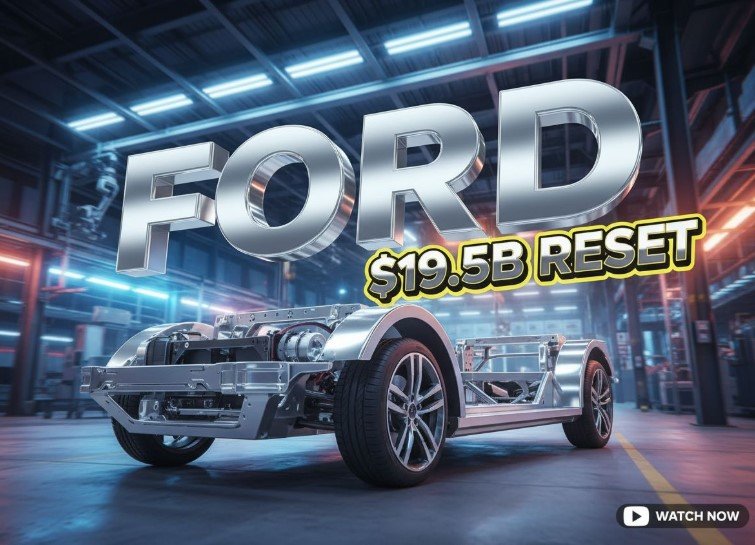
Ford electric vehicle chassis platform manufacturing line blue lighting
“Instead of plowing billions into the future knowing these large EVs will never make money, we are pivoting.”
— Jim Farley, Ford Chief Executive
Industry analysts believe this move is necessary for Ford’s survival in the EV sector. By taking these charges now, the company clears the deck. They hope this reset will allow their electric car business to finally turn a profit by 2029.
Killing the Giants to Save the Brand
The era of massive, expensive electric trucks and SUVs is taking a back seat at Ford. The automaker initially bet big on vehicles like the F-150 Lightning to lead the charge. While the truck earned praise for its performance, it failed to generate the massive sales volume needed to offset high production costs. The market reality is harsh: most buyers cannot afford or do not want $80,000 electric trucks.
Ford is responding by pulling the plug on several large-format electric vehicle projects. The company realized that huge batteries make these vehicles too heavy and too expensive to build profitably. Instead, they are shifting focus to a technology that bridges the gap between gas and electric.
What Ford is Changing:
- Cancelled: Multiple large, three-row electric SUV projects.
- Paused: Standalone battery manufacturing plants in the US.
- New Focus: Extended Range Electric Vehicles (EREV) and hybrids.
This transition to EREVs is a strategic play. These vehicles use a small gas engine specifically to charge the battery while driving, rather than powering the wheels directly. This solves range anxiety for truck owners who tow heavy loads, a key demographic for Ford that pure EVs struggled to satisfy.
The Race for Affordable Power
Ford is now placing its bets on a “skunkworks” team based in California to save its electric future. This group of engineers is developing a dedicated platform for smaller, more affordable electric vehicles. The goal is to produce EVs that can sell in the $30,000 range. This is the sweet spot where mass adoption happens, and it is a market currently threatened by Tesla and Chinese automakers like BYD.
Market Price Comparison:
| Vehicle Type | Average Price | Target Market |
|---|---|---|
| Current Large EVs | $60,000 – $90,000 | Luxury / Early Adopters |
| Ford’s Future Target | ~$30,000 | Mass Market / Families |
The first fruit of this new labor is expected to be a midsize pickup truck arriving in 2027. Jim Farley has promised that a family of affordable cars is right around the corner. The company knows it must compete on price.
Ford is shifting its focus from selling a few expensive cars to selling millions of affordable ones.
This strategy mimics the approach of successful rivals. By using a “Universal EV Platform,” Ford can build multiple vehicle types—sedans, small SUVs, and trucks—on the same underlying technology. This saves money and speeds up production.
Hybrids Bridge the Gap
While Ford develops its cheap EVs, hybrids will do the heavy lifting. The company plans to aim for a 50-50 sales split between traditional gas engines and a mix of hybrids and EVs. This is a recognition that the full transition to electric is taking longer than predicted. Demand for hybrids has surged as buyers look for fuel efficiency without the hassle of finding charging stations.
The plan for an all-electric commercial van has also been scrapped. It will be replaced by hybrid versions that make more sense for business owners. Businesses operate on tight margins. They cannot afford downtime for charging or the high upfront cost of electric vans.
Ford faces a steep mountain to climb. The market is already crowded with solid options like the Chevrolet Equinox EV and the Toyota BZ series. However, by offering a mix of gas, hybrid, and extended-range electric options, Ford hopes to have a vehicle for every type of customer. They are betting that flexibility will win over rigid adherence to an all-electric lineup.
In summary, Ford is enduring a painful $19.5 billion financial reset to fix its electric vehicle strategy. By moving away from expensive, large EVs and focusing on affordable models and hybrids, the company hopes to secure its future in a changing market. This is a bold gamble to remain relevant against aggressive competitors like Tesla and BYD.


Nvidia Buys Hugging Face, the Platform That Turned It Down

OpenAI Names GPT-6 Astra AGI, Then Locks It Down

Relay Q Bets a $150 Puck Can Beat Dictation Apps

Accel Backs Atira to Automate Industrial Sales Engineering

Beyerdynamic Hides a Spare Battery in the Aventho Y

Lummis Pushes the CLARITY Act to Export Wyoming’s Crypto Banks

AI Exposure Turns a Cloud Beat Into a Selloff

Citadel’s XRP ETF Filing Looks Like Dealer Inventory

Revolut’s OCC Nod Starts an 18-Month US Bank Clock

British Business Bank’s Zinc Fund Will Mint 80 Startups

Walter’s TWG Insists No Fraud as Insurer Probes Force Cleanup

30-Year Yield Hits 5.32% Highest Since 2007 as Debt Supply Locks In Costs

PCE Stays at 3.7% as Gas and Tariffs Outrun Coming Revisions

Astute’s $1.2M bet makes B2B creator deals feed AI discovery

Strategy Parks $1.59B Cash While Bitcoin Stack Stays Flat

SpaceX Stock Rebound Tests Real Demand Before Huge Unlock

The 20% Savings Ideal Meets a 2.7% Reality Check

Amber’s €7M locks Mittelstand knowledge inside Europe

Monzo chair Gary Hoffman exits after board revolt fallout

AI data centers win as RAM kits jump nearly 500 percent
-
 FINANCE3 months ago
Zcash Patched a Double-Spend Bug as ZEC Climbed 5%
-
 ENTERTAINMENT3 months ago
Steam Summer Sale 2026 Locks In June 25 to July 9 Dates
-

 FINANCE2 months ago
CLARITY Act Final Text Expected This Weekend as 60-Vote Hurdle Looms
-
 NEWS4 months ago
Meta Adds AI Replies to Threads, But Users Can’t Block It
-

 NEWS3 months ago
YouTube Shorts is testing a heart in place of the thumbs-up
-

 NEWS1 month ago
Senators Force Apple Off Chinese Memory as Big Three Cash In
-

 NEWS3 months ago
NEURA Robotics’ $1.4B Series C Redraws Europe’s Physical AI Bet
-
 ENTERTAINMENT5 months ago
Extraction 3 Is Officially Coming to Netflix in 2027