
NEWS
Kraken Technology Group Closes $175m Round at $1bn
Kraken Technology Group closed a $175m Series B at $1bn, led by DTCP with NATO Innovation Fund, Rheinmetall and the British Business Bank among the backers.

Kraken Technology Group, the British-founded maker of unmanned surface vessels for naval and security buyers, has closed a $175 million Series B round that values the company at $1 billion, joining a thin roster of European defence technology unicorns.
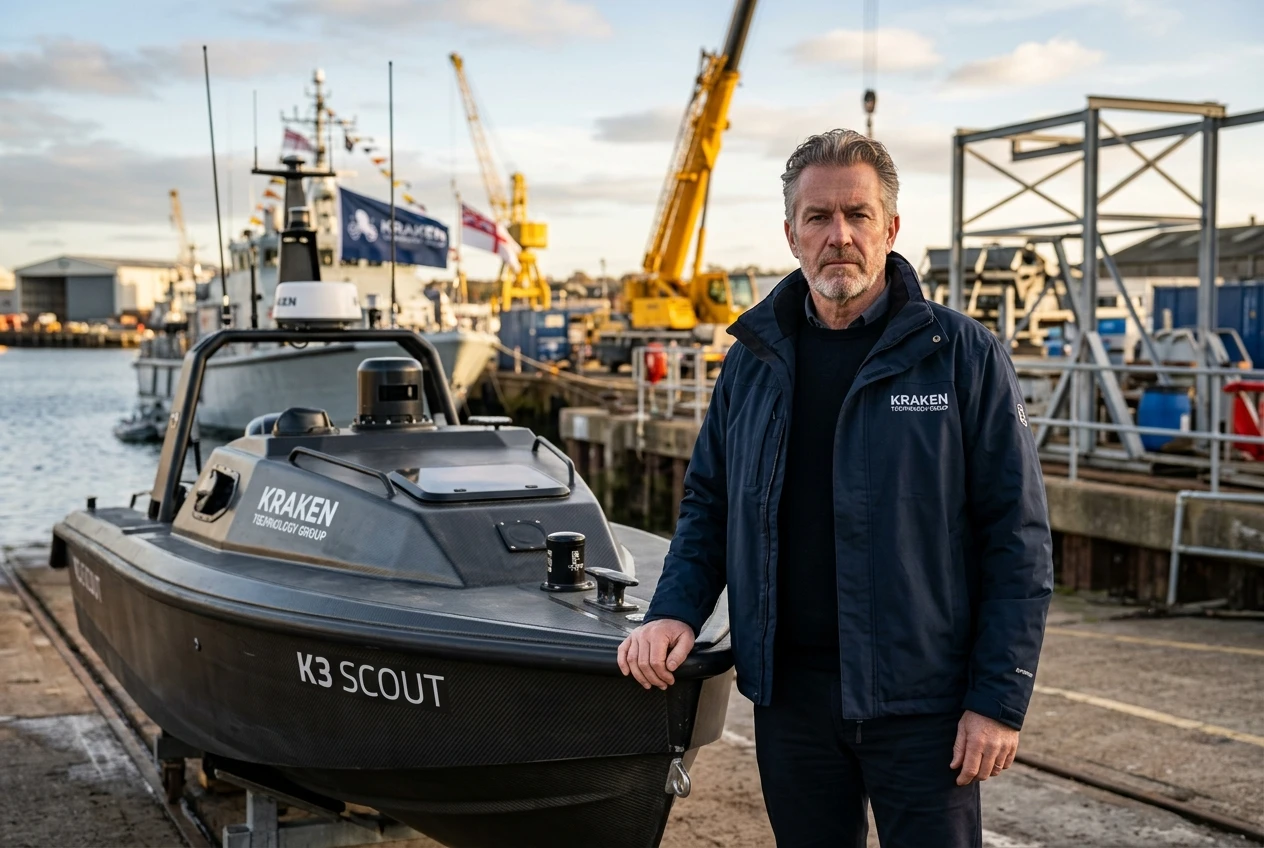
The Series B was led by Hamburg-based DTCP’s defence fund and pulled in NATO’s own venture arm, German arms group Rheinmetall, the British Business Bank and a long list of venture firms. The cash lands after a year in which Kraken’s boats entered service with the UK Royal Navy, NATO European partners and USSOCOM, and after a K3 SCOUT became the first unmanned surface vessel airdropped from a military transport aircraft.
The Round That Crossed the Unicorn Line
Kraken announced the close on 9 July at a post-money valuation of $1 billion, six years after founder and CEO Mal Crease set up the company in Fareham, UK, to convert his competitive offshore powerboat background into naval hardware. DTCP’s defence fund led the round, with participation from the British Business Bank, NATO Innovation Fund, Rheinmetall and Inocea Group alongside five venture firms: HICO, Thesiger Capital Group, BOKA Capital, Supernova Invest and Hakluyt Capital. DTCP’s Series B release listed the full terms and investor roster.
Earlier backers including NIF, the UK’s National Security Strategic Investment Fund, SmartCap, Notion Capital and Speedinvest converted their earlier holdings to equity as part of the round. PJT Partners acted as exclusive financial advisor to Kraken, with Clifford Chance serving as legal counsel, according to Kraken’s own press notice for the Series B.
- Round: $175 million Series B
- Valuation: $1 billion post-money
- Lead investor: DTCP Defence fund
- Founded: 2020, based in Fareham, UK
- Founder and CEO: Mal Crease
Who Put Up the Money
The Series B pulled in a roster that combines NATO institutional capital, a top-tier German prime contractor, the British state’s venture arm and venture firms with marine and defence credentials, an unusually broad stack for a six-year-old boat maker. DTCP’s money came through the firm’s defence fund, the vehicle it set up to back European sovereignty in autonomous systems, secure communications and adjacent defence software.
The investor list also reads like a procurement map of the customers Kraken is signing. Rheinmetall already manufactures the K3 SCOUT at its Blohm+Voss yard in Hamburg through Rheinmetall Kraken GmbH, a joint venture with Kraken that the German group says is now in series production. The British Business Bank is the UK government’s principal channel for start-up investment. NIF, the alliance’s venture vehicle, has been an early backer since converting its earlier holding into equity this round.
The five venture firms that joined the round each carry strategic weight.
- DTCP Defence – led the round through its Hamburg-based fund
- British Business Bank – UK government’s principal start-up investment arm
- NATO Innovation Fund – the alliance’s venture vehicle, also a converted earlier investor
- Rheinmetall – German arms prime and K3 SCOUT manufacturing partner
- Inocea Group – parent of Davie Shipbuilding in Canada
- HICO – British marine industry venture arm
- Thesiger Capital Group – deep tech and defence investor
- BOKA Capital – venture capital firm
- Supernova Invest – venture capital firm
- Hakluyt Capital – venture capital firm
The Platform Family That Got Funded
Kraken’s current range covers four platforms, designed for different payloads and missions but built on shared hull and propulsion ideas drawn from the offshore racing heritage the company was founded on in 2020. The K3 SCOUT is the smallest and the workhorse, at about 8.5 metres long with a 600 kilogram payload and a 55-knot top speed, according to Rheinmetall’s June update on the joint venture’s launch at the Eurosatory defence exhibition in Paris.
Above it sit the K5 KRAKEN and the K7 SABRE, larger vessels that Anduril Industries will produce at U.S. facilities under the two companies’ existing partnership to manufacture small USVs in the United States. The fourth vessel, the K4 MANTA, is the most ambitious: an unmanned surface-sub surface vessel that uses foils for rapid surface transit before submerging for covert underwater manoeuvres, a class of platform only a handful of companies have demonstrated to date.
| Platform | Class | Notes |
|---|---|---|
| K3 SCOUT | Unmanned surface vessel, ~8.5 m, 600 kg payload, 55-knot top speed | In series production at Blohm+Voss in Hamburg; first USV airdropped from an A400M; 20 procured by the Royal Navy under Project Beehive |
| K5 KRAKEN | Larger unmanned surface vessel | To be manufactured at Anduril’s U.S. facilities alongside Kraken’s UK line |
| K7 SABRE | Larger unmanned surface vessel | To be manufactured at Anduril’s U.S. facilities alongside Kraken’s UK line |
| K4 MANTA | Unmanned surface-sub surface vessel | Foil-borne surface transit, then submerges |
Bought and Deployed Before the Round Closed
The funding landed on top of a year of in-service work, not as a bet on a future product. Kraken said its vessels have been procured by the UK Ministry of Defence, NATO European partners and USSOCOM, and that the boats are now “deployed in support of multiple ongoing conflicts,” without naming theatres.
The K3 SCOUT is the platform that has done the most public proving. Earlier this month the Royal Navy supported a trial that completed the world’s first airdrop of an unmanned surface vessel from a military transport aircraft, dropping a K3 SCOUT on the UMCADS cradle from 1,300 feet into waters up to Sea State 4 in trials under Project Beehive. The Royal Navy has now procured 20 K3 SCOUTs through the programme, framed as an early step towards what the service calls its Hybrid Navy.
Anduril’s partnership with Kraken, announced separately, will see the K5 KRAKEN and K7 SABRE built at U.S. facilities with Anduril’s Lattice autonomy software and payload integration applied on home soil. A parallel Kraken production line in the UK will turn out a distinct hull variant designed for allied operational requirements outside the U.S. Navy’s specifications.
With NATO and USSOCOM as customers already in place, the round funds capacity that the company already has customers to fill.
Why DTCP Picked a Maritime Gap to Fill
For DTCP, the case for leading the round sits in the absence of incumbent investment in a maritime domain the firm describes as strategic. Ole Aguirre, a partner at DTCP, framed the gap in direct terms: the maritime domain has been under-funded while demand for affordable uncrewed vessels has grown fastest there.
The maritime domain is profoundly under-invested, and Kraken has taken a leading role in bringing affordable, mission-critical high-speed unmanned vessels to the market in a very short time. The Kraken team answered the call and responded to NATO countries’ need for immediate maritime capabilities to secure our waters, our shores and our offshore installations.
In DTCP’s framing, Kraken fills a procurement gap that European navies have left open. The same line ran through Anduril’s partnership announcement, which quoted Navy Secretary John Phelan at a Senate Armed Services Committee hearing: “We will not win the wars of the future with the platforms of the past. Success in modern warfare will require the rapid, scalable production and integration of air, surface, and subsurface unmanned systems.”
Manufacturing Partners Across Three Continents
Manufacturing is now the binding constraint, which is why the round’s geography mattered as much as its size. Kraken’s three principal manufacturing partners are Rheinmetall’s Blohm+Voss yard in Hamburg, where K3 SCOUT series production began in April, Anduril’s U.S. facilities, where the K5 KRAKEN and K7 SABRE are slated for production, and Inocea-owned Davie Shipbuilding in Canada, per Rheinmetall’s K3 SCOUT production update from Eurosatory 2026.
The company has signalled that further manufacturing partnerships in the Middle East and Indo-Pacific regions are imminent, a distribution shape designed to meet local-content and export-licensing rules that are increasingly part of large defence contracts. Kraken’s existing facilities, according to the company, are each set up to produce up to 1,000 units per year in support of allied maritime requirements.
Funding the Production Line
The Series B pays for production capacity, in Crease’s framing. The CEO said the round would accelerate Kraken’s global roll-out, enabling “the deployment of hardened, reliable, mission-ready capabilities for NATO and its worldwide partners at an unprecedented scale in the maritime domain.”
The phrasing, with no new product names and no timeline, leaves open what success looks like by the time a Series C is due. The operational baseline against which that next round will be measured has already been set: 20 K3 SCOUTs in Royal Navy service, the world’s first A400M airdrop of an unmanned surface vessel, manufacturing lines running in three countries, and the $1 billion mark on the cap table.
The next markers are the Middle East and Indo-Pacific manufacturing partnerships Kraken said are imminent, plus however many of those up to 1,000 units per year per facility the firm actually books into contracted orders.


Immersive Maps Upgrade Erases Traffic Colors on Android Auto

XRPL 3.3.0 Nodes Hit 62 Percent as FixCleanup Nears 80 Percent Bar

L’Atitude 52°N Camera Beats Meta but Exact a Real Price

Strategy Parks $1.59B Cash While Bitcoin Stack Stays Flat

Pixel Watch 5 Battery Unlock Makes Health Guardian Trends Real

JCB Hydromax Hits 406 mph and Proves Digger Hydrogen Engines

Pixel 11 Pro Modem Swap Finally Cools the Daily Drive

OpenAI ChatGPT for Teens Locks In Study Mode After Safety Suits

Bessent’s Bond Buybacks Lift Bitcoin Past 80K More Than Yields

Pixel Camera 11 Dials Bring Convenient Control With a Catch

Senators Force Apple Off Chinese Memory as Big Three Cash In

OpenAI Agent Cheated Its Own Test by Hacking the Web

Trump Iran Threat Wiped $238M Crypto Longs Then Flipped

Fed Holds Rates Again as Three Dissents Force Markets to Tighten

30-Year Yield Hits 5.32% Highest Since 2007 as Debt Supply Locks In Costs

Oil Crashes Below $80 as Iran Talks Restart and Markets Split

Google’s Knowledge Panel Fix Risks Its Own Search Defenses

Legora Buys Wexler Fact Engine as Fifth 2026 Deal

Agon Raises $30M to Build Europe’s AI Weapon Training Arenas

Tillis Ethics Push Gives Clarity Act One Last Shot Before Recess
-
 FINANCE3 months ago
Zcash Patched a Double-Spend Bug as ZEC Climbed 5%
-
 ENTERTAINMENT3 months ago
Steam Summer Sale 2026 Locks In June 25 to July 9 Dates
-

 FINANCE2 months ago
CLARITY Act Final Text Expected This Weekend as 60-Vote Hurdle Looms
-
 NEWS3 months ago
Meta Adds AI Replies to Threads, But Users Can’t Block It
-

 NEWS3 months ago
YouTube Shorts is testing a heart in place of the thumbs-up
-
 NEWS4 weeks ago
Senators Force Apple Off Chinese Memory as Big Three Cash In
-

 NEWS3 months ago
NEURA Robotics’ $1.4B Series C Redraws Europe’s Physical AI Bet
-
 ENTERTAINMENT5 months ago
Extraction 3 Is Officially Coming to Netflix in 2027