
NEWS
Michigan’s Stargate Data Center Revolt Is Turning Into a Career Killer
A $16 billion Stargate data center in Saline Township, Michigan united political rivals and is already costing officials their jobs nationwide.

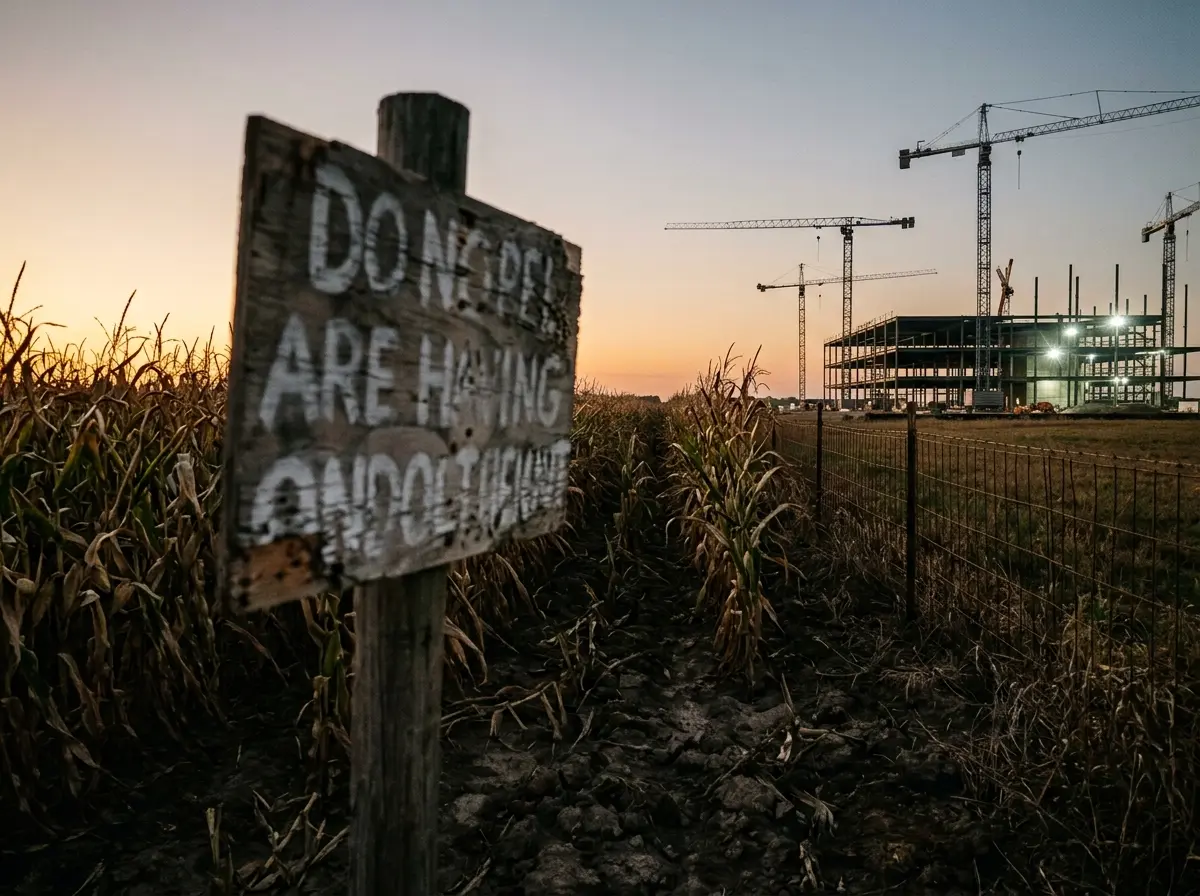
Cranes rise over cornfields in Saline Township, Michigan, where OpenAI and Oracle broke ground this summer on a $16 billion data center the town’s own board had voted to reject. Nicknamed “The Barn,” the project has united the far left, the far right and nearly everyone between them in protest.
That fury isn’t staying local. In Utah, Virginia and Oregon, officials who backed similar projects have already lost their seats over it, and Saline looks less like an outlier than a preview. The fight now sits inside Michigan’s toss-up US Senate primary, less than three weeks before voters decide.
How Did a 4-1 Vote Get Overturned?
Saline Township’s board rejected the data center’s rezoning request 4-1 in September. Developers sued two days later, alleging exclusionary zoning. Facing a legal fight it could not afford to lose, the township settled in October, allowing construction in exchange for $14 million in community benefits and new limits on water use and noise.
The vote followed months of packed, contentious hearings. Opponents argued the 250-acre campus, carved from a roughly 700-acre former farm, would strain the township’s water table and its power grid. Tammie Bruneau, who has led local opposition, said residents aren’t against development in general. “They’re interested in protecting the farmland,” she said.
Related Digital, the development arm of billionaire Stephen Ross’s Related Companies, saw it differently and sued alongside the landowners. Township officials settled rather than fight a battle they were unlikely to win. Opponents have since challenged that settlement in court.
Construction broke ground on June 1, with Governor Gretchen Whitmer and OpenAI Chief Executive Sam Altman both on site. Oracle and its partners say the finished campus will generate averaging north of $150 million a year in tax revenue for nearly two decades, plus about 450 permanent jobs and roughly 2,500 union construction jobs.
A Coalition That Spans the Political Spectrum
The opposition doesn’t sort into familiar camps. Beverly Kincaid, a 56-year-old Republican who lives near the township, said “big money pushed their way around” in Saline. Jeff Samoray, a 57-year-old Democrat from Huntington Woods outside Detroit, made a similar point in different words: that large tech companies are running over residents who have little power to stop them.
There is no way I’m going to take this laying down, and I will fight with all of you.
Kathryn Haushalter, a Marine Corps veteran who lives in the township, told a crowd of protesters gathered along the road into Saline last December, according to POLITICO’s E&E News.
Lisa Wozniak, president of the Michigan League of Conservation Voters, an environmental advocacy group, described politicians from both parties as scattered and inconsistent on the issue. For many residents, unease about the data center is tangled up with a broader distrust of AI and of corporate power generally, not just water bills or noise.
The Barn’s Resource Math
The numbers explain why residents worry, and why national polling shows they aren’t alone.
- 1.4 gigawatts – the power draw for the Saline campus, roughly the output of a nuclear reactor.
- 250 acres – the active construction footprint, carved from a roughly 700-acre former farm.
- $16 billion – the current construction price tag, more than double the $7 billion figure developers cited when the project was first announced.
- 14% – the share of Americans who would welcome a data center in their own community, according to a June Reuters and Ipsos poll.
A separate Gallup survey found that 71% of Americans oppose data center construction near their homes, more than the 53% who object to a nuclear plant nearby. Opposition runs about evenly across party lines, and it peaks in the Midwest at 76%.
Water is the sharper flashpoint nationally. Large data centers can draw up to 5 million gallons of water a day, comparable to a small town’s usage, according to the World Resources Institute, a global research nonprofit. Related Digital says its Saline design uses closed-loop, air cooling meant to draw less water than the farmland it replaced, and that it is preserving roughly 750 acres of wetlands and woodland.
Data Centers Are Turning Into Career Killers
Saline’s fight fits a pattern that is already costing officials their jobs well beyond Michigan.
| Official or Body | Location | What Happened |
|---|---|---|
| J. Stuart Adams, State Senate President | Utah | Lost his primary after backing a data center campus near the Great Salt Lake |
| Lee Perry, Box Elder County Commissioner | Utah | Lost his seat over the same project |
| Township treasurer | Saline Township, Michigan | Resigned in May citing death threats tied to the project; a recall effort followed |
| Five town council members | Warrenton, Virginia | Voted out over two election cycles after backing an Amazon data center |
| Two port commissioners | Cascade Locks, Oregon | Recalled in 2023 after supporting data center negotiations |
“Do I think that the data center vote cost me the election? Yes I do,” Perry said after conceding, part of Newsweek’s accounting of data center election losses from Georgia to Utah.
Billionaire investor Mark Cuban posted this month that the backlash has less to do with data centers themselves and more to do with public anger at AI and the concentration of wealth it is creating, warning tech companies that trying to buy elections would ultimately backfire. Business leaders like Sandy Baruah, president of the Detroit Regional Chamber, counter that critics are missing the economic upside such projects bring.
Michigan’s Senate Primary Becomes a Live Test
Michigan’s Democratic primary for an open US Senate seat falls on August 4, and the data center fight has forced its way onto the debate stage.
- Haley Stevens, the US representative from Birmingham, calls AI “a revolutionary technology” tied to job creation, while calling on companies to pay their own water and utility bills.
- Abdul El-Sayed has released a “No rate hikes” plan meant to stop data center costs from being passed on to ratepayers.
- Governor Gretchen Whitmer, who isn’t on the ballot, continues to back the Saline project and has opposed a proposed statewide moratorium alongside House Speaker Matt Hall.
The three positions capture the range Michigan Democrats are testing right now, from full-throated support to conditional backing to a narrower focus on ratepayer protection. Whoever wins the primary carries that answer into a competitive general election.
Washington Reaches for a Voluntary Fix
Michigan regulators have already weighed in once. The Michigan Public Service Commission, the state’s utility regulator, conditionally approved DTE Energy’s special contracts to power the Saline campus in December. Michigan’s attorney general has appealed that approval.
DTE Energy, the state’s largest electric utility, and Oracle both say the project’s energy and infrastructure costs will be paid by the companies, not passed on to ratepayers. That promise is being tested at a national scale, with data centers expected to help push US electricity demand tied to computing to up to 1,050 terawatt hours annually by 2030, according to the Environmental and Energy Study Institute, a nonpartisan policy research group.
The White House has reportedly begun working with utility companies and data center developers on a voluntary pledge meant to keep grid upgrade costs off consumer bills, though no formal agreement has been announced.
The power problem isn’t confined to Michigan, or to the United States. European developers are making a similar wager; Nscale’s $900 million and Proxima Fusion’s €411 million raises both bet that securing power, not chips, decides who wins the AI buildout.
Michigan’s Democratic primary falls on August 4, with opponents’ legal challenge to the Saline settlement still working through the courts.


Flower Labs Puts Endeavor 1.0 on Customer Servers

Cummins Bets on Emerald to Scout the Next Power Shift

Holifya Raises €2 Million to Wrap Italy’s GLP-1 Care

INLEAP Photonics Places a Factory Bet on Laser Defences

Instarc Takes €1.25 Million After a Quiet July Recap

nordIX Bets €21 Million on ID Finance’s Spanish Loans

Space Cargo Buys Into France’s Zero-G Flight Company

The $399 Omni Walks Away, Then Asks for a Dock

TECNO’s 0mm Bezelless Phone Still Needs a Rim

The Ryobi Tools That Unblocked a Garage Workbench

30-Year Yield Hits 5.32% Highest Since 2007 as Debt Supply Locks In Costs

Walter’s TWG Insists No Fraud as Insurer Probes Force Cleanup

Strategy Parks $1.59B Cash While Bitcoin Stack Stays Flat

Astute’s $1.2M bet makes B2B creator deals feed AI discovery

PCE Stays at 3.7% as Gas and Tariffs Outrun Coming Revisions

SpaceX Stock Rebound Tests Real Demand Before Huge Unlock

BlackRock Turns Cash Empire Into Stablecoin Reserve Rails

The 20% Savings Ideal Meets a 2.7% Reality Check

Amber’s €7M locks Mittelstand knowledge inside Europe

Monzo chair Gary Hoffman exits after board revolt fallout
-
 FINANCE3 months ago
Zcash Patched a Double-Spend Bug as ZEC Climbed 5%
-
 ENTERTAINMENT3 months ago
Steam Summer Sale 2026 Locks In June 25 to July 9 Dates
-

 FINANCE2 months ago
CLARITY Act Final Text Expected This Weekend as 60-Vote Hurdle Looms
-
 NEWS4 months ago
Meta Adds AI Replies to Threads, But Users Can’t Block It
-

 NEWS3 months ago
YouTube Shorts is testing a heart in place of the thumbs-up
-

 NEWS1 month ago
Senators Force Apple Off Chinese Memory as Big Three Cash In
-

 NEWS3 months ago
NEURA Robotics’ $1.4B Series C Redraws Europe’s Physical AI Bet
-
 ENTERTAINMENT5 months ago
Extraction 3 Is Officially Coming to Netflix in 2027