
BUSINESS
Syntetica Raises $30M as Fashion Brands Bet on Nylon Recycling
French startup Syntetica raised $30 million to scale chemical nylon recycling, backed by Lululemon, MAS Holdings and Bpifrance’s Ecotechnologies fund.

French startup Syntetica has raised $30 million to build its first commercial plant for recycling the nylon blends that have stumped the textile industry for decades. Lululemon and MAS Holdings, a major apparel manufacturer, joined the Series A round alongside Bpifrance’s Ecotechnologies 2 fund. The money will fund a demonstration plant built with Michelin in Clermont-Ferrand, designed to separate two chemically similar nylons inside one reactor, without sorting them first.
Lululemon and MAS Holdings are taking equity in the company that makes their recycled nylon. It is a bet against nylon’s price swings and Europe’s incoming recycled-content rules, placed years before the technology runs at industrial scale.
One Reactor Untangles Two Nylons at Once
Syntetica’s patented process recycles Nylon 6 and Nylon 6,6 from mixed textile waste in a single step, without separating the two types first, the company says. That single step is the technical barrier the rest of the industry has struggled to clear, since the two polymers are chemically similar but behave differently once melted.
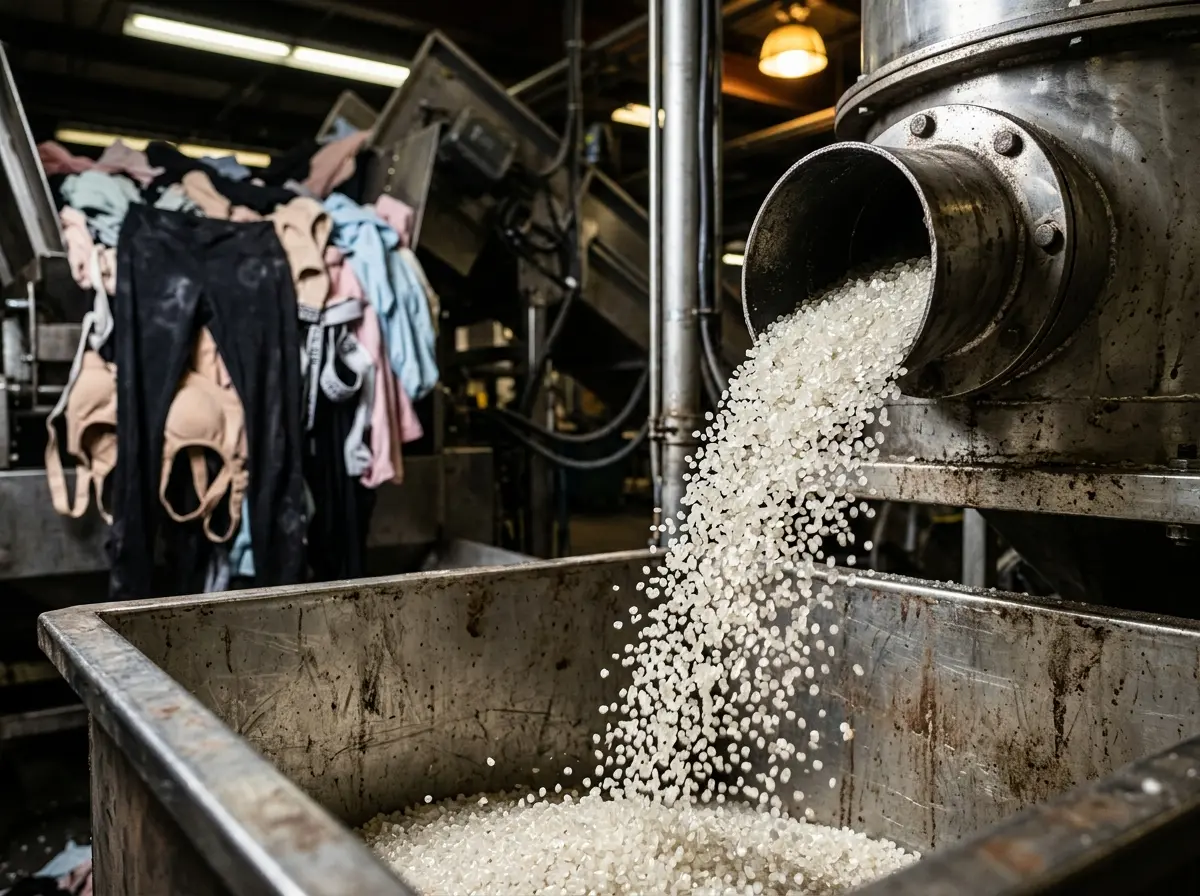
Most recyclers need clean, single-fiber scraps left over from manufacturing. Syntetica’s platform instead targets post-consumer textiles: stretched leggings, worn bras and stained sportswear, the blended, dyed waste that makes up most of what actually gets thrown away.
Shredded and treated fabric goes into a reactor where, in the reactor, the process molecularly separates nylon from elastane and cotton, according to the company, using a low-temperature, no-pressure chemical bath rather than heat or solvents that degrade fiber quality. Researchers writing in the journal Science Advances found that less than 0.5% of postconsumer textile waste is recycled worldwide, largely because blended fibers defeat most mechanical and chemical sorting lines. Mechanical recycling, the same research noted, typically shortens fiber length and downgrades the output into insulation or mattress stuffing rather than new nylon.
Syntetica does not make fabric. Its reactors output plastic pellets, a raw material manufacturers such as MAS Holdings can spin into yarn on their own lines, which keeps Syntetica out of the business of making textiles itself.
Oil Shocks Made Nylon a Boardroom Problem
Nylon tracks the price of oil, and oil has been volatile. Marco Bertone, Syntetica’s co-founder and chief executive, told TechCrunch that geopolitical turmoil in energy markets has forced quarterly or even weekly renegotiations of nylon contracts over the past six months.
“It’s been a wake-up call to many brands that have been relying on petrol-sourced nylon and petrol-sourced synthetics for pricing and convenience, and which today have seen massive shocks to their system,” Bertone said.
Europe has added a second pressure point. Mandatory separate collection of textile waste began in 2025, with tighter recycled-content requirements arriving in 2027, according to Michelin’s Center for Sustainable Materials. Recycled nylon still accounts for roughly 2% of the global nylon market, Tech Funding News reported, leaving brands little room to source the material even when they want it.
Why Would an Apparel Manufacturer Bet on Unproven Tech?
MAS Holdings, a major apparel manufacturer and production partner to global brands, joined Syntetica’s Series A even though the technology has not yet run at industrial scale, an unusual move for a supply chain company. Lululemon invested too, its second bet on a nylon-recycling startup after Australia’s Samsara Eco. Both said the scale of the waste problem justified moving early.
It is unusual for a supply chain company to back a technology that has not scaled, TechCrunch noted. Before the round closed, Syntetica had already lined up Michelin to host its demonstration plant, a partnership signed months before any Series A investor wrote a check.
We have built the company with the clarity that there’s no green premium. If you want to scale real solutions for a sustainable world, it needs to be cost competitive, highly scalable, and you need to build partnerships from the very start.
Bertone said in comments reported by TechCrunch.
“Recycling technology succeeds when brand commitment, manufacturing partnership, and industrial scale-up expertise all converge,” said Sid Amalean, director of group innovation at MAS Holdings, calling Syntetica one of the few ventures in the space to combine all three. Bertone described the manufacturer’s participation as “a recognition of how significant the problem has become.”
Lululemon has now backed more than one nylon-recycling bet. This is its second investment specifically in nylon recycling, after Australia’s Samsara Eco, Tech Funding News reported, and the brand has separately backed textile recycler Epoch Biodesign. Syntetica’s own project with Lululemon could reach the market as early as next year, alongside existing work with Victoria’s Secret and Etam, according to TechCrunch.
From a Paris Accelerator to an Industrial Balance Sheet
Bertone and Louis Monsigny, Syntetica’s co-founder and chief technology officer, founded the company in 2023 after meeting through Entrepreneur First, a startup accelerator based at Station F in Paris. Bertone came from a background in fashion and secondhand e-commerce; Monsigny brought the polymer chemistry. Bertone is originally from Italy, grew up in London, and has lived in Paris for six years, Tech Funding News reported.
EQT Ventures led a €4.2 million (about $4.6 million) seed round in July 2024, joined by family offices linked to Peugeot, Etam and Indorama Ventures’ shareholders, along with several angel investors. Syntetica’s first patent is public but still pending, with several more applications filed and five more submitted this year, Tech Funding News reported. The team has grown to about 22 people; Bertone expects 30 by the end of this year and 45 by the end of next.
The two funding rounds mark very different stages of the company’s life.
| Round | Date | Amount | Lead Investor | Primary Use |
|---|---|---|---|---|
| Seed | July 2024 | €4.2 million (about $4.6 million) | EQT Ventures | Build the founding team and produce first recycled nylon samples |
| Series A | July 2026 | $30 million | Ecotechnologies 2 fund (Bpifrance) | Build the first commercial demonstration plant with Michelin |
Bpifrance, France’s public investment bank, manages the Ecotechnologies 2 fund on behalf of the French government as part of the France 2030 industrial plan, according to TechCrunch. The European Innovation Council (EIC), the European Union’s fund for breakthrough deep-tech, also backed Syntetica with equity, grants and accelerator support. “Syntetica has developed a differentiated technology that addresses one of the textile industry’s most complex recycling challenges,” said Alexandre Wagner, investment director at Bpifrance Green Venture.
The Clermont-Ferrand Plant Runs on an Eighteen-Month Clock
The new funding will finance construction of Syntetica’s first commercial demonstration facility, built inside Michelin’s Center for Sustainable Materials at the Michelin Innovation Park in Clermont-Ferrand. Bertone expects it to be running within 18 months, producing commercial volumes of recycled nylon, Tech Funding News reported. At full capacity, the plant is designed to process hundreds of tonnes of textile waste a year.
Patrice Kéfalas, director of Michelin’s Center for Sustainable Materials, said the site “was designed to support this kind of breakthrough technology towards industrial scale.”
Syntetica’s roadmap for the plant includes several concrete steps:
- A pilot phase already running at the Michelin site, processing several tonnes of textile waste before scaling up.
- A full industrial demonstrator targeted from 2027, timed to Europe’s stricter recycled-content rules.
- Expansion beyond nylon into automotive parts and speciality chemicals, using the same chemistry platform.
- New facilities elsewhere, which Bertone says will be built close to waste sources and textile production hubs worldwide.
That last step remains distant. For now, Clermont-Ferrand is the only site with a construction timeline attached to it.
Rivals Are Stuck Near the Same Wall
Syntetica is not alone in chasing nylon’s economics. Chemical giant BASF already sells its own recycled nylon, and a cluster of startups is trying an entirely different route: enzymes engineered to break down plastic waste, Bertone told TechCrunch.
That enzymatic path remains far from industrial. A review in Nature Chemical Biology found that the best biocatalysts rarely exceed 1% conversion of solid polymer into usable products, a sign of how stubborn nylon’s chemistry remains across every approach, not only Syntetica’s.
Bertone said he does not see other recyclers as a threat. “If everyone were to scale to tens of factories, we still wouldn’t solve this problem,” he told TechCrunch. “Everyone needs to succeed for us to succeed as a society.”
Investors are placing similar bets elsewhere on waste streams once considered worthless. Elsewhere in Europe, startup StratX is turning landfill methane into recurring revenue, part of the same wave of capital chasing circular-economy technology once left to landfill operators and incinerators.
Frequently Asked Questions
What Is the Difference Between Nylon 6 and Nylon 6,6?
Nylon 6 and Nylon 6,6 are both synthetic polyamides used across activewear, hosiery and automotive parts, but they are built from different chemical building blocks and melt at different temperatures. That difference has historically forced recyclers to sort the two apart before processing. Syntetica’s chemistry treats both inside the same reactor, removing one of the costliest steps in nylon recycling.
Does Recycled Nylon Cost More Than Virgin Nylon?
Bertone has not disclosed a per-kilogram cost for Syntetica’s pilot-scale output. He has said the company aims to match the price of new nylon at scale rather than charge a sustainability premium, a condition he called necessary to win manufacturers and brands as investors.
Which Other Companies Are Trying to Recycle Nylon?
Beyond BASF and enzymatic specialists, Syntetica’s competitors include Ambercycle, Evrnu, Gr3n, Worn Again Technologies and Ioncell, according to PitchBook. Lululemon has separately backed Australia’s Samsara Eco and Epoch Biodesign, spreading its own bets across more than one recycling approach.
Has Any Clothing Made with Syntetica’s Recycled Nylon Reached Stores?
Etam, described by Tech.eu as France’s top lingerie brand, worked with Syntetica on a capsule collection using recycled material from the company’s process, first announced for 2025 with a market debut targeted for 2026, marking one of the first real-world tests of Syntetica’s output outside the lab.


Nvidia Buys Hugging Face, the Platform That Turned It Down

OpenAI Names GPT-6 Astra AGI, Then Locks It Down

Relay Q Bets a $150 Puck Can Beat Dictation Apps

Accel Backs Atira to Automate Industrial Sales Engineering

Beyerdynamic Hides a Spare Battery in the Aventho Y

Lummis Pushes the CLARITY Act to Export Wyoming’s Crypto Banks

AI Exposure Turns a Cloud Beat Into a Selloff

Citadel’s XRP ETF Filing Looks Like Dealer Inventory

Revolut’s OCC Nod Starts an 18-Month US Bank Clock

British Business Bank’s Zinc Fund Will Mint 80 Startups

Walter’s TWG Insists No Fraud as Insurer Probes Force Cleanup

30-Year Yield Hits 5.32% Highest Since 2007 as Debt Supply Locks In Costs

PCE Stays at 3.7% as Gas and Tariffs Outrun Coming Revisions

Astute’s $1.2M bet makes B2B creator deals feed AI discovery

Strategy Parks $1.59B Cash While Bitcoin Stack Stays Flat

The 20% Savings Ideal Meets a 2.7% Reality Check

Amber’s €7M locks Mittelstand knowledge inside Europe

SpaceX Stock Rebound Tests Real Demand Before Huge Unlock

Evernorth S-4 Clears Path for Active XRP Treasury on Nasdaq

Monzo chair Gary Hoffman exits after board revolt fallout
-
 FINANCE3 months ago
Zcash Patched a Double-Spend Bug as ZEC Climbed 5%
-
 ENTERTAINMENT3 months ago
Steam Summer Sale 2026 Locks In June 25 to July 9 Dates
-

 FINANCE2 months ago
CLARITY Act Final Text Expected This Weekend as 60-Vote Hurdle Looms
-
 NEWS4 months ago
Meta Adds AI Replies to Threads, But Users Can’t Block It
-

 NEWS3 months ago
YouTube Shorts is testing a heart in place of the thumbs-up
-

 NEWS1 month ago
Senators Force Apple Off Chinese Memory as Big Three Cash In
-
 ENTERTAINMENT5 months ago
Extraction 3 Is Officially Coming to Netflix in 2027
-

 NEWS3 months ago
NEURA Robotics’ $1.4B Series C Redraws Europe’s Physical AI Bet