
NEWS
Hyperion Robotics Raises $7.4 Million to Bet on Robotic Concrete Factories
Hyperion Robotics raised $7.4 million to scale robotic concrete microfactories across Europe, with its first UK plant near Scunthorpe still not open.

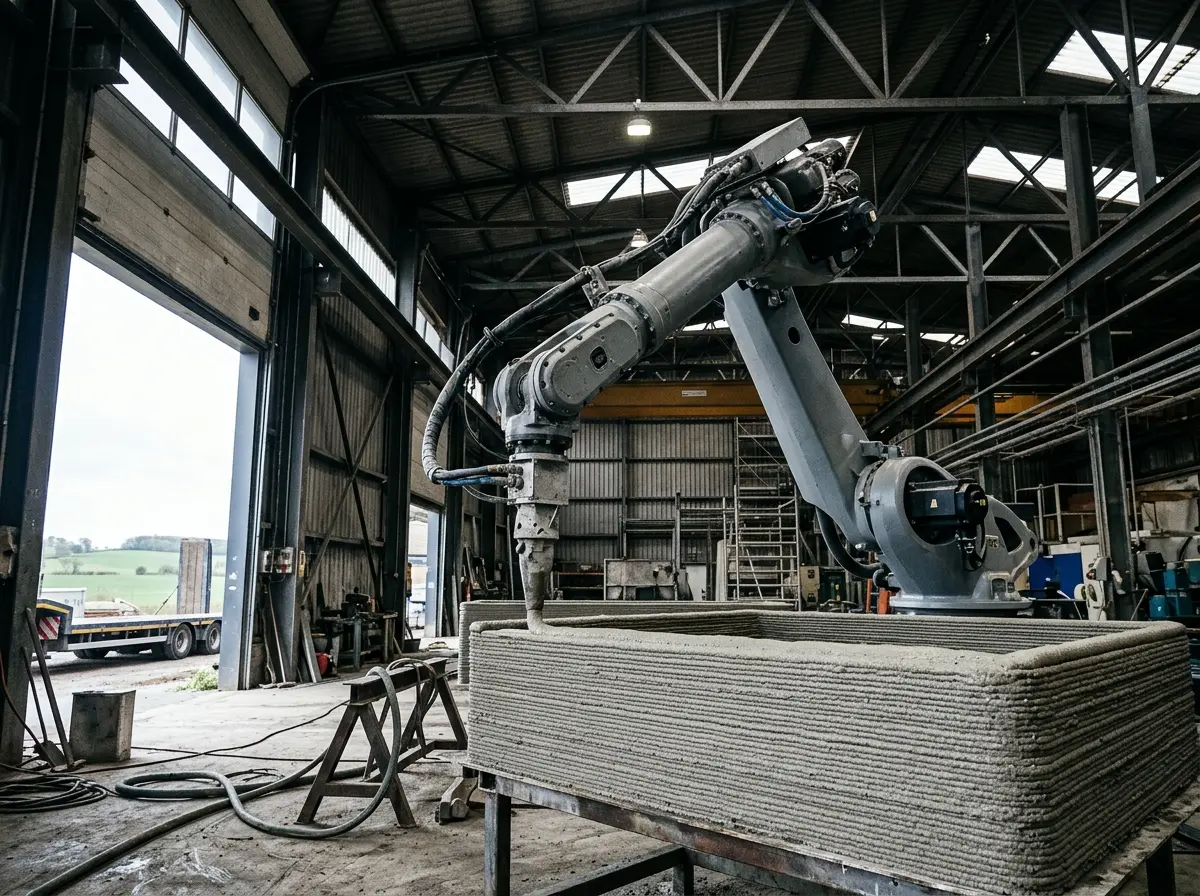
Hyperion Robotics has raised $7.4 million to move concrete manufacturing out of the mud and into robotic factories across Europe. The Espoo, Finland company builds bridges, substations and water infrastructure components with robotic arms guided by its own software, instead of pouring concrete by hand on-site the way most contractors still do. TechFundingNews first reported the round, which pushes Hyperion’s total funding toward $20 million.
The money is meant to open Hyperion’s first UK factory, in Flixborough near Scunthorpe. Earlier trade coverage had that plant opening in spring or, at the latest, before summer. The announcement of this round, on July 16, still describes the investment as what will support launching it.
Course Corrected and Brussels Money Lead a $7.4 Million Round
The round was co-led by Course Corrected, a venture capital firm, and the European Innovation Council Fund (EIC Fund, the European Union’s investment arm for deep-tech scaleups). Both had backed Hyperion before this raise.
Four other investors joined them:
- RE Ventures, the venture arm of Switzerland’s Romande Energie Group, a new backer in this round.
- Lifeline Ventures, a Nordic firm that led Hyperion’s prior three-million-euro raise.
- Übermorgen Ventures, an impact investor returning from that same earlier round.
- PC Rettig Impact & Co, another repeat backer from Hyperion’s investor syndicate.
Pitchbook’s own company profile, which can lag private disclosures, puts Hyperion’s headcount at 30 employees and its cumulative funding well below the $20 million figure cited this week, a gap that reflects how unevenly private funding data gets updated rather than any dispute over the new round itself.
Hyperion’s chief executive framed the round as existential rather than routine.
Europe doesn’t have the time, the budget or the labour for construction to keep working the way it has.
Fernando De los Rios, chief executive of Hyperion Robotics, made that case in the funding announcement, arguing that physical AI, not incremental fixes, is what closes the gap between Europe’s infrastructure needs and its shrinking construction workforce. He said the $7.4 million lets Hyperion start delivering at scale, from factories built next to the projects they serve rather than shipping parts from a central plant.
What Is Physical AI Doing in a Concrete Factory?
Physical AI describes software and robotics systems that act directly on the physical world instead of just processing data on a screen. Hyperion applies the idea to reinforced concrete: its Forge platform designs a structural component, checks it against building codes, then directs robots to manufacture it inside a factory rather than a trench.
Investors have been chasing that idea across Europe well beyond concrete. PitchBook data cited by TechFundingNews shows global robotics funding hit $27.6 billion in 2025, more than double the $13.7 billion invested the year before. NEURA Robotics alone raised a $1.4 billion Series C this year, dwarfing Hyperion’s round even though both are selling the same underlying thesis. Smaller, narrower bets have followed the same logic: one European startup put adaptive AI inside electric motors in a funding round worth £8.1 million, proof the category stretches well past robots that walk or drive.
Hyperion’s version targets a specific weak point in that broader story. Construction remains one of the least automated major industries, still building bridges, substations and water systems by hand and on-site in small batches, according to TechFundingNews’ reporting on the round.
Fifty Foundations a Week
Hyperion’s pitch rests on a specific set of numbers, repeated across its funding announcement and its own marketing.
- Up to three times faster production than pouring the same components on a conventional building site.
- Up to 50% lower costs compared with traditional construction methods.
- Up to 70% less carbon emitted per structure, mostly by cutting cement content and transport.
- Up to 75% less material used, through computationally optimized shapes instead of solid concrete blocks.
Those figures are meant to prove out first at Forge I. LKAB Minerals supplies the industrial site and mineral inputs, while Hyperion designs, builds and operates the line, according to the agreement that confirmed Flixborough as the manufacturing site. The plant is expected to start with around ten skilled roles, growing as output scales, and will target infrastructure clients in energy, water, data centres and carbon capture.
COBOD, XtreeE and CyBe Got There First
Hyperion is not alone in betting robots can fix concrete. TechFundingNews, which broke the funding story, was blunt about the risk: it remains unclear whether Hyperion can out-compete concrete and modular construction firms already operating at scale in this space.
| Company | Home Base | Business Model |
|---|---|---|
| Hyperion Robotics | Espoo, Finland | Builds and runs robotic microfactories inside a client’s own supply chain |
| COBOD | Nordhavn, Denmark | Sells 3D concrete printing hardware to construction companies |
| XtreeE | Rungis, France | Operates large-format 3D printers to produce structural elements |
| CyBe Construction | Netherlands | Prints structures directly using large-format 3D printers |
The distinction Hyperion draws is operational, not just technical. Rather than selling printers the way COBOD does, it runs the whole microfactory as part of the client’s own delivery chain. Peer-reviewed research on construction robotics flags recurring problems with mobility reliability on uneven sites and the need for specially trained operators, a reminder that the whole category is still working through basic deployment issues, not just market share.
A Spring Deadline Meets a Summer Funding Round
Trade coverage of Forge I set expectations early this year. New Civil Engineer reported in March that the site would open in spring 2026. Weeks later, 3D Printing Industry and Construction Management both described a target of opening before summer, with capacity to produce more than 50 foundation units a week, each up to three metres square.
Both of those windows had closed by July 16, when Hyperion announced the new $7.4 million round. The release still frames the money as support for launching Forge I, the same milestone earlier coverage had already placed months before.
Public filings show the UK entity behind the plant, Hyperion Robotics UK Ltd, was incorporated in April 2024, registered at the Flixborough Industrial Estate address itself. Neither Hyperion nor its investors addressed the gap between the original timeline and this week’s announcement in the materials reviewed for this story.
That gap doesn’t erase what the company has already built. Hyperion has delivered smaller, single-project foundations for National Grid, Yorkshire Water and Welsh Water. The open question is whether the same process holds up at Forge I’s promised industrial pace, not whether the underlying technology works at all.
Flixborough’s First Customer Is Already Lined Up
Forge I already has a named customer waiting. Costain, the engineering group delivering the Northern Endurance Partnership’s offshore carbon capture pipeline near Teesside, is sourcing 3D-printed concrete sleepers from Hyperion’s new UK plant for the East Coast Cluster project.
For that specific contract, Hyperion says the design will reduce concrete and steel use by 40%, cut carbon emissions by up to 50%, and produce sleepers up to ten times stronger despite being up to 60% lighter than conventional alternatives. Those figures apply to the Costain project specifically, distinct from the company-wide numbers behind the funding pitch.
The wager isn’t unique to concrete, either. Mirai Robotics raised $4.2 million for autonomous sea systems this year, a similarly modest sum backing a similarly narrow physical AI bet elsewhere in Europe. Hyperion’s new funding is also earmarked for expanding the Forge software platform and pushing into new European infrastructure markets, the company said. That expansion now has to outrun both its established rivals and its own deadlines, starting with the factory in Flixborough.


Veridue Raises $4 Million to Speed Energy Deal Diligence

Healey Adds a £150m Rung for Northern Scale-Ups

Ten Deals Took Most of Europe’s August Tech Money

Holmes Hired Fielder to Film Her Last Days

Molten Bets £100m of Plc Cash on Late-Stage Tech

Garlinghouse Cited Dutch Gold, and London Got the Bars

byFounders Bets $4.3 Million on Fluencify After $2M ARR

Alpha Gang Puts A-List Stars on a Zellner Wager

Angel Bets a Recut PG-13 Chase on Ritchson and Wilson

Flex IT and T1A Combine to Own Corporate Device Supply

Walter’s TWG Insists No Fraud as Insurer Probes Force Cleanup

30-Year Yield Hits 5.32% Highest Since 2007 as Debt Supply Locks In Costs

Evernorth S-4 Clears Path for Active XRP Treasury on Nasdaq

PCE Stays at 3.7% as Gas and Tariffs Outrun Coming Revisions

Astute’s $1.2M bet makes B2B creator deals feed AI discovery

Strategy Parks $1.59B Cash While Bitcoin Stack Stays Flat

Instinct Hits $2.5 Billion as AI Agent Access Sparks Trust Fights

Oracle’s 2.8 GW Bloom Deal Exposes the AI Power Bypass

Amber’s €7M locks Mittelstand knowledge inside Europe

CLARITY Act Cloture Opens a Door Ethics Still Blocks
-
 FINANCE3 months ago
Zcash Patched a Double-Spend Bug as ZEC Climbed 5%
-
 ENTERTAINMENT3 months ago
Steam Summer Sale 2026 Locks In June 25 to July 9 Dates
-

 FINANCE2 months ago
CLARITY Act Final Text Expected This Weekend as 60-Vote Hurdle Looms
-
 NEWS4 months ago
Meta Adds AI Replies to Threads, But Users Can’t Block It
-
 ENTERTAINMENT5 months ago
Extraction 3 Is Officially Coming to Netflix in 2027
-

 NEWS3 months ago
YouTube Shorts is testing a heart in place of the thumbs-up
-

 NEWS1 month ago
Senators Force Apple Off Chinese Memory as Big Three Cash In
-

 NEWS3 months ago
NEURA Robotics’ $1.4B Series C Redraws Europe’s Physical AI Bet