
NEWS
Luffy AI Lands £8.1M to Put Adaptive AI Inside Electric Motors
Luffy AI raised £8.1M Series A led by BGF to embed neuroplastic AI in industrial motors, claiming up to 400 times the efficiency of deep learning.

Luffy AI, a British startup building AI controllers for industrial machinery, has raised an £8.1 million Series A round led by growth investor BGF, with Munich-based MIG Capital AG joining through MIG Fonds. The Oxfordshire company, founded in 2019 by two former nuclear fusion scientists, plans to deploy the capital into motors, pumps, fans and conveyors, betting that small, on-device neural networks can replace a piece of electric-motor engineering that has barely moved in a century.
The fresh funding will support Luffy’s bid to scale a “neuroplastic AI” stack out of proof-of-concept pilots and into long-term industrial partnerships. The round was announced on 7 July 2026, the same day BGF publicly confirmed its lead role. Both lead and follow-on backers framed the deal as a vote of confidence in a different kind of factory AI. That new style of controller targets motor engineering that has changed little in the last century.
What Luffy AI Just Raised, and From Whom
BGF, one of the UK and Ireland’s most active growth investors, completed the £8.1m investment on 7 July 2026 as part of Luffy’s Series A round. Joining the lead investor are Munich-based deep-tech firm MIG Capital AG through MIG Fonds, plus existing backers Bow Capital, Chrysalix, Momenta and UKI2S, according to BGF’s full £8.1m Series A announcement. BGF’s lead role puts the publicly-backed UK growth investor alongside four specialist follow-on investors in the deal.
The round brings together a UK growth investor with a roster of deep-tech specialists, all of whom have signed on to fund Luffy’s motor-control commercialisation. BGF’s published early-stage investment range of £3m to £10m places Luffy within the firm’s standard bracket for late-seed to Series B companies. Momenta publicly disclosed its stake in Luffy in 2024 through its Digital Industry Fund IV. BGF’s release describes Bow Capital, Chrysalix, Momenta and UKI2S as ‘existing investors,’ confirming each has backed earlier Luffy funding rounds.
The combined backing signals continuity across Luffy’s path from research lab to industrial deployment. None of the customer brand names involved in the round have been disclosed publicly. The Luffy site has previously positioned its controllers against deep learning at the timescale level, calling the contrast ‘Big & Slow’ versus the company’s own real-time control.
How the Model Skips the Cloud
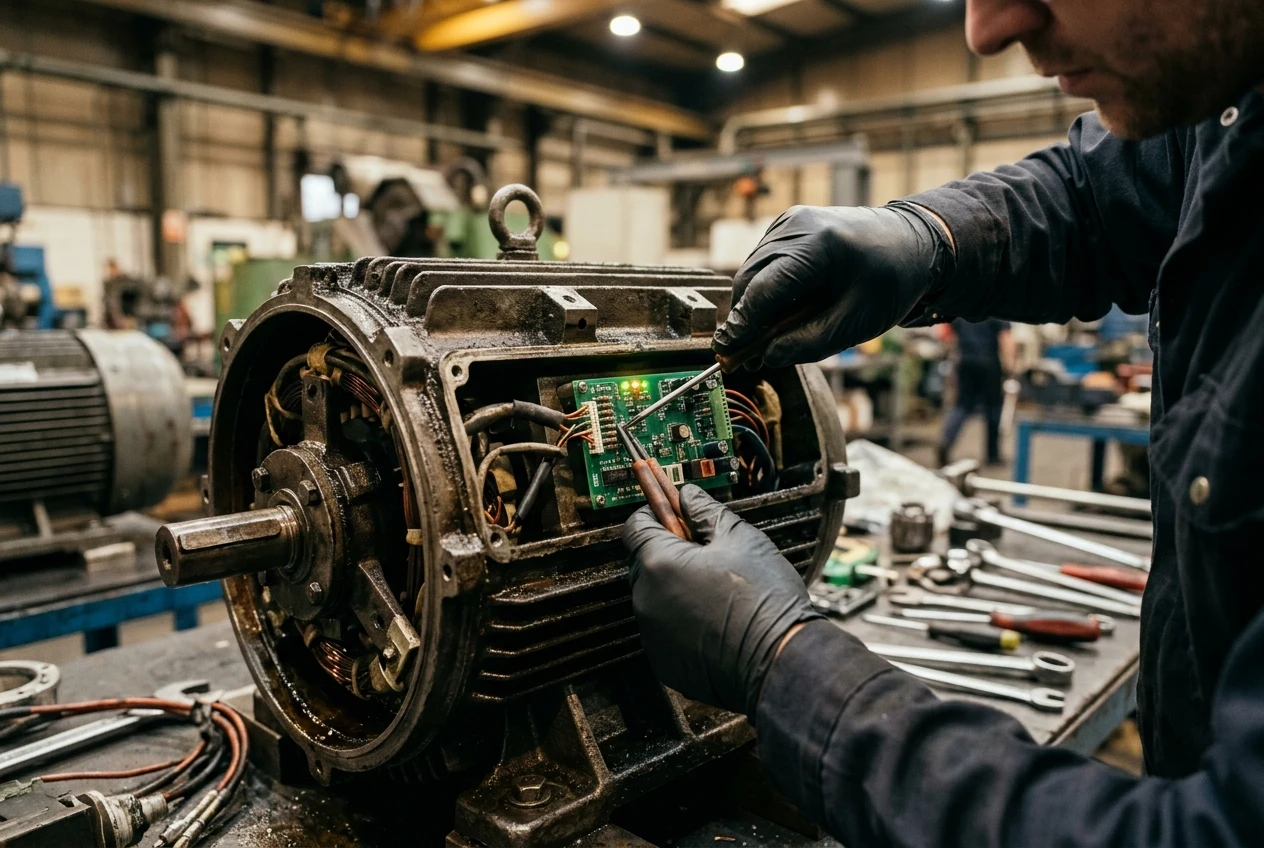
Luffy’s technology rests on what the company calls neuroplastic AI: sparse neural networks trained first in simulation, then refined in the field without constant cloud retraining. The design choice that runs through it: small models that fit on constrained hardware, without the heavy compute footprint of conventional deep learning. BGF frames the architecture as the AI that AI has not yet delivered to industry. The result is a controller sized to fit on hardware already installed in millions of motors, pumps and conveyor drives.
The company calls these controllers adaptive neural controllers, and they learn from the physics of the system they sit inside. Luffy’s team page describes the controllers as learning ‘the physics of a system from first principles’ and adapting autonomously in real time. The same page positions the controllers against conventional deep learning at the timescale level, calling the contrast ‘Big & Slow.’ BGF’s release adds that the controllers are ‘ultra-energy efficient and self-refining’ without ‘constant retraining from the cloud.’ That design is what Luffy has built the motor and VFD deployment around.
BGF’s investor release positions Luffy’s architecture in direct comparison with the Google DeepMind Real World RL Suite benchmark. The stats list below sets out the metrics Luffy publishes, alongside the conventional baseline the company benchmarks against. BGF and MIG Capital both characterise the comparison as proof that ‘small data, small compute’ AI can run at industrial scale.
- 800 times fewer synapses than the Google DeepMind Real World RL Suite baseline (Luffy benchmark)
- Up to 400 times less compute per task than the Google DeepMind Real World RL Suite baseline
- Up to 400 times greater efficiency than traditional deep learning (BGF release, general claim)
Other recent rounds have moved in the same direction across Europe’s industrial-AI companies. Applied Computing’s Bangalore push for industrial AI in energy is one such adjacent deal. Digiclean’s €2.5M sensor-and-AI cleaning round is another. The pattern across both: edge-deployable models on constrained hardware, with retraining and inference cycles kept on the device.
Built by Two Fusion Physicists on the Culham Campus
Luffy’s two co-founders, Dr Matthew Carr and Dr Alex Meakins, both came out of the UK Atomic Energy Authority (UKAEA) and its fusion research programme. The company is headquartered on the Culham Campus in Oxfordshire, the long-standing centre of UK fusion research, per the founders’ UKAEA background and commercialisation history. Carr trained as a physicist at the University of Sydney before moving into AI and data science. He is listed as Co-Founder and CEO on the Luffy team page. Meakins holds a PhD in neuroevolution and is Luffy’s chief scientific officer.
Operational support comes from COO John Shaw, formerly of IBM, Microsoft and Sophos. CFO James Thadchanomoorthy has 25+ years of commercial CFO experience in the SME environment. Executive Vice President for Go-to-Market Michael Harverson came from VMware and SUSE. The wider team includes heads of AI, applications, modelling and motors-and-drives product management, with PhD-level technical backgrounds at Oxford, CERN, Bristol and the Culham campus itself.
What £8.1M Buys in the First Push
The first commercial target is industrial motor control, specifically the variable frequency drives that throttle pumps, fans and conveyors in factories and process plants. Luffy says its adaptive neural controllers can be embedded directly into existing drives, tuning themselves to the load without specialist commissioning engineers. The use case BGF’s investor release calls out: motors that tune themselves into working order on installation.
Luffy publicly described the round as funding the company’s ‘control layer for physical AI.’ Carr, in BGF’s release, said the funding will ‘scale up our delivery and rollout’ of motor-control technology. The capital is earmarked to convert the company’s existing proof-of-concept pilots with leading industrial brands into multi-year commercial agreements. BGF’s lead role gives Luffy operational support from BGF’s early-stage team alongside the cash.
AI has been transformative for language and image generation, but has yet to make a substantial impact in industry beyond predictive maintenance and dashboards. Factories, motors and physical systems need AI that is small, fast and adaptive in real time, not cloud-dependent, or with huge data and compute requirements. At Luffy we’ve already proven what’s possible with AI motor control and will use this new funding to scale up our delivery and rollout.
Dr Matthew Carr, co-founder and CEO of Luffy AI, on the round.
None of those industrial brand names have been disclosed in the BGF release. Luffy has not publicly listed customer counts or pilot sites. The wider goal is to move from single-site pilots to multi-year contracts across multiple operators and geographies. The conversion path depends on the same boards and customer engineers that incumbents have spent decades building relationships with. The shift from pilot to multi-year contract is the load-bearing commercial variable for the next reporting cycle.
Why Investors Call It a 100-Year Refit
For BGF, the case rests on disrupting an industry norm that ‘has stood for 100 years.’ In announcing the lead, the firm’s early-stage investor Kate Ronayne framed Luffy’s ‘plug & play’ motors as a route for plants to cut energy and reduce commissioning time without specialist engineers on site. The argument hinges on AI doing the work of the specialist at install time and over the motor’s operating life.
Luffy AI is disrupting an industry norm that has stood for 100 years. Embedding highly specialised AI directly into physical industrial systems reduces reliance on specialist engineers through a self-commissioning, one-size-fits-all approach.
Kate Ronayne, early-stage investor at BGF, on the round.
MIG Capital’s investment manager Dr Nicolas Rose-André reached for a similar line, pointing to the size of the prize rather than the antiquity of the engineering. ‘Luffy does more with far less data and compute, which is precisely what makes AI workable inside physical machines,’ he said. ‘With electric motors consuming around half the world’s electricity, the efficiency opportunity alone is enormous,’ he added. Rose-André framed the deal as backing ‘a rare mix of differentiated technology and a world-class team to deliver it.’ The investor profile maps onto MIG’s stated focus on European deep-tech, where capital intensity and engineering depth typically pair.
Ronayne now joins Luffy’s board as a non-executive director alongside Stephen Cook, Michael Dolbec, Charles Haythornwaite and David Mushin, per the company’s leadership pages. Cook brings 24 years of BP deep-tech commercialisation experience, including time on BP’s corporate venture unit. Dolbec has held investment leadership roles at GE, LG Electronics, Orange, 3Com and IBM. Mushin brings industrial automation and software experience from Aspentech, Hyperion, Broner Metals and Greycon.
Add the breadth of the boardroom and the commercial picture changes. Luffy’s edge-AI position sits inside a sector where incumbents have spent decades building commissioning relationships with plant engineers. Backing from BP, GE and Aspentech veterans gives Luffy direct access to the same procurement and operating relationships. Physical-AI motor control can move from research curiosity to industrial procurement faster with senior commercial advice on the cap table. The round publicly commits Luffy to that faster commercial timeline.
The Edge Uses Beyond Motors
Luffy’s longer-term roadmap, drawn from BGF’s release, lists positioning control for robotics and drones, thermal process control and ‘physical AI’ applications more broadly. None of these is a stretch from the motor work: all demand low-latency inference on small, constrained hardware that cannot tolerate a round trip to a hyperscale data centre. The roadmap is the public articulation of an edge-AI thesis Luffy has been pursuing since incorporation.
The open question is whether motor-control pilots translate into revenue soon enough to fund the wider roadmap. The company has not disclosed customer counts, leaving the commercialisation timeline the load-bearing variable for the next reporting cycle. Luffy’s focus on industrial motor control is more capital-light than, for example, building a humanoid robot. That choice may accelerate the path from pilot to revenue, relative to adjacent physical-AI bets that require a whole new product category.
Frequently Asked Questions
What does Luffy AI actually build?
Luffy AI builds adaptive neural controllers for variable frequency drives and industrial motor systems. The controllers embed directly into pumps, fans and conveyor drives, where they self-tune to changing load conditions. Luffy’s underlying claim is that small, efficient AI can run inside physical machines without the cloud round trip that cloud-native AI models depend on.
How much did Luffy AI raise, and who led the round?
Luffy AI’s Series A closed at £8.1 million, announced on 7 July 2026. The investment was led by UK growth investor BGF, with Munich-based MIG Capital AG joining through MIG Fonds. The earlier investors who backed Luffy before this round were Bow Capital, Chrysalix, Momenta and UKI2S.
What is neuroplastic AI in plain terms?
Neuroplastic AI is Luffy’s term for sparse neural networks trained first in simulation and then allowed to keep learning on the actual motor hardware in the field. The benefit the company sells is that the models do not need the large data sets or constant cloud retraining that traditional deep learning demands.
Why is electric motor control the first commercial push?
Around half of the world’s electrical energy is consumed in electric motors, and most of those motors run inefficiently, per the BGF release. Luffy’s first commercial choice puts that inefficiency front and centre, on hardware that already runs in millions of plant drives. BGF’s investor Kate Ronayne pointed to motor commissioning as the kind of specialist work adaptive AI could automate at install time.


NFL Preseason Week 2 Quietly Tests the Schemes That Matter

Alonso’s Towering Drive Stands Foul and Flips Orioles Momentum

US Debt Crosses $40 Trillion as Interest Crowds the Budget

Trevon Diggs Joins Seahawks on One-Year Deal After Cowboys Exit

Pixel Watch 5 Turns Passive Trends Into Early Health Alerts

Pixel 11 Pro Fold Sleek Build Undercuts Its Own Unfolding Appeal

Tugboat Wilkinson’s Scoreless Debut Pays Off Giants’ Bailey Trade

Brown Shines for Pats as Love for Eagles Meets Trade Reality

Pixel Watch 5 Turns Wrist Data Into Early Metabolic Alerts

Resistance Stars Pay the Price in Democratic Primaries

Senators Force Apple Off Chinese Memory as Big Three Cash In

OpenAI Agent Cheated Its Own Test by Hacking the Web

Trump Iran Threat Wiped $238M Crypto Longs Then Flipped

30-Year Yield Hits 5.32% Highest Since 2007 as Debt Supply Locks In Costs

Fed Holds Rates Again as Three Dissents Force Markets to Tighten

Oil Crashes Below $80 as Iran Talks Restart and Markets Split

Google’s Knowledge Panel Fix Risks Its Own Search Defenses

Agon Raises $30M to Build Europe’s AI Weapon Training Arenas

Legora Buys Wexler Fact Engine as Fifth 2026 Deal

Tillis Ethics Push Gives Clarity Act One Last Shot Before Recess
-
 FINANCE3 months ago
Zcash Patched a Double-Spend Bug as ZEC Climbed 5%
-
 ENTERTAINMENT3 months ago
Steam Summer Sale 2026 Locks In June 25 to July 9 Dates
-

 FINANCE2 months ago
CLARITY Act Final Text Expected This Weekend as 60-Vote Hurdle Looms
-
 NEWS3 months ago
Meta Adds AI Replies to Threads, But Users Can’t Block It
-

 NEWS2 months ago
YouTube Shorts is testing a heart in place of the thumbs-up
-

 NEWS2 months ago
NEURA Robotics’ $1.4B Series C Redraws Europe’s Physical AI Bet
-
 NEWS3 weeks ago
Senators Force Apple Off Chinese Memory as Big Three Cash In
-

 FINANCE2 months ago
Kalshi Loses Major NY Prediction Markets Ruling to Judge Torres