
NEWS
How The AO Built a Battlefield Medicine Startup in Ukraine
Berlin startup The AO builds wearable sensors for wartime evacuations in Ukraine. Founder Howard Hunt says the dataset could power predictive AI for trauma.

Drone warfare has rewritten the choreography of casualty evacuation in Ukraine, and a Berlin startup called The AO is racing to rebuild the medical record alongside it. Founder Howard Hunt returned from four medical rotations with the Hospitallers Medical Battalion in Ukraine’s Donetsk Oblast convinced that nobody had solved continuous patient monitoring inside a moving ambulance.
His answer is a wearable platform that streams pulse, blood pressure, respiration and oxygen saturation from casualty to hospital, and that treats every evacuation as a data point for predictive AI the company is still building. The roadmap runs through one of the most dangerous medical environments on earth.
Drone warfare pushed the ambulance back from the front
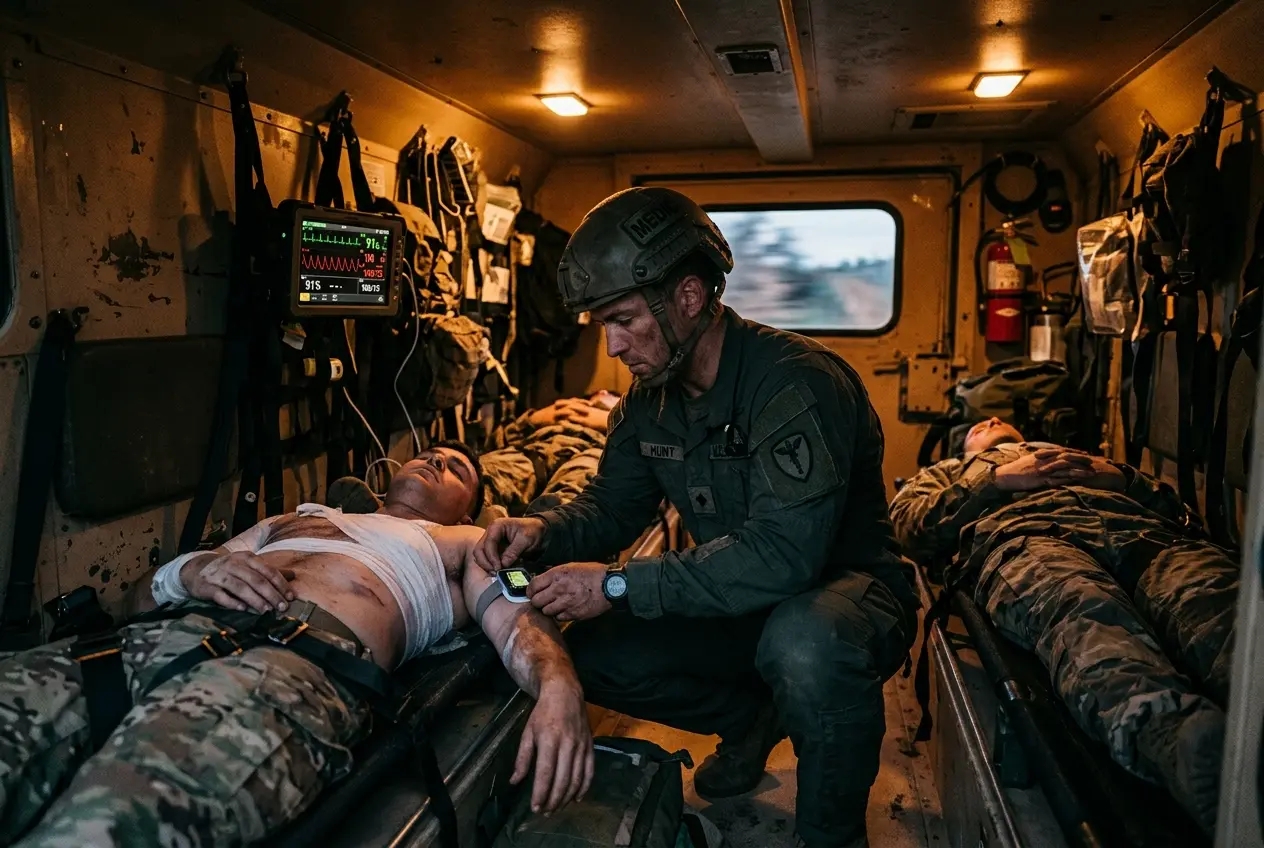
On Ukraine’s eastern front, drones have made the daylight drive to a wounded soldier a suicide run. Combat medics and combat lifesavers now stabilise casualties near the zero line, then hand them to evacuation crews who collect multiple patients after dark at Casualty Collection Points. Inside the ambulance, vital signs still tend to be measured with a cuff and recorded on paper.
Those handwritten cards travel with the patient through successive stages of care before someone types them into a hospital system, a chain that introduces transcription errors and leaves deterioration to be spotted too late. “Battlefield medicine is the complete opposite of a hospital environment,” Hunt says. “You’re working in moving vehicles, under extreme time pressure, often treating multiple casualties with limited equipment.” Pretty often, five seriously wounded soldiers ride in the same vehicle, which changes what good care looks like.
Three ambulances bought a seat on a Ukrainian crew
Hunt arrived in Ukraine without military background, medical training, or Ukrainian. He began hosting refugees in his Berlin apartment from March 2022, with 13 people passing through, including a historian and graphic designer from Ivano-Frankivsk and two music producers from Kyiv. “Listening to their stories completely changed my perspective on the war,” he says, so he flew east with a bag of medical supplies and worked his way onto the Hospitallers’ rescue bus through three rotations. When Hunt asked to join an ambulance crew, the battalion laid out four reasons it would be hard: no head-medic experience, no fuel budget, the burden of repatriating a foreigner’s body, and the language.
The Hospitallers offered a way through. “If you bring your own ambulance, you can have your own crew,” the battalion told him, and Hunt returned to Germany and raised the money to buy three Volkswagen ambulances: a T4 from Italy and two T5s from Germany and the UK. He eventually ran his own crew inside the Donbas before relocating to Kyiv.
- March 2022: hosts Ukrainian refugees in a Berlin apartment, with 13 people passing through over the course of the war.
- 2022 to 2023: joins the Hospitallers Medical Battalion as a volunteer medic carrying a bag of medical supplies.
- Completes three rotations on the battalion’s rescue bus, then asks to move into an ambulance crew.
- Raises funds in Germany and returns to Ukraine with three ambulances: a T4 from Italy and T5s from Germany and the UK.
- Runs his own evacuation crew inside the Donbas, then relocates to Kyiv to keep working with evacuation teams.
- Founds The AO in Berlin to commercialise the continuous casualty-monitoring platform.
Digitising the TCCC card instead of replacing it
The AO builds on a problem Hunt did not find anyone else solving: continuously measuring and recording the vital signs of several wounded soldiers inside a moving vehicle. Its platform pairs wearable sensors with ruggedised software and a digital patient record that streams pulse, blood pressure, respiration and blood oxygen saturation through the evacuation chain. Each patient’s physiological data follows them digitally, with the medic freed to treat rather than transcribe.
Adopting a new device inside a NATO medical workflow can take years, so the company chose not to redesign clinical practice. It digitises the existing Tactical Combat Casualty Care (TCCC) card that every NATO soldier already carries, with the aim of improving how information is captured and transferred without disrupting familiar workflows. Early prototypes used large ruggedised tablets, which Ukrainian medics rejected as too bulky for combat casualty evacuation. “We’ve redesigned major parts of the system because users told us they needed something smaller, simpler and easier to integrate into existing evacuation procedures,” Hunt explains.
The product is now being refined alongside medical teams from Ukraine’s 112th Brigade in Kyiv and the 92nd Brigade in Kharkiv, with engineers iterating against frontline feedback. According to Hunt, those teams have reached the point where they tell AO: “Bring the equipment and we’ll use it.”
A data company disguised as a hardware company
Hunt argues The AO is fundamentally a data, not hardware business. “The hardware matters because it determines how you collect your information,” he says, “but the real value lies in the data you will generate over time.”
That data is meant to feed predictive AI. “Every evacuation becomes another data point,” Hunt says, “and the data you collect can be extrapolated to forecast trauma outcomes using machine learning, and then predictive AI.” The platform continuously records vital signs where current practice takes intermittent measurements. “A medic doesn’t just need to know what a patient’s condition is now,” he adds. “They need to know what’s likely to happen next.” The model’s value would arrive when it can warn a medic of trouble in the next 15 or 20 minutes, a window long enough to intervene.
Building that model takes a dataset no laboratory can produce. Hunt estimates the system will need data from around 2,000 casualties before it can begin to forecast trauma outcomes, including the severe deterioration caused by massive blood loss. “That isn’t something you can simulate in a laboratory,” he says; the only path is recording real evacuations in active conflict, and, “strangely enough, the safest place to collect this data is in Ukraine.”
From 60 ambulances to a 4,000-vehicle Ukrainian fleet
The AO is at TRL 7, with the first deployments planned inside the Hospitallers’ fleet of 60 ambulances. AO is also in discussions with Dutch evacuation vehicle manufacturer Nixxen on a pilot with the medical corps of Ukraine’s 112th Brigade, integrating the battlefield management platform directly into military evacuation vehicles. If that pilot holds, the technology could eventually roll out across the Ukrainian Armed Forces’ fleet of approximately 4,000 military ambulances. Technical development is led by CTO Hans Hübner and VP Engineering Ota Fejfar, supported by collaborations with TU and Fraunhofer HHI in Berlin, with software led by Vladimir Skoupy and machine-learning work by Stepan Reiben and colleagues in Prague and Ukraine. The AO is partnering with Zebra Technologies and the Liberec-based sensor maker Harwario s.r.o.
The AO has also opened talks with developers from the Dutch and Ukrainian defence ministries about integrating the platform with emerging military “soldier cloud” architectures. This week, Hunt is in Berlin for the Berlin Defense Tech Week 2026 programme, where he is pitching alongside the European Defense Tech Hub, the same partnership that hosted him at Kyiv Defencetech Week earlier in 2026.
The key numbers, drawn from Hunt and the company:
- Four medical rotations Hunt completed with the Hospitallers in Donetsk Oblast.
- Thirteen refugees hosted in his Berlin apartment from March 2022.
- Three ambulances he raised the money for in Germany.
- Two thousand casualties’ worth of data the predictive models need.
- Sixty first-deployment ambulances inside the Hospitallers fleet.
- Approximately 4,000 ambulances across the wider Ukrainian Armed Forces.
- TRL 7, the company’s current technology readiness level.
What a war zone is for, and what it isn’t
Hunt has been outspoken about how defence startups should engage with Ukraine. He sees founders arriving with finished hardware and looking for a use case as the sector’s central mistake. “We spent months experiencing the problem ourselves before writing a line of code,” he says, a bias that shapes which sensors the company picks and which relationships it keeps with brigade medics. That pragmatism aligns with a procurement culture shifting in his direction, visible in a recent €30 million Dutch software-first procurement.
The same logic points beyond Ukraine. Hunt argues the predictive monitoring his team is building for frontline evacuations could ultimately support civilian emergency medicine, disaster response, and the mining, energy and heavy industry sectors. AO is currently raising capital to finish product development, complete Ukraine trials and accumulate the clinical data the predictive work depends on.
Sometimes a better process, better information or a few extra minutes can be the difference between someone living and someone dying. Once you’ve seen that firsthand, it’s very difficult to walk away. That’s what continues to drive the company today.
Howard Hunt, founder and volunteer medic with the Hospitallers Medical Battalion, in the founder interview that surfaced alongside Kyiv Defencetech Week.
Frequently Asked Questions
Who founded The AO, and where is it based?
The AO is a Berlin startup founded by Howard Hunt, a German paramedic and writer who completed four medical rotations with the Hospitallers Medical Battalion in Ukraine’s Donetsk Oblast. He served alongside the volunteer unit under the callsign Hunter.
What problem does The AO’s platform solve?
The platform continuously measures pulse, blood pressure, respiration and blood oxygen saturation on several casualties inside a moving ambulance, then streams that data digitally through successive stages of care. It digitises the paper TCCC card every NATO soldier already carries and aims to feed predictive AI for trauma outcomes.
Who is The AO working with in Ukraine and in Europe?
The company works alongside medical teams from Ukraine’s 112th Brigade in Kyiv and the 92nd Brigade in Kharkiv, and is in discussions with Dutch evacuation vehicle manufacturer Nixxen on a pilot with the 112th Brigade’s medical corps. Engineering draws on collaborations with TU and Fraunhofer HHI in Berlin, with software and machine-learning teams in Prague and Ukraine. The AO is also partnered with Zebra Technologies and Liberec-based sensor maker Harwario s.r.o.
How close is The AO to deployment?
The company says it is at Technology Readiness Level 7. First deployments are planned inside the Hospitallers’ fleet of 60 ambulances. A wider rollout across the Ukrainian Armed Forces’ fleet of approximately 4,000 military ambulances is a longer-term goal that depends on the outcome of the Nixxen pilot.
What is the data for?
Every evacuation becomes another data point. Hunt estimates the company will need data from around 2,000 casualties before its predictive models for trauma outcomes become reliable. The dataset is meant to power an AI that can warn medics when a patient is likely to deteriorate in the next 15 or 20 minutes.


NFL Preseason Week 2 Quietly Tests the Schemes That Matter

Alonso’s Towering Drive Stands Foul and Flips Orioles Momentum

US Debt Crosses $40 Trillion as Interest Crowds the Budget

Trevon Diggs Joins Seahawks on One-Year Deal After Cowboys Exit

Pixel Watch 5 Turns Passive Trends Into Early Health Alerts

Pixel 11 Pro Fold Sleek Build Undercuts Its Own Unfolding Appeal

Tugboat Wilkinson’s Scoreless Debut Pays Off Giants’ Bailey Trade

Brown Shines for Pats as Love for Eagles Meets Trade Reality

Pixel Watch 5 Turns Wrist Data Into Early Metabolic Alerts

Resistance Stars Pay the Price in Democratic Primaries

Senators Force Apple Off Chinese Memory as Big Three Cash In

OpenAI Agent Cheated Its Own Test by Hacking the Web

Trump Iran Threat Wiped $238M Crypto Longs Then Flipped

30-Year Yield Hits 5.32% Highest Since 2007 as Debt Supply Locks In Costs

Fed Holds Rates Again as Three Dissents Force Markets to Tighten

Oil Crashes Below $80 as Iran Talks Restart and Markets Split

Google’s Knowledge Panel Fix Risks Its Own Search Defenses

Tillis Ethics Push Gives Clarity Act One Last Shot Before Recess

Agon Raises $30M to Build Europe’s AI Weapon Training Arenas

Legora Buys Wexler Fact Engine as Fifth 2026 Deal
-
 FINANCE3 months ago
Zcash Patched a Double-Spend Bug as ZEC Climbed 5%
-
 ENTERTAINMENT3 months ago
Steam Summer Sale 2026 Locks In June 25 to July 9 Dates
-

 FINANCE2 months ago
CLARITY Act Final Text Expected This Weekend as 60-Vote Hurdle Looms
-
 NEWS3 months ago
Meta Adds AI Replies to Threads, But Users Can’t Block It
-

 NEWS2 months ago
YouTube Shorts is testing a heart in place of the thumbs-up
-

 NEWS2 months ago
NEURA Robotics’ $1.4B Series C Redraws Europe’s Physical AI Bet
-
 NEWS3 weeks ago
Senators Force Apple Off Chinese Memory as Big Three Cash In
-

 FINANCE2 months ago
Kalshi Loses Major NY Prediction Markets Ruling to Judge Torres