
NEWS
Trump Tariffs Settled Into a 7.2 Percent Patchwork
Trump tariffs now bite at 7.2 percent after the Supreme Court struck the emergency wall, with $820 household costs, USMCA leaks, and a Canada 50 percent match.

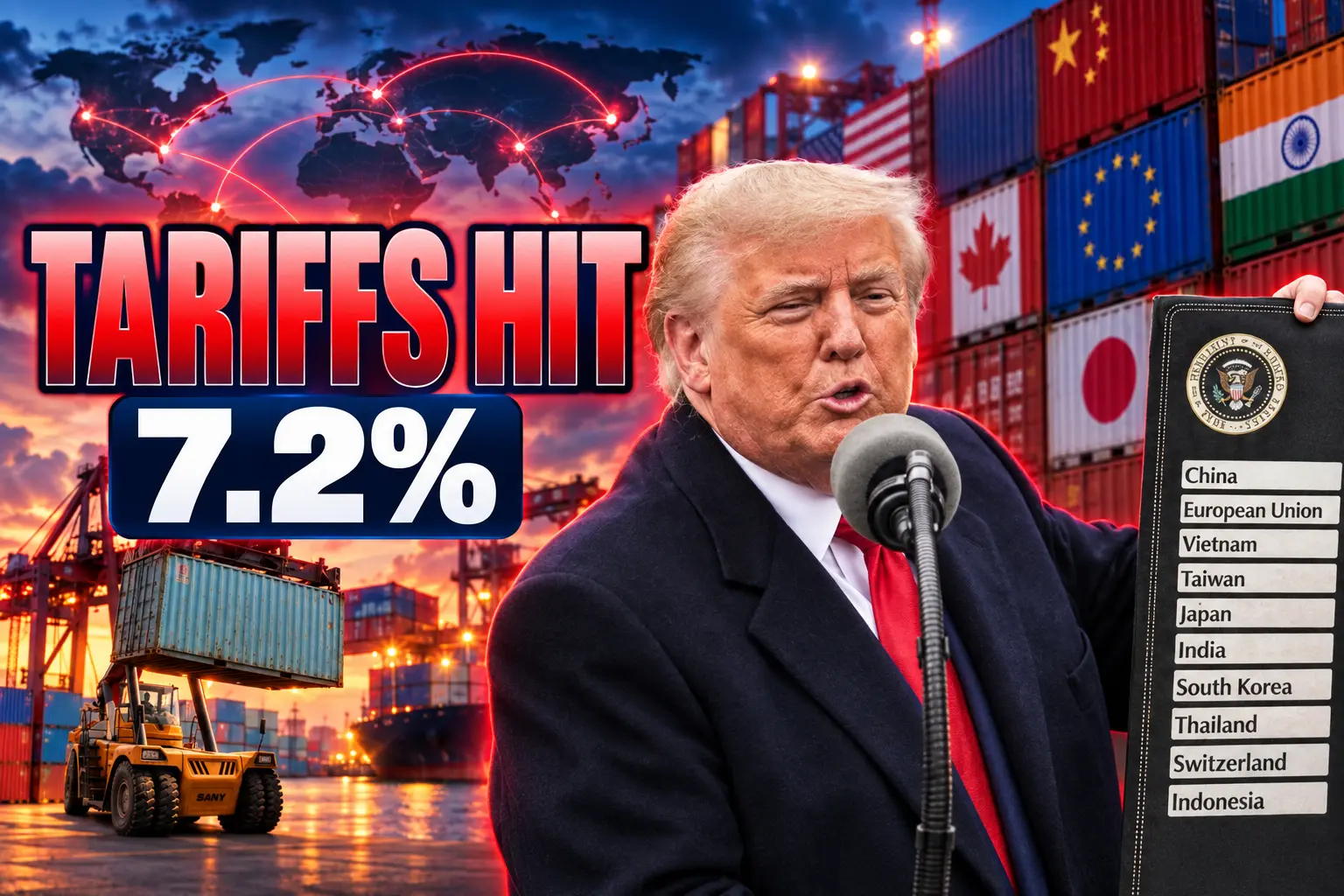
The average U.S. import duty is 7.2 percent, more than triple the 2.3 percent rate in January 2025. That is the wall that remains after the Supreme Court struck President Donald Trump’s emergency tariffs on February 20, 2026, and after Canada’s matching duties on $27.6 billion of U.S. goods took effect on September 8.
The 2024 campaign chart was simpler: 10 or 20 percent on everything, 60 percent on China, 25 percent on Mexico and Canada. The 2026 machine is a patchwork of older statutes, refunds, and a North American loophole wide enough that most qualifying goods still roll in free.
A 7.2 Percent Rate Replaced the Campaign Chart
Trump called tariff his favorite word at the Economic Club of Chicago in October 2024. He sold the tool as a way to punish unfair trade, keep factories home, and raise billions for tax cuts, including a child-care plan and, at one point, a swap for the federal income tax. Howard Lutnick, then the incoming commerce secretary, tried to narrow the pitch, saying the president understood not to tax goods America does not make.
Policy still moved more than 50 times after January 2025. The Tax Foundation estimates the new duties cover 54 percent of U.S. goods imports and lift the applied rate to 11.8 percent, from 1.5 percent in 2022. Collections, after importers change what they buy, sit lower. The Penn Wharton Budget Model puts the average effective tariff rate of 7.2 percent as of May 2026, matching the Tax Foundation’s calendar-year figure.
China’s effective rate in that May snapshot was 23.4 percent, not the 60 percent campaign number, after a tariff truce struck with Beijing and the Court decision. A later 10 percent tariff shock for European imports sits inside the same rebuilt wall, not as a universal emergency tax. Steel and aluminum still take the hardest hit, at 41.2 percent effective. Cars sit at 13.5 percent.
THE AUTHORITIES STILL STANDING
| Authority | Rate | When it hit | What it covers |
|---|---|---|---|
| Section 232 metals | 50 percent on steel, aluminum, copper | March 12, 2025 | About $320 billion of imports |
| Section 232 autos | 25 percent on cars and heavy trucks | April 3, 2025 | About $407 billion of imports |
| Section 232 furniture and lumber | 25 percent furniture, 10 percent lumber | October 14, 2025 | About $19 billion of imports |
| Section 301 forced labor | 10 or 12.5 percent | July 24, 2026 | About $954 billion of imports |
| Section 338 Canada | 50 percent on listed goods | August 22, 2026 | Finance Canada’s $27.6 billion package |
| IEEPA (struck down) | 10 to 50 percent, nearly all partners | Struck February 20, 2026 | Emergency “Liberation Day” wall |
| Section 122 (expired) | 10 percent, nearly all partners | February 24 to July 24, 2026 | 150-day stopgap after the ruling |
The first Trump term put duties on about $380 billion of goods, roughly 14 percent of imports. This term taxes a much larger share, then leaks through exemptions, court refunds, and substitution. That gap between the statutory sticker and cash at the dock is the whole story.
The Supreme Court Took the Emergency Wall
On April 2, 2025, a date the White House branded Liberation Day, Trump used the International Emergency Economic Powers Act to drop a 10 percent global tariff and much higher “reciprocal” rates on dozens of partners. IEEPA had already been used in March for fentanyl-and-migration duties on Canada, Mexico, and China. Importers led by Learning Resources, Inc. and V.O.S. Selections sued, arguing a sanctions law is not a tax statute.
The Court heard the cases on November 5, 2025, and ruled 6-3 on February 20, 2026, in Learning Resources, Inc. v. Trump. Chief Justice John Roberts, joined by Justices Sonia Sotomayor, Elena Kagan, Neil Gorsuch, Amy Coney Barrett, and Ketanji Brown Jackson, held that IEEPA’s power to “regulate importation” does not include the power to impose tariffs. Article I gives Congress, Roberts wrote, access to the pockets of the people. Justices Clarence Thomas, Samuel Alito, and Brett Kavanaugh dissented.
The majority did not say how to give the money back. Penn Wharton estimates IEEPA collections at about $166 billion before the ruling. If those sums are fully refunded, net new tariff revenue since January 2025 falls to about $102.8 billion. Treasury books already show the clawback: net customs receipts were about zero in May 2026, with roughly $21 billion in IEEPA-related refunds that month.
FROM LIBERATION DAY TO THE REFUND
- April 2, 2025: Liberation Day reciprocal tariffs go on under IEEPA, on top of the March fentanyl duties.
- November 5, 2025: The Supreme Court hears the importer challenges.
- February 20, 2026: The Court holds 6-3 that IEEPA does not authorize tariffs.
- February 24, 2026: A 10 percent Section 122 surcharge replaces the dead emergency layer for 150 days.
- July 24, 2026: Section 122 expires; Section 301 forced-labor tariffs of 10 or 12.5 percent take its place.
- August 22, 2026: Section 338 duties of 50 percent land on listed Canadian goods, including USMCA-qualified lines.
The White House did not abandon the project. It rebuilt the wall with statutes Congress wrote for national security, unfair trade, and, in Canada’s case, a 1930 provision almost nobody had used at this scale. The legal rewrite is why the campaign’s universal rate never became the 2026 rate.
Who Pays the Duty at the Dock
The importer writes the check to Customs. That was true in 2018, and it is true now. Studies of the first China tariffs, including work by the U.S. International Trade Commission, found Americans bore almost the entire cost. Trump still argued on the 2024 trail that the duties “cost Americans nothing,” then told an interviewer he could not guarantee prices would not rise.
Campaign-era studies of a full across-the-board package put the hit to a middle-class family between $1,350 and $3,900 a year. That package is not the one still in force. The Tax Foundation estimates the current duties raise taxes by $820 per household in 2026, after the IEEPA layer came down, compared with $1,000 in 2025 while that layer still stood.
Pass-through is real and incomplete. Mary Amiti, Sebastian Heise, and David E. Weinstein at the Federal Reserve Bank of New York, studying the 2025 duties, found about 26 percent of the tariff increase shows up in consumer prices relative to less-exposed goods. Direct effects, higher prices on the foreign variety itself, account for 64 percent of that move and arrive fast. The other 36 percent is indirect: pricier imported inputs, and U.S. firms lifting markups when foreign rivals get more expensive. That second wave takes nine to 12 months.
THE 2026 TARIFF LEDGER
- Effective rate: 7.2 percent as of May 2026, up from 2.3 percent in January 2025.
- Household bill: $820 in 2026, below the 2024 study range because the emergency layer is gone.
- Price pass-through: about 26 percent of the tariff increase, with a slower indirect tail.
- IEEPA cash: about $166 billion collected, now moving through refund fights at the Court of International Trade.
Sen. Patty Murray of Washington put the dock math in one line after the Canada 50 percent duty landed: American businesses and American families pay it. A Baltimore maker, Marlin Steel, takes the other side of the same ledger, backing the U.S. wall because it pours and fabricates at home, while hoping talks blunt Ottawa’s reply. Both can be true at once. The duty is a tax at the border. Who feels it depends on whether a substitute exists inside the country.
Nearly 84 Percent of North American Goods Claim an Exemption
The loudest leak is not a court docket. It is paperwork. Penn Wharton finds that 83.8 percent of import value from Canada and Mexico claimed a USMCA exemption in May 2026, a sharp jump from late 2024, as brokers leaned on rules of origin to stay duty-free. The 2024 threat was a flat 25 percent on all Mexican and Canadian goods. The 2026 practice is a surcharge on the minority of shipments that cannot prove they belong inside the pact, plus later Section 338 lines that punch through even qualifying Canadian goods.
Importers did what a price does: they moved. Penn Wharton estimates new tariffs raised $268.8 billion in gross customs revenue from January 2025 through May 2026. If buying patterns had stayed put, another $57.9 billion would have come in. That missing slice is front-loading, country switching, and certification, not a rounding error.
The White House has spent 2026 arguing that China uses Mexico, Canada, and more than 40 other countries as a transshipment web, finishing or relabeling goods to duck China-specific rates. Mexico answered in its own way, lifting duties of 5 to 50 percent on more than 1,400 lines from countries without a free-trade deal, chiefly China, and opening more anti-dumping cases. The United States declined to renew USMCA in its current form when the six-year review opened on July 1, 2026, so the exemption that now shields most North American cargo is itself on the table.
A universal 10 or 20 percent tax does not survive contact with a live free-trade pact, a customs broker, and a nine-month lag in consumer prices. The second bill is the industry that grew up to route around the first one.
Ottawa Matched 50 Percent After Talks Collapsed
Section 338 of the Tariff Act of 1930 lets the president put up to 50 percent on a country’s goods to offset “unequal” treatment. Trump used it on listed Canadian products after talks failed on August 21, 2026. The 50 percent duty took effect at 12:01 a.m. Eastern on August 22 and, unlike the earlier fentanyl tariffs, does not spare USMCA-qualified goods on those lines.
Finance Canada says the U.S. package covers $27.6 billion of Canadian goods. Ottawa then copied the hit. Effective September 8, Canada put 15, 25, and 50 percent duties on a matching $27.6 billion of U.S. imports, rate for rate, on products drawn from the U.S. Section 338 and Section 232 lists.
WHAT CANADA TAXED ON SEPTEMBER 8
- Fifty percent lines: steel and aluminum that had sat at 25 percent, plus furniture and clothing.
- Twenty-five percent lines: appliances, dairy including cheese, and some steel and aluminum derivatives.
- Fifteen percent lines: other listed electronics, pulp and paper, and farm equipment drawn from the U.S. target list.
- Still in force: earlier Canadian auto counter-duties, with a remission process for one-off relief.
Prime Minister Mark Carney framed the collapse as an attack and said Canada would cut its reliance on the U.S. market, a line he has been working since 2025, not a slogan invented for the September 8 start date. Finance Minister François-Philippe Champagne put the official reason on paper.
When the United States asked too much and offered too little, we chose to stand up for Canadians. Our dollar-for-dollar, rate for rate counter-tariffs as well as a multi-billion dollar support package will protect workers, farmers, families, and businesses as we build a stronger, more resilient, and more diversified Canadian economy.
François-Philippe Champagne, Minister of Finance and National Revenue, Department of Finance Canada, August 25, 2026
Ottawa also rolled out a $7.5 billion support package on top of nearly $25 billion already spent since the U.S. duties began, including regional liquidity, a diversification fund, and faster employment-insurance rules. The dollar-for-dollar, rate-for-rate counter-tariffs are the border piece. The fiscal piece is a running tab for a fight the 2024 chart treated as a one-way U.S. collection.
Customs Cash Falls Short of the Tax-Cut Math
Trump said tariff revenue would pay for extending the 2017 tax cuts, for ending taxes on tips, overtime, and Social Security benefits, and still cut the deficit. Jason Miller, a campaign adviser, called the income-tax swap an “aspirational goal.” The 2026 cash register is large next to 2024 and small next to that aspiration.
U.S. Customs and Border Protection, through July 27, 2026, reports $282.0 billion of duty, taxes, and fees collected in fiscal 2026, against $216.7 billion in fiscal 2025 and $88.1 billion in fiscal 2024. Those CBP figures include refunds already processed and are not the same as Treasury’s net customs line, which swung negative in some spring and summer months when IEEPA refunds landed. Informal entries, the small shipments that used to ride in under the old $800 de minimis rule, jumped to 63.2 million in fiscal 2026 from 5.16 million in fiscal 2024.
The Tax Foundation’s long-run score on the duties still in force is $1.4 trillion from 2026 through 2035 on a conventional basis, and about $1 trillion after slower growth. The same model cuts long-run GDP by 0.4 percent and hours worked by 338,000 full-time equivalent jobs. Even the larger conventional number does not replace individual income tax, which still supplies the bulk of federal receipts.
Trump has floated a $5,000 dividend to every adult if Republicans hold Congress, with tariffs as the suggested well. That pledge sits on top of a stream that has already been paying refunds, and on top of a 7.2 percent effective rate that is not the 20-and-60 machine from the stump. The dock is collecting. It is not a second IRS.
Steel, Cars and Furniture Still Carry the Wall
What survived the Court is the old-fashioned kind of protection: metals, vehicles, lumber, and a 25 percent duty on imported furniture that began on October 14, 2025. Section 232 national-security tariffs do not need IEEPA, and they stack. A sofa, a beam, and a pickup now do more of the fiscal work that a 10 percent tax on every crate was supposed to do.
That is why a plant that melts steel in Baltimore can like the policy while a Canadian appliance line and a U.S. retailer filing for an IEEPA refund do not. The remaining wall is narrow, high, and leaky at the USMCA door. It raises real money. It raises some prices, about 26 percent of the duty increase, with a slower markup wave behind it. It does not make foreign finance ministries write the check, and it does not retire the income tax.
Canada’s 15, 25, and 50 percent lists have been live since September 8, 2026. The Court of International Trade is still grinding through reliquidations. USMCA is in review, not in the grave. The favorite word still collects. The campaign math is the part that did not survive contact with a docket, a broker, and a border.

Procuros Raises €20 Million to Own the Trade Data Layer

Ace Combat 8’s Steam Peak Harvests a Seven-Year PC Bet

Finches Raises €2 Million to Spot Tight Harvests Early

Mercedes Built One AMG Cabriolet to Replace Two Cars

Hadrian Raises $40 Million to Turn Pentests Into Software

The Orchard Bug Forced Zcash to Open an Empty Pool

The $5.99 Game That Won Steam’s 2026 Summer Sale

Don Lee Joins Hemsworth as Extraction 3 Starts Shooting

YouTube Shorts Retires Dislikes and Swaps Likes for Hearts

NEURA Robotics Is Spending Its $1.4B on a Machine Stack
-
 NEWS4 months ago
The Orchard Bug Forced Zcash to Open an Empty Pool
-
 GAMING4 months ago
The $5.99 Game That Won Steam’s 2026 Summer Sale
-
 ENTERTAINMENT6 months ago
Don Lee Joins Hemsworth as Extraction 3 Starts Shooting
-
 NEWS4 months ago
YouTube Shorts Retires Dislikes and Swaps Likes for Hearts
-
 NEWS4 months ago
NEURA Robotics Is Spending Its $1.4B on a Machine Stack
-

 AUTO6 months ago
Kawasaki Bets the New Z1100 Against Its Own Supercharger
-

 BUSINESS5 months ago
Norway’s Export Bank Backs Nscale’s $790 Million Narvik Loan
-

 GAMING4 months ago
Game of Thrones Dragonfire Follows Boston’s Conquest Playbook