
NEWS
Honda’s 1990 NSX Wager Still Holds at 65,000 Miles
A 65,867-mile 1991 Acura NSX from Honda’s collection still drives the way the 1990 brief promised, and good cars now sit in Hagerty’s $61,933 band.

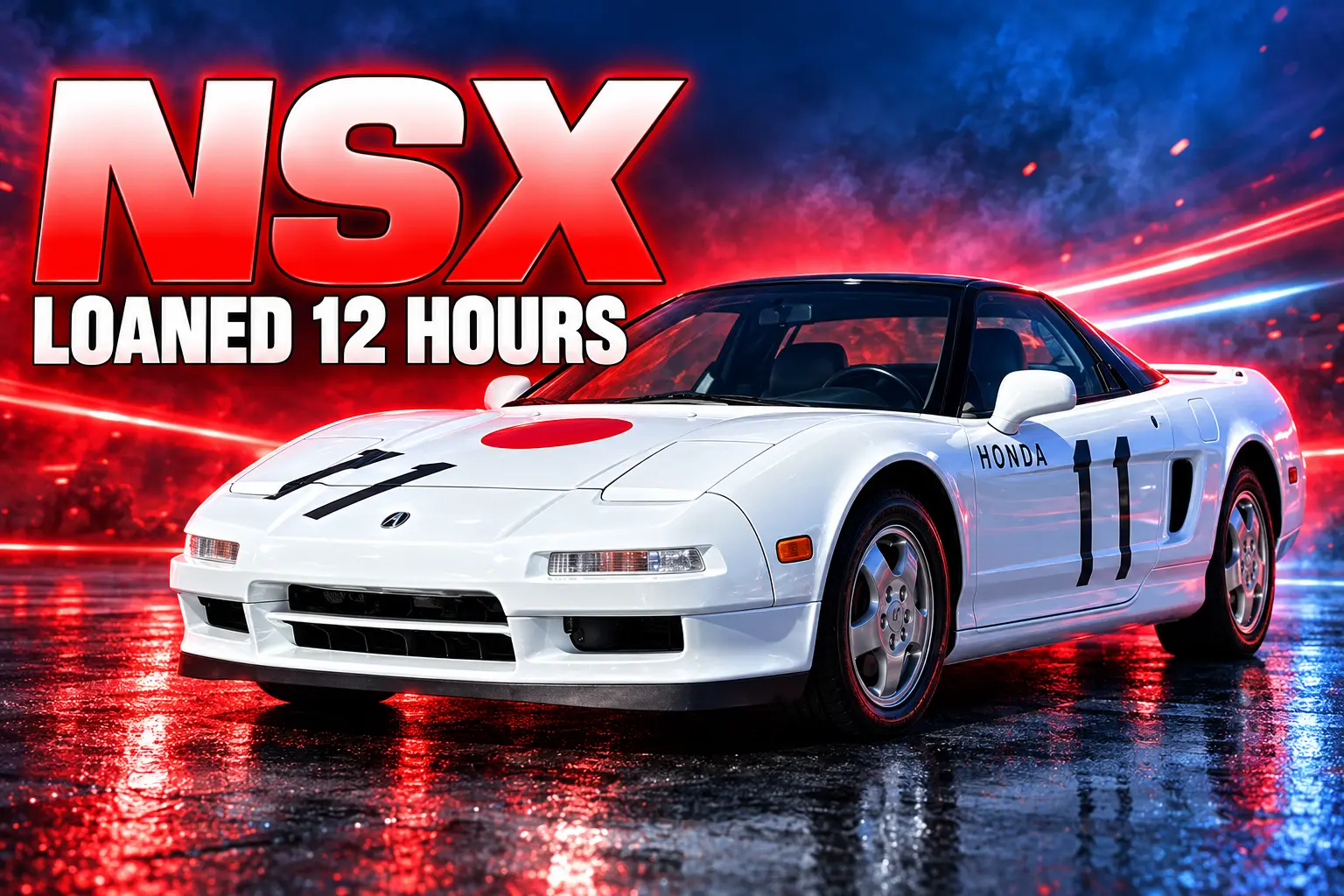
Honda lent a visiting journalist a 1991 Acura NSX for 12 hours, then wanted it back before night. The car showed about 65,000 miles, rode out of a covered trailer in Los Angeles, and wore a racing wrap over silver paint. That is a strange fate for a supercar Honda once said you should be able to use every day.
The loaned car still does the job the 1990 brief described. The company that wrote that brief now treats one surviving example like a display piece, while another Honda factory in Japan is paid to keep the same generation on the road.
Honda Trailered a Wrapped 1991 NSX for 12 Hours
The NSX came from the American Honda Collection Hall at 1919 Torrance Blvd in Torrance, California, a lobby museum with more than 60 Honda products on view on weekdays. Unlike a Honda S2000 the same journalist had been allowed to keep overnight, this car was not staying in anyone’s driveway.
Carl Pulley, who manages Honda Heritage public relations, has said the car is silver under the wrap. The livery copies the RA272, the Honda Formula 1 car Richie Ginther drove to the company’s first grand prix win in Mexico, and it carries Ginther’s No. 11. Pulley said the NSX began as a marketing and durability mule, sat at the Art Center College of Design in Pasadena, came back undrivable, and was later brought back to life for the collection’s vintage fleet.
Honda Racing US parked that wrapped NSX next to the real RA272 on October 25, 2025, and called it a first meeting of the two.
The legendary RA272 meets the iconic ’91 Acura NSX for the first time, wrapped in a legacy that spans generations and honors our first victory at the Mexico GP. #RacingTheDream pic.twitter.com/V0dCza6roz
— Honda Racing US (@HondaRacing_US) October 25, 2025
The journalist got a freeway crawl through downtown Los Angeles, open rural stretches, and more than 100 miles of mountain pavement, the same loop used for other tests. Honda set the clock, not the route. The Collection Hall’s next public Cars, Bikes & Coffee date is October 17, 2026, an autumn show with a customization theme; the April 11 racing show and the July 18 picnic date have already passed.
The 1990 Brief Said It Would Not Be a Sunday Car
Honda Research and Development put liveability as a core design goal when it published the 1991 Acura NSX press kit on June 3, 1990. The project had started as basic research at the Wako R&D Center in January 1984, then turned into a dedicated sports-car program in the fall of 1985 under large project leader Shigeru Uehara. The kit said the NSX had to match existing exotics in performance and still be as easy to live with as any other Acura.
Honda listed the traits that usually get dropped when a mid-engine car is built around the engine first: visibility, comfort, reliability, and both active and passive safety. The press kit drew a line under the point in plain language.
The Acura NSX would not be a car just for Sunday afternoons.
Honda Research and Development, 1991 Acura NSX press kit, June 3, 1990
The same document named the General Dynamics F-16 as the image in the engineers’ heads: light, responsive, and built around the pilot. Honda wanted a power-to-weight ratio of 11.0 to 12.1 pounds per horsepower and a curb weight under 3,000 pounds, which pushed the team to aluminum. A dedicated plant on the Tochigi R&D grounds was capped at 25 cars a day, with 3,000 units scheduled for the United States in the first full year.
THE 1990 LIVEABILITY LIST
- Daily use: Honda said the car had to be as easy to live with as any other Acura, not a weekend toy that wore the driver down.
- Cabin and view: Excellent visibility and comfort were written in next to the performance targets, including a cockpit sized for real people.
- Aids, not theater: Power windows, full automatic air conditioning, traction control, and four-channel anti-lock brakes were planned in from the start.
- Weight as the method: The all-aluminum body existed so those comfort pieces would not push the car past the handling target.
Japan put the car on sale on September 14, 1990, at 8,000,000 yen for the five-speed. U.S. sticker price for the 1991 manual was $62,000, with the four-speed automatic listed at $66,000. The production five-speed weighed 3,010 pounds, a hair over the original under-3,000-pound wish; the automatic was 3,098 pounds.
Why Senna Called the Prototype Fragile
Honda already wanted Porsche- and Ferrari-level rigidity when Ayrton Senna, in Japan to test a McLaren F1 car, drove a prototype in February 1989. Senna said it felt a little fragile anyway, and Honda’s own heritage account treats that comment as the reason the team raised its rigidity targets in April.
I’m not sure I can really give you appropriate advice on a mass-production car, but I feel it’s a little fragile.
Ayrton Senna, Honda heritage record, February 1989
The follow-up work went to the Nurburgring, 20.8 km of pavement with more than 200 blind corners and a 300-meter change in elevation, the circuit where Honda had made its F1 debut. Honda R&D Europe set up a shop in Mullenbach, about two kilometers from the track. Uehara later said the company wanted a car that could sit between its front-drive showroom models and its F1 machines, and that American Honda’s new Acura channel had asked for the same thing.
The body that came out of that fight was the first mass-produced all-aluminum monocoque. Honda used five aluminum alloys, cut about 140 kg from the body versus steel, and nearly 200 kg from the whole car. The unpainted body shell weighed 210 kg. Titanium connecting rods went into the 3.0-liter V6 so the engine could live at the speeds the chassis could now take.
Mountain Roads Still Show the Original Point
Power is the easy knock. The C30A V6 makes 270 hp and 210 lb-ft, figures a family sedan can match now. Acura’s 1990 estimate for 0-60 mph was about six seconds. The loaned five-speed still had the better argument Honda actually made, which was how that power shows up in a 3,010-pound mid-engine car.
On the climb to the 8,000 rpm redline, with fuel cutoff at 8,300 rpm, the pull stays linear. VTEC changes the pitch around 5,500 rpm, over the driver’s shoulder, and the engine wants the rest of the tach. The exhaust stays quiet at light throttle and does not drone on the highway. The shift action is light, the knob sits where the right hand expects it, and the whole car feels assembled rather than raw.
The mid-engine layout puts 58 percent of the weight on the rear axle and 42 percent on the front. Through the mountain corners the journalist used, the rear never stepped out, even with extra throttle on exit. Independent double wishbones and coil springs at both ends, with an 18.3 mm front sway bar and a 17.5 mm rear bar, keep the ride firm without beating the driver up on broken Los Angeles freeway. Early manual cars used unassisted variable-ratio rack-and-pinion steering, heavy in a parking lot and talkative once the speed rises.
The cabin is the F-16 idea made small and useful. Thin A-pillars, a low dash, and large glass mean the driver can see the road instead of the interior. Honda said owners over six feet fit; the journalist, at 5-foot-9, had no space complaint. The Collection Hall car’s leather was worn and a bit torn, still supportive, with white gauge numerals and orange needles on a black-and-gray interior. Someone had added a Bluetooth adapter. The VTEC soundtrack was enough.
Japan Is Restoring NSXs so Owners Keep Driving
That 12-hour trailer rule is an American museum habit. In Japan, Honda spent 2026 standing up a factory program whose stated aim is the opposite: keep first-generation cars in use. Honda said about 70% of those NSXs remain registered there, which is why the first-gen car is the first model in the new shop.
FROM TOCHIGI PROTOTYPE TO TAKANEZAWA SHOP
- January 1984: Wako R&D begins research on a midship layout, including a City converted to underfloor mid-engine rear drive.
- Fall 1985: The sports-car program starts in earnest under Shigeru Uehara.
- February 1989: Senna drives a prototype and calls it a little fragile; rigidity targets rise in April, with long tests at the Nurburgring.
- September 14, 1990: Honda puts the NSX on sale in Japan; the U.S. 1991 car follows through Acura.
- 1993: Honda starts the NSX Refresh Plan, a factory reset to as-built feel.
- December 12, 2025: Honda announces Honda Heritage Works, with the Tochigi Refresh Center to be renamed Honda Heritage Works Takanezawa.
- April 1, 2026: The Honda Heritage Works restoration service begins, using reprinted Heritage Parts, with NA1-100 cars first.
- September 8, 2026: Honda’s sports-drive channel posts the fifth NSX restore film, pulling the shift knob, door hardware, and body parts off a first-gen car.
Work is packaged as a basic restore, starting from 11.55 million yen, or a total restore that adds paint, interior, and whatever the shell needs. Applications run through Honda Cars dealers in Japan. For now the labor stays in Takanezawa, the place that built the car, which means a U.S. owner who wants the factory version has to ship an NSX across the Pacific. Honda’s public line for the program is that it wants sports-car owners to keep driving one more day and one more kilometer.
A Honda-blessed, ultra-limited tribute based on the later hybrid NSX was shown at Goodwood in July 2026, dressed in original-NSX cues. It still reads like the European exotic Honda spent 1989 trying not to copy. The hybrid can wear the old clothes. It does not reset the 1990 brief.
What a 1991 Acura NSX Sells for Now
The idea that early cars trade like new hot hatches only holds at the tired end of the market. Hagerty’s July 2026 guide puts good-condition 1991 NSX values between $61,933 and $89,333, up 7 percent on the quarter and 7 percent on the year. Completed sales sit on both sides of that band, depending on miles, originality, and whether the car is a later 3.2-liter first-gen rather than a 1991 3.0.
RECENT FIRST-GEN SALES
| Car | Date | Miles | Price |
|---|---|---|---|
| 1991 Acura NSX, Bring a Trailer | September 8, 2026 | Not listed in the Hagerty recap | $95,025 |
| 1994 Acura NSX 5-speed, Bring a Trailer | September 5, 2026 | 276,000 | $86,500 |
| 1991 Acura NSX, Bring a Trailer | March 4, 2026 | 28,000 | $121,121 |
| 1991 Acura NSX, Mecum | January 10, 2026 | 9,000 | $137,500 |
Classic.com’s trailing-year average for all Acura NSX first-gen cars from 1991 to 2005, a mix that includes later 3.2-liter cars, is $125,849 across 128 sales, with a low of $51,500 and a top of $350,000. That is a different pile of cars from the 1991-only Hagerty band, and it is the pile a shopper actually meets when a targa or a six-speed NA2 is in the same search. A flood-damaged 1991 still drew a long bid list in September 2026 after a seller tried to call it junk, which is the collector market saying the shell still has a number even when the brief’s daily-driver promise has been soaked.
Honda’s Civic Type R Now Makes 315 Horsepower
Honda’s own showroom now sells the daily performance car the NSX was supposed to be, and it makes more power. The 2025 Civic Type R starts at $45,895 and uses a turbo 2.0-liter four rated at 315 hp and 310 lb-ft. It weighs 3,188 pounds, 178 pounds more than the 1991 five-speed NSX, and it is a front-drive hatch with four seats. Power-to-weight is about 10.1 pounds per horsepower in the Type R and 11.1 in the NSX, inside Honda’s original 11.0 to 12.1 target for the sports car.
1991 NSX AND 2025 TYPE R
| Spec | 1991 Acura NSX (manual) | 2025 Civic Type R |
|---|---|---|
| Engine | 3.0-liter VTEC V6 | 2.0-liter turbo four |
| Power | 270 hp | 315 hp |
| Torque | 210 lb-ft | 310 lb-ft |
| Curb weight | 3,010 lb | 3,188 lb |
| Layout | Mid-engine, rear-drive | Front-engine, front-drive |
| New price | $62,000 MSRP | $45,895 starting |
A Type R will leave the NSX in a straight line and cost less than a clean 1991 does now. It will not give you unassisted steering, an 8,000 rpm V6 at your spine, or the F-16 sightlines Honda put in the press kit. The journalist who had already spent real time in the hybrid second-gen NSX still came back from the mountains saying the original felt special in a way a new hatch, and that later hybrid, do not copy.
Honda’s American hall will keep trailering the wrapped mule for short, watched days. Honda’s Takanezawa shop, on September 8, 2026, was still unbolting a first-gen NSX so someone can drive it after the cameras leave.

Copilot Capital Buys the Autopilot Already Running 90 GW

Walmart Puts Dunkin on the App to Sell More Groceries

Molten Bets £100m of Plc Cash on Late-Stage Tech

Ascentiz Recruits Developers Around Its Modular Exoskeleton at IFA

BIS Puts a Public Timestamp Under Official Statistics on XRPL

The Orchard Bug Forced Zcash to Open an Empty Pool

The $5.99 Game That Won Steam’s 2026 Summer Sale

Don Lee Joins Hemsworth as Extraction 3 Starts Shooting

YouTube Shorts Retires Dislikes and Swaps Likes for Hearts

NEURA Robotics Is Spending Its $1.4B on a Machine Stack
-
 NEWS3 months ago
The Orchard Bug Forced Zcash to Open an Empty Pool
-
 GAMING4 months ago
The $5.99 Game That Won Steam’s 2026 Summer Sale
-
 ENTERTAINMENT5 months ago
Don Lee Joins Hemsworth as Extraction 3 Starts Shooting
-
 NEWS3 months ago
YouTube Shorts Retires Dislikes and Swaps Likes for Hearts
-
 NEWS3 months ago
NEURA Robotics Is Spending Its $1.4B on a Machine Stack
-
 AUTO5 months ago
Kawasaki Bets the New Z1100 Against Its Own Supercharger
-

 BUSINESS4 months ago
Norway’s Export Bank Backs Nscale’s $790 Million Narvik Loan
-
 AUTO5 months ago
The Kawasaki Z1100 Awakens Sugomi With Less Peak Power