
NEWS
Kawasaki Priced a 399cc Four Beside a $59,100 H2R
Kawasaki’s 2025 U.S. street list led with supercharged H2 bikes, but the $8,999 ZX-4R four and $5,299 Ninja 500 were the models dealers could actually sell.

Kawasaki Motors Corp., U.S.A. opened its fall release of 2025 street motorcycles on October 1, 2024, with a $8,999 Ninja ZX-4R ABS and a $59,100 closed-course Ninja H2R ABS in the same packet. Most of the catalog was already in shops. The H2 family went on a special order clock the same morning.
Two seasons later the cheap four is still the odd one out in mass production, and the expensive supercharged bike is the one Kawasaki is teasing to rewrite.
Kawasaki Opened the 2025 Street Book in October
The Foothill Ranch release was a restock, not a clean-sheet show. Hypersport, supersport, sport, retro classic, hypernaked, supernaked, mini naked, retro sport, cruiser, adventure touring, and dual-sport bikes were told to arrive through the fall so riders could keep using the “Let the Good Times Roll®” line through colder months. Availability on the volume machines was listed as Now. The supercharged quartet was the exception.
The order period for the 2025 Ninja H2R ABS, Ninja H2 ABS, Ninja H2 Carbon ABS, and Ninja H2 SX SE ABS opened on October 1, 2024. That is how Kawasaki has sold the H2 street bike and the track-only H2R for years: a window, not a floor demo you sit on at lunch.
WHAT THE OCTOBER PACKET PUT ON THE FLOOR
- Supersport floor: The Ninja ZX-4R family from $8,999 and the 1,441cc Ninja ZX-14R ABS at $17,599, still billed as “King of the Quarter Mile.”
- Lightweight sport: The 451cc Ninja 500 line from $5,299 to $6,399, with ABS, SE, and KRT editions stacked on the same twin.
- Naked and retro: Z H2 SE ABS at $21,700, Z650 from $8,149, Z500 ABS at $5,599, W800 ABS at $10,399, Z650RS ABS at $8,899, and the Z900RS trio from $12,649 to $14,149.
- Cruiser and trail: Eliminator from $6,499, Vulcan S at $7,399, Vulcan 900 Classic at $9,399, Vulcan 1700 Vaquero ABS at $19,499, Versys-X 300 ABS at $6,199, and KLR650 from $6,899.
The spread is the tell. Kawasaki asked U.S. dealers to sell a $3,699 Z125 PRO and a $59,100 closed-course missile from the same fall memo, through about 1,100 independent retailers, with about 260 of the company’s roughly 3,100 U.S. staff at the Burbank Avenue headquarters in Foothill Ranch.
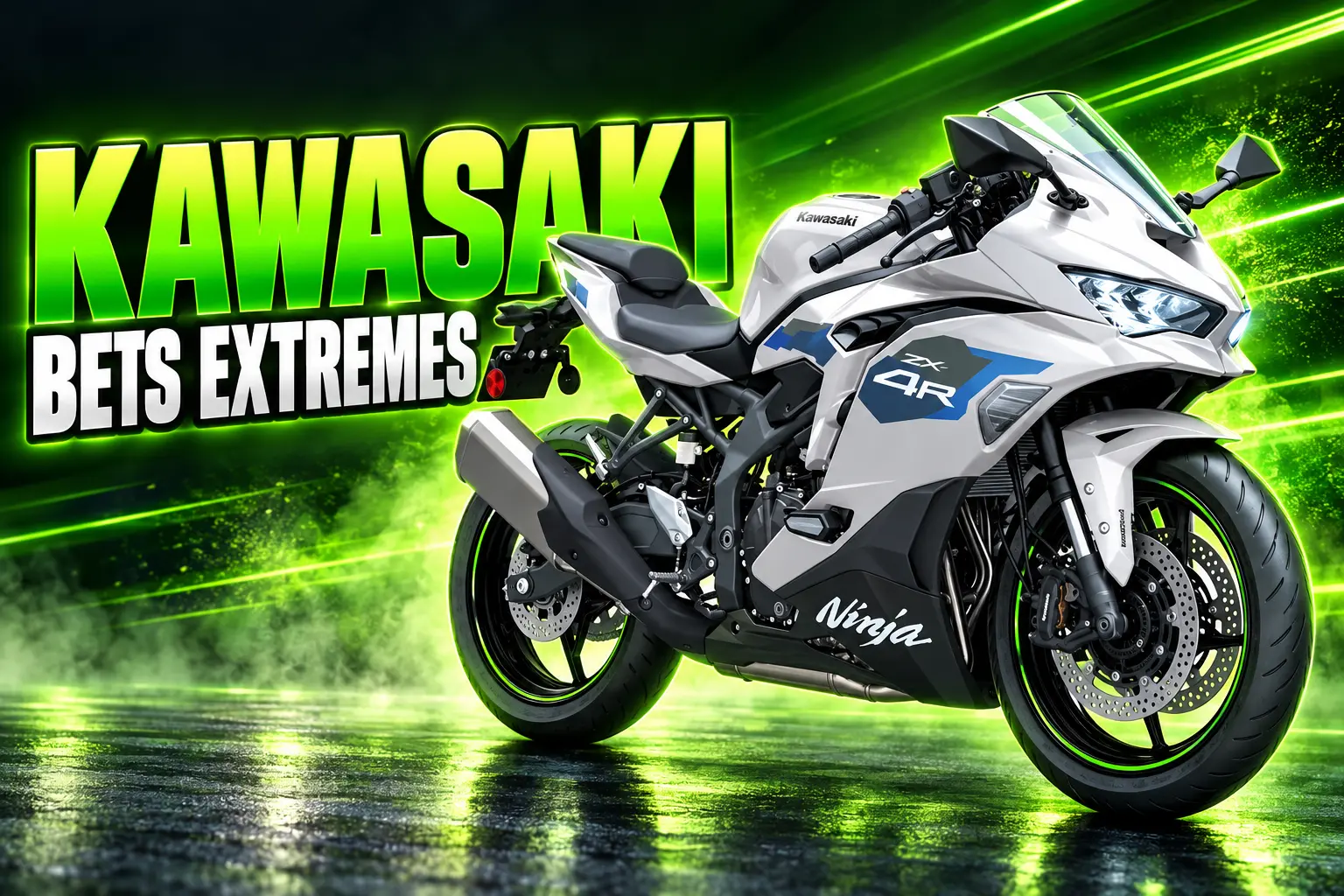
The $8,999 Four That No Rival Builds
The ZX-4R is the machine that memo quietly protected. Kawasaki said it had redefined the 400cc supersport class with a 399cc inline four in a compact trellis frame, dual 290mm front discs, a 37mm Showa SFF-BP fork, a 4.3-inch TFT dash, and riding modes that link KTRC traction control to power maps. The base ABS bike listed at $8,999 in Metallic Spark Black, available immediately. The ZX-4RR ABS and ZX-4RR KRT Edition ABS listed at $9,699, the KRT bike in Lime Green, Ebony, and Pearl Blizzard White.
U.S. spec sheets on the RR put claimed output at 56.0 hp at 11,500 rpm and 26.5 lb-ft at 11,000 rpm from a 57.0 x 39.1mm, 12.3:1 four, with a 414.5 lb curb weight, a 31.5-inch seat, a 4.0-gallon tank, and a 54.3-inch wheelbase. Destination on that bike is $650, so the 2025 RR’s advertised out-the-door math before tax was $10,349. Those U.S. horsepower numbers sit below the figures Kawasaki Motors published for the same 399cc architecture in its technical paper.
And as of 2024, the ZX-4R is the world’s only mass-produced four-cylinder 400-cm3 model.
Shohei Naruoka, Kawasaki Motors, Technical Review No. 186
That paper, issued in March 2025, is the engineering argument hiding under the sticker. Naruoka’s group wrote that 400cc sportbikes were born for Japan’s license rules, then found volume in the U.S., Europe, and China on the twin-cylinder Ninja 400. Rivals answered with singles and twins. Kawasaki answered with a new four, the first complete 400cc four-cylinder design since the 1989 ZXR400. The paper cites 57 kW at 14,500 rpm against 35 kW for the Ninja 400 twin, and 59 kW (80 hp) once the ram-air system is pushing, a duct layout borrowed from the ZX-6R and ZX-10R.
Kawasaki’s U.S. product copy still sells the same idea in plainer words: a 399cc in-line four-cylinder engine with a central ram-air snout, WorldSBK-inspired chassis numbers, and a wail you cannot fake with two pistons. The company later called that bike the world’s only mass-produced 400cc four in the 2024 engineering note, and nobody has since put a matching four on a showroom floor.
WHAT THE ZX-4RR ADDS
- Shifter: Dual-direction Kawasaki Quick Shifter for clutchless upshifts and downshifts.
- Front fork: Higher-grade Showa fork with adjustable spring preload on top of the SFF-BP internals.
- Rear shock: Showa BFRC Lite gas-charged unit with compression, rebound, and preload clickers.
- KRT paint: The $9,699 KRT Edition kept those parts and added factory lime race graphics.
Street riders who never see a pit board can skip the RR. The base bike already has the four, the dual discs, the TFT circuit layout, and RIDEOLOGY THE APP motorcycle connectivity for logs and settings when the bike is parked. That is the product Kawasaki chose to keep building after everyone else left the 400cc four for dead.
Closed-Course H2R Sold Only by Appointment
The other pole of the same PDF is theater on a short fuse. The Ninja H2 ABS listed at $32,700 in Mirror Coated Spark Black. The H2 Carbon ABS, with a carbon-fiber front cowl and special insignia, listed at $36,200. The Ninja H2R ABS, “Built Beyond Belief,” listed at $59,100 in Mirror Coated Matte Spark Black and was described as suitable only for closed-course circuits. The Ninja H2 SX SE ABS sport-tourer, stacked with adaptive cruise, blind-spot detection, and electronically controlled suspension, listed at $29,100.
Kawasaki’s later hypersport notice put claimed output at 239.6 HP for the street H2 and 321.5 HP for the H2R, both under ISO 4106, a standard the company warns can read higher than SAE car ratings. The street bike’s supercharged 998cc inline-four uses an in-house centrifugal blower that Kawasaki says compresses air up to 2.4 times atmospheric pressure, with an impeller spun at 9.2 times crank speed, near 130,000 rpm, moving more than 200 liters of air per second. Planetary gears for that drive come from Kawasaki Heavy Industries’ aerospace shop. No bulky intercooler sits in the bay because the compressor is efficient enough to skip it.
Brembo Stylema calipers, a KYB AOS-II fork, an Öhlins TTX36 rear shock, nine-mode KTRC, launch control, and self-healing paint finish the street H2. The H2R adds carbon aero devices and a closed-course brief. Destination on the current H2 product page is $840. You still cannot ride the H2R home.
H2 FAMILY SNAPSHOT
- Street H2, 2025: $32,700 base, 239.6 HP claimed, ISO 4106, order-window bike.
- H2 Carbon, 2025: $36,200 base, carbon upper cowl, same supercharged 998cc four.
- H2R, 2025: $59,100 base, 321.5 HP claimed, closed course only.
- H2 SX SE, 2025: $29,100 base, the supercharged tourer with radar assists.
The halo is real hardware. It is also the bike Kawasaki refuses to leave on a peg with a key in it.
How 2025 Stickers Moved by 2026
Carryover did not mean frozen forever. For the 2026 hypersport trio, Kawasaki opened orders on September 2, 2025, and shut them on October 31, 2025, at the same $32,700, $36,200, and $59,100 figures. After that window, the public product pages moved. The ZX-4R moved too, in smaller steps, because it is a stocked bike, not a lottery ticket.
2025 FALL STICKER VS LATER PRODUCT-PAGE MSRP
| Model | 2025 fall MSRP | Later listed base | Change |
|---|---|---|---|
| Ninja ZX-4R ABS | $8,999 | $9,299 | +$300 |
| Ninja ZX-4RR ABS | $9,699 | $9,999 | +$300 |
| Ninja H2 ABS | $32,700 | $34,400 | +$1,700 |
| Ninja H2 Carbon ABS | $36,200 | $38,100 | +$1,900 |
| Ninja H2R ABS | $59,100 | $62,100 | +$3,000 |
| Ninja H2 SX SE ABS | $29,100 | $29,999 | +$899 |
| Z H2 SE ABS | $21,700 | $21,999 | +$299 |
The $34,400 H2 page price plus the $840 destination charge is $35,240 before tax, title, and dealer fees. The ZX-4R’s $300 step is a rounding error next to a $3,000 H2R jump, which is the point of the two-speed bet: the four that dealers actually inventory crept up a little, and the appointment-only halo moved like a limited watch.
THE H2 AND SHARE CALENDAR
- October 1, 2024: Kawasaki opens the 2025 street restock and the H2 family order period.
- September 2, 2025: The 2026 H2, H2 Carbon, and H2R order window opens at 2025 money.
- October 31, 2025: That window closes.
- July 1, 2026: Eiko Kirino becomes president of Kawasaki Motors Corp., U.S.A., and the company credits 2025 with a No. 1 U.S. motorcycle market-share finish under her predecessor.
- July 1, 2026: Kawasaki Motors Japan adds Galaxy Silver to the Ninja ZX-4R SE and keeps the ZX-4RR in the domestic book.
- Early September 2026: Kawasaki posts a supercharger teaser under the line “Return to Beyond Belief.”
Share-lead years are usually sold as new-model years. This one was sold as a restock year with a 400cc four still hiding in the middle of the price list.
The Twin That Filled the Showroom
If the ZX-4R is the exotic small four and the H2R is the closed-course poster, the Ninja 500 is the bike that makes the lights stay on. The 451cc parallel twin, assist-and-slipper clutch, 310mm front disc, LED headlamps, and phone link were priced from $5,299 for the non-ABS KRT and silver bikes to $6,399 for the SE ABS and SE KRT. The SE added a TFT, KIPASS keyless start, a USB-C outlet, a taller screen, sliders, a seat cowl, and LED turn signals.
The same 451cc mill underpins the Z500 ABS at $5,599 and the Z500 SE ABS at $6,299. The Eliminator cruiser used it again from $6,499. That is three body styles on one twin, all in the fall packet, all marked Now. The ZX-4R four is the passion object in that band. The 500 twin is the one a new rider can finance without a second job.
Above them, the Z H2 SE ABS kept the balanced supercharged 998cc four, Skyhook KECS suspension, and Brembo Stylema calipers at $21,700, a street-naked cousin of the H2 that you could actually order off the board. The W800 ABS at $10,399 covered the air-cooled 773cc retro brief. None of those bikes needed a 60-day order window.
The Share Lead Came With Carryovers
On July 1, 2026, Kawasaki named Eiko Kirino president of the U.S. company after more than 30 years inside sales, marketing, product planning, and communications. The announcement said Yoshinori Kawaguchi’s North American run, which started in 2024, ended with Kawasaki claiming No. 1 motorcycle market share in 2025. Kirino called the United States the most important market as the company marks 60 years in the country.
That share claim sits on a year whose marquee street PDF was mostly last year’s metal in new paint. The ZX-4R four, the 500 twin, the KLR650, and the Eliminator are the kind of bikes that pile up registrations. The H2R does not. Treating the October 2024 memo as a boring carryover sheet misses the mix that a dealer can actually sell: a unique 400cc four at $8,999, a friendly 451cc twin in three costumes, and a supercharged halo for the customer who likes to wait.
Japan kept faith with the four well after the U.S. fall drop. On July 1, 2026, the official Kawasaki Motors Japan account posted new-model art for the Ninja ZX-4R SE and ZX-4RR and said Galaxy Silver was being added to the SE.
/
ニューモデル発表!
\Ninja ZX-4R SE
Ninja ZX-4RRNinja ZX-4R SEにNEWカラーのギャラクシーシルバーが追加されます!
▼詳しくは製品ページをご覧ください▼https://t.co/7imBhRUjyW#カワサキ #Kawasaki #Ninja pic.twitter.com/E39l0fxaix
— カワサキモータースジャパン (@Kawasaki_JPN) July 1, 2026
Dealer floors in Japan were still doing ZX-4RR handovers into early September 2026. The 400cc four is not a one-season curiosity. It is inventory.
Return to Beyond Belief
The halo is the one under the knife. In early September 2026, Kawasaki posted a short teaser built around supercharger noise and the phrase “Return to Beyond Belief,” a deliberate echo of the original “Built Beyond Belief” line. A second clip showed a tach with a 12,000-rpm redline band and a 14,000-rpm face, which is how the Z H2 and H2 SX clusters are drawn, not the 16,000-rpm street H2 face. Kawasaki has not published power, price, or a date. Trade-show timing has pointed toward a November debut, the same kind of stage that launched the first H2 at EICMA in 2014, but that remains unconfirmed.
What is confirmed is the shape of the 2025 bet. Kawasaki put a closed-course $59,100 H2R on a calendar and an $8,999 ZX-4R on a crate. The four is still the only one of its kind you can buy new. The supercharged flagship is the one the company is now asking people to listen to in the dark, waiting to see what “beyond belief” costs next.
The October 2024 packet did not need a new engine to make that split. It only needed Kawasaki to keep building the small four while the big blower stayed a limited run. Japanese color books are still adding ZX-4R paint. The H2 soundtrack is the one being remixed.

UPI MDR Delay Hands Traders the Calendar After Paytm Falls

Google Messages Builds Nine In-Chat Games After Samsung’s Exit

Anthropic’s $100 Million Academy Trains the Firms That Bill Both Sides

Toyota’s Electric C-HR Leaves the Cheap Twin to Subaru

Markets Bet the Fed Skips October After Hawkish Minutes

The Orchard Bug Forced Zcash to Open an Empty Pool

The $5.99 Game That Won Steam’s 2026 Summer Sale

Don Lee Joins Hemsworth as Extraction 3 Starts Shooting

YouTube Shorts Retires Dislikes and Swaps Likes for Hearts

NEURA Robotics Is Spending Its $1.4B on a Machine Stack
-
 NEWS4 months ago
The Orchard Bug Forced Zcash to Open an Empty Pool
-
 GAMING4 months ago
The $5.99 Game That Won Steam’s 2026 Summer Sale
-
 ENTERTAINMENT6 months ago
Don Lee Joins Hemsworth as Extraction 3 Starts Shooting
-
 NEWS4 months ago
YouTube Shorts Retires Dislikes and Swaps Likes for Hearts
-
 NEWS4 months ago
NEURA Robotics Is Spending Its $1.4B on a Machine Stack
-
 AUTO6 months ago
Kawasaki Bets the New Z1100 Against Its Own Supercharger
-
 BUSINESS5 months ago
Norway’s Export Bank Backs Nscale’s $790 Million Narvik Loan
-
 GAMING4 months ago
Game of Thrones Dragonfire Follows Boston’s Conquest Playbook