
NEWS
Honda Keeps Its Mini 125s Selling With 2026 Paint
Honda’s 2026 Monkey, Dax and Super Cub colours keep a small European 125 franchise alive after almost 25,000 Monkey sales since 2018.

Honda has issued 2026 colours for the Monkey 125, ST125 Dax and Super Cub C125. Nothing under the paint is new.
The European press note on 23 January 2026 said the Monkey is on course for almost 25,000 sales since it returned in 2018. That is the figure that explains why three 1960s silhouettes still get a new year of factory colour.
Honda’s Mini Icons Get a 2026 Paint Job
Honda Motor Europe changed the clothes, not the bikes. Euro 5+ arrived on the 2025 year models through a hotter catalyser, fresh ECU maps and extra onboard diagnostics. For 2026 the same air-cooled 124 cc singles roll on with new tanks, frames and seats.
The ST125 Dax, back in Europe since 2023, keeps its T-shaped frame, tall bars and 12-inch wheels. Pearl Horizon White and Candy Energy Orange join Pearl Shining Black.
THE 2026 COLOUR CHART
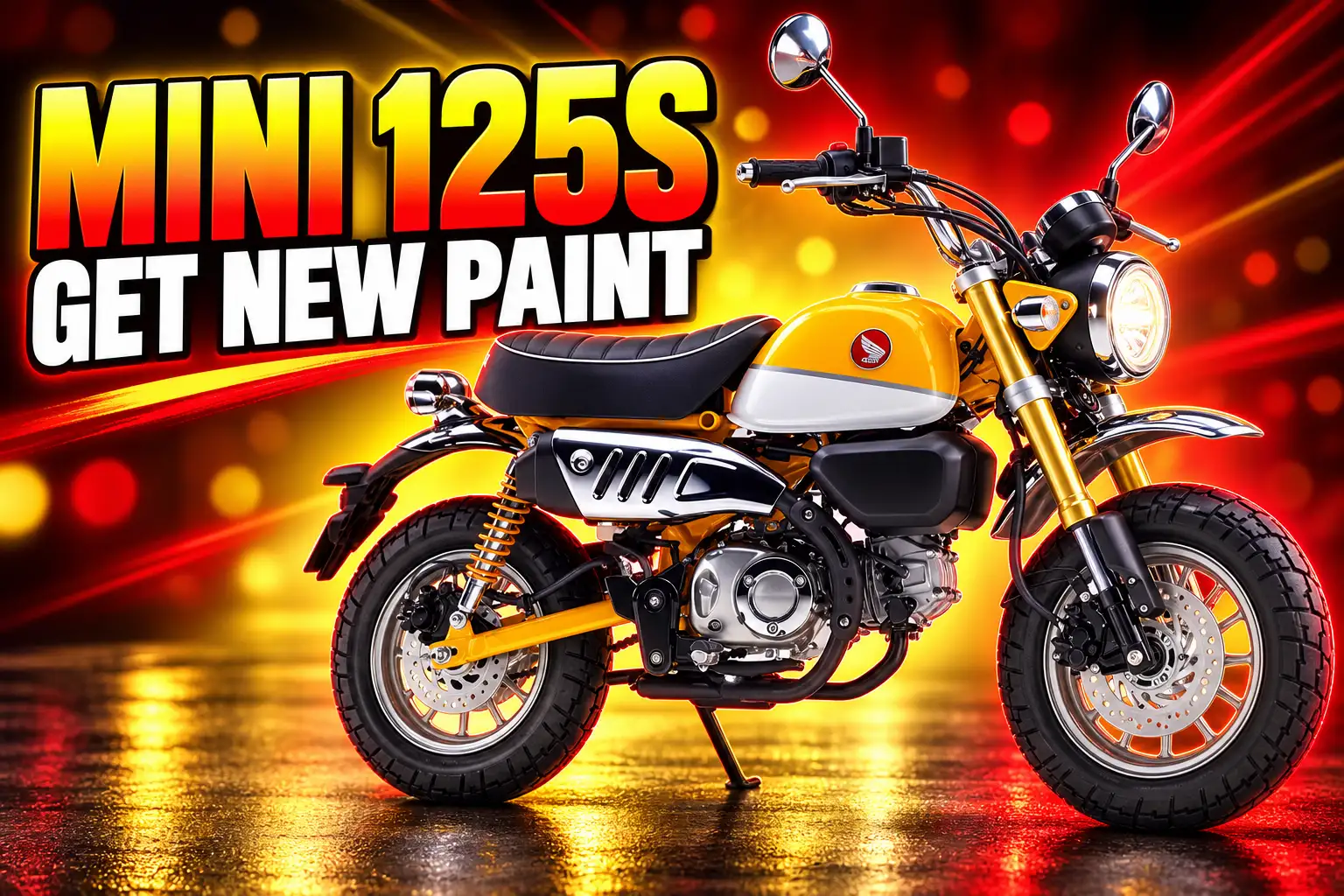
- Monkey 125: Powder Black Metallic on a Mat Gun Powder Black Metallic frame, Knight Silver Metallic on Millennium Red, and Pearl Himalayas White on a Banana Yellow frame.
- ST125 Dax: Pearl Horizon White and Candy Energy Orange join the holdover Pearl Shining Black.
- Super Cub C125: Premium Silver Metallic over Pearl Sugarcane Beige, finished with a two-tone brown and cream leather seat.
The Banana Yellow Monkey is the loudest of the set. The Cub is the quiet one, dressed like a café object rather than a park ride.
Almost 25,000 Monkeys Since the 2018 Return
Honda’s own Europe note is careful with the arithmetic. The Monkey, back on European lists since 2018, has reached a cumulative total of almost 25,000 units and is almost 25,000 European Monkey sales away from the round number Honda says it will pass in 2026. That 25,000 mark was still a forecast in January, not a counted result.
The Dax and Monkey together have taken over 16,000 European sales since the Dax returned in 2023. That 16,000 figure is both bikes, not the Dax alone.
HONDA’S EUROPE MINI TALLY
- Monkey since 2018: Almost 25,000 units in Europe, with Honda saying the total should pass 25,000 during 2026.
- Dax plus Monkey since 2023: Over 16,000 units in Europe after the Dax rejoined the range.
- 2026 hardware: Colour and trim only; the Euro 5+ work was done on the 2025 bikes.
Those totals will not trouble Honda’s SH scooters. They are large enough that the company still tools new paint for three nameplates rather than letting the minis fade after the emissions change.
Banana Yellow Arrives With a Beige Super Cub
The 2026 palette splits the family on purpose. The Monkey gets three full swaps, including the Pearl Himalayas White and Banana Yellow pairing Honda says gives the pocket bike a more playful character. The Dax adds two colours beside black. The Cub gets one two-tone, Premium Silver Metallic over Pearl Sugarcane Beige, plus that brown and cream seat.
Honda did not drop the colours on every market on the same day. Europe had the press note on 23 January 2026. Honda Motorcycle Japan then said the Monkey 125 with the new colour set would go on sale on 6 March 2026.
Hondaは、原付二種(第二種原動機付自転車)レジャーバイク「モンキー125」のカラーバリエーションを変更し、3月6日(金)に発売します。
広報発表:https://t.co/dM4Ya3A24p
機種ページ:https://t.co/EgRlbGxccf pic.twitter.com/iS822B9uUi— Honda Bike (ホンダ バイク) (@HondaBike_hmj) January 30, 2026
Indonesia’s factory arm was still adding ST125 Dax colours in early September 2026, with Candy Energy Orange and Pearl Shining Black going on sale there after the European note. The same three bikes are being refreshed in sequence, not as one global drop.
£4,199 for Honda’s Smallest 125 in Britain
Honda (UK) lists the 2026 Monkey at £4,199 on the road, the dearest of the mini trio. The same lists put the ST125 Dax at £3,899. The Super Cub C125 is £3,999, matching the MSX125. The plain CB125F commuter is £3,299, which is £900 less than the Monkey.
HONDA UK ON-THE-ROAD PRICES
| Model | UK OTR price |
|---|---|
| Monkey 125 | £4,199 |
| ST125 Dax | £3,899 |
| Super Cub C125 | £3,999 |
| MSX125 | £3,999 |
| CB125F | £3,299 |
Honda Finance Europe is still quoting Super Cub C125 PCP from £79 a month at 8.9% APR on that £3,999 on-the-road price, with the deal open for bikes ordered from 1 July 2026 through 30 September 2026. The Dax is advertised from £69 a month on the same APR. Buyers are paying Mini money for 6.9 kW and a new colour, not for a new engine.
What Changed Under the New Paint?
Nothing in the engines. The Monkey and Dax both make 6.9 kW, the Monkey at 6,750 rpm and the Dax at 7,000 rpm. The Super Cub C125 is the stronger of the three on paper at 7.2 kW at 7,500 rpm. Claimed fuel use is 1.5 L/100 km on all three. Honda (UK) puts Monkey CO2 at 35 g/km.
The split is in how you ride them. The Monkey uses a five-speed gearbox and a normal wet clutch. The Dax uses a four-speed rotary box with an automatic centrifugal clutch, as does the Cub. Monkey and Dax roll on 12-inch wheels; the Cub uses 17-inch wheels and a step-through spine that still reads as 1958 from ten metres away.
THE THREE 124 CC BIKES COMPARED
| Spec | Monkey 125 | ST125 Dax | Super Cub C125 |
|---|---|---|---|
| Peak power | 6.9 kW at 6,750 rpm | 6.9 kW at 7,000 rpm | 7.2 kW at 7,500 rpm |
| Peak torque | 10.7 Nm | 10.8 Nm | 10.4 Nm |
| Kerb weight | 105 kg | 107 kg | 111 kg |
| Seat height | 776 mm | 775 mm | 780 mm |
| Fuel tank | 5.6 L | 3.8 L | 3.7 L |
| Gearbox | 5-speed, wet clutch | 4-speed centrifugal | 4-speed centrifugal |
| Wheels | 12-inch | 12-inch | 17-inch |
| Claimed fuel use | 1.5 L/100 km | 1.5 L/100 km | 1.5 L/100 km |
Honda (UK) quotes a 90 km/h top speed for the Dax. The Monkey carries the largest tank, 5.6 L against 3.8 L and 3.7 L, which is the one practical edge in a group sold as toys first and transport second. Heated grips are optional on the Monkey and Dax. The Cub adds a smart key as standard.
Super Cub Hit 100 Million Units in 2017
The Cub is the reason the other two exist. Honda marked 100 million Super Cub series motorcycles in October 2017 at the Kumamoto Factory, 59 years after the C100 went on sale in 1958. Then-president Takahiro Hachigo rode a Cub 110 on stage for the ceremony.
Honda Super Cub, which was created in Japan, fulfills the expectations of our customers and embodies Honda’s passion to serve people worldwide with the joy of expanding their life’s potential.
Takahiro Hachigo, President and CEO, Honda Motor, Kumamoto Factory ceremony, 19 October 2017
The European C125 is a lifestyle cut of that machine, not the working 110s still built across Asia. Honda’s Europe note still calls it the most produced motor vehicle in history. The original was a clay model from Soichiro Honda’s own hands, never a drawing, and every Cub since 1958 has used a four-stroke engine.
HOW THE THREE ICONS ARRIVED
- 1958: Super Cub C100 goes on sale in Japan.
- 1961: The Monkey appears as the Z100, a park bike using the Super Cub C50’s 3.1 kW, 49 cc engine.
- 1969: The ST50 Dax is built for Europe and the US around the same C50 engine, named for its dachshund silhouette.
- 1974: The third-generation Monkey sets the frame that stayed put for more than three decades.
- October 2017: Super Cub series production reaches 100 million units.
- 2018: The Monkey returns to Europe as a 125, and the Super Cub C125 follows that market back.
- 2023: The ST125 Dax is reintroduced in Europe.
- 2025: All three meet Euro 5+ with small engine and exhaust changes.
- 23 January 2026: Honda issues the 2026 colour sets for Europe.
The first export Monkeys were built by five Honda staff who could finish 20 bikes a day on a line only 7 metres long. The joke has always been the size. The business is that Honda never stopped making a version of all three.
A 12.9% Registration Drop After Euro 5+
The colour year landed in a smaller market. The European Association of Motorcycle Manufacturers counted 1,002,848 new motorcycles in 2025 across France, Germany, Italy, Spain and the UK, down 12.9% from 1,150,852 in 2024. ACEM said 2024 had been inflated by stock registrations ahead of Euro 5+.
The 2025 figures confirm the anticipated market correction following the Euro 5+ transition, with motorcycle registrations returning to just over one million units.
Antonio Perlot, Secretary General, ACEM statistical release, 27 January 2026
Spain grew 8.3% to 242,580. Italy still led on volume at 331,634, down 6%. France fell 16.4% to 179,225, the UK 19.3% to 89,645, and Germany 35.7% to 159,764. Mopeds in six monitored countries fell 20.7% to 142,060. Against 2019, ACEM still had motorcycle registrations up 14.7%.
Honda’s answer for the minis was not a new platform. It was Pearl Himalayas White, Candy Energy Orange and a beige Cub seat, priced in Britain above the firm’s own CB125F. The Japan sale on 6 March 2026 and Indonesia’s Dax colours in September 2026 show the same bet running on through the year: keep the 1960s shapes in the window, and change the paint when the engines cannot move.
Frequently Asked Questions
Can You Ride the 2026 Honda Monkey on an A1 Licence?
Honda (UK) lists the Monkey 125, ST125 Dax and Super Cub C125 in its A1 licence 125 cc range, alongside the MSX125, CB125R and CB125F. Peak outputs sit at 6.9 kW or 7.2 kW, inside the A1 cap, so a restricted car-licence 125 rider in Britain can use any of the three on the same legal footing as Honda’s cheaper commuter 125s.
How Many Countries Has Honda Sold the Super Cub In?
Honda’s Europe note says the Super Cub has been sold in 160 countries and built in 16 factories across 15 countries. That factory count matches Honda’s own 2017 100 million announcement, which put production at 16 plants in 15 countries after knockdown assembly began in Taiwan in 1961.
When Did the Super Cub Get a 3D Trademark?
The Japanese Patent Office awarded the Super Cub a 3D trademark in 2014 for its shape and design, which Honda says made it the first vehicle to receive that status. The badge sits on a product that, in Honda’s telling, began as a clay model rather than a set of drawings.
Did Honda Stop Building 50 cc Super Cubs?
Honda ended 50 cc Super Cub production in Japan in 2025 after tighter emissions rules made sub-50 cc bikes uneconomic to recertify. The company sold a limited Final Model, then continued the line with 110 cc Cubs, including lower-output 110 cc Light models aimed at Japan’s revised moped licence from late 2025. The European C125 was not part of that 50 cc shutdown.

Copilot Capital Buys the Autopilot Already Running 90 GW

Walmart Puts Dunkin on the App to Sell More Groceries

Molten Bets £100m of Plc Cash on Late-Stage Tech

Ascentiz Recruits Developers Around Its Modular Exoskeleton at IFA

BIS Puts a Public Timestamp Under Official Statistics on XRPL

The Orchard Bug Forced Zcash to Open an Empty Pool

The $5.99 Game That Won Steam’s 2026 Summer Sale

Don Lee Joins Hemsworth as Extraction 3 Starts Shooting

YouTube Shorts Retires Dislikes and Swaps Likes for Hearts

NEURA Robotics Is Spending Its $1.4B on a Machine Stack
-
 NEWS4 months ago
The Orchard Bug Forced Zcash to Open an Empty Pool
-
 GAMING4 months ago
The $5.99 Game That Won Steam’s 2026 Summer Sale
-
 ENTERTAINMENT5 months ago
Don Lee Joins Hemsworth as Extraction 3 Starts Shooting
-
 NEWS3 months ago
YouTube Shorts Retires Dislikes and Swaps Likes for Hearts
-
 NEWS3 months ago
NEURA Robotics Is Spending Its $1.4B on a Machine Stack
-
 AUTO5 months ago
Kawasaki Bets the New Z1100 Against Its Own Supercharger
-

 BUSINESS4 months ago
Norway’s Export Bank Backs Nscale’s $790 Million Narvik Loan
-
 AUTO5 months ago
The Kawasaki Z1100 Awakens Sugomi With Less Peak Power