
NEWS
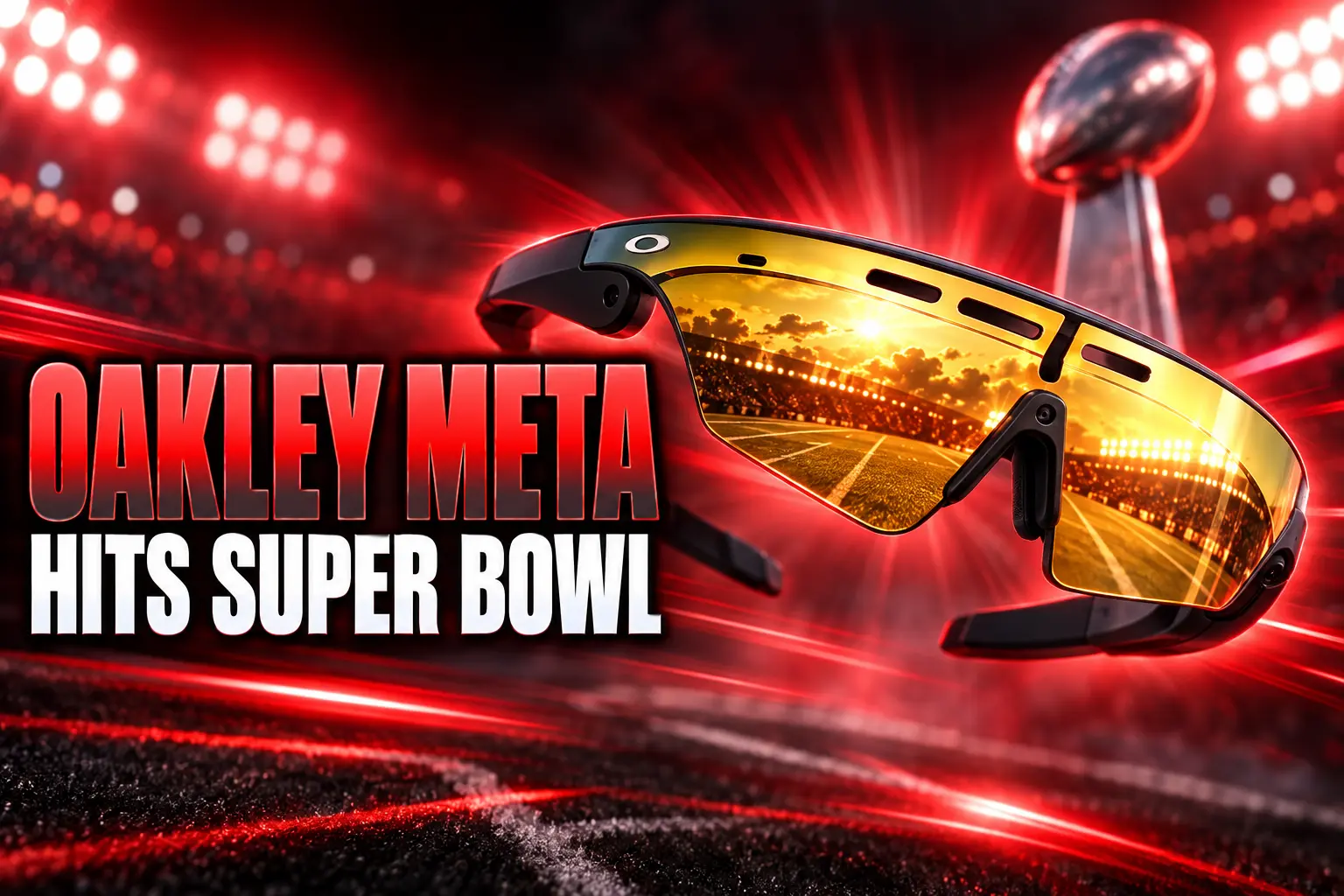
Oakley Meta Bets Super Bowl Airtime on Training Glasses
Oakley’s first Super Bowl spots sold Meta AI glasses as training gear. Sales climbed, recaps hated the ads, and cheaper Meta frames followed.

Oakley ran its first Super Bowl commercial on February 8, 2026, selling Oakley Meta glasses as on-field training gear. Two 30-second spots landed in the first and third quarters of Super Bowl LX, with a 60-second cut online.
The campaign, tagged Athletic Intelligence Is Here, put Marshawn Lynch, Spike Lee, and iShowSpeed in wraparound frames and asked Meta AI for playlists, slow-motion clips, and weather while they moved. The product Meta wanted on the field was a camera, open-ear audio, and a live Garmin hookup, not another lifestyle Wayfarer.
Oakley Bought Its First Super Bowl Spot
Oakley called Super Bowl LX its first ever Super Bowl commercial, 34 years after Max Fearlight, the brand’s 1992 broadcast ad. The company already sits on NFL sidelines as the league’s official on-field eyewear sponsor, with Football Shields on players and signature frames tied to Patrick Mahomes and Justin Jefferson.
Meta had already used the game for glasses. Super Bowl LIX carried Ray-Ban Meta spots with Chris Hemsworth, Chris Pratt, and Kris Jenner. A Meta Quest ad ran in 2022. Returning with Oakley was a category shift, from fashion frames that made AI glasses normal to sport frames meant to bring in people who had never bought a pair.
Meta said most Oakley Meta buyers were new to AI glasses after HSTN and Vanguard launched in fall 2025. A companion note already walks through the Super Bowl ad specs and price for both frames. The Super Bowl buy was the national proof of that pitch.
FROM MAX FEARLIGHT TO SUPER BOWL LX
- 1992: Oakley airs Max Fearlight, its first national broadcast ad.
- 2022: Meta runs a Super Bowl spot for Quest.
- Super Bowl LIX, 2025: Ray-Ban Meta ads star Hemsworth, Pratt, and Kris Jenner.
- September 17, 2025: Garmin says it will pipe live training data into Oakley Meta Vanguard.
- October 21, 2025: Vanguard goes on sale at $499.
- February 8, 2026: Oakley Meta takes two 30-second Super Bowl LX breaks.
- February 16, 2026: A 15% HSTN promo, down to $339 from $399, ends in the US and Canada.
- June 23, 2026: Meta Glasses launch at $299 under Meta’s own name.
Oakley also used Super Bowl week for Bay Area try-ons and put glasses on athletes in the Gatorade Hydration Games, so the TV spots were not the only place the frames showed up.
Lynch Skydives While Speed Chases a Plane
Antoine Bardou-Jacquet directed both Super Bowl LX spots, cut tight on faces and lens reflections, with Travis Scott’s HYAENA underneath. Meta posted the 60-second film before kickoff after a TODAY show premiere.
https://www.youtube.com/watch?v=NerlyGrv7WM
In the first 30 seconds, Lynch in Oakley Meta Vanguard asks Meta AI to play his Beast Mode playlist, then leaves an aircraft. A desert runner in Vanguard asks whether vultures eat people. iShowSpeed, also in Vanguard, sprints at a pilotless plane. Olympic skateboarder Sky Brown drops into an empty pool in HSTN. Mountain biker Kate Courtney goes down a trail, crashes, and asks if it is OK to eat mud. Lynch then skies toward a falling football and asks who says humans cannot fly.
The second spot opens on PGA golfer Akshay Bhatia asking when the storm hits. A snowboarder flips. Olympic breaker Sunny Choi hits a 2000. Speed finally boards the moving plane and yells that they have liftoff. Spike Lee, in HSTN, grabs a slow-motion poster dunk at Harlem’s Rucker Park. Lynch pulls a chute. The tagline lands, and Speed tells Meta to post the clip to Instagram.
WHO WEARS WHICH FRAME
- Vanguard: Marshawn Lynch and iShowSpeed wear the wraparound training pair in the spots.
- HSTN: Spike Lee and Sky Brown wear the lifestyle sport pair.
- Also on camera: Akshay Bhatia, Kate Courtney, and Sunny Choi fill the cuts between stunts.
Speed said he needed gear that fits his pace, and that the glasses let him capture moments and hear music without breaking his flow. Clips that traveled after the game were the plane chase, not the Garmin pitch. For a creator audience, Speed was the ad.
The Training Loop Runs Through Garmin
The Super Bowl film never dwells on a watch. The product page does. Oakley Meta glasses talk to compatible Garmin devices so you can ask for pace, speed, or heart rate without looking down. A status LED in the frame can show whether you are inside a target zone.
Garmin announced that hookup on September 17, 2025, built around a Meta AI app in the Connect IQ Store. Athletes pair Vanguard with Garmin watches and bike computers, then get autocapture clips when pace or heart rate jumps, plus a recap with stats laid over the video for Strava, Instagram, Facebook, or WhatsApp. Snow users can pull speed, vert, and run count by voice.
WHAT THE WATCH FEEDS THE GLASSES
- Live stats: Ask for pace, speed, heart rate, or a full readout mid-session.
- Status LED: Set the in-frame light for pace, heart rate, or power zones.
- Autocapture: The camera starts on milestones, then the Meta AI app builds a highlight reel.
- Workouts by voice: Ask Meta to build a timed ride or run with a power band, then send it to the Garmin.
Apple Health, Health Connect, and Strava can still overlay some numbers after a session. They do not get the live readouts or autocapture. The Super Bowl script sold “Hey Meta, play my Beast Mode playlist.” The shelf pitch is real-time fitness metrics and alerts for people who already train with a Garmin on the wrist.
We are thrilled to team up with Meta to support the Vanguard line of AI glasses with real-time fitness metrics and post-activity insights. The ability to receive personalized Garmin data while working out hands-free will help athletes optimize their performance and stay in the zone.
Susan Lyman, Vice President of Consumer Sales and Marketing, Garmin
Will Townsend, a wearables analyst, later rode Vanguard on gravel with a heart-rate strap and cadence sensor. He wrote that the Garmin link was amazing while he still heard cars, and that picture capture was buggy at times. The training loop is the part of the Super Bowl promise that holds up on a bike. The camera still drops shots.
How Vanguard Stacks Up Against HSTN
Oakley Meta is two products that share Meta AI, a 12 MP ultra-wide camera, 3K video, open-ear audio, and 32 GB of storage. Vanguard is the training SKU. HSTN is the everyday pair Spike Lee wears in the spots, and it is the one Meta discounted for the game.
THE SUPER BOWL PAIR AND THE EVERYDAY PAIR
| Model | Starting price | Camera field | Water rating | Typical battery | Prescription |
|---|---|---|---|---|---|
| Oakley Meta Vanguard | $499 | 122 degrees, centered | IP67 | Up to 9 hours | No |
| Oakley Meta HSTN | $399 | 100 degrees | IPX4 | Up to 8 hours | Yes |
| Ray-Ban Meta Wayfarer | From $379 | Lifestyle camera glasses | Everyday wear | Up to 8 hours | Yes, on many styles |
Vanguard adds wraparound Prizm lenses, wind-tuned speakers, Oakley’s three-point fit with swappable nose pads, and the higher water rating. HSTN adds more lens colors, including polarized and Transitions options, and an Rx range. Meta’s HSTN shop lists the frame at $399, or from $33.25 a month with Affirm. For Super Bowl week, US and Canada buyers could take 15% off HSTN, starting at $339, through February 16, 2026.
Ray-Ban Meta still sits under both Oakley prices. The Super Bowl spots did not argue that Oakley was cheaper. They argued it belonged on a trail, a bike, and a skydive, which is why Vanguard, not HSTN, is the $499 frame Lynch jumps in.
Recaps Filed the Spot Under Nightmare Fuel
A Super Bowl recap of celebrity ads ranked the Oakley Meta film among the worst of the night. The complaint was the craft, tight fisheye close-ups of athletes talking to mirrored lenses while they ran, skated, and jumped. The recap called that nightmare fuel and wanted out of the timeline.
That is a fair read of the images Bardou-Jacquet chose. The spots never show a clean product hero. They show faces warped in Prizm glass, then cut before a viewer can sit with a feature. Speed’s plane chase is the only beat that plays like a stunt people already knew how to watch.
These Oakley Meta Vanguard glasses are hella smooth. The camera lets me make moves and stay connected, when I see it, I snap it! No more phone fumbling and missing the moment.
Marshawn Lynch, Super Bowl campaign, Oakley Meta
Lynch’s line is the ad in one breath: stop pulling out a phone. The Super Bowl version of that idea is a skydive. The weekday version is a runner who wants music, a camera, and a split time without a watch glance. Recaps graded the fisheye. Buyers still had to decide whether $499 of Vanguard replaced a pair of sport shades, open-ear buds, and a clip-on cam.
7 Million Pairs, Then a Cheaper Frame
EssilorLuxottica, which owns Oakley and Ray-Ban and builds the Meta glasses, told investors it sold more than 7 million AI glasses in 2025 across those brands. Chairman and CEO Francesco Milleri, with deputy CEO Paul du Saillant, said the new category posted exponential growth, driven by Ray-Ban and Oakley in every region and channel.
THE SHELF AFTER THE GAME
- 2025 volume: More than 7 million Ray-Ban and Oakley AI glasses, per EssilorLuxottica.
- Q2 2026: AI smart glasses sales almost doubled against the prior year.
- June 23, 2026: Meta Glasses start at $299, under Meta’s own mark.
- High end: Meta Ray-Ban Display sits at $799 with a lens screen.
Those unit numbers are the whole Meta-EssilorLuxottica glasses line, not Oakley Meta alone. They still matter for the Super Bowl buy, because Meta went back to the game after Ray-Ban Meta had already pulled the category into the millions. Oakley’s job was to add athletes who would not wear a Wayfarer on a ride.
Q2 2026 kept that climb going, with AI glasses sales almost doubling. Shares in EssilorLuxottica had still been under pressure on questions about the category’s profit and about production. Selling more pairs is not the same as making the Super Bowl spots beloved. It is the score Meta said it would watch: awareness, traffic, and sales.
Meta Put Its Own Name on the Glasses
On June 23, 2026, Meta and EssilorLuxottica introduced Meta Glasses, starting at $299, in Adventurer and Fury shapes, plus a Kylie Jenner oval at $399. Meta still uses EssilorLuxottica for lenses and still sells Ray-Ban and Oakley. The new line is the first time the cheapest camera AI glasses wear Meta’s mark instead of a sunglass house’s.
That undercuts the Super Bowl math in a quiet way. Vanguard remains $499. HSTN remains $399. The June frames take $80 off the Ray-Ban Meta floor of $379 and sit $200 under Vanguard. If the February ads were meant to make $499 training glasses feel normal, the summer line is meant to make a $299 Meta pair feel easy.
Oakley Meta still has the Garmin loop, the Prizm visor, and the NFL sideline. The Super Bowl film is still the only time the brand has paid for that half-hour of America. The cheaper Meta pair is what you buy if you wanted the camera and the voice, and you never planned to ask your glasses for wattage on a climb.
Frequently Asked Questions
Can You Get Prescription Lenses for Oakley Meta Glasses?
Oakley Meta HSTN accepts prescription lenses in a range from -12.00 to +6.00, which covers most everyday scripts. Oakley Meta Vanguard does not take Rx lenses at all, so a training buyer who needs correction has to wear contacts or look at HSTN instead.
How Much Storage Do Oakley Meta Glasses Have?
Each pair carries 32 GB on the glasses, enough for more than 100 clips of 30 seconds and more than 1,000 photos before you offload. The charging case can move media to the cloud while the frames sit in it, so a long race does not have to wait for a laptop.
Are Oakley Meta Glasses Built for Rain and Sweat?
Vanguard is rated IP67 for heavy rain, sweat, and wet trail use. HSTN is rated IPX4 for light rain and splashes. Meta says to dry both after water, and neither pair is meant for swimming or sitting in liquid.
Which Music Apps Work on Oakley Meta Vanguard?
The open-ear speakers work with Amazon Music, Apple Music, Shazam, Spotify, Audible, and iHeart, with adaptive volume so road noise does not bury the mix. You still hear the street, which is the point of skipping in-ear buds on a run.
Did Meta Advertise Glasses in the Super Bowl Before Oakley Meta?
Yes. Ray-Ban Meta ran Super Bowl LIX spots with Chris Hemsworth, Chris Pratt, and Kris Jenner, and Meta Quest had a 2022 Super Bowl ad. Oakley’s 2026 buy was the first time the sport brand used the game, and the first time Meta used Super Bowl time to sell performance frames instead of Wayfarers.

Copilot Capital Buys the Autopilot Already Running 90 GW

Walmart Puts Dunkin on the App to Sell More Groceries

Molten Bets £100m of Plc Cash on Late-Stage Tech

Ascentiz Recruits Developers Around Its Modular Exoskeleton at IFA

BIS Puts a Public Timestamp Under Official Statistics on XRPL

The Orchard Bug Forced Zcash to Open an Empty Pool

The $5.99 Game That Won Steam’s 2026 Summer Sale

Don Lee Joins Hemsworth as Extraction 3 Starts Shooting

YouTube Shorts Retires Dislikes and Swaps Likes for Hearts

NEURA Robotics Is Spending Its $1.4B on a Machine Stack
-
 NEWS4 months ago
The Orchard Bug Forced Zcash to Open an Empty Pool
-
 GAMING4 months ago
The $5.99 Game That Won Steam’s 2026 Summer Sale
-
 ENTERTAINMENT5 months ago
Don Lee Joins Hemsworth as Extraction 3 Starts Shooting
-
 NEWS3 months ago
YouTube Shorts Retires Dislikes and Swaps Likes for Hearts
-
 NEWS3 months ago
NEURA Robotics Is Spending Its $1.4B on a Machine Stack
-
 AUTO5 months ago
Kawasaki Bets the New Z1100 Against Its Own Supercharger
-

 BUSINESS4 months ago
Norway’s Export Bank Backs Nscale’s $790 Million Narvik Loan
-

 AUTO5 months ago
The Kawasaki Z1100 Awakens Sugomi With Less Peak Power