
FINANCE
Bybit Dual License Puts Regulated Payments Under One Roof
Bybit Payments GmbH secured an Austrian EMI license on 4 August 2026, pairing e-money and payment services beside its MiCA crypto entity on Bybit.eu.

Bybit Payments GmbH received an Electronic Money Institution licence from Austria’s Financial Market Authority on 4 August 2026, giving the exchange a regulated base for e-money and payment services across the European Economic Area while its sister company keeps crypto under a separate MiCA authorisation.
The two Austrian entities stay legally distinct yet feed the same Bybit.eu platform. That dual stack is the real shift: Bybit can now build its own fiat rails instead of renting them.
The grant lands more than a year after the crypto authorisation and completes a deliberate sequence. One competent authority now oversees both halves of the stack, and passporting under each regime can carry services into most EEA markets once products go live.
Two Entities, One Platform Interface
Bybit EU GmbH has held MiCAR crypto-asset service provider authorisation from the FMA since 28 May 2025. It handles custody, exchange of crypto for funds or other crypto-assets, placing and transfers. It does not run a trading platform or give investment advice.
Bybit Payments GmbH, commercial register FN 636179h and based at Donau-City-Straße 7 in Vienna, now holds the EMI licence under the E-Money Act 2010. Customers reach both through bybit.eu, but each firm stays inside its own permission set.
| Entity | Licence | Core Scope |
|---|---|---|
| Bybit EU GmbH | MiCAR CASP (May 2025) | Crypto custody, exchange, placing, transfers |
| Bybit Payments GmbH | EMI (4 Aug 2026) | E-money issuance plus listed payment services |
Georg Harer, managing director of both companies, said Europe is setting the global benchmark for how digital assets and financial services can evolve together under clear regulation. The EMI and MiCAR pieces create complementary foundations that connect crypto-assets, payments and everyday financial services on the platform.
That shared management line does not collapse the legal perimeter. Each company answers for its own licence conditions, capital rules and safeguarding duties. The single interface is a product choice; the two rulebooks remain separate by design.
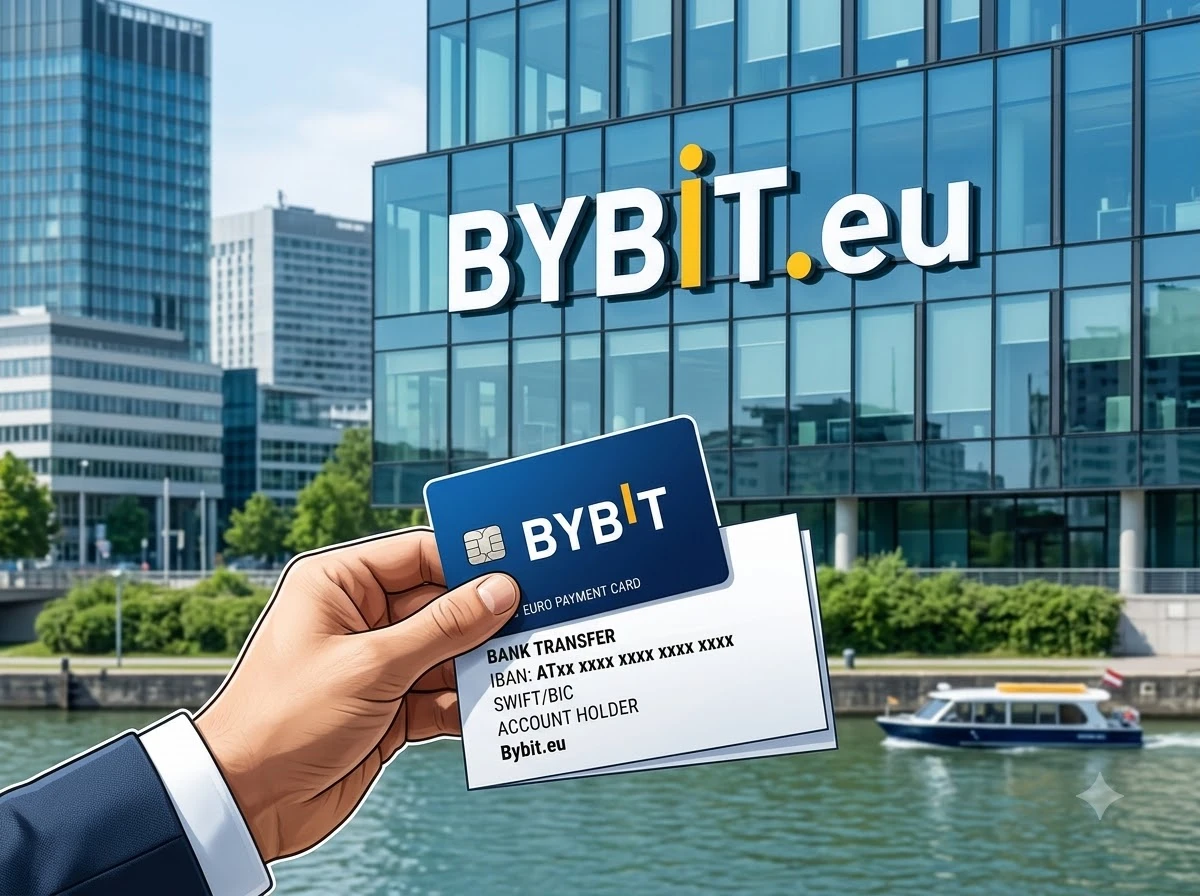
What the EMI Authorizes
The FMA licence decision dated 4 August 2026 authorises Bybit Payments to issue electronic money under the E-Money Act. It also covers four payment services under the Payment Services Act 2018:
- Incoming payment business
- Outgoing payment business
- Payment business
- Issuing and acquiring of payment instruments
That package supports person-to-person transfers, e-money wallets, Strong Customer Authentication, open-banking features, merchant solutions and future card programmes once further product approvals arrive. No concrete launch dates were given.
An EMI can hold client funds, issue IBANs, run SEPA flows and issue cards. It goes further than a basic payment institution licence. Bybit said the approval will also help it form direct relationships with banks and payment partners and reduce reliance on third-party infrastructure over time.
In practice the four services plus e-money issuance form a single operating kit. Incoming and outgoing payment business cover the deposit and withdrawal legs. Payment business and the issuing and acquiring permissions open the door to instruments and merchant flows once the firm clears product-level steps with the FMA.
This licence enables Bybit Payments GmbH to build regulated payment capabilities that complement the crypto-asset services offered by Bybit EU GmbH. Maintaining a clear distinction between the two regulated entities is fundamental.
Bernhard Krick, managing director at Bybit Payments GmbH, made that point in the official Bybit.eu announcement of the EMI grant.
Austria’s Quiet Hub for Full-Stack Crypto
Bybit set its European headquarters in Vienna when it secured the MiCAR licence. The same FMA now oversees both entities. Passporting under both regimes lets services reach most of the 29 EEA markets (Malta remains excluded for the crypto side).
Austria has become a practical base for firms that want one competent authority for both crypto-asset and e-money rules. Other large exchanges hold MiCA authorisations in Luxembourg, Cyprus, France or Malta. Dual EMI-plus-CASP structures remain less common, which gives Bybit an early operational edge on the payments layer.
- 28 May 2025, Bybit EU GmbH receives MiCAR CASP authorisation from the FMA.
- June 2025 onward, European headquarters active in Vienna; EEA clients migrate to bybit.eu.
- 4 August 2026, Bybit Payments GmbH receives EMI licence for e-money and payment services.
The sequence shows deliberate layering rather than a one-off filing.
One supervisor for both licences cuts coordination friction. Filings, inspections and passport notifications run through a single home authority, which shortens the path from approval to cross-border rollout compared with split-home models.
Payment Rails Bybit Can Now Own
Crypto exchanges have long depended on banking partners and payment service providers for fiat on- and off-ramps. Those relationships can be expensive, slow or suddenly withdrawn when banks de-risk digital assets. An in-house EMI changes the equation.
Bybit can issue its own e-money, offer dedicated IBANs, process SEPA payments directly and eventually launch cards that sit inside the same app as the crypto wallet. Users move between euro balances and crypto without leaving the regulated perimeter. The firm keeps more of the economics and the customer relationship.
- E-money issuance under the firm’s own licence
- Dedicated IBANs and direct SEPA processing
- Client funds held inside the EMI perimeter
- Card and merchant programmes once further approvals land
- Direct bank and payment-partner relationships in place of pure rental
That second-order effect matters more than the licence headline. Ownership of the rails turns a pure trading venue into a regulated financial platform. It also aligns with the direction of the EU Markets in Crypto-Assets framework rules, which already require e-money token issuers to hold credit-institution or EMI status.
Recent product moves fit the same pattern. Bybit’s recent BYUSDT yield and CFD collateral update already lets eligible users earn while using holdings as margin. Adding native payments completes more of the stack.
How Users and Rivals Feel the Change
For EEA customers the practical upside is a cleaner experience: euro deposits and withdrawals under one regulated roof, stronger authentication options, and eventually cards or merchant tools that treat crypto balances as first-class. The legal separation still means crypto and payment ledgers stay distinct, which satisfies supervisors even if the app looks unified.
Competitors that still rent all fiat rails face higher costs and more counterparty risk. Unlicensed or lightly regulated platforms lose further ground as MiCA enforcement tightens. Traditional payment firms that once treated crypto clients as high-risk niches now confront exchanges that can issue their own e-money.
| Party | Immediate effect of the dual stack |
|---|---|
| EEA customers | Single interface for euro and crypto flows under two Austrian licences |
| Rail-renting exchanges | Higher relative cost and continued counterparty exposure |
| Unlicensed platforms | Further ground lost as MiCA enforcement tightens |
| Traditional payment firms | Exchanges that issue e-money become direct peers, not only clients |
Crowd reaction on X treated the news as infrastructure rather than marketing. One widely shared take called it “regulatory approval, not a backdoor” and a “real infrastructure play.” That reading matches the official language about cutting third-party dependence.
European wallet and identity startups are racing the same problem from the other direction. European wallet startups racing to fix payments show how crowded the regulated payments layer has become. Bybit arrives with existing scale and a dual licence already in hand.
Clear Separation Protects Both Rulebooks
Krick’s insistence on a clear distinction is more than corporate hygiene. MiCA and the e-money rules impose different safeguarding, capital and conduct duties. Mixing the two ledgers inside one legal person would blur those duties and invite supervisory pushback.
Keeping Bybit EU GmbH on the crypto side and Bybit Payments GmbH on the fiat side lets each firm map controls to its own statute. Crypto custody, exchange, placing and transfers stay under the CASP perimeter. E-money issuance, IBANs, SEPA flows and payment instruments stay under the EMI perimeter.
Customers still see one bybit.eu front end. Behind that interface the firms route euro balances and crypto-asset balances through separate legal and operational channels. Supervisors can examine each channel against the correct rulebook without untangling a merged balance sheet.
The model also supports passporting without scope creep. Notifications for crypto services travel under MiCA. Notifications for payment services travel under the Electronic Money Directive and Payment Services Directive frameworks. Each path stays clean.
The Build-Out Still Ahead
The licence is the foundation, not the finished product. Concrete roll-out dates, priority markets and card partners remain unannounced. Further approvals will be needed for many of the listed features.
What we know
- EMI granted 4 August 2026 under Austrian E-Money Act and Payment Services Act.
- Four payment services plus e-money issuance authorised.
- Entities stay separate; customers access both via bybit.eu.
- Passporting available across most EEA states.
What’s unconfirmed
- Launch calendar for P2P, cards or open banking.
- Which markets receive services first.
- Exact capital or safeguarding arrangements beyond the licence text.
Bybit has already shown it can move clients onto a local platform after MiCA. The EMI path will test whether the same team can ship regulated payment products at exchange speed while staying inside two distinct rulebooks.
Product sequencing will matter as much as licence text. P2P transfers and e-money wallets can draw on the core permissions sooner. Card programmes and fuller open-banking features will wait on further product approvals and partner choices that the firm has not yet named.
If it succeeds, the dual-entity model becomes a template other large platforms will copy. The winners will be the firms that treat payments as core infrastructure rather than a bolted-on bank partnership.
Frequently Asked Questions
What payment services does Bybit Payments GmbH’s EMI licence cover?
The FMA authorisation covers electronic money issuance plus incoming payments, outgoing payments, payment business, and issuing and acquiring of payment instruments under Austria’s Payment Services Act 2018. These permissions form the base for future IBANs, SEPA flows and card programmes once product-level approvals are obtained.
Are Bybit’s crypto and payment businesses the same legal company?
No. Bybit EU GmbH holds the MiCAR crypto-asset service provider licence and handles crypto services. Bybit Payments GmbH holds the separate EMI licence for e-money and payments. Both are Austrian companies that present a single interface on bybit.eu while remaining legally and operationally distinct.
Does the Austrian EMI licence passport across the EEA?
Yes. An EMI licence issued by a home-member-state authority such as the FMA can be passported to other EEA countries under the Electronic Money Directive and Payment Services Directive frameworks, subject to notification procedures. Bybit has indicated Europe-wide availability through the platform once services launch.
How does an EMI licence differ from a MiCA CASP authorisation?
MiCA governs crypto-asset services such as custody, exchange and transfer of crypto-assets. An EMI licence governs the issuance of electronic money and fiat payment services, including holding client funds in safeguarded accounts and issuing payment instruments. The two regimes are complementary and deliberately kept separate by Bybit’s structure.
Where is Bybit’s European headquarters located?
Bybit established its European headquarters in Vienna when it obtained the MiCAR licence in 2025. Both Bybit EU GmbH and Bybit Payments GmbH are registered Austrian companies with offices at Donau-City-Straße 7, 1220 Vienna.
Disclaimer: This article is for informational purposes only and does not constitute financial, investment or legal advice. Digital-asset and payment services involve risk and may not be available in all jurisdictions.


Bybit Dual License Puts Regulated Payments Under One Roof

Bandcamp Boots Boy George Over AI Song, Not Just the Lyrics

Olix Triples to $3.3bn on Optical Bet Against Nvidia

Four Teens Died After Platforms Vowed Fixes and Suits Began

Google Health Now Writes Fitbit Data Into Apple Health

Pixel 11 Pre-Orders Open Eight Hours Before the Event

2026 Lexus RZ Gains Power and Range Yet Still Falls Short

Ankr Nodes Clear Path for XRPL Institutional Features

Xbox Disc Licenses Turn Physical Games Into Portable Rights

BlackRock Turns Cash Empire Into Stablecoin Reserve Rails

Kalshi Loses Major NY Prediction Markets Ruling to Judge Torres

Fed Minutes Cite AI Demand as Inflation Risk, Put a 2026 Hike Back on the Map

Marker AI Writing Startup Lands $13M Seed Led by Index Ventures

Dota 2 Esports World Cup 2026: Spirit Defends $2M Title In Paris

Meta’s Muse Spark 1.1 Beats Rivals on Price, Trails on Coding

Finto Picks Munich Over Silicon Valley After YC, Raises $3.4M

ARC Intelligence Closes €4M Seed Round in Roughly a Week

CS2 Premier Season 5 Lands With Cache and a C4 Damage Rework

Backrooms Returns to Theaters as the Everything Must Go Edition

Magnificent Seven Shed $2 Trillion in June as the Rally Broadens
-
 FINANCE2 months ago
Zcash Patched a Double-Spend Bug as ZEC Climbed 5%
-
 ENTERTAINMENT2 months ago
Steam Summer Sale 2026 Locks In June 25 to July 9 Dates
-

 FINANCE1 month ago
CLARITY Act Final Text Expected This Weekend as 60-Vote Hurdle Looms
-
 NEWS3 months ago
Meta Adds AI Replies to Threads, But Users Can’t Block It
-
 ENTERTAINMENT3 months ago
‘Widow’s Bay’ Review: Apple TV’s Sleeper Horror-Comedy Earns Its Fog
-
 NEWS5 months ago
U.S. Navy Deploys Solar-Powered Lightfish Drone to Patrol Oceans
-
 FINANCE2 months ago
CLARITY Act Floor Vote Likely Shifts to August, Lummis Says
-
 FINANCE4 weeks ago
Kalshi Loses Major NY Prediction Markets Ruling to Judge Torres