
FINANCE
Thune Flags CLARITY Act Vote as Recess Clock Hits Zero
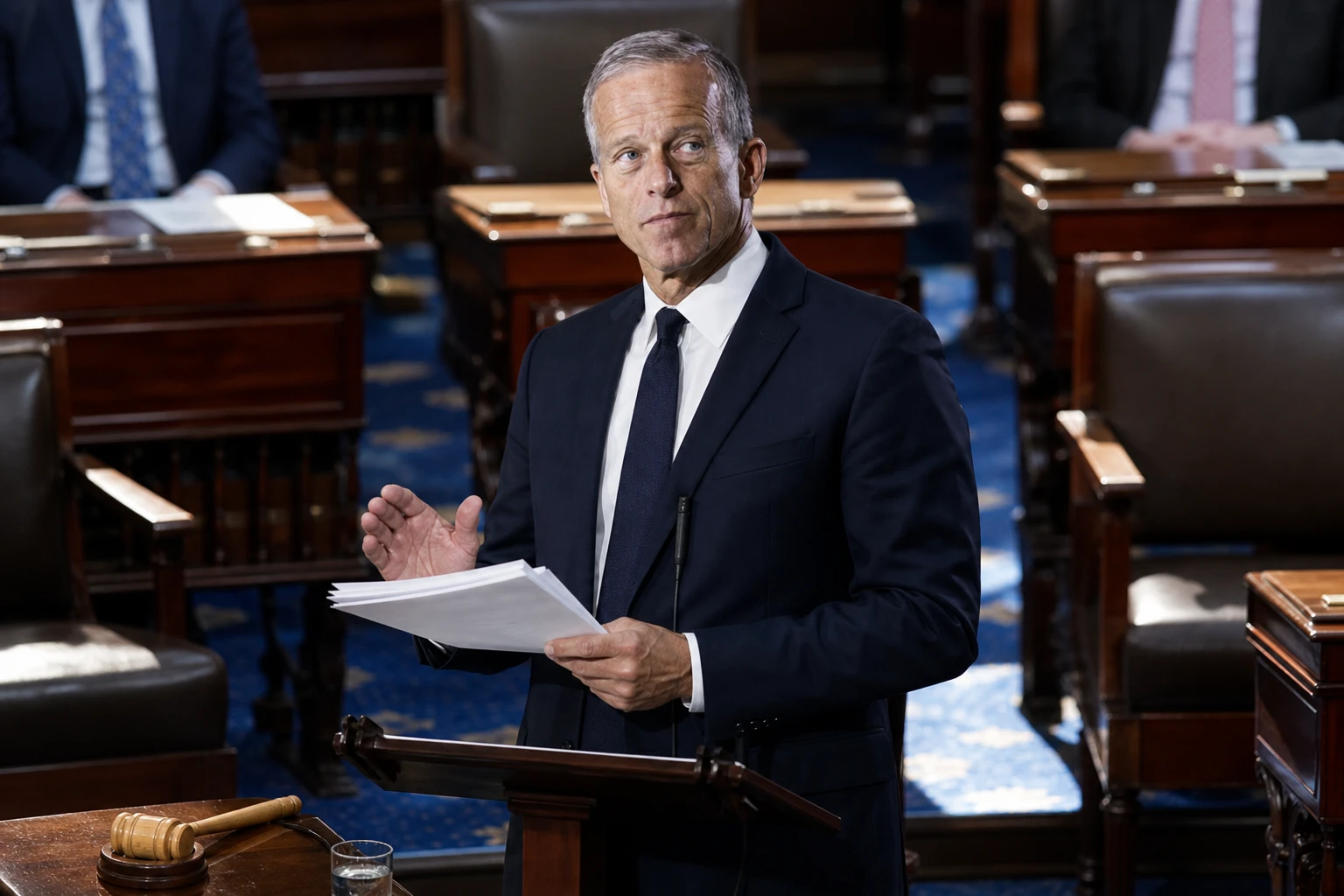
Senate Majority Leader John Thune still wants a CLARITY Act procedural vote this week, but Democrats and a packed floor leave full passage unlikely before.

Senate Majority Leader John Thune said Monday he still expects a preliminary procedural vote on the CLARITY Act before the August recess, even though the crypto market-structure bill remains off the official Senate floor calendar.
Thune told reporters the chamber has “a bunch of stuff that we have to finish, and we’ll just stay here until we finish it.” His list included a continuing resolution, a nominations package, Russia sanctions, the crypto bill’s procedural vote, and the Jonathan Blanche nomination.
Thune Keeps Market Structure on a Crowded Board
“I think market structure we’ll get a vote on. Whether we can get on it or not, we’ll see,” Thune added, according to reporting that matches the Monday interview. The remark keeps H.R. 3633 alive in a week already jammed with must-pass items.
- Continuing resolution to fund the government
- Nominations package covering roughly 74 names
- Russia sanctions legislation that Thune said Democrats are “dragging out”
- Crypto market structure limited to a procedural vote
- Blanche nomination, which he would “ideally” move but would not firmly commit to
Punchbowl News reporter Andrew Desiderio posted the full Thune rundown on X, confirming the crypto item sits as a procedural step rather than final passage.
What the Clarity Act Builds
The bill, formally the Digital Asset Market Clarity Act summary, creates a federal framework for digital commodities. It largely assigns the Commodity Futures Trading Commission oversight of spot digital commodity markets, exchanges, brokers and dealers while preserving Securities and Exchange Commission roles for investment contracts and certain intermediaries.
| Agency | Core Role under CLARITY | Key Requirements |
|---|---|---|
| CFTC | Primary regulator of digital commodities and intermediaries | Trade monitoring, recordkeeping, customer asset protections, BSA AML |
| SEC | Investment contracts, dual-registered brokers, alternative trading systems | Registration exemptions for mature blockchains under sales caps |
| Both | Classification and provisional registration paths | Decentralization tests and issuer reporting for non-mature chains |
House members passed the original version in July 2025. The Senate Banking Committee advanced it 15-9 in May 2026. On July 22 Senator Cynthia Lummis released updated Clarity Act text released July 22 that merges Banking and Agriculture work products and adds an ethics title.
That ethics language bars covered federal officials and spouses from issuing or sponsoring digital assets for consideration while in office, with a 2029 sunset and Attorney General-only enforcement.
The Floor Calendar Still Shows Nothing
Lawmakers returned August 3 to a calendar that listed a 5:30 p.m. cloture vote on H.R. 6500, not H.R. 3633. No cloture petition for the crypto bill had been filed. Crypto analyst Ted Pillows noted the math on X: if leadership waits until Wednesday to file cloture, the earliest vote lands Friday.
- August 3: Senate reconvenes; CLARITY absent from daily schedule
- August 5: latest practical day to file cloture for a Friday vote under normal rules
- August 7: potential procedural vote if cloture is filed mid-week
- August 10: target start of the month-long recess
That leaves almost no time for actual debate before senators leave. Unanimous consent or other shortcuts remain possible, yet the public calendar gives no signal. An earlier two-week Senate window warning already flagged how quickly the calendar can erase momentum.
Democratic Holdouts Still Shape the Odds
Republicans hold 53 seats. Sixty votes are needed to advance most contested bills. On July 22, seven Democrats said the text falls short on ethics for elected officials, consumer protection, illicit finance, conflicts of interest and market integrity. The group included Catherine Cortez Masto, Angela Alsobrooks, Cory Booker, Ruben Gallego, John Hickenlooper, Mark Warner and Raphael Warnock. They pledged to keep negotiating.
Senator Elizabeth Warren has separately opposed the revised draft. Thune has previously conditioned a procedural vote on enough Democratic support materializing. That condition remains live. Tillis ethics package talks that still shape the text show how the White House and Senate negotiators have already tried to close the gap without fully satisfying the holdouts.
What we know
- Thune publicly lists a procedural vote as unfinished business before recess
- Updated text exists and includes ethics and stablecoin yield limits
- Banking Committee already cleared a bipartisan version 15-9
What remains unconfirmed
- Exact day any cloture petition will be filed
- Whether seven or more Democrats will supply the needed votes this week
- Whether leadership will accept a bare procedural test or wait for a stronger deal
Coinbase’s Public Pressure Campaign
Coinbase CEO Brian Armstrong used X on August 3 to frame the week as a test of popular will. Armstrong urged senators to vote yes, writing that the bill “represents a ton of bi-partisan work to finally establish clear rules for crypto in America, which 70% of Americans say we should already have.”
This week we get to see who in the Senate represents the will of the people, and will step up to vote YES on this common sense legislation.
Armstrong argued the measure advances consumer protection, gives law enforcement new tools, keeps activity inside the U.S. perimeter instead of offshore, and opens bank pathways for stablecoins and crypto services. The post drew thousands of likes and hundreds of reposts within hours. Grayscale’s public push for the same recess deadline shows asset managers making parallel noise.
How the Industry Reached This Narrow Gate
Senator Lummis and Senator Kirsten Gillibrand first introduced comprehensive digital-asset framework language years earlier. The House cleared its CLARITY version in mid-2025. Senate Banking and Agriculture spent months reconciling their drafts. The May 2026 committee vote and July 22 text drop were meant to tee up floor action before the long break.
July already saw leadership signal the window might close. Odds tracked by some research desks dropped after Thune’s earlier caution. The Monday comment resets expectations just enough to keep markets and lobbyists watching the daily schedule.
Procedural votes have cleared earlier crypto bills that later stalled. One reply circulating on X called the step “a false signal” that means only agreement to talk, not law. That skepticism tracks the history.
September Becomes the Real Arena if Friday Passes Empty
A successful cloture vote this week would let debate begin and preserve momentum. Failure or simple inaction parks the bill until senators return around mid-September. By then midterm pressures intensify and the same ethics and consumer fights reappear under tighter political oxygen.
Banks that want clearer stablecoin authority, exchanges seeking dual-registration paths, and projects that need a capital-raising exemption all remain in limbo. Offshore platforms continue to operate under lighter rules. Consumer and enforcement groups keep pressing for tougher illicit-finance language.
Thune’s pledge buys one more news cycle. The calendar, the 60-vote math, and the July 22 Democratic statement together write the likelier script: a procedural test if Democrats blink, or a quiet slide into the fall with the same unresolved text. Either outcome leaves the market-structure fight unfinished when the gavel drops for recess.


Bandcamp Boots Boy George Over AI Song, Not Just the Lyrics

Olix Triples to $3.3bn on Optical Bet Against Nvidia

Four Teens Died After Platforms Vowed Fixes and Suits Began

Pixel 11 Pre-Orders Open Eight Hours Before the Event

Aflabox Seed Funds Field Mycotoxin Tests That Beat Lab Delays

2026 Lexus RZ Gains Power and Range Yet Still Falls Short

Ankr Nodes Clear Path for XRPL Institutional Features

Xbox Disc Licenses Turn Physical Games Into Portable Rights

BlackRock Turns Cash Empire Into Stablecoin Reserve Rails

Android 17 QPR2 Beta 2 Locks Out Pixel 6 as December Nears

Kalshi Loses Major NY Prediction Markets Ruling to Judge Torres

Fed Minutes Cite AI Demand as Inflation Risk, Put a 2026 Hike Back on the Map

Marker AI Writing Startup Lands $13M Seed Led by Index Ventures

Dota 2 Esports World Cup 2026: Spirit Defends $2M Title In Paris

Meta’s Muse Spark 1.1 Beats Rivals on Price, Trails on Coding

Finto Picks Munich Over Silicon Valley After YC, Raises $3.4M

ARC Intelligence Closes €4M Seed Round in Roughly a Week

CS2 Premier Season 5 Lands With Cache and a C4 Damage Rework

Backrooms Returns to Theaters as the Everything Must Go Edition

Magnificent Seven Shed $2 Trillion in June as the Rally Broadens
-
 FINANCE2 months ago
Zcash Patched a Double-Spend Bug as ZEC Climbed 5%
-
 ENTERTAINMENT2 months ago
Steam Summer Sale 2026 Locks In June 25 to July 9 Dates
-

 FINANCE1 month ago
CLARITY Act Final Text Expected This Weekend as 60-Vote Hurdle Looms
-
 NEWS3 months ago
Meta Adds AI Replies to Threads, But Users Can’t Block It
-
 ENTERTAINMENT3 months ago
‘Widow’s Bay’ Review: Apple TV’s Sleeper Horror-Comedy Earns Its Fog
-
 NEWS5 months ago
U.S. Navy Deploys Solar-Powered Lightfish Drone to Patrol Oceans
-
 FINANCE4 weeks ago
Kalshi Loses Major NY Prediction Markets Ruling to Judge Torres
-
 NEWS8 months ago
FolderFresh Review: This Free Tool Automates Windows File Organizing