
LIFESTYLE
Hennessey Blackbird Turns Analog Friction Into $2.5M Luxury
Hennessey’s Blackbird pairs an 800-850 hp NA V8 and gated manual with zero screens, limited to 71 cars from $2.5 million as pure driving becomes scarce status.

Hennessey Special Vehicles revealed the Blackbird on August 3, 2026, a Texas-built touring hypercar with an all-new 6.2-liter naturally aspirated V8 targeting 800-850 hp, a six-speed gated manual, rear-wheel drive, and a cabin free of screens. Priced from $2.5 million before taxes and limited to 71 examples worldwide, more than two-thirds are already allocated ahead of its public debut at The Quail on August 14.
The car draws its name and stance from the Lockheed SR-71. It promises 0-60 mph in 2.5 seconds and a 220 mph top speed while weighing under 3,000 pounds. Yet the real pitch is pure mechanical involvement in an era of hybrids, turbos and digital cockpits.
What the Numbers Say
Power comes from a bespoke Ilmor Engineering 6.2-liter V8 built to exceed 9,000 rpm. Hennessey calls it the highest-revving and most powerful naturally aspirated road-car V8 yet. No turbos. No hybrid boost. Just linear throttle and the sound that comes with it.
| Spec | Target |
|---|---|
| Engine | 6.2L NA V8 (Ilmor) |
| Horsepower | 800-850 hp |
| Redline | Over 9,000 rpm |
| Transmission | 6-speed gated manual |
| Drive | Rear-wheel drive |
| 0-60 mph | 2.5 seconds |
| Top speed | 220 mph |
| Curb weight | Under 3,000 lbs |
| Production | 71 units, 2029-2030 |
| Price | From $2.5 million |
Those figures lock together on purpose. An 800-850 hp naturally aspirated engine in a car under 3,000 pounds yields the kind of power-to-weight ratio that once required forced induction. The 2.5-second sprint and 220 mph claim follow from that math rather than from boost maps or electric torque fill.
The chassis is a full-carbon tub with carbon bodywork, adaptive suspension, ABS, traction control and Michelin Pilot Sport Cup 2 tires. That hardware keeps the performance credible while the experience stays mechanical.
Ilmor’s brief was narrow and demanding. Build a road-car V8 that revs past 9,000 rpm, makes its power without turbos or hybrid assist, and still survives daily use. The IndyCar specialists answered with a clean-sheet 6.2-liter unit whose entire character hangs on throttle response and exhaust note rather than peak numbers alone.
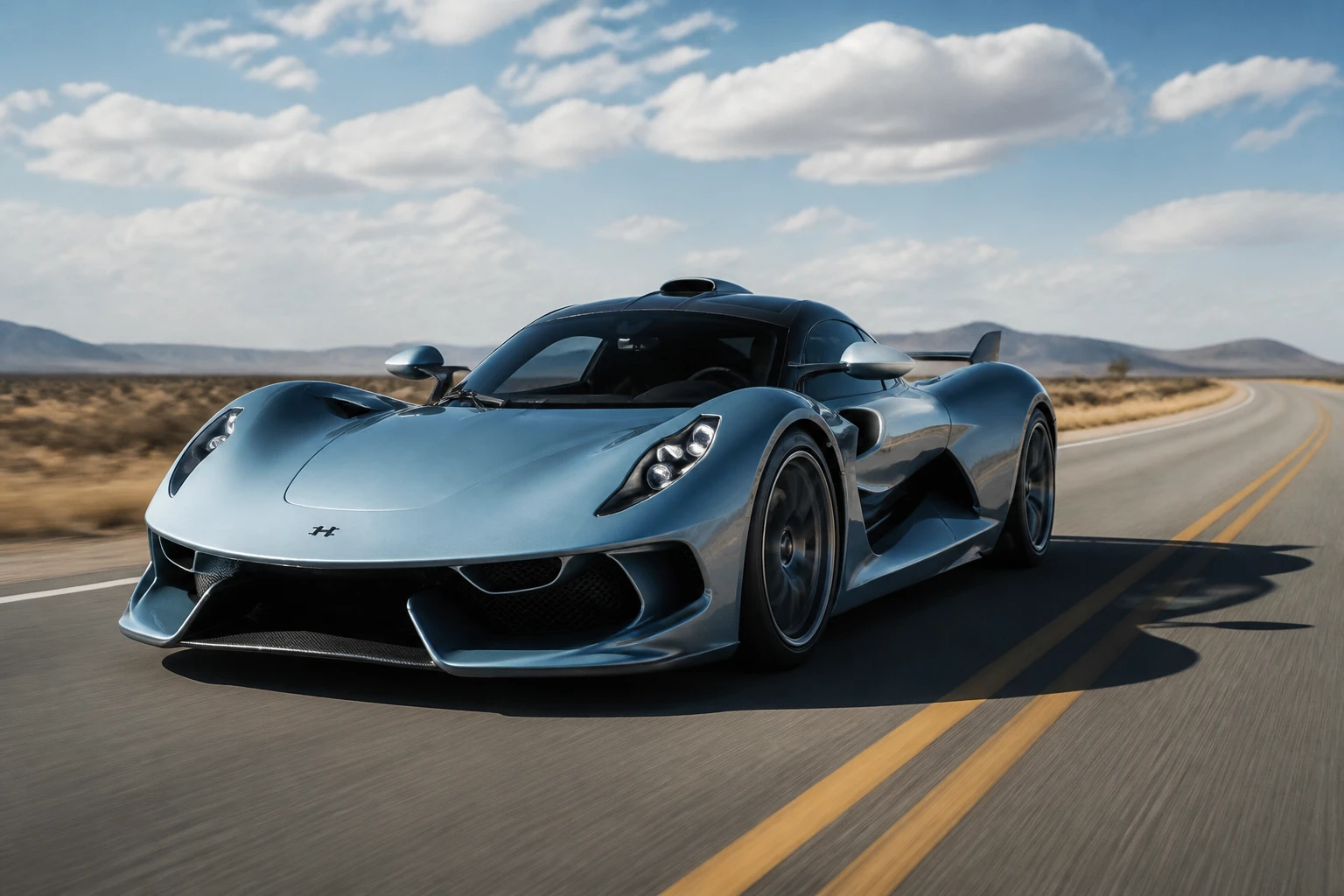
SR-71 Lines and Active Stabilizers
Design director Nathan Malinick shaped the Blackbird around beauty first, free of the 300-mph packaging that dictated the Venom F5. The long stance, crisp body-side chine and disciplined surfaces echo the spy plane. Active vertical stabilizers deploy automatically at 71 mph and sit at +/- 71 degrees, a direct nod to the aircraft’s designation. They can also be raised by the driver at any speed.
Other cues pile up:
- Diamond-shaped quad exhaust inspired by the Bell X-1, the first plane to break the sound barrier
- Formula 1-style side pods and LMP1 winglets
- Optional Sky Glass canopy with asymmetrical tapering
- Gullwing doors that take a section of the sill for easier entry
- Shaker roof scoop feeding the V8 directly
The result looks more elegant and less cartoonish than earlier Hennesseys. It still reads unmistakably American and aerospace.
Every exterior choice serves the same brief. The shaker scoop feeds the engine without complex ducting. The gullwing doors cut into the sill so entry stays practical even with the low carbon tub. The active stabilizers add high-speed stability without permanent wings that would blunt the clean profile at parking speeds. Form and function stay aligned rather than fighting each other.
The Cabin That Refuses Screens
Open the gullwings and the philosophy hits hardest. No infotainment screen. No digital instrument cluster. No buttons on the leather-wrapped steering wheel. A large central analog tachometer dominates. Physical climate controls, an exposed shift linkage for the gated manual, and a real ignition key you twist complete the picture.
What the driver actually faces:
- Central analog tachometer as the primary instrument
- Physical climate controls within easy reach
- Exposed gated-manual shift linkage
- Traditional twist ignition key
- Discreet phone holster with hidden music integration
- Camera feed limited to the rearview mirror for homologation
Phone connectivity and music still work through a discreet holster and hidden integration. The only camera feed appears in the rearview mirror for homologation reasons. Four cup holders, more cabin space than the Venom F5, and luggage room for two full-size carry-ons sit alongside the drama. Hennessey targets low NVH and the ability to cover more than 800 miles in a day.
That combination is deliberate. Screens age. Analog gauges and mechanical linkages do not. The cabin rejects the idea that every surface must display information. Instead it trusts the driver to read the road, the tachometer and the sound of the Ilmor V8.
Why Hennessey Stepped Away From Records
The Venom F5 still owns the extreme end of the range, with production winding down by 2028. Blackbird is the third Hennessey hypercar after the Venom GT and F5, but it measures success differently. Company founder and CEO John Hennessey put it plainly.
Blackbird isn’t just the next chapter in the Hennessey story, it represents the beginning of a new book. Our third hypercar, Blackbird, is unexpected by design, yet it’s exactly what I wanted to create and what our customers have been asking for.
Malinick explained the strategic choice in interviews. Customers often own multiple cars. Putting another 2,000-plus-horsepower missile next to an F5 would make the earlier car feel obsolete. The Blackbird fills the second garage slot as a different kind of experience: usable, beautiful, and engaging at any speed.
He described a broader desire for “a true material connection with the car” without electric motors, all-wheel drive, turbos or screens. The 6-speed gated manual transmission is authentic, not a simulated dual-clutch trick. Every shift is mechanical and deliberate.
The timing reinforces the split. F5 production ends in 2028. Blackbird builds begin in 2029-2030. Owners who already hold an F5 can keep that car’s record-chasing identity intact while adding a machine built for distance and feel. The two cars stop competing with each other inside the same garage.
Touring Hardware Behind the Purity Claim
Hennessey calls the Blackbird a touring hypercar. Adaptive suspension, improved visibility, premium audio and thoughtful storage support that claim. The frunk takes two large carry-ons. Rear-quarter storage and cabin stowage handle the rest. Four cup holders include smaller outer ones sized for energy drinks.
Global homologation is planned. The car keeps traction control and ABS so owners can actually use the performance on public roads. The irony sits right here. Delivering an uncomplicated drive required a clean-sheet carbon structure, a bespoke high-revving V8 from IndyCar specialists Ilmor, active aero, and years of development. Simplicity at this level is an engineering luxury.
Storage and comfort details that back the touring label:
- Frunk sized for two large carry-on bags
- Rear-quarter and cabin stowage for remaining gear
- Four cup holders, outer pair sized for energy drinks
- Low NVH targets for long highway days
- Range ambition beyond 800 miles in a single day
On X, the official Hennessey account framed the car around the connection between driver, machine, and road. Replies zeroed in on the gated manual as the instant sell, then immediately joked about the $2.5 million barrier. Enthusiasts clocked the purity and the price in the same breath.
Traction control and ABS remain present precisely so the mechanical drama can be used on public roads rather than reserved for track days. The touring claim is not marketing softener. It is the reason the car carries adaptive suspension, real luggage space and homologation hardware alongside the high-revving V8 and gated gearbox.
Where It Sits Among Other Driver Cars
The Blackbird joins a small group of recent machines that treat engagement as the product. Gordon Murray’s T.50 and T.33 put a high-revving NA V12 and manual at the center. Singer’s reimagined 911s chase mechanical feel. Porsche’s 911 S/T made limited-edition status out of a pure driver’s package. Ferrari has returned a manual option after a long absence. Bugatti’s Tourbillon uses watchmaker-crafted gauges. Pagani never left the craft lane.
Hennessey’s version adds American V8 character, genuine touring range and a production number low enough to stay exclusive. Two-thirds of the 71 cars spoken for before the Quail debut shows the bet is already working with the target buyers: collectors who already own extreme machinery and want something they will actually drive far and often.
Shared traits across this small peer group remain consistent. High-revving naturally aspirated engines. Manual gearboxes or highly tactile alternatives. Cabins that favor physical controls over glass screens. Limited production that keeps each car rare. The Blackbird meets every point on that list while adding rear-wheel-drive American V8 character and a stated goal of covering more than 800 miles in a day.
The fatigue with seamless tech is real. Self-checkout, instant messaging and cars that calculate the perfect exit line have made friction feel special again. The Blackbird packages that feeling at a price and volume only the top of the market can reach.
The Build Calendar Stretches Across Years
The path from reveal to delivery is deliberately long. Key dates already on the public record form a clear sequence.
- August 3, 2026 – Hennessey Special Vehicles reveals the Blackbird
- August 14, 2026 – Public debut at The Quail
- 2028 – Venom F5 production winds down
- 2029-2030 – Blackbird production window
More than two-thirds of the 71-car run was already allocated before the Quail appearance. That leaves a thin remainder for buyers who wait until the car is shown in public. The multi-year gap between allocation and first deliveries is typical at this price and complexity level. A bespoke Ilmor V8, full-carbon structure and global homologation do not compress easily.
By the time the first cars reach owners, the Venom F5 will have finished its own run. The two model lines will not overlap in production. Collectors can treat them as sequential chapters rather than rivals for the same build slot.
Price and Exclusivity Shape the Buyer Pool
At $2.5 million before taxes and a hard cap of 71 cars, the Blackbird addresses a narrow slice of the collector market. These are buyers who already own extreme machinery and still want a car they will drive far and often. The gated manual and screen-free cabin are the draw. The price and volume are the filter.
Comparison against the car’s own targets makes the positioning plain.
| Element | Blackbird Approach |
|---|---|
| Powertrain | NA V8, no hybrid, no turbo |
| Gearbox | 6-speed gated manual |
| Cabin | Analog tach, no screens |
| Volume | 71 examples worldwide |
| Use case | Touring, 800-plus miles a day |
| Price floor | $2.5 million before taxes |
Production does not begin until 2029-2030. By then the digital status quo will have advanced further, and the 71 owners will hold one of the last clean mechanical statements of the era.
The car proves that rejecting complexity can itself become the ultimate status signal, provided you can afford the wait and the check.


Bandcamp Boots Boy George Over AI Song, Not Just the Lyrics

Olix Triples to $3.3bn on Optical Bet Against Nvidia

Four Teens Died After Platforms Vowed Fixes and Suits Began

Google Health Now Writes Fitbit Data Into Apple Health

Pixel 11 Pre-Orders Open Eight Hours Before the Event

Aflabox Seed Funds Field Mycotoxin Tests That Beat Lab Delays

2026 Lexus RZ Gains Power and Range Yet Still Falls Short

Ankr Nodes Clear Path for XRPL Institutional Features

Xbox Disc Licenses Turn Physical Games Into Portable Rights

BlackRock Turns Cash Empire Into Stablecoin Reserve Rails

Kalshi Loses Major NY Prediction Markets Ruling to Judge Torres

Fed Minutes Cite AI Demand as Inflation Risk, Put a 2026 Hike Back on the Map

Marker AI Writing Startup Lands $13M Seed Led by Index Ventures

Dota 2 Esports World Cup 2026: Spirit Defends $2M Title In Paris

Meta’s Muse Spark 1.1 Beats Rivals on Price, Trails on Coding

Finto Picks Munich Over Silicon Valley After YC, Raises $3.4M

ARC Intelligence Closes €4M Seed Round in Roughly a Week

CS2 Premier Season 5 Lands With Cache and a C4 Damage Rework

Backrooms Returns to Theaters as the Everything Must Go Edition

Magnificent Seven Shed $2 Trillion in June as the Rally Broadens
-
 FINANCE2 months ago
Zcash Patched a Double-Spend Bug as ZEC Climbed 5%
-
 ENTERTAINMENT2 months ago
Steam Summer Sale 2026 Locks In June 25 to July 9 Dates
-

 FINANCE1 month ago
CLARITY Act Final Text Expected This Weekend as 60-Vote Hurdle Looms
-
 NEWS3 months ago
Meta Adds AI Replies to Threads, But Users Can’t Block It
-
 ENTERTAINMENT3 months ago
‘Widow’s Bay’ Review: Apple TV’s Sleeper Horror-Comedy Earns Its Fog
-
 NEWS5 months ago
U.S. Navy Deploys Solar-Powered Lightfish Drone to Patrol Oceans
-
 FINANCE4 weeks ago
Kalshi Loses Major NY Prediction Markets Ruling to Judge Torres
-
 NEWS8 months ago
FolderFresh Review: This Free Tool Automates Windows File Organizing