
ENTERTAINMENT
Howard the Duck at 40 Still Owns Marvel’s First Flop
At 40 the 1986 Howard the Duck remains a Razzie legend, yet its opening haul, B-minus audience grade and MCU cameos show the ironic pioneer that stalled then.

Howard the Duck opened in 1,554 theaters on August 1, 1986, and finished the weekend at number three with a domestic opening of $5,070,136. Forty years later the film still carries the weight of four Razzie wins and a 14 percent Rotten Tomatoes score, yet that same opening proves audiences showed up before the legend calcified.
The duck from Duckworld remains Marvel’s accidental first theatrical feature of the modern era, a live-action gamble that both stalled comic adaptations for a decade and quietly secured the character’s later MCU afterlife. The gap between that first-weekend curiosity and the punchline that followed still defines how the industry talks about the movie.
Third Place Before the Collapse
That first weekend sat behind only Aliens and Friday the 13th Part VI. Top Gun was still hanging around in twelfth place. Howard looked like a contender in a stacked summer that also held The Karate Kid Part II.
Word of mouth evaporated fast. Weekend two dropped 46.4 percent. Weekend three fell another 62.2 percent and lost nearly half its theaters. By weekend four the count sat at 349 screens and the drop hit 65.9 percent. Domestic total settled at $16,295,774.
| Weekend | Drop | Notes |
|---|---|---|
| Opening | – | $5.07M, 1,554 theaters, third place |
| Weekend two | 46.4% | Curiosity faded |
| Weekend three | 62.2% | Nearly half the theaters gone |
| Weekend four | 65.9% | Down to 349 screens |
- $5.07 million opening weekend, third place
- $16.3 million final domestic gross
- $21.7 million international, for roughly $37.9 million worldwide
- B- CinemaScore from opening audiences
International actually out-earned domestic. America turned first and hardest. The B-minus grade from ticket buyers sits miles from the eternal “worst ever” tag that followed. Those opening crowds left with mild approval, not the hostility later reviews assumed. The collapse was a second-week story, not a first-night one.
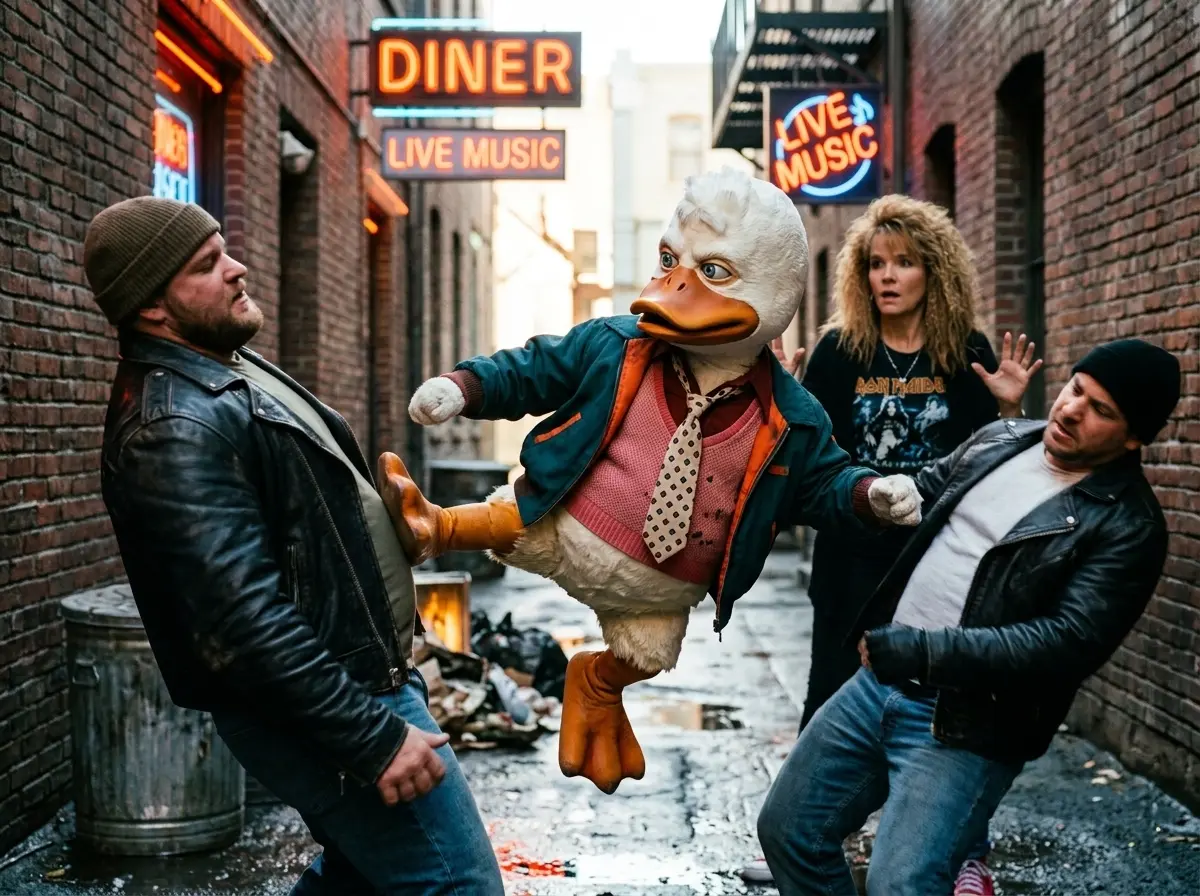
Why the Duck Walked Instead of Floated
George Lucas had loved Steve Gerber’s comic since the American Graffiti days. He brought in film-school friends Willard Huyck and Gloria Katz to write and direct. They wanted animation. Universal needed a summer live-action slot and a contractual obligation forced Lucasfilm to deliver one. Industrial Light & Magic built the suits instead.
That single contractual turn locked every later choice. Animation would have preserved Gerber’s elastic satire. Live-action demanded a physical duck that could share frames with Lea Thompson and Tim Robbins, so the production bent toward effects set pieces the suits could survive.
Key production turns stacked the deck:
- Personality softened from Gerber’s rude, existential cynic into a nicer leading duck
- Satire and surrealism traded for effects set pieces and a Dark Overlord possession plot
- Robin Williams quit the voice after a week, calling the bill-sync “handcuffed”
- Chip Zien took over; multiple suit performers including Ed Gale handled the physical work
- Disney lawyers reviewed the design so Howard would not look too much like Donald
Lea Thompson landed Beverly Switzler after an audition wave that included Tori Amos. Tim Robbins got his first big film role as the lab assistant Phil. Jeffrey Jones played the possessed scientist. John Barry scored; Thomas Dolby wrote the Cherry Bomb songs and even appeared as a bartender. The opening Duckworld sequence still looks inventive. Everything after the crash to Cleveland starts fighting itself.
Once the personality softens and the plot shifts to possession, the film has fewer tools left for the cosmic giggle Gerber prized. Hot-tub gags and nuclear-plant detours fill the space where viewpoint jokes once lived. The suit work and the voice change compound the same problem: the duck has to stay likable enough for a summer crowd, which leaves less room for the rude outsider the comics sent to Cleveland.
The Numbers That Locked the Legend
Budget estimates land between $30 million and $37 million. Worldwide gross of about $37.9 million left the film underwater once marketing and prints entered the math. Universal production chief Frank Price’s exit got pinned on the duck in the trades even though he had not green-lit it.
| Metric | Figure |
|---|---|
| Production budget | $30-37 million |
| Domestic gross | $16,295,774 |
| Worldwide gross | $37.9 million |
| Rotten Tomatoes | 14% (158 reviews) |
| Metacritic | 28/100 |
| Razzie wins | 4 (including Worst Picture, tied) |
| CinemaScore | B- |
The $30-37 million budget and $37.9 million worldwide total became the cautionary spreadsheet every studio cited. Seven Razzie nominations produced wins for Worst Picture (tied with Under the Cherry Moon), Worst Screenplay, Worst Visual Effects, and Worst New Star for “the six guys and gals in the duck suit.”
That spreadsheet mattered more than any single review. A film that barely matched its production cost after prints and ads looked like proof that Marvel properties could not carry theatrical budgets. The four Razzie wins then supplied the easy headline that kept the numbers circulating long after the theaters emptied.
Gerber’s Duck Versus the Screen Version
In the comics Howard arrives via Thog the Nether-Spawn tilting the cosmic axis. He lands near the Nexus of All Realities, teams with Man-Thing, and eventually washes up in Cleveland. Howard’s path from Fear #19 in December 1973 leads to his own 1976 series, a presidential run under the All-Night Party, battles with Doctor Bong and Hellcow, an Iron Duck suit, and later private-eye work with the Guardians.
The film keeps Beverly Switzler, the “trapped in a world he never made” tag, and Quack-Fu. It drops the existential joke Gerber called the cosmic giggle. Life’s serious and dumb moments become interchangeable only by point of view. The movie prefers hot-tub gags, nuclear-plant detours, and an alien tongue sequence that still makes viewers flinch. Gerber later said the finished film “sucks” yet “not quite as sucky as the reviews” after eleven more years of worse movies. He liked the three human leads.
Those retained pieces explain why the character could still travel. Beverly, the tagline, and Quack-Fu gave later writers a recognizable core. The missing cosmic giggle explains why the 1986 tone felt scrambled: without the viewpoint joke, the set pieces had to carry meaning they were never built to hold. Gerber’s measured verdict, years on, tracks with the B-minus CinemaScore more closely than with the Razzie sweep.
Who Took the Hit and Who Walked Away
- August 1, 1986: Theatrical release; opens number three.
- Labor Day 1986: Domestic run effectively over after steep weekly collapses.
- 1987 Razzies: Four wins cement the punchline.
- 1990: Teenage Mutant Ninja Turtles succeeds with better creature work; studios note the difference from Howard’s façade.
- 1998: Blade proves R-rated Marvel can work; the long drought ends.
- 2014 onward: Seth Green voices Howard in Guardians of the Galaxy films, Endgame, and What If…?
- July 14, 2026: 40th-anniversary 4K Steelbook lands.
Lea Thompson has said she took Some Kind of Wonderful partly because she needed another movie after the bomb. Robbins collected overtime double-pay and later shrugged that he thinks more about the money than the quality. Ed Gale still gets more fan mail for Howard than for Chucky. Lucas took the critical darts that attached to his name as executive producer. The character outlasted all of them.
The timeline shows the hit landing on careers and on the Marvel brand at different speeds. Thompson and Robbins moved on within a year or two. The studio caution lasted roughly until Blade. The duck himself waited nearly three decades for the wry cameo treatment that finally matched the comics’ tone.
Studios Read the Duck as a Warning
The cautionary spreadsheet did not stay inside Universal. Other studios watched a live-action Marvel property open in third place and then shed screens by the hundreds. The lesson they drew was simple: comic characters that looked cheap or confused on arrival would not hold a wide release.
Teenage Mutant Ninja Turtles in 1990 offered the counter-example already visible in the timeline. Better creature work and a clearer tone showed the same family audience would turn out when the façade held. Blade in 1998 then proved an R-rated Marvel hero could earn without chasing summer-blockbuster softness. Each success quietly narrowed the shadow Howard had cast.
Early early Marvel casting battles would look different without that long caution. The industry had a ready example of a talking animal property that spent its goodwill in three weekends. That memory shaped how carefully later Marvel films guarded tone, creature design, and opening-weekend exit polls.
The Quiet MCU Afterlife and a Fresh 4K Disc
Howard first pops up as a Collector exhibit in Guardians of the Galaxy. He returns in Vol. 2, survives the Blip off-screen for Endgame, and appears again in Vol. 3. What If…? even gives him a whole “got hitched” episode. The cameos treat him as the wry oddball the comics always preferred. No one asks him to carry a $200 million tentpole.
Lea Thompson later pitched Marvel Studios on directing a new Howard film herself. They passed. The 4K Steelbook still shipped in July 2026 anyway, complete with the original Thomas Dolby tracks. Crowds on X this anniversary weekend split between pure nostalgia rewatches that rate it a cheerful 7/10 and the old punchline routines. Private fondness and public shame keep coexisting.
The cameo strategy solves the problem the 1986 film never could. A few dry lines inside a larger ensemble let Howard stay rude and existential without supporting a romance, a possession plot, and a creature feature at once. Thompson’s pitched revival would have tested whether that smaller version could scale again. Marvel’s pass left the Steelbook and the late-night converts as the main anniversary forms.
The Tone Never Settled on One Genre
The 1986 film never figured out whether it wanted to be Ghostbusters, a romance, or a creature feature. Each mode pulls the others off balance. Ghostbusters energy wants rapid-fire bits and a loose conspiracy. The romance wants Beverly and Howard to share quieter scenes the suit and the bill-sync make hard to play. The creature feature wants the Dark Overlord and the tongue sequence to dominate the final act.
Stacked together, those aims produce the overstuffed feel audiences still argue about. The inventive Duckworld opening belongs to one movie. The Cleveland crash and the lab-assistant plot belong to another. The anniversary split on X, cheerful 7/10 nostalgia beside the old punchlines, mirrors that internal split. Viewers can like pieces without agreeing the pieces form one film.
That split is the ironic residue. The same overstuffed, tonally confused spectacle that made studios allergic to Marvel for years also proved a talking duck could hold the screen long enough for better filmmakers to try again later.
It remains fascinating precisely because it failed so publicly at all three. The duck who just needed a job to support his hairless-ape girlfriend still waits for someone to crack the egg properly. Until then the original botch keeps collecting anniversary steelbooks and late-night converts who discover the B-minus grade for themselves.
Frequently Asked Questions
When was Howard the Duck released and what did it earn?
The film reached U.S. theaters on August 1, 1986. It opened to $5.07 million and finished with $16.3 million domestic plus $21.7 million overseas for a worldwide total near $37.9 million against a $30-37 million budget.
Is Howard the Duck really the first Marvel movie?
It is the first major theatrical Marvel feature since the 1944 Captain America serial. Earlier TV movies and series existed, and some argue 1985’s Red Sonja complicates the claim, but the 1986 film is the one most often cited as the modern starting point.
How many Razzie Awards did it win?
It received seven nominations and won four: Worst Picture (tied), Worst Screenplay, Worst Visual Effects, and Worst New Star for the performers inside the duck suit.
Why was the movie live-action instead of animated?
Huyck and Katz preferred animation. A contractual obligation required Lucas to deliver a live-action project to a distributor, and Universal wanted product for the summer calendar, so ILM built practical suits and effects instead.
Did Howard the Duck’s failure create Pixar?
No. The Graphics Group that became Pixar was spun out of Lucasfilm and incorporated in February 1986 with Steve Jobs’s money, nearly six months before the film opened.


Howard the Duck at 40 Still Owns Marvel’s First Flop

Valve Skin Ban Hits BLAST and Forces CS2 Teams Toward Betting Cash

Oil Crashes Below $80 as Iran Talks Restart and Markets Split

Netflix Screening Erases Fortitude Exclusivity in $105M Cage Suit

Bitget BGBTC Upgrade Turns Idle Bitcoin Into Daily Yield

FFXIV Switch 2 Port Brings Portability With a Second Bill

MacBook Air Delays Reveal AI Memory Crunch Repricing Laptops

Bitcoin BIP-110 Soft Fork Dies on Tiny Miner Support

CXMT LPDDR6 Push Locks In Mobile DRAM Split

Snapchat Hands Spotlight Priority to Human Creators Over AI Farms

Kalshi Loses Major NY Prediction Markets Ruling to Judge Torres

Fed Minutes Cite AI Demand as Inflation Risk, Put a 2026 Hike Back on the Map

Marker AI Writing Startup Lands $13M Seed Led by Index Ventures

Dota 2 Esports World Cup 2026: Spirit Defends $2M Title In Paris

Meta’s Muse Spark 1.1 Beats Rivals on Price, Trails on Coding

Finto Picks Munich Over Silicon Valley After YC, Raises $3.4M

ARC Intelligence Closes €4M Seed Round in Roughly a Week

CS2 Premier Season 5 Lands With Cache and a C4 Damage Rework

Backrooms Returns to Theaters as the Everything Must Go Edition

Trump Calls Iran ‘Islamic Republic of Japan’ as Ceasefire Ends
-
 FINANCE2 months ago
Zcash Patched a Double-Spend Bug as ZEC Climbed 5%
-
 ENTERTAINMENT2 months ago
Steam Summer Sale 2026 Locks In June 25 to July 9 Dates
-

 FINANCE1 month ago
CLARITY Act Final Text Expected This Weekend as 60-Vote Hurdle Looms
-
 NEWS3 months ago
Meta Adds AI Replies to Threads, But Users Can’t Block It
-
 ENTERTAINMENT3 months ago
‘Widow’s Bay’ Review: Apple TV’s Sleeper Horror-Comedy Earns Its Fog
-
 NEWS5 months ago
U.S. Navy Deploys Solar-Powered Lightfish Drone to Patrol Oceans
-
 NEWS8 months ago
FolderFresh Review: This Free Tool Automates Windows File Organizing
-
 FINANCE4 weeks ago
Kalshi Loses Major NY Prediction Markets Ruling to Judge Torres