
NEWS
Aflabox Seed Funds Field Mycotoxin Tests That Beat Lab Delays
Italian agritech Aflabox closed a €1.35 million seed round to scale its UV-AI device that delivers mycotoxin results in under 90 seconds across African and.

Italy-based agritech Aflabox has closed a €1.35 million seed round to scale a portable device that delivers mycotoxin test results in under 90 seconds directly in fields, collection centres and warehouses. The equity came through the FoodSeed accelerator inside CDP Venture Capital’s network, managed by Eatable Adventures, with Farming Future also participating.
Founders Luca Alinovi and Fabrizio Cardillo built the system after watching supply-chain decisions stall while samples waited days for lab results. The capital now funds certification, a micro-factory, deeper AI accuracy and commercial push in Kenya, Nigeria and Italy.
A Scanner That Turns Hours into Seconds
Conventional mycotoxin testing still means specialised laboratories, costly benchtop gear and turnarounds of several hours to several days. Aflabox moves the process to the point of production, storage or trade.
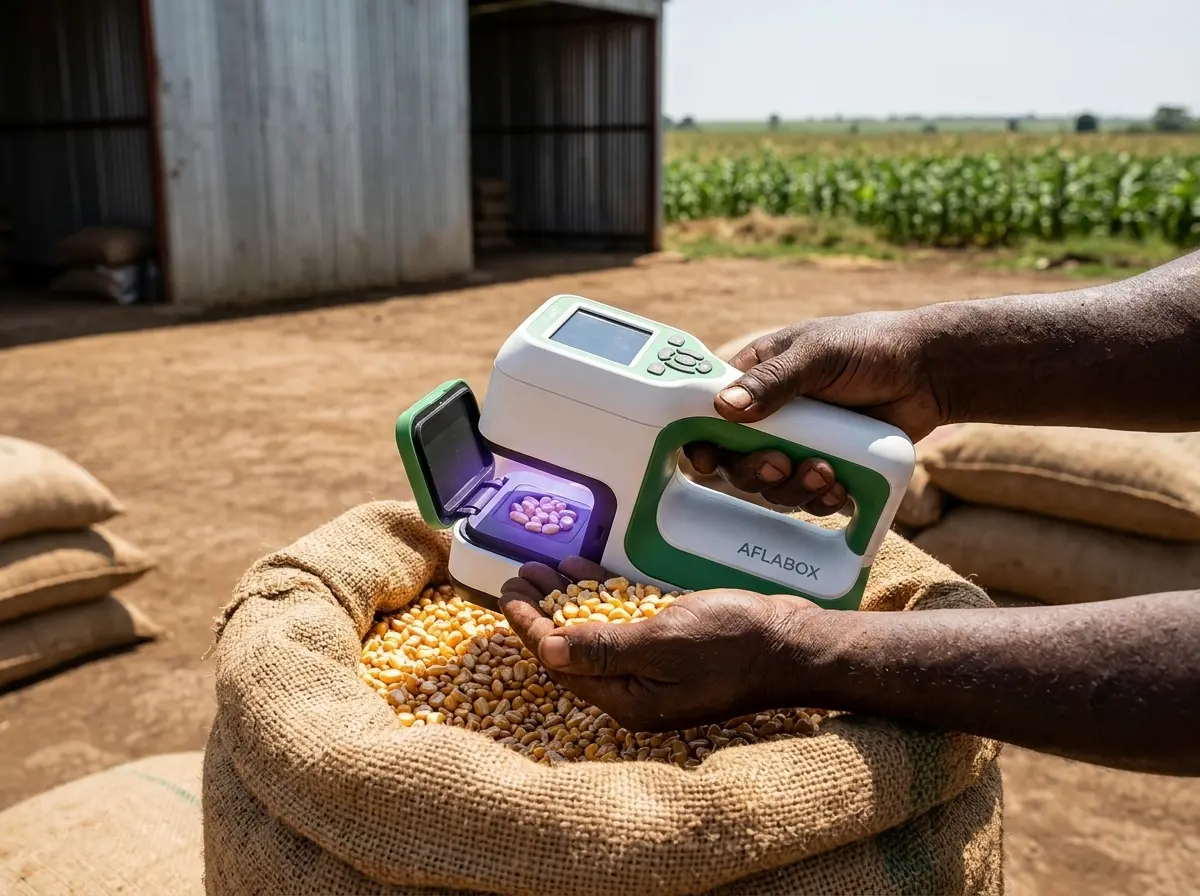
Its portable UV and AI imaging platform combines handheld hardware, ultraviolet and white-light imaging, on-device artificial intelligence, geolocated capture and cloud dashboards. Each scan yields a digital, shareable result while feeding a growing database of contamination, quality and commercial value.
- Portable hardware designed for field and warehouse use
- UV plus white-light imaging of grain samples
- AI models that process images into risk scores
- Geolocated data points that aggregate into territorial maps
- Cloud dashboards for farmers, traders, processors and institutions
The company says the full cycle finishes in less than 90 seconds. That speed lets a collection centre accept or reject a load before it enters storage, rather than discovering a problem after the truck has left.
Why Aflatoxins Still Cost Billions
Mycotoxins, especially aflatoxins produced by Aspergillus fungi, remain a stubborn threat in warm, humid growing regions. They contaminate maize, groundnuts, nuts and other staples, causing liver cancer, immune suppression and stunted growth in children. Acute outbreaks still kill: Kenya’s 2004 episode claimed 125 lives.
Economically the damage is larger. A 2025 review synthesised by the European Commission’s Knowledge for Policy service puts global estimated USD 6 to 18 billion in annual losses from trade rejections, healthcare and lost productivity. Africa alone has long been assessed at more than USD 750 million a year in crop losses. EU border rejections of African shipments for aflatoxin remain routine; one 2024 tally counted 127 consignments blocked for exceeding the 2 ppb AFB1 limit.
| Impact area | Scale cited | Source context |
|---|---|---|
| Global annual economic losses | USD 6-18 billion | Trade, health, productivity |
| Africa crop contamination cost | >USD 750 million/year | Long-standing estimates |
| EU rejections of African goods (example year) | 127 shipments (2024) | Aflatoxin above 2 ppb AFB1 |
| Kenya 2004 outbreak deaths | 125 | Acute aflatoxicosis |
Lab capacity is thin precisely where risk is highest. Smallholder farmers and rural aggregators rarely have affordable, same-day options. Crowd reports from Kenya put single laboratory aflatoxin tests at roughly 5,000 to 7,000 Kenyan shillings, enough to deter routine screening.
Who Moves Faster When Data Arrives on Site
Farmers can grade crops before sale. Collection centres and traders can set purchase prices and storage rules on the spot. Processors and exporters gain stronger traceability for buyers who demand residue proofs. Public bodies and donors can target interventions with maps instead of anecdotes.
Alinovi, who spent years at FAO and brings more than 25 years in food systems, and Cardillo, with deep African market experience, framed the problem plainly. “We created Aflabox in response to a tangible problem we observed directly in the field: when testing is distant, expensive and slow, too many decisions across the supply chain are made without reliable data.”
Our ambition is to build a bridge between Italian technology, African supply chains and international markets, transforming agricultural quality into data that is fast, accessible, geolocated and actionable for businesses, governments and institutions, directly where it is truly needed.
The pair said that in the EU-Startups report on the round. Existing rapid options such as existing rapid lateral-flow mycotoxin kits already cut lab dependence for some users, yet Aflabox adds imaging AI, permanent digital records and the territorial layer that turns individual tests into system intelligence.
Italy Base, Nairobi Operations, Early Wins
Aflabox is headquartered in Sassuolo, Italy, and operates in Kenya through Aflazero Ltd. The company has already supplied 20 devices to the World Food Programme in Kenya and presented at the Cereal Millers Association Annual Technical Conference in April 2026. An initial AI validation phase is complete and a patent application has been filed.
- July 2024, Company founded by Alinovi and Cardillo
- 2025-early 2026, Technology validation and first field units
- April 2026, Commercial debut at Cereal Millers Association conference
- By seed close, 20 devices delivered to World Food Programme Kenya; patent filed
- August 2026, €1.35 million seed closed
José Luis Cabañero, CEO of Eatable Adventures, called the platform “a tangible example of how technology and innovation can help make agrifood supply chains safer, more efficient and more transparent.”
Where the €1.35 Million Lands
The round was completed through the FoodSeed agrifood accelerator programme inside CDP Venture Capital’s National Accelerator Network, managed by Eatable Adventures, with Farming Future, the National Agrifood Tech Technology Transfer Hub, also in. LinkedIn posts from the circle describe Accelera Ventures (linked to Eatable) as co-lead alongside CDP support.
Proceeds target device validation and certification, AI model improvements for higher detection accuracy, establishment of a micro-factory for hardware production, stronger commercial teams in Kenya, Nigeria and Italy, broader distribution across Africa and Europe, and headcount growth. FoodSeed’s standard model offers equity cheques around €250,000 per selected startup with follow-on potential; the larger total reflects additional participation.
The company already sits inside a wider European push to back deep-tech solutions that travel into high-need markets rather than remaining domestic pilots.
The Practical Edge for Export and Local Markets
EU aflatoxin limits remain among the world’s strictest. Exporters who can document low contamination at origin gain negotiating power and fewer border surprises. Domestic markets in East and West Africa also benefit: safer grain means lower chronic exposure for consumers who eat maize daily.
Every geolocated scan feeds maps that governments and agencies can use to prioritise storage upgrades, biocontrol distribution or farmer training. That second layer of value is what separates a simple detector from a field intelligence system.
Aflabox is still early. Certification must finish, manufacturing must scale, and accuracy claims will face independent scrutiny. Yet the core bet is clear: put reliable numbers in the hands of the people who first touch the crop, and both trade and public health move faster.
Frequently Asked Questions
What does the Aflabox device actually measure?
It analyses grain samples for mycotoxins, with a primary focus on aflatoxins, while also supporting commercial quality assessment through UV and white-light imaging processed by AI models that output digital risk and quality scores.
How long does one Aflabox test take from sample to result?
The full cycle from imaging to a shareable digital result is designed to finish in less than 90 seconds, compared with hours or days for conventional laboratory workflows.
Who founded Aflabox and when?
Luca Alinovi, a food-systems specialist with more than 25 years’ experience including time at FAO, and Fabrizio Cardillo, an Africa-market executive, founded the company in July 2024 and base it in Italy with Kenyan operations.
Which investors backed the €1.35 million seed round?
The equity closed through FoodSeed, the CDP Venture Capital National Accelerator Network programme managed by Eatable Adventures, with participation from Farming Future and reported co-lead involvement from Accelera Ventures.
What will Aflabox spend the new capital on first?
Priority uses are device validation and certification, AI accuracy upgrades, building a micro-factory for hardware, commercial expansion in Kenya, Nigeria and Italy, wider African and European distribution, and team growth.


Bandcamp Boots Boy George Over AI Song, Not Just the Lyrics

Olix Triples to $3.3bn on Optical Bet Against Nvidia

Four Teens Died After Platforms Vowed Fixes and Suits Began

Google Health Now Writes Fitbit Data Into Apple Health

Pixel 11 Pre-Orders Open Eight Hours Before the Event

Aflabox Seed Funds Field Mycotoxin Tests That Beat Lab Delays

2026 Lexus RZ Gains Power and Range Yet Still Falls Short

Ankr Nodes Clear Path for XRPL Institutional Features

Xbox Disc Licenses Turn Physical Games Into Portable Rights

BlackRock Turns Cash Empire Into Stablecoin Reserve Rails

Kalshi Loses Major NY Prediction Markets Ruling to Judge Torres

Fed Minutes Cite AI Demand as Inflation Risk, Put a 2026 Hike Back on the Map

Marker AI Writing Startup Lands $13M Seed Led by Index Ventures

Dota 2 Esports World Cup 2026: Spirit Defends $2M Title In Paris

Meta’s Muse Spark 1.1 Beats Rivals on Price, Trails on Coding

Finto Picks Munich Over Silicon Valley After YC, Raises $3.4M

ARC Intelligence Closes €4M Seed Round in Roughly a Week

CS2 Premier Season 5 Lands With Cache and a C4 Damage Rework

Backrooms Returns to Theaters as the Everything Must Go Edition

Magnificent Seven Shed $2 Trillion in June as the Rally Broadens
-
 FINANCE2 months ago
Zcash Patched a Double-Spend Bug as ZEC Climbed 5%
-
 ENTERTAINMENT2 months ago
Steam Summer Sale 2026 Locks In June 25 to July 9 Dates
-

 FINANCE1 month ago
CLARITY Act Final Text Expected This Weekend as 60-Vote Hurdle Looms
-
 NEWS3 months ago
Meta Adds AI Replies to Threads, But Users Can’t Block It
-
 ENTERTAINMENT3 months ago
‘Widow’s Bay’ Review: Apple TV’s Sleeper Horror-Comedy Earns Its Fog
-
 NEWS5 months ago
U.S. Navy Deploys Solar-Powered Lightfish Drone to Patrol Oceans
-
 FINANCE4 weeks ago
Kalshi Loses Major NY Prediction Markets Ruling to Judge Torres
-
 NEWS8 months ago
FolderFresh Review: This Free Tool Automates Windows File Organizing