
BUSINESS
Coinbase Rejects CLARITY Act Draft, Stalling Crypto’s Biggest Bill

The CLARITY Act just hit another wall. Coinbase, the largest crypto exchange in the United States, has told Senate offices it cannot support the latest version of the stablecoin yield compromise. The move threatens to derail months of negotiations and leaves the future of America’s most important crypto legislation hanging in the balance.
What Happened and Why It Matters
9 Coinbase has again opposed the latest version of the CLARITY Act amid a long-running debate over stablecoin yield. According to a Wednesday report from Punchbowl News, Coinbase told the Senate earlier this week that it could not support the latest bill text, which includes a compromise to ease banks’ concerns over stablecoin yield. 9 The report, citing four sources familiar with the matter, said Coinbase expressed “significant concerns” about the latest provisions on stablecoin yield, which were led by Senators Thom Tillis and Angela Alsobrooks.
This is not the first time Coinbase has walked away from the table. 9Coinbase had previously withdrawn its support for the CLARITY Act’s Senate Banking Committee draft text in January, which included a ban on stablecoin yield offerings. CEO Brian Armstrong said at the time that banks were lobbying to stifle competition from crypto platforms.
That January standoff forced the Banking Committee to postpone its scheduled markup hearing entirely. Now, history appears to be repeating itself.
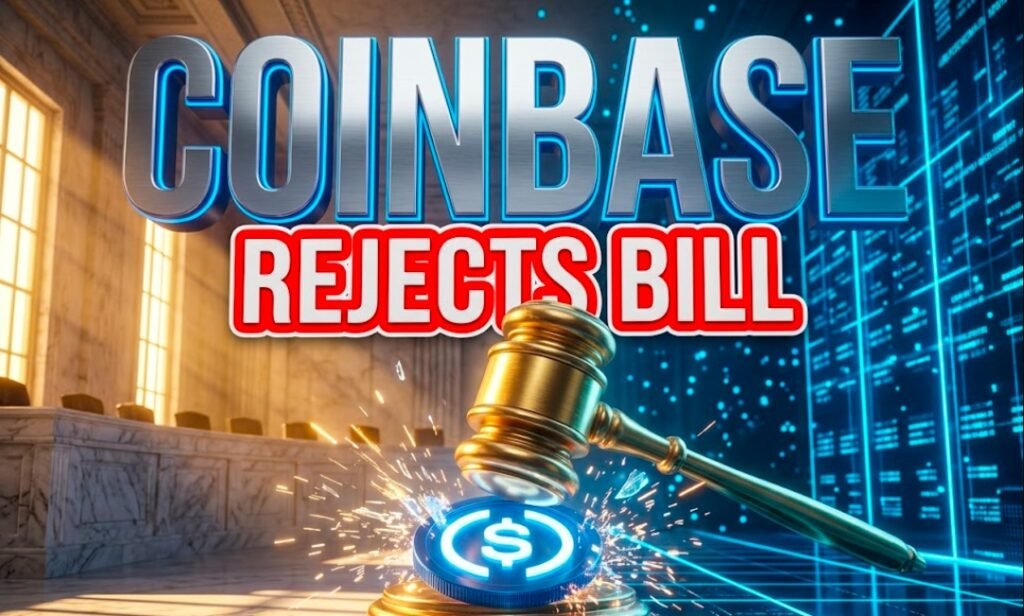
CLARITY Act stablecoin yield ban Coinbase opposition crypto regulation
Inside the Stablecoin Yield Fight
At the heart of this battle is a simple question: should crypto platforms be allowed to pay users rewards for holding stablecoins like USDC?
14
Banks have been pushing hard for this restriction. 11Bankers had argued that stablecoin rewards on holdings of the dollar-tied tokens could closely resemble interest on bank deposits, and any threat to that core component of U.S. banking could put lending at risk.
But crypto firms see the language as too broad and dangerously vague. 16The newest language on stablecoin yield has crypto insiders cringing. Several industry leaders believe future regulators could read the provisions even more restrictively than intended.
Here is how the two sides stack up:
| Banks’ Position | Crypto Industry’s Position |
|---|---|
| Passive stablecoin yield competes unfairly with deposits | Yield drives stablecoin adoption and innovation |
| Rewards must not resemble bank interest | Current draft language is too restrictive and vague |
| Protect traditional lending system | Activity-based rewards alone are not enough |
| Support the current compromise text | The draft differs from what was discussed with the White House |
The Financial Stakes for Coinbase and Circle
The money at risk here is massive.
9 Coinbase reported $1.35 billion in stablecoin revenue in 2025, much of which derived from distribution payments tied to its partnership with Circle on USDC. 32 That accounted for roughly 19% of the company’s total revenue. 32 Unlike trading fees, which fluctuate sharply with crypto prices, stablecoin income is tied to interest earned on reserves backing USDC. That makes it a far more predictable and higher-margin business.
The stock market reaction was swift and brutal:
- 1 Coinbase (COIN) dropped 8% and Circle fell 18% after the CLARITY Act draft emerged.
- 8 The release of the draft caused Coinbase’s stock to drop below $200, closing at $181.10.
- 18 Keyrock digital asset researcher Amir Hajian warned the draft “pulls the rug on the pass-through model that has been driving stablecoin adoption.”
2 Mizuho’s Dan Dolev offered a straightforward assessment. Prohibiting passive stablecoin interest could “reduce the use case for Circle in the near-term,” he noted, while simultaneously diminishing the appeal of maintaining USDC holdings on Coinbase’s platform over the long haul.
Crypto Leaders Split as Industry Conference Call Turns Heated
Coinbase is not alone in its opposition, but it is not getting universal support from the crypto world either.
5 Crypto policy leaders are split over the latest stablecoin yield language. An industry conference call between representatives from crypto exchanges, fintechs, and venture capital firms took place over the draft text, during which some called it unworkable while others defended it.
Meanwhile, banking representatives have signaled they are satisfied. 5A banking representative who reviewed the text told Crypto in America that the stablecoin language appears to reflect the compromise that the senators and the White House set out to achieve.
That gap between what banks accept and what crypto firms reject is exactly why this bill keeps stalling.
7 Senator Cynthia Lummis has urged both sides to reach a compromise, warning that prolonged delays could harm the U.S. financial system. 17 Senator Bernie Moreno has said explicitly that if the bill does not reach the full Senate floor by May, digital asset legislation may not move again before the midterm election cycle makes major votes politically untouchable.
That deadline is real and closing fast.
What Happens Next for the CLARITY Act
The odds of the CLARITY Act becoming law this year are falling. 21As of today, Polymarket shows a 61% probability that the CLARITY Act will be signed into law in 2026. 23Just five days ago, Polymarket traders had assigned a 71% probability to the same outcome.
The bill still has a long road ahead even if this stablecoin issue gets resolved. 12The CLARITY Act still has five sequential hurdles: a Senate Banking Committee markup, a full Senate floor vote requiring 60 votes, reconciliation with the Agriculture Committee version, reconciliation with the House-passed version from July 2025, and a presidential signature.
12 Open questions on DeFi provisions and ethics language, specifically whether senior government officials should be barred from personally profiting from crypto, remain unresolved.
Brian Armstrong’s silence on the latest text is also worth watching. 6In January, he posted publicly on X the night before the Senate Banking Committee’s scheduled markup, announced that Coinbase could not support the bill, and single-handedly caused the hearing to be postponed. 6Armstrong’s silence this time keeps his options open.
The crypto industry came into 2026 believing this would be the year it finally got clear rules in America. The GENIUS Act, signed into law in July 2025, was supposed to be just the warm-up act. The CLARITY Act was meant to finish the job. Instead, the same fight over stablecoin yield that killed progress in January is once again threatening to push crypto regulation past the point of no return for this congressional session. For millions of investors and builders waiting on the sidelines, the frustration is real, and the clock is ticking louder than ever. Drop your thoughts in the comments below.


Replit Opens Its London Office Inside an AI Crowd

Straight Circle Trailer Lands Without a U.S. Date

Anemo Labs Bets £700,000 on an AI Sense of Smell

Nintendo Prices the Zelda 40th Switch 2 at $519

Copilot Capital Buys the Autopilot Already Running 90 GW

Ground A Raises €9.1 Million for a Pallet Laser

Gibney’s Musk Film Opens in Venice Without Its Subject

Torvalds Blames AI for a Full-Fat Linux 7.3-rc2

Dexter Returns Sharper, Older, and Stuck Between Killers

Meta’s Muse Agent Can Spend Before the Privacy Lock

Walter’s TWG Insists No Fraud as Insurer Probes Force Cleanup

30-Year Yield Hits 5.32% Highest Since 2007 as Debt Supply Locks In Costs

PCE Stays at 3.7% as Gas and Tariffs Outrun Coming Revisions

Evernorth S-4 Clears Path for Active XRP Treasury on Nasdaq

Astute’s $1.2M bet makes B2B creator deals feed AI discovery

Strategy Parks $1.59B Cash While Bitcoin Stack Stays Flat

Instinct Hits $2.5 Billion as AI Agent Access Sparks Trust Fights

Oracle’s 2.8 GW Bloom Deal Exposes the AI Power Bypass

CLARITY Act Cloture Opens a Door Ethics Still Blocks

Space Mirror Demo Revives 1993 Russian Night-Light Test
-
 FINANCE3 months ago
Zcash Patched a Double-Spend Bug as ZEC Climbed 5%
-
 ENTERTAINMENT3 months ago
Steam Summer Sale 2026 Locks In June 25 to July 9 Dates
-

 FINANCE2 months ago
CLARITY Act Final Text Expected This Weekend as 60-Vote Hurdle Looms
-
 NEWS4 months ago
Meta Adds AI Replies to Threads, But Users Can’t Block It
-
 ENTERTAINMENT5 months ago
Extraction 3 Is Officially Coming to Netflix in 2027
-

 NEWS3 months ago
YouTube Shorts is testing a heart in place of the thumbs-up
-

 NEWS1 month ago
Senators Force Apple Off Chinese Memory as Big Three Cash In
-

 NEWS3 months ago
NEURA Robotics’ $1.4B Series C Redraws Europe’s Physical AI Bet