
BUSINESS
Carlyle’s Three Co-Presidents Follow the Money Into Credit
Carlyle’s three co-presidents lock PE, credit, and clients as equal seats after credit took the AUM lead, leaving fast-growing AlpInvest outside the triad.

Carlyle seated three co-presidents on January 1, 2026, splitting private equity, credit, and client coverage under CEO Harvey Schwartz. The titles followed a July 28, 2025 announcement and mapped the firm’s money, not a single heir.
Global Credit held $211 billion of assets on June 30, 2026, against $163 billion in Global Private Equity. AlpInvest, the secondaries and solutions arm, sat at $112 billion with no co-president of its own.
The New Year Titles Split Carlyle Three Ways
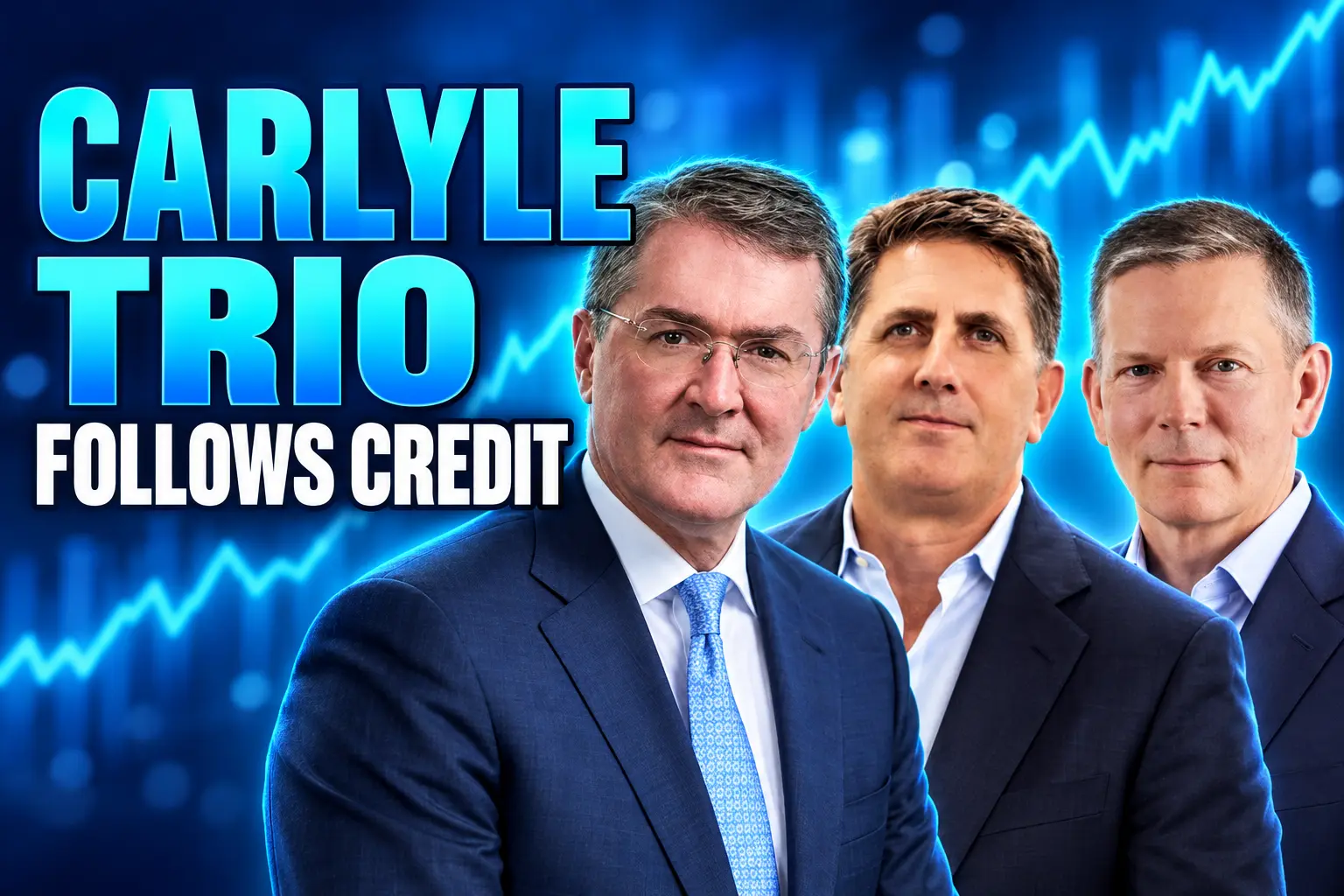
John Redett, Mark Jenkins, and Jeff Nedelman took the newly created co-president roles and kept running three different machines. Redett, who had been chief financial officer and head of corporate strategy since October 2023, moved to Global Private Equity, covering corporate buyouts and real assets. Jenkins kept Global Credit and added insurance. Nedelman kept Global Client Business, which covers investor relations and sales into institutions and wealth channels.
Schwartz said the three would work with him and with chief operating officer Lindsay LoBue. He called them Carlyle veterans whose experience would drive the next phase of growth. Redett stayed CFO through the end of 2025 so the finance seat could change hands on the same morning the co-president titles went live.
These individuals, all Carlyle veterans, are proven leaders whose deep expertise and extensive experience will drive our next phase of growth. I look forward to partnering closely with them, together with Lindsay LoBue, our Chief Operating Officer, as we execute our strategy and deliver significant value to our investors and stakeholders around the world.
Harvey Schwartz, CEO, Carlyle announcement, July 28, 2025
The firm’s ages and duties in its July 8-K listed Redett at 57, Jenkins at 58, and Nedelman at 58 as of that filing, with Justin Plouffe, then 48, named as the incoming CFO. All four already sat in Carlyle’s senior professional ranks and invest in and alongside the funds, the filing said.
THE THREE CO-PRESIDENT BRIEFS
- John Redett: Co-President and Global Private Equity, including corporate private equity and real assets, after joining in 2007 on the financial services team.
- Mark Jenkins: Co-President and Global Credit and Insurance, the seat he has held since joining in 2016 from CPPIB.
- Jeff Nedelman: Co-President and Global Client Business, covering institutions and wealth, after joining in 2023 from Certares.
Nedelman is the newest of the three inside the firm and the one whose brief is closest to inflows. He spent more than 25 years at Goldman Sachs, including as co-chief operating officer of Global Equities and global head of Prime Services, before the Certares stop. Jenkins also did 11 years at Goldman in fixed income and financing, then built CPPIB’s credit platform and led its Antares Capital work. Redett’s own Goldman stint was shorter, from 2005 to 2007, after JPMorgan.
Credit Now Outruns Buyouts on the Books
Carlyle’s second-quarter results published in August put total assets at a record $485 billion as of June 30, 2026, up 4% from a year earlier. Fee-earning assets were $334 billion. Perpetual-capital fee-earning assets were $113 billion, 34% of that fee-earning base. Pending fee-earning assets were $28 billion, up 57% year over year, and capital available to invest was $97 billion.
CARLYLE AUM BY SEGMENT ON JUNE 30, 2026
| Segment | AUM | Year-over-year | Co-President brief |
|---|---|---|---|
| Global Credit | $211 billion | +4% | Mark Jenkins |
| Global Private Equity | $163 billion | -1% | John Redett |
| Carlyle AlpInvest | $112 billion | +16% | None |
Credit’s lead is the structure. Private equity’s 1% decline was a realization story, with $20.1 billion returned from that segment over the prior twelve months, not a freeze in new capital. Inflows in the second quarter were $16.8 billion, including $6.4 billion into private equity, of which $5 billion was earmarked for the next U.S. buyout fund, $5.8 billion into credit, and $4.5 billion into AlpInvest. Trailing-twelve-month inflows were $55.8 billion, up 10%. Deployment was $14.3 billion in the quarter and $53.0 billion over the year.
Schwartz used the August release to talk about cash going back to clients, not about the new titles. Fee-related earnings were $358 million in the quarter. Income before tax on a U.S. GAAP basis was $274 million, a 24.4% margin. The board set a $0.35 quarterly dividend for holders of record on August 17, 2026, paid on August 26.
Carlyle continues to distinguish itself as an industry leader and an outlier in returning capital to our clients, distributing nearly $7 billion during the quarter and $37 billion over the past year.
Harvey M. Schwartz, CEO, second-quarter 2026 results, August 5, 2026
First-half organic inflows were $30 billion, and the firm said a flagship fundraising cycle was still ahead. Wealth is the quiet pressure under Nedelman’s seat. In January 2026, Shane Clifford, global head of wealth, said that channel had nearly doubled since Schwartz became CEO in 2023 and was on track for about 20% of capital flows. That is why a distribution executive sits level with the heads of investing.
Schwartz Already Lived This Org Chart at Goldman
The co-president layer is a bank diagram dropped onto a buyout firm that spent a decade arguing over one successor. Schwartz was president and co-chief operating officer of Goldman Sachs with David Solomon from December 2016. The Goldman board picked Solomon as heir to Lloyd Blankfein, and Schwartz retired on April 20, 2018. He became Carlyle’s CEO on February 15, 2023, after a six-month search that followed the collapse of the prior handoff.
CARLYLE’S TOP JOB SINCE 2018
- 2018: Glenn Youngkin and Kewsong Lee become co-CEOs as founders David Rubenstein, Bill Conway, and Daniel D’Aniello step back from day-to-day running of the firm.
- 2020: Youngkin leaves to run for governor of Virginia, and Lee becomes sole CEO.
- August 2022: Lee exits after a contract fight with the founders. Conway serves as interim CEO, and the search for a permanent chief begins with no successor named.
- February 15, 2023: Schwartz, the former Goldman president and co-COO, takes over as CEO.
- July 28, 2025: Carlyle names three co-presidents, a new CFO, an EMEA investments head, and a vice chairman, all effective January 1, 2026.
- January 1, 2026: The titles take effect. Plouffe appears as CFO on subsequent earnings calls, including the August 5, 2026 review of second-quarter results.
Lee’s exit was the last time Carlyle concentrated operating power in one designated heir while the founders were still on the board. Youngkin’s political departure had already broken the co-CEO pairing. Schwartz’s answer is a single CEO with three co-presidents and a COO, a shape closer to the Goldman office he left than to the founder partnership he inherited.
Public argument around the firm still runs through that Goldman chapter and through whether the cash-return push can close the gap with larger rivals. The co-president titles themselves barely registered once they went live. Carlyle’s January 2026 leadership reset put the names on the door. The asset mix is what the names now have to manage.
Redett Takes the Franchise That Lost the AUM Lead
Putting the CFO on private equity is the personnel bet inside the title change. Redett is a financial-services investor, not a classic industrial buyout partner. He joined in 2007, ran Global Financial Services from 2020 to September 2023 after a co-head stretch from 2016, and only took the finance job in October 2023. His deal list runs through Duff & Phelps, TCW, BankUnited, Hilb Group, EPIC, DBRS, Central Pacific Bank, CFGI, PIB Group, and JenCap. He sits on the boards of Hilb Group and NSM Insurance Group.
That is a useful resume for a platform that now makes more of its living in credit, insurance, and wealth products, and a less obvious one for a U.S. buyout franchise that had a rough fundraising patch. In June 2026, as global PE head, Redett pointed at the U.S. overhaul and said, “It’s actually remarkable how much better that business is.” The next U.S. buyout vintage already had $5 billion of earmarked commitments in the second quarter, before a full flagship launch.
Private equity still throws off the realizations Schwartz is selling to shareholders. The segment’s AUM slipped because money went back to clients, including a heavy U.S. buyout return. Redett’s job is to raise the next funds without letting that engine become a smaller cousin of Jenkins’s credit book. He does it as one of three, not as heir apparent.
AlpInvest Grew Fastest and Still Has No Co-President
The missing seat is the tell. Carlyle reports three segments, and only two of them have a co-president who is also the line investor. AlpInvest, the primaries, secondaries, co-invest, and portfolio-finance platform, grew 16% year over year to $112 billion, the sharpest move on the scoreboard. It still reports through the existing segment head and through Nedelman’s client channel, not through a fourth president.
As of March 31, 2026, Carlyle said AlpInvest had $107 billion of assets and more than 710 investors. On July 15, 2026, it closed AlpInvest Atom Fund II at a $1.7 billion hard cap, above a $1 billion target, and said single-asset continuation-vehicle capacity across that platform had reached $7 billion for the fund’s investment period. Chris Perriello, partner and global head of secondaries, called single-asset continuation vehicles a core pillar of GP-centered secondaries and said the firm had built a dedicated team to lead those deals.
That is a growth business with its own partners, its own fundraising cycle, and its own wealth feed via evergreen products. It is also the segment that most resembles a solutions shop rather than a classic principal-investing silo. Leaving it outside the co-president triad keeps secondaries from becoming a fourth court, and it leaves the fastest AUM line without a peer in the office next to Schwartz.
Jenkins’s credit book is the scale story, Nedelman’s client book is the flow story, and Redett’s buyout book is the brand story. AlpInvest is the compounding story that the org chart did not promote.
Plouffe, Wand, and a Wider Vice Chair
The same effective date moved three other jobs that sit around the new triangle. Plouffe’s jump from deputy chief investment officer for Global Credit into the CFO office is the cleanest of them. He joined in 2007, the same year as Redett, and had been a portfolio manager on cross-platform credit, including Carlyle Tactical Private Credit Fund. He also served as president and CEO of the affiliated business development companies Carlyle Secured Lending and Carlyle Credit Solutions, and as CEO of TCG Capital Markets, the broker-dealer affiliate. He is a CFA charterholder with a J.D. from Columbia Law School.
By February 2026 he was already on the year-end 2025 earnings call as CFO. He was there again in May and on August 5, 2026, which is how the succession actually looked from the outside: a credit investor reading the numbers for a firm whose largest segment is now credit.
OTHER TITLE CHANGES ON JANUARY 1, 2026
- Justin Plouffe: CFO, succeeding Redett, after more than 18 years in Global Credit and the affiliated BDCs.
- Michael Wand: Head of EMEA Investments, expanding a Europe private-equity brief he had run from London after joining in 2001.
- Admiral James Stavridis: Vice Chairman, up from vice chair of global affairs, with the same geopolitical advisory brief he has held since joining in 2018.
Wand’s extra stripe covers all investing in Europe, the Middle East, and Africa and puts him in partnership with the co-presidents on regional growth. His own record is concentrated in technology, including P&I AG, Foundry, and DEPT. Stavridis, the former NATO supreme allied commander, keeps the founder-era habit of parking a statesman near the deal table, now with a vice chairman title. Carlyle said it employed more than 2,500 people in 28 offices across four continents as of the August results.
The January 1 slate left Schwartz as the only CEO, LoBue as COO, and three co-presidents whose jobs match the ledgers. Credit is the largest book. Client coverage is the path for wealth. Private equity is the franchise that has to raise and return at the same time. AlpInvest keeps compounding without a matching title. That is the firm the new office actually runs.
Frequently Asked Questions
Who Are Carlyle’s Three Co-Presidents?
John Redett, Mark Jenkins, and Jeff Nedelman. Redett holds a B.S. from the University of Colorado and an M.B.A. from New York University. Jenkins holds a B.Comm from Queen’s University and sits on the board of Fortitude Re. Nedelman holds a B.A. from UC Berkeley and an M.B.A. from Northwestern’s Kellogg School and sits on Carlyle’s Leadership Committee and New Products Committee.
When Did Carlyle’s Co-President Roles Take Effect?
January 1, 2026, five months after the July 28, 2025 announcement. Redett remained CFO and head of corporate strategy through year-end 2025, and Plouffe remained deputy CIO for Global Credit until the same date, so finance and the new PE brief did not overlap in one person.
Who Succeeded John Redett as Carlyle’s CFO?
Justin Plouffe, a Princeton graduate and former Ropes & Gray attorney who clerked on the U.S. Court of Appeals for the First Circuit. He holds Series 7, 24, 57, 63, 79, and 99 licenses and is a CFA charterholder. He continues as a named executive around the credit products he used to manage, including CTAC and the affiliated BDCs.
What Other Carlyle Titles Changed on January 1, 2026?
Michael Wand became Head of EMEA Investments after leading Europe private equity from London, and Admiral James Stavridis, U.S. Navy retired, became Vice Chairman. Stavridis joined in 2018 after serving as the 16th Supreme Allied Commander at NATO and later as dean of the Fletcher School; he also chairs the Rockefeller Foundation board. Lindsay LoBue stayed COO and is named in Schwartz’s announcement as a partner to the new co-presidents.
Disclaimer: This article is news reporting and analysis of Carlyle’s leadership changes and of figures the firm has published in filings and earnings materials. It is for information only and does not constitute investment advice, a recommendation to buy or sell Carlyle shares or any Carlyle fund, or an offer or solicitation. Readers should consult a licensed financial adviser or other qualified professional before making any investment decision involving the firm or its products. Titles, assets, inflows, and other figures reflect company statements and filings through the August 5, 2026 second-quarter release and may change in later reports.

Copilot Capital Buys the Autopilot Already Running 90 GW

Walmart Puts Dunkin on the App to Sell More Groceries

Molten Bets £100m of Plc Cash on Late-Stage Tech

Ascentiz Recruits Developers Around Its Modular Exoskeleton at IFA

BIS Puts a Public Timestamp Under Official Statistics on XRPL

The Orchard Bug Forced Zcash to Open an Empty Pool

The $5.99 Game That Won Steam’s 2026 Summer Sale

Don Lee Joins Hemsworth as Extraction 3 Starts Shooting

YouTube Shorts Retires Dislikes and Swaps Likes for Hearts

NEURA Robotics Is Spending Its $1.4B on a Machine Stack
-
 NEWS4 months ago
The Orchard Bug Forced Zcash to Open an Empty Pool
-
 GAMING4 months ago
The $5.99 Game That Won Steam’s 2026 Summer Sale
-
 ENTERTAINMENT5 months ago
Don Lee Joins Hemsworth as Extraction 3 Starts Shooting
-
 NEWS3 months ago
YouTube Shorts Retires Dislikes and Swaps Likes for Hearts
-
 NEWS3 months ago
NEURA Robotics Is Spending Its $1.4B on a Machine Stack
-

 AUTO5 months ago
Kawasaki Bets the New Z1100 Against Its Own Supercharger
-

 BUSINESS4 months ago
Norway’s Export Bank Backs Nscale’s $790 Million Narvik Loan
-

 AUTO5 months ago
The Kawasaki Z1100 Awakens Sugomi With Less Peak Power