
BUSINESS
Senate Confirms Kevin Warsh to Fed Board, Chair Vote Looms

The U.S. Senate has officially confirmed Kevin Warsh to the Federal Reserve Board of Governors in a razor-thin 51-45 vote, setting the stage for a historic leadership change at the nation’s central bank. A separate vote to confirm him as the next Fed chair could come as early as Wednesday, just days before Jerome Powell steps down.
Tight 51-45 Vote Falls Along Party Lines
Tuesday’s vote was one of the most politically charged confirmation battles for a Federal Reserve nominee in recent memory. Only one Democrat, Senator John Fetterman of Pennsylvania, crossed party lines to support Warsh.
Every Republican senator voted in favor, while the rest of the Democratic caucus stood firmly against the nomination. It marked the first time in history that a Fed chair nominee received a fully partisan vote at the Senate Banking Committee stage.
Senator Elizabeth Warren, the committee’s ranking member, led the opposition. She called Warsh a “sock puppet” for President Donald Trump and warned that his confirmation would weaken the central bank’s independence. Warsh pushed back on those claims during his hearing, insisting he would act independently.
The vote followed the Senate invoking cloture on Sunday, which capped debate and cleared the path for a final decision on his Board seat. Warsh now returns to the same institution where he served as a governor from 2006 to 2011.
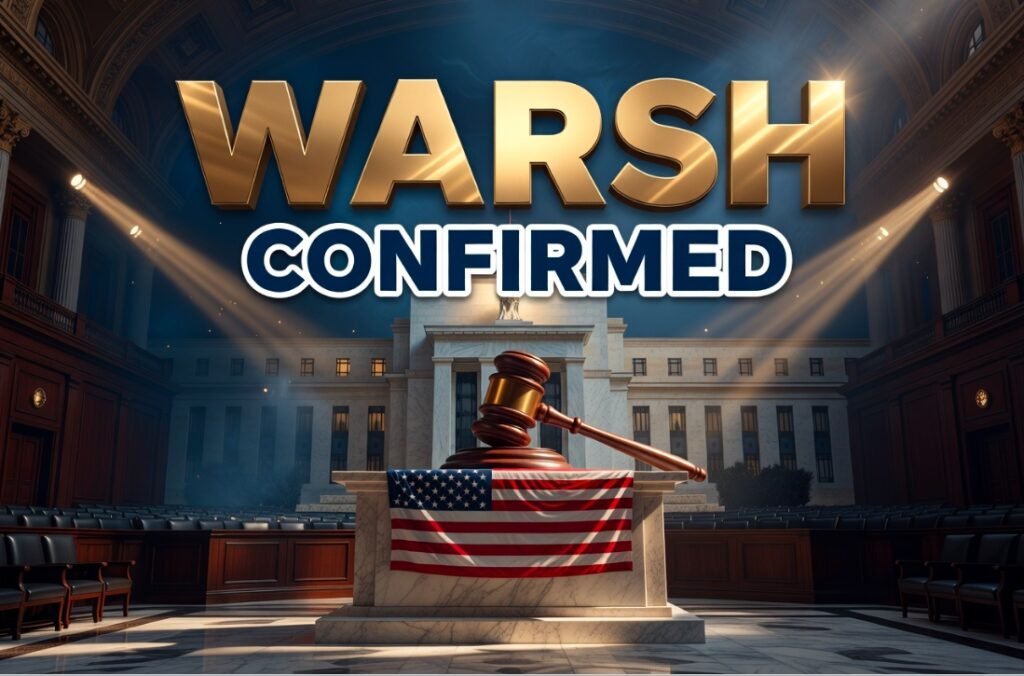
Kevin Warsh Federal Reserve Board confirmation Senate vote 2026
Fed Chair Vote Expected Wednesday
The Senate has already started the 30-hour countdown for the next and more important vote. That vote will determine whether Warsh takes over as Fed chair for a four-year term.
If confirmed Wednesday, Warsh will be ready to assume the top job the moment Powell’s term ends on Friday, May 15.
Powell, who led the Fed for eight years through a global pandemic and the worst inflation spike in four decades, has confirmed he will stay on the Board of Governors until his board term expires in 2028. It is the first time a departing Fed chair has chosen to remain on the board since 1948, when Marriner Eccles stayed under President Truman.
This means Trump will not immediately hold a majority on the seven-member Fed Board. That detail matters, because it limits how quickly any policy shift, including potential rate cuts, can happen under new leadership.
Warsh Brings Pro-Crypto Views to the Fed
What makes this appointment stand out is Warsh’s unusually open stance toward digital assets. During his confirmation hearing, he said crypto is already woven into the American financial system and deserves proper rules, not hostility.
He has publicly called Bitcoin “an important asset” and “a very good policeman for policy.” In his view, Bitcoin’s price movements reflect how much trust the public has in the Fed’s ability to manage inflation.
His financial disclosures revealed a deep web of crypto investments. Key holdings include:
- Equity positions in over a dozen blockchain and digital asset companies
- Investments in major platforms like Solana and Polymarket
- Stakes in DeFi lending, decentralized derivatives, and Layer 2 networks
- Interests in Bitcoin payments infrastructure startups
Warsh also rejected the idea of a central bank digital currency, calling it a “bad policy choice.” That position puts him firmly in line with the Trump administration’s stance on CBDCs.
Before entering public service, Warsh spent seven years at Morgan Stanley, where he worked in mergers and acquisitions and rose to executive director. He later served in the George W. Bush White House before joining the Fed Board at age 35, making him the youngest governor in the institution’s history at the time.
Inflation Hits 3.8% as Rate Hike Talk Grows
Warsh’s confirmation comes at a moment of rising economic pressure. The Bureau of Labor Statistics released April’s Consumer Price Index on the same day as the vote, and the numbers were not reassuring.
Here are the key takeaways from the April CPI report:
- Headline CPI rose 3.8% year over year, up from 3.3% in March
- That figure came in above the expected 3.7%, reaching its highest level since May 2023
- Energy prices surged, accounting for more than 40% of the monthly gain
- Gasoline prices jumped 28.4% on an annual basis
- Core CPI, which strips out food and energy, rose 2.8% year over year
- Real wages turned negative for the first time in a year
Much of the inflationary pressure traces back to the ongoing U.S. conflict with Iran. The war has disrupted oil supplies flowing through the Strait of Hormuz, a corridor that handles roughly 20% of the world’s oil trade. Average gas prices have climbed to $4.50 per gallon, up sharply from $2.98 before the strikes began in late February.
The Fed acknowledged during its April meeting that inflation is now “elevated,” dropping the softer language of “somewhat elevated” it had used previously. That shift in tone caught the attention of traders and economists alike.
Prediction markets now reflect a growing belief that the Fed may actually raise rates this year. Polymarket data shows the odds of a rate hike in 2026 have climbed significantly, while the chances of any rate cut this year have fallen sharply. Most traders are now pricing in zero cuts for the remainder of 2026.
What This Means for Markets and Everyday Americans
Warsh has previously called for “regime change” at the Fed and expressed belief that the benchmark interest rate can come down. But with inflation running nearly double the Fed’s 2% target, his hands may be tied in the near term.
The Fed held its benchmark rate steady at 3.50% to 3.75% during its April meeting, the third consecutive pause. The next meeting is scheduled for June 16 and 17, and it will likely be the first one Warsh chairs if confirmed this week.
For crypto investors, his appointment is a mixed signal. His personal investment history and public statements suggest a more welcoming regulatory environment for digital assets. But his likely reluctance to cut rates quickly could keep pressure on risk assets, including Bitcoin, in the short term.
For everyday Americans, the picture is more immediate. Rising gas prices, higher grocery bills, and shrinking real wages are squeezing household budgets. Workers earned 3.6% more than a year ago on average, but prices rose 3.8%, meaning paychecks are actually losing value in real terms.
The leadership change at the Federal Reserve arrives during one of the most challenging economic periods in years. A new Fed chair inheriting a war-driven inflation spike, political pressure from the White House, and a divided board will face tough choices with no easy answers. Whether Kevin Warsh can steer the economy through this storm while protecting the Fed’s independence is the question that millions of Americans, investors, and global markets will be watching closely. Share your thoughts in the comments below and let us know what you think this transition means for the economy.


Orbio Closes $21M From Dawn Capital to Scale AI Frontline Agents

Honda’s Electric Trial Bike Lands in the Top Five at TrialGP Japan

GTA 6’s November Launch Is Reshaping the 2026 Game Calendar

Qorelo Lands $3.5M Seed to Tackle SAP’s 2027 Migration Crunch

Italian Edtech Sirius Game Raises €1.3M to Scale Primary School Play

Bestie Bite Raises €1.5M to Take AI Video Reviews to the US

European Tech’s €2.8B Week Came With a US Acquirer Twist
Rainn Wilson Calls Out Media’s Double Standard on Platner

OnePlus N6 Confirmed for June 30 India Launch as First N-Series Phone

Munich Court: Google Liable for False Answers in AI Overviews

Zcash Patched a Double-Spend Bug as ZEC Climbed 5%

Steam Summer Sale 2026 Locks In June 25 to July 9 Dates

Amazon Scraps Its Stargate Revival After a 20-Week Writers Room
Citigroup Says ETF Outflows Drove Bitcoin’s Crash, Not Strategy’s Sale
CLARITY Act Floor Vote Likely Shifts to August, Lummis Says
Coinbase Invests in Ethena, ENA Jumps 10% on Open-Market Buy

Gigaton Lands $26M to Replace Heavy Industry’s Control Stack

London AI Lab Inherent Raises $50m to Reinvent Science

Quobly’s €115M Bet to Scale Silicon Quantum Computing

SpaceX Frees 5% of IPO Shares While Locking Musk for a Year
-
FINANCE3 weeks ago
Zcash Patched a Double-Spend Bug as ZEC Climbed 5%
-
ENTERTAINMENT3 weeks ago
Steam Summer Sale 2026 Locks In June 25 to July 9 Dates
-
 NEWS2 months ago
Meta Adds AI Replies to Threads, But Users Can’t Block It
-
 ENTERTAINMENT1 month ago
‘Widow’s Bay’ Review: Apple TV’s Sleeper Horror-Comedy Earns Its Fog
-
ENTERTAINMENT3 weeks ago
Amazon Scraps Its Stargate Revival After a 20-Week Writers Room
-
FINANCE3 weeks ago
Citigroup Says ETF Outflows Drove Bitcoin’s Crash, Not Strategy’s Sale
-
FINANCE3 weeks ago
CLARITY Act Floor Vote Likely Shifts to August, Lummis Says
-
FINANCE3 weeks ago
Coinbase Invests in Ethena, ENA Jumps 10% on Open-Market Buy