
FINANCE
Bitcoin Reclaims $65K on US-Iran Deal, Oil Crashes 4.7%
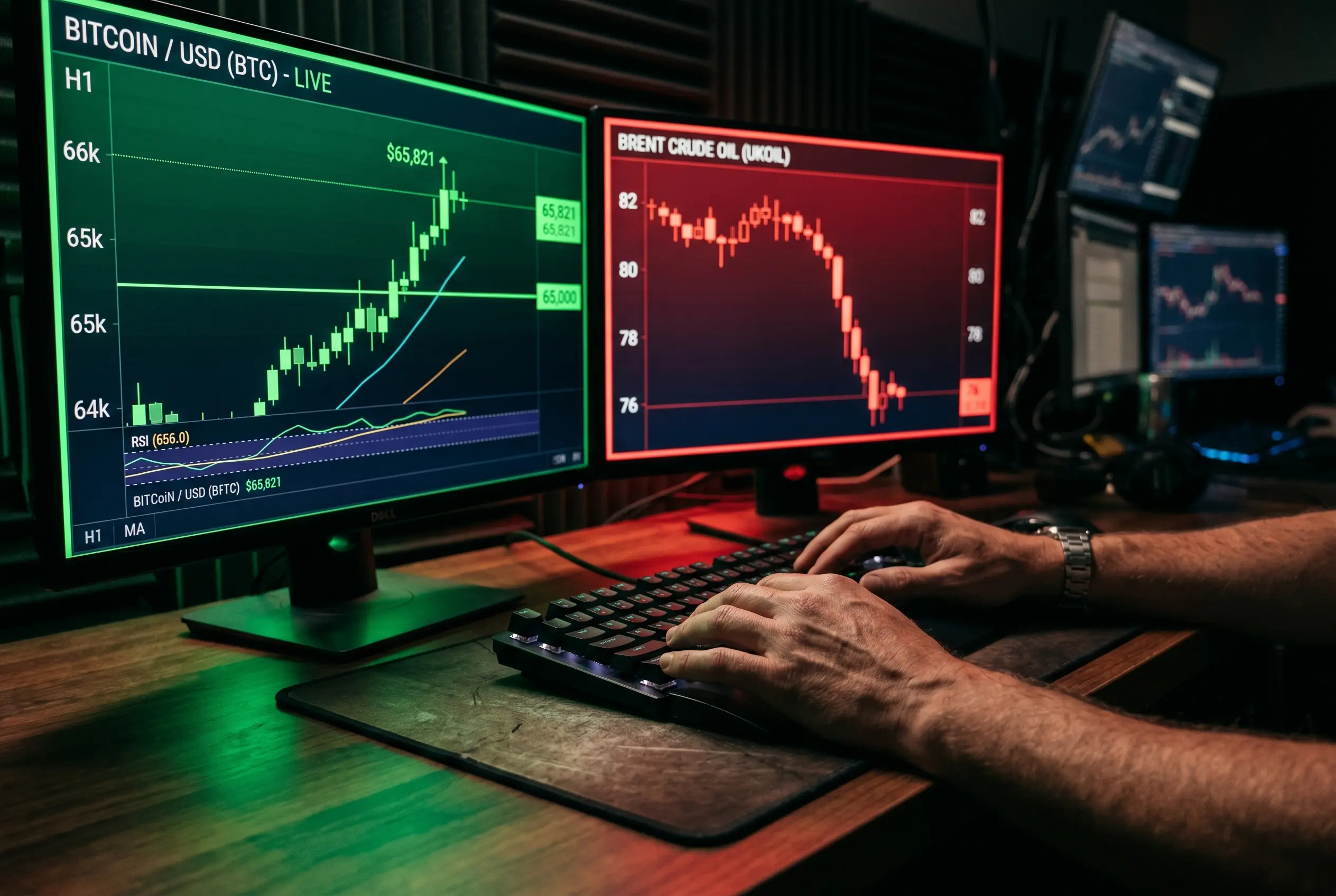
Bitcoin reclaimed $65,000 after Pakistan’s PM confirmed a US-Iran peace deal, signing set for June 19 in Switzerland. Brent fell 4.7%, Asian stocks jumped 5%.

Bitcoin reclaimed $65,000 in Asian trade on Monday after Pakistan’s prime minister confirmed a US-Iran peace deal to end their three-and-a-half-month war, with an official signing set for June 19 in Switzerland. Bitcoin rose 1.77% on the news. Brent crude dropped 4.7% and Asian stock markets jumped 5% in a single session, as the Strait of Hormuz headed back toward normal operations under the deal.
The crypto bounce followed days of selloff during the conflict. Short sellers across the market took losses as the deal news hit.
Bitcoin Bounces Back Above $65,000
The de-escalation trade had a familiar shape. Bitcoin dropped first, then rallied on the news, the same pattern it traced through earlier episodes of the conflict. On June 8, when the US launched retaliatory strikes against Iran, the price fell sharply, and a subsequent bounce to $64,000 wiped out $320 million in short positions inside 15 minutes, per bitcoin.com.
Monday’s session was a smaller version of the same tape. Bitcoin jumped on the news, slipped back, then consolidated. The two-week high was the headline. The move from Friday’s close ran in the low single digits.
Bitcoin had been trading above $64,000 before tumbling below $63,500 earlier in the weekend as Beirut strikes threatened to derail the talks. The deal news reset the market in a single overnight session.
- Bitcoin price: $65,546.29, up 1.77% in 24 hours
- Session high: $65,910
- Shorts liquidated: roughly $150 million across the crypto market
Two Statements, One Announcement
The deal arrived through two parallel channels, and the language in each placed different weight on different parts of the agreement. Pakistan Prime Minister Shehbaz Sharif broke the news in his full post laying out the peace agreement in the early hours of June 15, Pakistan time, framing it as a regional peace pact with Lebanon explicitly included. US President Donald Trump, in a separate post on Truth Social hours later, framed the same outcome as a US-Iran deal that also reopened a vital oil chokepoint.
Sharif’s post, in his own words, said the two sides had “declared the immediate and permanent termination of military operations on all fronts, including in Lebanon,” with a formal signing ceremony scheduled for June 19 in Switzerland. Trump’s post, posted later the same evening in Washington, was more transactional: “The Deal with the Islamic Republic of Iran is now complete. I hereby fully authorize the toll free opening of the Strait of Hormuz, and, simultaneously herewith, authorize the immediate removal of the United States Naval blockade.”
| Speaker | Channel | Core claim | Signing plan |
|---|---|---|---|
| Pakistan PM Shehbaz Sharif | X (June 15, 2:45 am PKT) | End of military operations on all fronts, including Lebanon | Friday, June 19, Switzerland |
| U.S. President Donald Trump | Truth Social (June 14, evening ET) | Deal “complete”; reopen Strait of Hormuz toll-free; lift US naval blockade | Friday, Switzerland (per Sharif) |
The Bigger Move Was in Oil
While Bitcoin moved 1.77%, oil fell twice that and global stocks rose sharply. Brent crude, the global oil benchmark, dropped 4.7% to $83.24 a barrel on Monday, per the BBC, while US West Texas Intermediate for July delivery lost more than 5% to around $80.25, its lowest level since March 10, per bitcoin.com. The Asia session caught the bulk of the move: Japan’s Nikkei 225 closed 5% higher and South Korea’s Kospi ended up 5.2%, with European indexes following higher.
The move unwound a war premium that had pushed Brent from around $70 a barrel before the conflict to a peak near $120 during the fighting. In late March, industry consultant Fereidun Fesharaki had warned that oil could spike to between $150 and $200 a barrel if the Strait stayed closed. The market has been moving in the opposite direction ever since.
European buyers were already positioning for the next leg. The United Kingdom, France, Germany and Italy are reportedly preparing to lift sanctions against Iran, per bitcoin.com, a step that would loosen global supply further and weigh on prices. Cheaper oil, in turn, eases inflation expectations and gives central banks more room to cut.
Bitcoin’s move was a fraction of the action, but it tracked the same direction. As the macro risk premium unwound, the digital asset bounced with the rest of the risk-on complex.
The Strait of Hormuz, but Not Just Yet
The chokepoint at the heart of the deal has been effectively closed since February 28, when the US and Israel launched their first airstrikes on Iran, per the BBC. Around 20% of the world’s oil and liquefied natural gas normally passes through the waterway, according to the same report. Tehran’s threats to attack commercial shipping in the early days of the war collapsed traffic and triggered what analysts called the biggest oil supply disruption in history.
Reopening the Strait and restoring normal flow are different problems. Industry consultants told the BBC that mines would first need to be cleared from the waterway, a process that Andrew Lipow of Lipow Oil Associates said could take from a few weeks to up to six months. A backlog of tankers would then need to clear, production and loading at regional terminals would need to restart, and vessel traffic would have to return to pre-war patterns. Retired US Navy rear admiral Mark Montgomery told the BBC that reaching a “normal pumping balance, and vessels moving in and out smoothly” would take a month or 45 days. Until then, the price action in oil is a forecast, not a settled fact. The chokepoint’s role in global oil transit and Hormuz traffic data is detailed by the US Energy Information Administration.
- Clear mines laid across the waterway (Lipow: a few weeks to six months)
- Work through the backlog of tankers waiting at either end of the Strait
- Restart oil production and loading at regional export terminals
- Reach a “normal pumping balance” (Montgomery: 30 to 45 days)
- Resume smooth, two-way vessel traffic at pre-war volumes
Israel Says It Isn’t Bound
Even as the deal was being celebrated in Washington, Tehran, Islamabad, London and Paris, the Israeli government was signalling that the agreement’s reach stopped at its own border. CBS News, citing Israeli outlet Ynet, reported that Prime Minister Benjamin Netanyahu told Trump that Israel would not withdraw its troops from Lebanon and does not consider itself obligated to the Lebanon-related parts of the US-Iran deal. Ynet cited Israeli sources for the account.
Israel’s far-right National Security Minister Itamar Ben-Gvir went further in a social media post, publicly rejecting the deal’s applicability to Israel. He framed the US-Iran agreement as a non-binding document. His post rejected any obligation on Israel to follow it. Netanyahu received his cabinet’s full backing for refusing to withdraw from Lebanon, per Ynet.
We are not partners to this agreement that does not ensure our security, and it does not bind us in any way. The State of Israel is not a banana republic.
Itamar Ben-Gvir, Israel’s far-right National Security Minister, posted the above on his social media account on June 14, 2026. He called the US-Iran agreement inapplicable to Israel.
Iran’s side kept the same distance in reverse. Iranian Deputy Foreign Minister Kazem Gharibabadi confirmed the text of the memorandum had been finalised, per Iranian state media carried by CBS. He added that the agreement “does not signify trust in the enemy and was drafted in an atmosphere of continued distrust.”
The 60-Day Nuclear Clock
The Friday signing in Switzerland is the public marker. The real work starts the Monday after. Iranian negotiator Abbas Araghchi said, per CBS, that terms dealing with Iran’s nuclear program would be finalised in the 60 days after the initial agreement is signed, opening a negotiating window for sanctions relief in exchange for limits on Tehran’s nuclear work. Sharif’s announcement thanked Qatar, Saudi Arabia and Turkey for their mediation roles. European leaders have signalled their readiness to support the talks.
Sharif’s announcement made the procedural point: mediators will facilitate pre-implementation meetings this week, laying the foundation for the technical talks and the official signing ceremony. UK Prime Minister Keir Starmer, French President Emmanuel Macron and European Council President António Costa all welcomed the deal, with Macron calling for “rapid and complete implementation by all belligerents.” The European Council president said the EU was ready to contribute to a strategy for “lasting peace.”
Bitcoin’s Rally Meets a Fifth Week of ETF Outflows
Monday’s bounce erased the weekend dip, but the structural backdrop is still pointing the other way. Spot bitcoin exchange-traded funds recorded $316 million in net outflows during the week of June 8 to June 12, the fifth consecutive week of withdrawals, per bitcoin.com. The macro shock of an end to the war, though, has so far done more for the price than institutional positioning has done against it.
For now, the macro tailwind from cheaper oil and a calmer Middle East is winning the day. The earlier June bounce to $64,000 already wiped out $320 million in shorts in 15 minutes, and Monday’s session added roughly $150 million more to that running total. The price action traced the same pattern as Bitcoin’s drop on the US strikes against Iran, just in the opposite direction.
The Friday signing in Switzerland is the next scheduled test of whether peace holds long enough for the rally to follow.
Disclaimer: This article is for informational purposes only and does not constitute financial or investment advice. Cryptocurrency markets are highly volatile, and prices can change rapidly. Readers should consult a qualified financial professional before making any investment decisions. Figures cited are accurate as of publication date.


Howard the Duck at 40 Still Owns Marvel’s First Flop

Valve Skin Ban Hits BLAST and Forces CS2 Teams Toward Betting Cash

Oil Crashes Below $80 as Iran Talks Restart and Markets Split

Netflix Screening Erases Fortitude Exclusivity in $105M Cage Suit

Bitget BGBTC Upgrade Turns Idle Bitcoin Into Daily Yield

FFXIV Switch 2 Port Brings Portability With a Second Bill

MacBook Air Delays Reveal AI Memory Crunch Repricing Laptops

Bitcoin BIP-110 Soft Fork Dies on Tiny Miner Support

CXMT LPDDR6 Push Locks In Mobile DRAM Split

Snapchat Hands Spotlight Priority to Human Creators Over AI Farms

Kalshi Loses Major NY Prediction Markets Ruling to Judge Torres

Fed Minutes Cite AI Demand as Inflation Risk, Put a 2026 Hike Back on the Map

Marker AI Writing Startup Lands $13M Seed Led by Index Ventures

Dota 2 Esports World Cup 2026: Spirit Defends $2M Title In Paris

Meta’s Muse Spark 1.1 Beats Rivals on Price, Trails on Coding

ARC Intelligence Closes €4M Seed Round in Roughly a Week

CS2 Premier Season 5 Lands With Cache and a C4 Damage Rework

Finto Picks Munich Over Silicon Valley After YC, Raises $3.4M

Backrooms Returns to Theaters as the Everything Must Go Edition

Trump Calls Iran ‘Islamic Republic of Japan’ as Ceasefire Ends
-
 FINANCE2 months ago
Zcash Patched a Double-Spend Bug as ZEC Climbed 5%
-
 ENTERTAINMENT2 months ago
Steam Summer Sale 2026 Locks In June 25 to July 9 Dates
-

 FINANCE1 month ago
CLARITY Act Final Text Expected This Weekend as 60-Vote Hurdle Looms
-
 NEWS3 months ago
Meta Adds AI Replies to Threads, But Users Can’t Block It
-
 ENTERTAINMENT3 months ago
‘Widow’s Bay’ Review: Apple TV’s Sleeper Horror-Comedy Earns Its Fog
-
 NEWS5 months ago
U.S. Navy Deploys Solar-Powered Lightfish Drone to Patrol Oceans
-
 NEWS8 months ago
FolderFresh Review: This Free Tool Automates Windows File Organizing
-
 FINANCE4 weeks ago
Kalshi Loses Major NY Prediction Markets Ruling to Judge Torres