
FINANCE
Bitcoin Drops as US Launches Retaliatory Strikes on Iran
Bitcoin fell toward $61,400 on June 8 as the US launched retaliatory strikes on Iran after a US Army Apache went down off Oman. Oil, ETFs, and a fragile ceasefire all in play.

Bitcoin extended its slide on Tuesday as the United States launched retaliatory strikes on Iran, adding a fresh geopolitical shock to a crypto market that was already reeling from a week of heavy selling. The U.S. military said its fighter jets hit air defence, ground control stations, and surveillance radar sites in Iran between 22:00 GMT on Tuesday and just before 01:00 GMT on Wednesday, in what Central Command (CENTCOM) called a “proportional response to unjustified Iranian aggression.”
Tehran vowed retaliation, and Bitcoin’s path lower intersected a stack of pre-existing pressures: an ETF exodus, a Strategy sell-off, oil at $93, and a Korean stock market forced to halt trading. The conflict also broke what had been a fragile April ceasefire between Washington and Tehran, the same truce that had briefly calmed energy markets the week before.
The Strike and the Denial
The strikes came hours after President Donald Trump, posting on Truth Social on Monday night, blamed Iran for shooting down a U.S. Army AH-64 Apache helicopter that had gone down off the coast of Oman the previous evening. The aircraft was patrolling regional waters near the Strait of Hormuz when it crashed, U.S. Central Command said, and two crew members were rescued by an unmanned surface vessel about two hours after the crash. The helicopter loss was the first reported loss of a U.S. Apache since the April 8 ceasefire took effect, according to Shafaq News.
Nevertheless, the United States must, of necessity, respond to this attack.
The post was from Donald Trump on Truth Social the night of June 8, 2026, hours before U.S. fighter jets began their strikes on Iran. The CENTCOM statement carried by Al Jazeera described the strikes as “self-defense strikes” and a “proportional response to unjustified Iranian aggression.” Targets included air defence, ground control stations, and surveillance radar sites around Bandar Abbas and Qeshm Island.
Iran denied any role in the Apache downing. Deputy Foreign Minister Kazem Gharibabadi told reporters that Tehran “was not behind the attack” and that there had been “no deliberate action targeting the aircraft,” according to the Iranian denial carried by Shafaq News. Iran struck back almost immediately. Foreign Minister Abbas Araghchi, writing on X, said Iranian forces “will leave no attack or threat unanswered” and warned foreign militaries to “leave our region if you want to be safe.” Iran launched attacks in Bahrain and Kuwait, both of which sounded alerts and fired air defences, and said it had targeted a U.S. air base in Jordan, a claim neither American nor Jordanian officials had acknowledged at the time of the AP’s reporting on the strikes and Iran’s retaliation.
Iranian state television said Israeli strikes had killed at least two members of Iran’s air-defence units, and the fighting marked the most serious escalation between Iran and Israel since the April truce.
Bitcoin’s Path Into the Strike
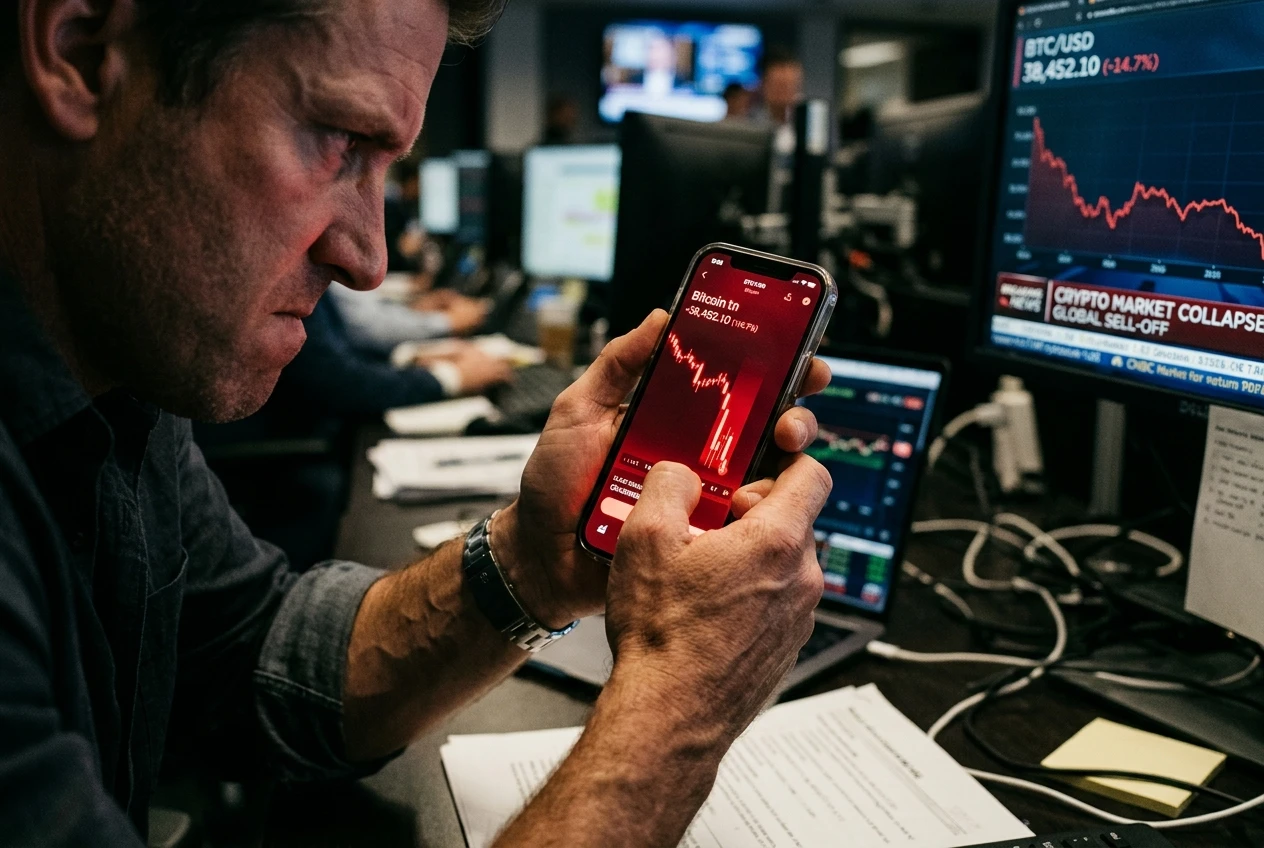
Bitcoin was already deep in a downtrend when the strike landed. According to CoinDesk data, the leading cryptocurrency traded at $61,412.97 on June 8 after pulling back from a Sunday high of $63,776, having touched $62,900 at 04:00 UTC. The same report noted Bitcoin had fallen nearly 14% the prior week, briefly penetrating the $60,000 mark, on a combination of Strategy’s BTC sale, the rotation of capital into AI stocks, and the steady exodus from spot Bitcoin ETFs.
- Bitcoin price (June 8, 2026, CoinDesk): $61,412.97
- Sunday high (June 7): $63,776
- Prior week: nearly 14% decline
- WTI crude (June 8): jumped over 3% to $93.50
- South Korea KOSPI (June 8): fell over 6.8%, trading halted
The Macro Stack the Strike Landed On
The strike did not land in a vacuum. WTI crude futures climbed more than 3% to $93.50 as Iran and Israel traded airstrikes, breaking a fragile ceasefire that had calmed energy markets the week before. South Korea’s KOSPI index fell more than 6.8% on Monday, triggering a temporary trading halt. Japan’s Nikkei dropped more than 3%. Both moves traced back to the same fear the strikes crystallised: that the Strait of Hormuz, a critical lane for oil shipments, could be choked off again.
Bitcoin was already exposed on multiple fronts. Strategy’s recent BTC sale, the rotation of capital into AI stocks and tech IPOs, and spot Bitcoin ETF outflows were the prior week’s main drags, according to Bitcoin’s slide and the KOSPI trading halt reported by CoinDesk. U.S. Treasury yields had surged on Friday after a strong monthly jobs report, and rising yields typically lift the dollar at crypto’s expense.
| Asset | Move | Date | Source |
|---|---|---|---|
| Bitcoin (BTC) | $61,412.97, down from a $63,776 Sunday high | June 8, 2026 | CoinDesk |
| WTI Crude Oil | +3% to $93.50 | June 8, 2026 | CoinDesk |
| South Korea KOSPI | -6.8%, trading halted | June 8, 2026 | CoinDesk |
| Japan Nikkei | -3% | June 8, 2026 | CoinDesk |
The prior week’s losses were already tied to a record ETF exodus, a separate wave of liquidations that wiped out $1.86 billion in leveraged bets, and a Citi read pinning 45% of weekly price moves on ETF flows. A separate blockade-driven squeeze on Iran’s Kharg Island oil hub had already pushed crude higher before Monday’s escalation.
A Ceasefire That Was Already Cracking
The April 8 truce between Washington and Tehran had been on life support for weeks. Sunday’s exchange of airstrikes between Iran and Israel was the most serious fighting since the ceasefire, Stars and Stripes reported, driven by escalating tensions over Israel’s campaign against Iran-backed Hezbollah in Lebanon. Trump, speaking to Axios on Monday, said he was “going to call Bibi right now and tell him not to retaliate.” “Israel had its strike and Iran had its strike,” he said. “We don’t need another one.”
The underlying talks had been going nowhere. The U.S. wants Iran to give up its stockpile of highly enriched uranium, much of which the AP reports is “believed to be entombed in the aftermath of American airstrikes that happened during the 12-day war in 2025.” Iran is refusing and demanding sanctions relief plus the release of frozen assets, even before a final deal. Trump told Stars and Stripes the U.S. was “two or three days” away from a “very, very good, strong, powerful deal,” a forecast he had repeated for weeks.
- Late February 2026: The U.S. and Israel launch strikes on Iran that kill a number of Iran’s top leaders.
- April 8, 2026: A ceasefire takes effect between Washington and Tehran.
- Weeks before the helicopter downing: Intermittent fighting continues and peace talks stall.
- June 7, 2026 (Sunday): Iran and Israel exchange airstrikes in one of the most serious days of fighting since the ceasefire.
- June 8, 2026 (Monday): The U.S. Army AH-64 Apache goes down off the coast of Oman while patrolling regional waters. Two crew are rescued by a drone boat about two hours later. Trump posts on Truth Social blaming Iran.
- June 9, 2026 (Tuesday): The U.S. military launches strikes on Iran, 22:00 GMT to just before 01:00 GMT Wednesday. Iran retaliates with attacks in Bahrain, Kuwait, and (it claims) a U.S. air base in Jordan.
Three Accounts of the Helicopter
The U.S. government’s own account of the helicopter’s downing is still unsettled. Trump, in his Truth Social post, said Iran had “shot down” the aircraft and that the U.S. “must, of necessity, respond.” A U.S. official, speaking to The Associated Press on condition of anonymity, said the Apache had “collided with an Iranian drone” and that it wasn’t clear whether the collision was intentional; official statements only said the crash was under investigation. Al Jazeera, reporting from Washington, said the U.S. military believes the helicopter was brought down by an Iranian Shahed drone, a one-way attack drone, just off the coast of Oman.
Iran’s account flatly contradicts both. Gharibabadi, the deputy foreign minister, said Tehran was “not behind the attack” and there was no deliberate action. The downing is the first reported loss of a U.S. Apache since the April ceasefire, and the helicopter had been operating in waters where the U.S. has enforced a naval blockade on Iranian crude shipments for months. The investigation will likely run longer than the trading week.
The First Drone Rescue at Sea
One piece of the operation is not in dispute. The two Apache crew members were recovered by a 24-foot unmanned vessel called a Corsair, made by Saronic Technologies and assigned to the Navy’s Task Force 59, the U.S. military’s first uncrewed and artificial intelligence unit. CENTCOM spokesman Capt. Tim Hawkins told reporters it was the first known drone rescue at sea by the U.S. military, with the aviators picked up about two hours after the crash at 3:30 a.m. local time Tuesday. The drone boat transferred them to another location on the water, where a helicopter took them to safety.
CENTCOM said the Apache was part of the U.S. blockade enforcement mission that has used attack helicopters to interdict Iranian crude shipments, and that the helicopters have also been used by the United Arab Emirates to shoot down Iranian drones. The Corsair’s role in the rescue, AP reported, was a quiet milestone for the U.S. military’s expanding unmanned surface fleet in the Gulf, one that landed at the same moment the aircraft it came to recover was lost.
By Tuesday evening, both Apache crew members were in stable condition, and Iran’s foreign minister was still on X warning foreign forces to leave the region.


Bandcamp Boots Boy George Over AI Song, Not Just the Lyrics

Olix Triples to $3.3bn on Optical Bet Against Nvidia

Four Teens Died After Platforms Vowed Fixes and Suits Began

Google Health Now Writes Fitbit Data Into Apple Health

Pixel 11 Pre-Orders Open Eight Hours Before the Event

Aflabox Seed Funds Field Mycotoxin Tests That Beat Lab Delays

2026 Lexus RZ Gains Power and Range Yet Still Falls Short

Ankr Nodes Clear Path for XRPL Institutional Features

Xbox Disc Licenses Turn Physical Games Into Portable Rights

BlackRock Turns Cash Empire Into Stablecoin Reserve Rails

Kalshi Loses Major NY Prediction Markets Ruling to Judge Torres

Fed Minutes Cite AI Demand as Inflation Risk, Put a 2026 Hike Back on the Map

Marker AI Writing Startup Lands $13M Seed Led by Index Ventures

Dota 2 Esports World Cup 2026: Spirit Defends $2M Title In Paris

Meta’s Muse Spark 1.1 Beats Rivals on Price, Trails on Coding

Finto Picks Munich Over Silicon Valley After YC, Raises $3.4M

ARC Intelligence Closes €4M Seed Round in Roughly a Week

CS2 Premier Season 5 Lands With Cache and a C4 Damage Rework

Backrooms Returns to Theaters as the Everything Must Go Edition

Magnificent Seven Shed $2 Trillion in June as the Rally Broadens
-
 FINANCE2 months ago
Zcash Patched a Double-Spend Bug as ZEC Climbed 5%
-
 ENTERTAINMENT2 months ago
Steam Summer Sale 2026 Locks In June 25 to July 9 Dates
-

 FINANCE1 month ago
CLARITY Act Final Text Expected This Weekend as 60-Vote Hurdle Looms
-
 NEWS3 months ago
Meta Adds AI Replies to Threads, But Users Can’t Block It
-
 ENTERTAINMENT3 months ago
‘Widow’s Bay’ Review: Apple TV’s Sleeper Horror-Comedy Earns Its Fog
-
 NEWS5 months ago
U.S. Navy Deploys Solar-Powered Lightfish Drone to Patrol Oceans
-
 FINANCE4 weeks ago
Kalshi Loses Major NY Prediction Markets Ruling to Judge Torres
-
 NEWS8 months ago
FolderFresh Review: This Free Tool Automates Windows File Organizing