
BUSINESS
Xi and Trump Bet Three Years, With Taiwan as the Stake
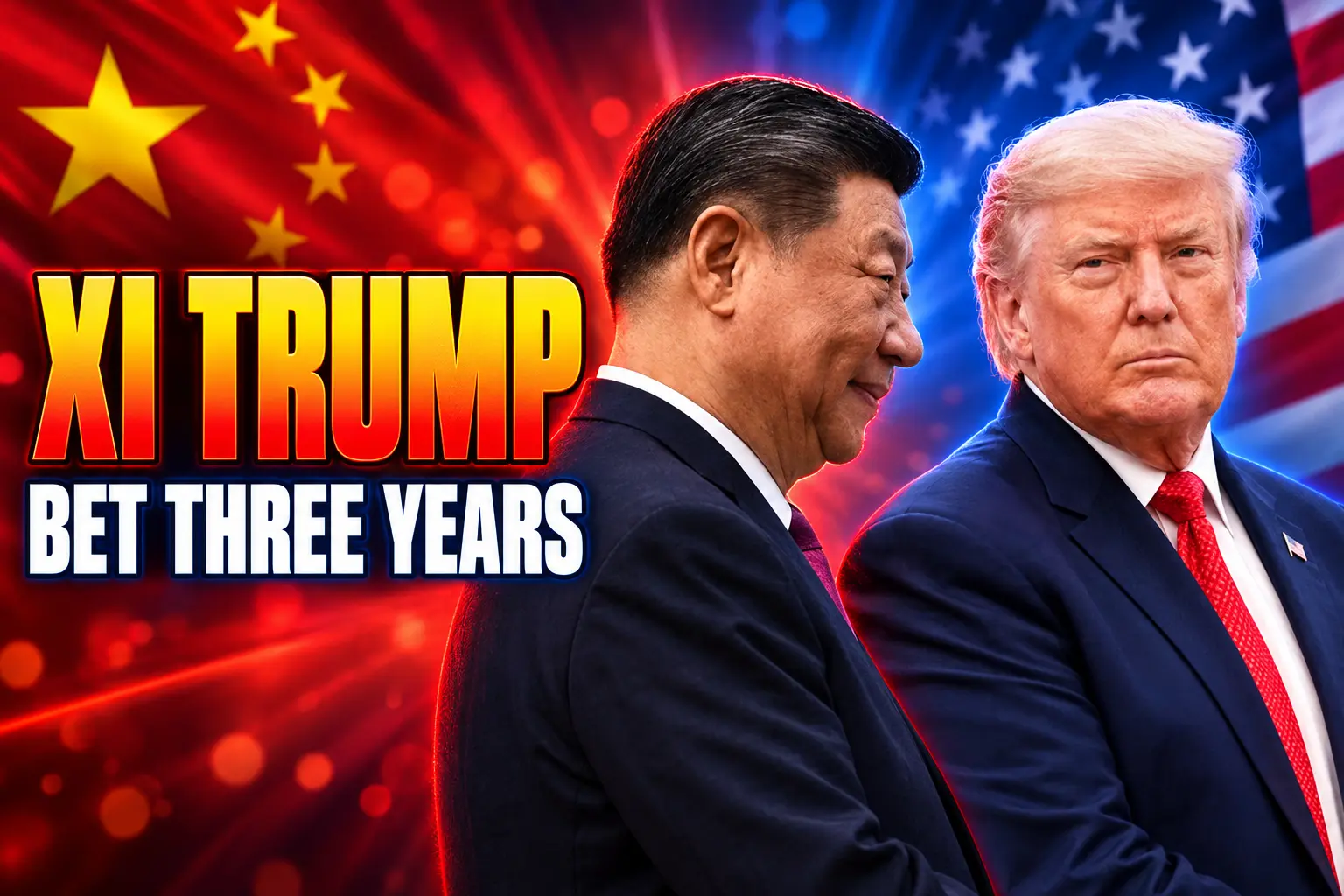
Xi and Trump’s May pact set a three-year clock on China-U.S. relations. Taiwan remains the tripwire as Xi heads to Washington on September 24.

Xi Jinping and Donald Trump agreed on May 14 to a three-year stability pact that treats Taiwan as a tripwire.
In the Great Hall of the People, they endorsed a new frame for China-U.S. relations and pledged to back each other as hosts of APEC and the G20 later in 2026. Xi is due at the White House on September 24, the first test of whether that bet holds.
Xi Put a Three-Year Clock on the Relationship
Honor guards lined the square outside the eastern entrance of the Great Hall before the talks began. The band played both national anthems, a 21-gun salute sounded on Tiananmen Square, and Trump reviewed a People’s Liberation Army guard with Xi beside him.
Cai Qi, Wang Yi, and Vice Premier He Lifeng sat in on the meeting. Trump asked each of the U.S. business leaders traveling with him to present themselves to Xi, and he said he had brought “the best representatives of American businesses.”
Xi called the moment a chance to “steer the giant ship of China-U.S. relations” and to make 2026 a landmark year. He said the two men had agreed on a three-year strategic stability vision that would guide the relationship “over the next three years and beyond.”
Trump answered in personal terms. He called Xi “a great leader,” said they had “the longest and greatest relationship the presidents of the two countries have ever had,” and described the session as “the biggest summit the world is watching.” He said the two countries could “do a lot of big and good things” if they handled differences and kept talking.
It was the first U.S. presidential visit to China in nearly a decade. The ceremony did the work visits like this always do. The clock did the rest.
What Constructive Strategic Stability Means in Practice
Xi defined the phrase in four parts and then said it was not a slogan. Cooperation would sit at the center, competition would stay inside limits, differences would stay manageable, and peace would be something both sides could plan around.
XI’S FOUR KINDS OF STABILITY
- Positive stability: Cooperation is the mainstay of the relationship, not a side project.
- Healthy stability: Competition continues, but inside what Beijing calls proper limits.
- Constant stability: Differences stay manageable rather than spilling into crises.
- Lasting stability: Peace is expected, which is another way of saying both sides can plan.
He told Trump the two governments should use political, diplomatic, and military-to-military channels more often, and should widen work on trade, health, farming, tourism, people-to-people ties, and law enforcement. The U.S. version of the same phrase, issued after the trip, added “on the basis of fairness and reciprocity.”
That extra clause is the wager in miniature. Beijing wants a floor under the rivalry. Washington wants the floor to come with matching concessions. Neither side published a list of what would count as a breach.
200 Jets and a $30 Billion Tariff Cut
Xi said the economic teams had already produced “generally balanced and positive outcomes” the day before the Great Hall meeting. Those talks ran on May 12 and 13 in the Republic of Korea, where He Lifeng sat down with Treasury Secretary Scott Bessent to clear the path for the presidents.
China’s commerce ministry, speaking on May 20, confirmed a purchase of 200 Boeing aircraft, with the United States guaranteeing engines and spare parts. The ministry also said both sides had agreed in principle to matching tariff cuts on products of equivalent scale, worth $30 billion or more on each side, with those goods moving toward most-favored-nation rates or lower.
Trump told reporters the Boeing order could rise as high as 750 planes. That figure is his ceiling, not the number China put in writing. In 2017, during his first visit to Beijing, China had agreed to buy 300 Boeing jets. The 2026 tranche is smaller, and the ministry did not name models or delivery dates.
The same package pointed to a Board of Trade and a Board of Investment, work on farm barriers (dairy and aquatic detentions, Penjing plants in growing media, and recognition of Shandong as free of highly pathogenic avian influenza), restored registration for eligible U.S. beef exporters, and a review of rare earth export licences for civilian use. Both sides also talked about extending the Kuala Lumpur tariff truce, which expires in November 2026.
THE MAY TRADE LIST
| Item | May announcement | September status |
|---|---|---|
| Boeing aircraft | 200 jets, with engine and parts supply guaranteed | Models and delivery dates unpublished |
| Tariffs | Matching cuts on $30 billion or more each side | Board of Trade still being designed |
| Farm goods | Dairy, aquatic products, Penjing, beef, Shandong bird-flu status | U.S. officials say purchases are ramping up |
| Rare earths | Review of civilian export licences | No public timetable released |
| New boards | Board of Trade and Board of Investment | USTR asked for comment on June 2 |
The commercial map around those promises has already shifted. Chad Bown of the Peterson Institute for International Economics, using government data, puts China’s share of U.S. goods imports at 7.5% in the first quarter of 2026, down from 22% in 2017. The May package tries to rebuild selected lanes (planes, farms, a slice of tariffs) without putting that wider shift into reverse.
Taiwan Is the Line That Can Break the Pact
Xi used the sharpest language of the day on Taiwan. He called it the most important issue in China-U.S. relations and said mishandling it would put the entire relationship in jeopardy.
The Taiwan question is the most important issue in China-U.S. relations. If it is handled properly, the bilateral relationship will enjoy overall stability. Otherwise, the two countries will have clashes and even conflicts, putting the entire relationship in great jeopardy.
Xi Jinping, talks with Donald Trump, Great Hall of the People, May 14, 2026
He added that “Taiwan independence” and cross-Strait peace “are as irreconcilable as fire and water,” and that the U.S. side “must exercise extra caution.” Beijing wrote those lines into the public record the same afternoon. The White House readout of the meeting left Taiwan out.
On the flight home, Trump said he and Xi “talked a lot about Taiwan,” that he had “heard him out,” and that he “didn’t make a comment.” He said he was “not looking to have somebody go independent,” and that the last thing Washington needed was “a war that’s 9,500 miles away.” Asked later whether he would call Taiwan’s president, Lai Ching-te, he said, “Well, I’ll speak to him. I speak to everybody.”
Lai answered on May 17. He wrote that “there is no ‘Taiwan independence’ issue,” that “Taiwan, the Republic of China, is a sovereign and independent democratic country,” and that the island “will not provoke, will not escalate conflict, but will not under pressure give up national sovereignty.” He also argued that continued U.S. arms sales remain necessary because China has not ruled out force.
A pending arms package for Taiwan remained under White House review in September. There was no public call with Lai as the Washington visit drew near. The pact’s own terms make that silence part of the wager: if Taiwan is handled “properly,” the rest of the relationship can hold; if not, Xi has already described the failure mode.
Shenzhen, Miami and the Rest of the Year
The two presidents agreed in Beijing to support each other in hosting the APEC Economic Leaders’ Meeting and the G20 summit in 2026. That promise is now a calendar, not a toast.
THE 2026 MEETING CALENDAR
- May 12 and 13, 2026: He Lifeng and Scott Bessent hold trade talks in the Republic of Korea.
- May 14, 2026: Xi and Trump meet in the Great Hall and announce the three-year frame.
- May 20, 2026: China’s commerce ministry confirms the 200-jet Boeing order and the $30 billion tariff slice.
- June 2, 2026: The U.S. trade representative asks for public comment on a China trade mechanism.
- September 1, 2026: Bessent closes G20 finance talks without a full consensus.
- September 24, 2026: Xi is due at the White House for a one-day visit and a state dinner.
- November 18 and 19, 2026: China chairs the 33rd APEC leaders’ meeting in Shenzhen.
- December 14 and 15, 2026: The United States chairs the G20 at Trump National Doral Miami.
China is hosting APEC for the third time, and for the first time in 12 years. The China Council for the Promotion of International Trade said the CEO gathering on November 17 and 18 will bring together about 1,000 political and business representatives, beside the APEC Economic Leaders Meeting in Shenzhen. The foreign ministry has described a “China Year” of about 300 events. The leaders’ theme is “Building an Asia-Pacific Community to Prosper Together.”
They also exchanged views in May on the Middle East, the Ukraine crisis, and the Korean Peninsula. No public commitments came out of those passages. The published product was the three-year phrase, the trade list, and a year with too many summits to treat any one of them as a one-off.
The New Trade Boards Still Lack Operating Rules
The Board of Trade and the Board of Investment were the institutional heart of the May package, the thing that would turn a photo session into a process. Four months of that process have produced a comment file, not a rulebook.
On June 2, the Office of the U.S. Trade Representative asked for public comment on the trade board, describing “the scope and operation of a mechanism to promote balanced and reciprocal trade with China.” By September, no public operating rules, member lists, or meeting dates had been issued for either board. U.S. Trade Representative Jamieson Greer has said he expects announcements on the Board of Trade and farm sales during Xi’s Washington visit.
The wider economic track is already showing strain. Bessent closed G20 finance meetings on September 1 by saying the group could not reach a full consensus, and the United States issued a chair statement that China did not join. That split, three weeks before the White House visit, is a reminder that a leader-level slogan does not automatically travel into the rooms where communiqués are drafted.
Andrew Harding, a Heritage Foundation policy analyst, wrote on September 9 that the Washington meeting should be judged by whether China makes measurable progress on May’s promises, not by how many new deals are announced. Diplomacy at the top and rivalry below have kept moving at different speeds. The boards were supposed to be the hinge. In September they were still a press release.
Washington Gets One Day With Xi
Trump confirmed on September 4 that Xi and Peng Liyuan will visit on September 24, with a state dinner on the schedule. Xi is expected to spend one day at the White House and has no plans to attend the United Nations General Assembly around the same dates. He is preparing a large business delegation, a mirror of the U.S. chief executives who stood up one by one in Beijing.
Expectations are lower than the calendar implies. Neither side looks ready to give much ground on Taiwan, on advanced technology, or on the farm and tariff details that were left open in May. The September 24 Washington summit is a maintenance stop on a three-year clock, not a second founding.
WHAT WE KNOW
- The date: Xi is scheduled to meet Trump in Washington on September 24.
- The format: One day at the White House, a state dinner, and no UN General Assembly appearance.
- The commercial cast: A large Chinese business delegation is being assembled to match Trump’s May entourage.
- The open U.S. ask: Greer has pointed to the Board of Trade and farm sales as likely announcement lines.
WHAT IS UNCONFIRMED
- Boeing paper: Aircraft models, airline buyers, and delivery years for the 200 jets have not been published.
- Board rules: No public charter, roster, or first-meeting date exists for either new board.
- Taiwan arms: The pending package remains under White House review, with no new sale announced.
- A Lai call: Trump said he speaks to everybody; no call with Taiwan’s president has been scheduled in public.
Xi is due at the White House on September 24. APEC follows in Shenzhen in November. The G20 lands at Trump National Doral Miami on December 14 and 15. The three-year phrase from May will have to live through all three, or it will stay what Xi said it must not be, a slogan with a ceremony attached.

Copilot Capital Buys the Autopilot Already Running 90 GW

Walmart Puts Dunkin on the App to Sell More Groceries

Molten Bets £100m of Plc Cash on Late-Stage Tech

Ascentiz Recruits Developers Around Its Modular Exoskeleton at IFA

BIS Puts a Public Timestamp Under Official Statistics on XRPL

The Orchard Bug Forced Zcash to Open an Empty Pool

The $5.99 Game That Won Steam’s 2026 Summer Sale

Don Lee Joins Hemsworth as Extraction 3 Starts Shooting

YouTube Shorts Retires Dislikes and Swaps Likes for Hearts

NEURA Robotics Is Spending Its $1.4B on a Machine Stack
-
 NEWS4 months ago
The Orchard Bug Forced Zcash to Open an Empty Pool
-
 GAMING4 months ago
The $5.99 Game That Won Steam’s 2026 Summer Sale
-
 ENTERTAINMENT5 months ago
Don Lee Joins Hemsworth as Extraction 3 Starts Shooting
-
 NEWS3 months ago
YouTube Shorts Retires Dislikes and Swaps Likes for Hearts
-
 NEWS3 months ago
NEURA Robotics Is Spending Its $1.4B on a Machine Stack
-

 AUTO5 months ago
Kawasaki Bets the New Z1100 Against Its Own Supercharger
-
 BUSINESS4 months ago
Norway’s Export Bank Backs Nscale’s $790 Million Narvik Loan
-

 AUTO5 months ago
The Kawasaki Z1100 Awakens Sugomi With Less Peak Power