
NEWS
Caracol’s Robotic 3D Printers Crack Open Big Manufacturing

An Italian deep tech firm spent its first five years refusing to sell a single machine. That patience just paid off. Caracol is now shipping room sized robotic 3D printers to aerospace giants, yacht builders, and defence suppliers across two continents, and it just raised serious cash to scale even faster.
The Italian Startup Reshaping Large Format 3D Printing
For decades, 3D printing meant tiny plastic toys sitting on a desk. Caracol wanted to print things the size of a car, a boat hull, or an aircraft wing tool.
Founded near Milan in 2015 by Francesco De Stefano along with co-founders Paolo Cassis, Giovanni Avallone and Jacopo Gervasini, the company bet on a simple but bold idea. Bolt a 3D printing head onto an industrial robotic arm, and the printer no longer fits inside a fixed box.
A traditional desktop printer moves on three axes. A six axis robotic arm can twist, tilt, and reach in ways that unlock huge, complex shapes.
“Back in 2015 there were very few solutions for printing over the metre. We had the intuition of combining a six-axis robotic tool with geometrical flexibility to build an integrated platform,” De Stefano told industry press earlier this year.
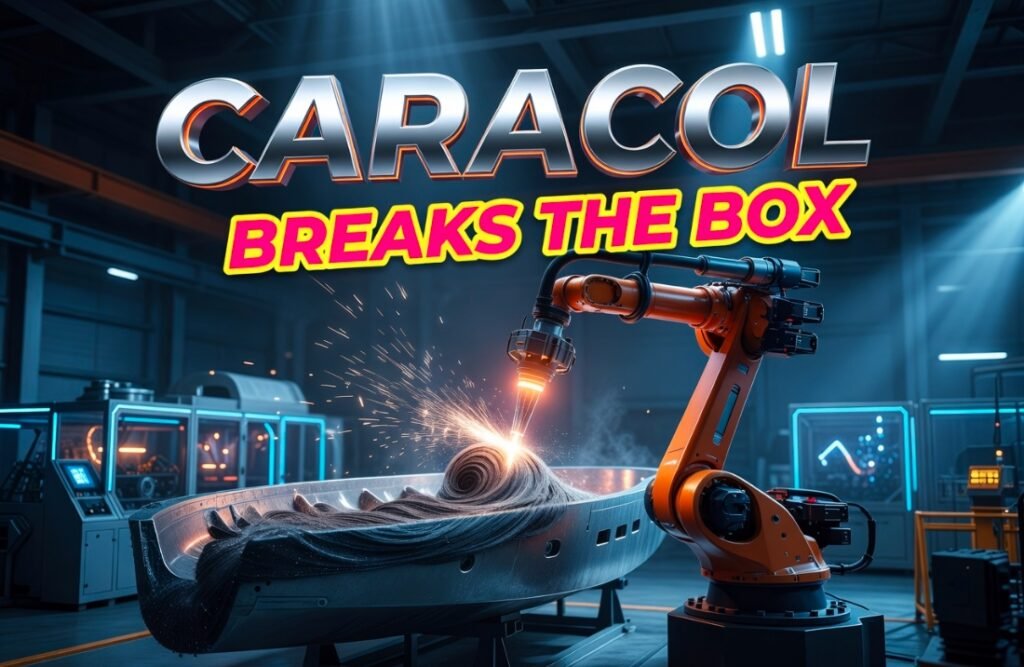
caracol robotic arm large format 3d printing factory
Why Caracol Refused to Sell For Five Years
Most hardware startups rush to ship products. Caracol did the opposite.
In the early stages of its development, Caracol validated its technology through internal manufacturing services before commercialising its systems. The company started as a service bureau using its own technology, created the applications for it, and then scaled up to offer its turnkey platform.
That slow approach had a reason. Industries like aviation and shipbuilding live and die by certification. Without paperwork, a part cannot fly or float.
The work paid off in early 2022. SAI Global certified Caracol and its Robotic Large Scale Additive Manufacturing process for the production of aerospace parts under the globally recognized AS/EN 9100:2018 standard. That milestone unlocked real orders from aerospace OEMs.
Heron, Vipra, and a Smarter Software Brain
Caracol today sells two flagship machines. The Heron AM platform handles polymer and composite printing. The Vipra AM platform handles metal.
The metal 3D printing system is a large-scale direct energy deposition platform that leverages wire arc additive manufacturing processing, seamlessly incorporated into the proprietary system. It was created to maximize users’ flexibility, control and performance, expanding large format additive manufacturing’s possibilities to a broader range of applications.
Behind both machines sits a software layer the company built in-house. It collects data from every print, everywhere in the world, and feeds it back to improve future jobs.
“The job isn’t done when we install a machine. It’s done when our partners are scaling successfully with the applications they purchased the system for.” Francesco De Stefano, CEO and Co-founder
The Numbers That Matter
| Benefit | Caracol LFAM | Traditional Method |
|---|---|---|
| Material waste | Below 5% | 70 to 80% |
| Aerospace tooling lead time | Cut by up to 80% | Months of work |
| Yacht component cost (Ferretti project) | Over 30% savings | Baseline |
| Tool weight | One tenth of original | Heavy steel or aluminium |
$40 Million in Fresh Funding and a Texas Power Move
The patient strategy is finally paying off in dollars. Italian deep-tech manufacturer Caracol raised $40 million in a Series B funding round to accelerate its international expansion and scale up its large-format 3D printing business.
The money is already moving. On September 4, 2025, Caracol cut the ribbon on its North American headquarters in Pflugerville, Texas, near Austin. Based in Italy, Caracol previously established its presence in North America with an office in Austin, but now it has a permanent and strategic home base.
The new site is no small workshop. Running at full tilt, Caracol says it will be able to produce up to 100 Heron and Vipra AM systems per year. Supporting this level of machine production will also entail scaling the U.S. supply chain by adding and validating new vendors for components.
- 40 percent of Caracol’s global revenue already comes from the United States
- 100 plus systems installed across 30 countries
- 55 plus countries served by its global support network
- Doubled revenue year on year for five straight years
From Yachts to Trains to Space
The customer roster reads like a who’s who of heavy industry. Products on display at JEC World 2026 included a train front cover developed with Alstom, a composite lamination tool for aircrafts developed by Formes et Volumes, and a custom yacht hard top developed with Treddy and Polymaker. A finished racing car roof developed by ES Garaj and LFAM Center, the largest LFAM production center in Turkey, was also on view.
Caracol is now eyeing orbit. The company has secured a European Space Agency grant to lead a space focused additive manufacturing project, and De Stefano says aerospace and space systems are the next big frontier.
European expansion is moving fast too. The acquisition of Weber’s additive extrusion assets will see Caracol integrate that expertise into its Heron and Vipra LFAM platforms, offering customers broader customization options and industrial automation choices, including Siemens control systems and ABB robots. The deal strengthens its ability to provide a comprehensive LFAM ecosystem to international clients while ensuring continuity of support for Weber’s existing additive customers through Caracol’s global service network spanning more than 55 countries.
The Race Toward Lights Out Factories
The endgame for De Stefano is not just bigger printers. It is factories that run themselves.
In 2017, operators had to babysit every print. Today, Caracol’s systems can run for days with the lights off. The next leap is machines that spot their own mistakes and fix them mid print.
The company’s ADOS AI platform already lets systems read process data, detect drift from the target, and adjust parameters live. Every machine learns. Every machine teaches the rest.
That vision turns a single Texas robot and a single Italian robot into nodes of one global brain. It is a quiet idea with loud consequences for supply chains everywhere.
Ten years ago, four friends from Milan looked at a small plastic 3D printer and asked a stubborn question. Why does it have to be so small? Today, their robots are building yacht roofs in Italy, train covers in France, and aerospace tools in Texas, all from digital files and a layer of plastic at a time. It is a reminder that the best industrial revolutions often start with someone willing to wait five years before making a single sale. What do you think about the rise of robotic 3D printing in heavy industry? Drop your thoughts in the comments and let us know if this is the future of manufacturing or just another hype cycle.


Orbio Closes $21M From Dawn Capital to Scale AI Frontline Agents

Honda’s Electric Trial Bike Lands in the Top Five at TrialGP Japan

GTA 6’s November Launch Is Reshaping the 2026 Game Calendar

Qorelo Lands $3.5M Seed to Tackle SAP’s 2027 Migration Crunch

Italian Edtech Sirius Game Raises €1.3M to Scale Primary School Play

Bestie Bite Raises €1.5M to Take AI Video Reviews to the US

European Tech’s €2.8B Week Came With a US Acquirer Twist
Rainn Wilson Calls Out Media’s Double Standard on Platner

OnePlus N6 Confirmed for June 30 India Launch as First N-Series Phone

Munich Court: Google Liable for False Answers in AI Overviews

Zcash Patched a Double-Spend Bug as ZEC Climbed 5%

Steam Summer Sale 2026 Locks In June 25 to July 9 Dates

‘Widow’s Bay’ Review: Apple TV’s Sleeper Horror-Comedy Earns Its Fog

Amazon Scraps Its Stargate Revival After a 20-Week Writers Room

Citigroup Says ETF Outflows Drove Bitcoin’s Crash, Not Strategy’s Sale

Coinbase Invests in Ethena, ENA Jumps 10% on Open-Market Buy

CLARITY Act Floor Vote Likely Shifts to August, Lummis Says

Gigaton Lands $26M to Replace Heavy Industry’s Control Stack

London AI Lab Inherent Raises $50m to Reinvent Science
Quobly’s €115M Bet to Scale Silicon Quantum Computing
-
FINANCE2 weeks ago
Zcash Patched a Double-Spend Bug as ZEC Climbed 5%
-
ENTERTAINMENT2 weeks ago
Steam Summer Sale 2026 Locks In June 25 to July 9 Dates
-
 NEWS1 month ago
Meta Adds AI Replies to Threads, But Users Can’t Block It
-
ENTERTAINMENT4 weeks ago
‘Widow’s Bay’ Review: Apple TV’s Sleeper Horror-Comedy Earns Its Fog
-
ENTERTAINMENT2 weeks ago
Amazon Scraps Its Stargate Revival After a 20-Week Writers Room
-
FINANCE2 weeks ago
Citigroup Says ETF Outflows Drove Bitcoin’s Crash, Not Strategy’s Sale
-
FINANCE2 weeks ago
Coinbase Invests in Ethena, ENA Jumps 10% on Open-Market Buy
-
FINANCE2 weeks ago
CLARITY Act Floor Vote Likely Shifts to August, Lummis Says