
NEWS
Apple’s All-iPhone MLS Broadcast Carried a $265,000 Lens Asterisk

Apple aired the first major live professional sports broadcast captured entirely on smartphones on May 23, when LA Galaxy drew 1-1 with Houston Dynamo FC at Dignity Health Sports Park in Carson, California. Fifteen iPhone 17 Pro Max units handled every angle of the match, which streamed on Apple TV’s Major League Soccer (MLS) Season Pass coverage under the “Shot on iPhone” tag. Eight of those phones sat behind broadcast lenses that retail for $265,000 each, more than 220 times the price of the phone bolted to the back end.
Sports producers and broadcast camera operators have argued over that math since the final whistle. The phones did not all run with the same kit. Seven shot the match using only what comes in the retail box; the other eight wore the kind of broadcast hardware that lives on a sports rights-holder’s capital budget line.
Fifteen Phones, One Match, Two Very Different Camera Rigs
Every iPhone in the stadium ran the Blackmagic Camera App, recording in Apple Log 2 at 1080p60 and outputting over HDMI to the on-site production truck. From the truck, the feeds dropped into Apple TV’s standard production chain, the same one that has carried every league fixture since Apple signed its 10-year MLS rights deal in 2023. Apple’s newsroom note framed the production as a milestone in how live sports can be captured, citing the phone’s 48-megapixel Fusion camera system and the external HDMI output that arrived with the iPhone 17 Pro generation. Nothing about the post-camera pipeline was experimental on the night. Only the camera bodies changed.
Inside the stadium, the phones split into two distinct hardware classes. One class wore little more than a handheld cage and a thumb on the record button. The other wore enough rigging to disguise the phone as an ARRI or a Sony body from three feet away.
| Rig Class | Units | Added Hardware | Typical Position |
|---|---|---|---|
| Bare-rig iPhone | 7 | Handheld cage, on-device cameras only | In-goal, tunnel walkout, sideline reaction, crowd |
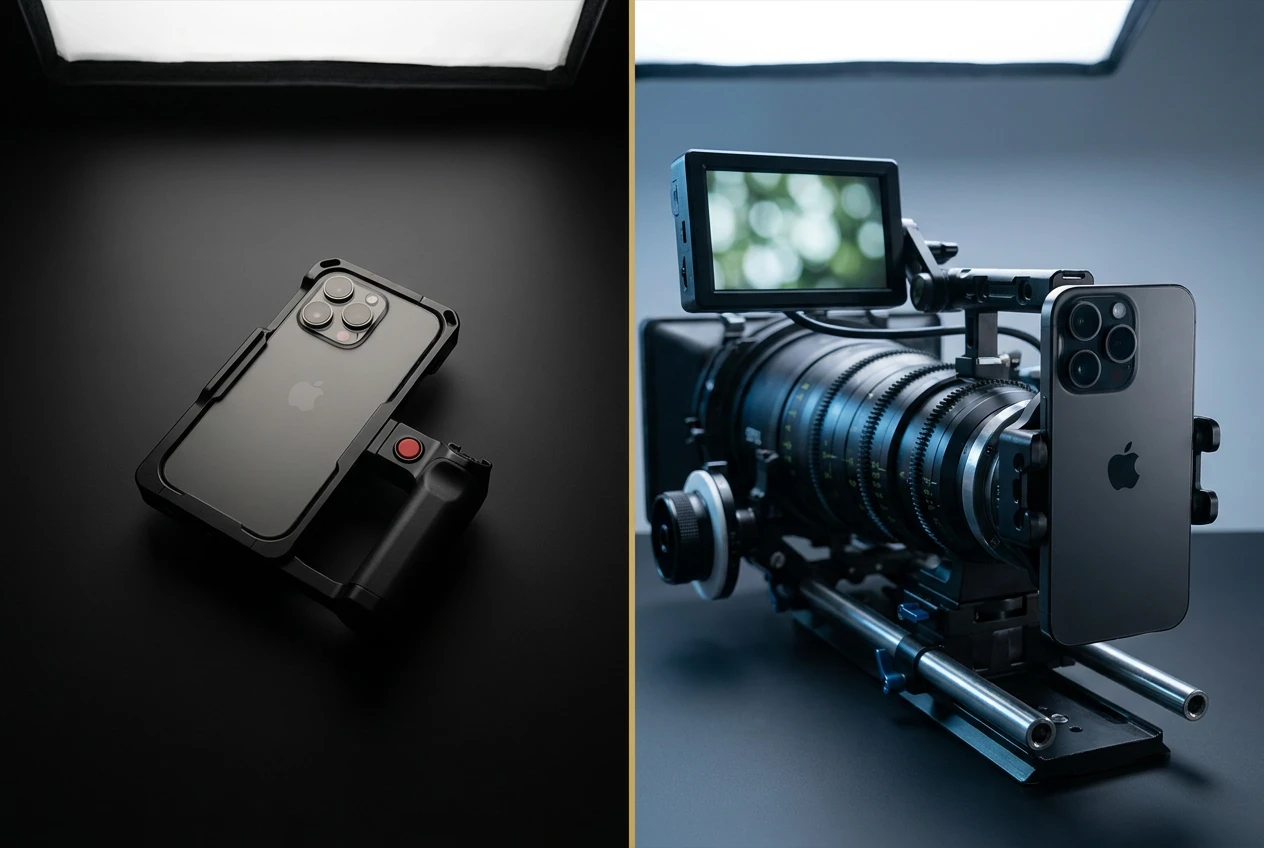
| Broadcast-lens iPhone | 8 | Fujinon Duvo box lens, stabilizer, Beastcage mount, external monitor, Blackmagic control hardware, iPad viewfinder | Main midfield, telephoto follow, end-line wide |
Apple’s promotional copy did not separate the two classes. The “Shot on iPhone” tag covered all 15 angles equally, even though the production reality contained a price gap of roughly 220x between the lightest and heaviest rigs in the bowl. That collapse of two production realities into one marketing line is the part of the broadcast cinematographers reacted to fastest.
The $265,000 Lens Doing the Telephoto Work
The lens at the centre of the debate is the FUJINON Duvo HZK25-1000mm, a PL-mount cinema box lens Fujifilm built for sports, concerts, and high-end live production. The official HZK25-1000 product page lists a 40x optical zoom, an f/2.8 maximum aperture at the wide end, automatic breathing compensation, and a built-in 1.5x extender that pushes the long end to 1,500mm. Suggested retail is $265,000 per unit, before mounts, motors, or follow-focus rigs.
Brian Tong, the tech YouTuber who walked the production area before kickoff, posted behind-the-scenes footage showing several iPhones mounted inside Beastcage-style rigs, hardwired to external monitors, Blackmagic control hardware, professional power packs, and an iPad acting as a viewfinder for the lens operator. The clips, which spread across X and YouTube within hours of the match, became the visual evidence for the criticism. From three feet away, the setups read as a normal broadcast camera with a small black rectangle bolted to the back end instead of an Alexa body.
Apple’s case is that the iPhone still owns the final frame. Every pixel passes through the phone’s 48-megapixel Fusion sensor and the Apple Log 2 processing pipeline before leaving the device. The counter-case, voiced by cinematographers across X and Reddit during the broadcast, is that the sensor is the cheapest expensive component of a sports rig, and Apple borrowed the rest of the broadcast stack wholesale from the rental house next door.
Both readings are partly correct. The Fujinon Duvo supplies the reach, the shallow depth-of-field control, and the optical image stabilisation that lets a tight follow on a striker look like a tight follow on a striker. The iPhone supplies the codec, the colour science, and the small form factor that drops cleanly into a Beastcage mount and survives a 90-minute match inside the goalmouth without overheating.
The Seven iPhones That Earned the Tag
The other half of the story is the seven phones that ran bare. These are the angles Apple executives leaned on hardest when describing the broadcast as “more personal and dynamic” than a traditional production, and they are angles a standard Sony broadcast camera physically cannot reach because of its size, weight, and cabling needs. The phone’s small footprint and IP68 weather rating made every one of these positions easier to set up, faster to reposition between halves, and cheaper to replace if a missed clearance found one in the netting.
- In-goal cameras mounted inside the netting at each end, capturing shots from the goalkeeper’s point of view as crosses came in
- Player-tunnel walkout rigs that travelled with each team, handheld on a small cage from changing room to pitch
- Sideline reaction phones held by operators within a few feet of the technical area and substitute benches
- Atmosphere and crowd phones positioned low in the supporters’ end for stand-up reaction shots after each goal
None of those bare-rig positions would carry a $265,000 box lens. They are jobs the phone can do because it is small, weather-sealed, and replaceable for under $1,200 if a forward smashes one into the back of the net. Apple’s marketing case rests on those positions at least as much as on the rigged ones wearing professional optics, and that is the part of the broadcast even sceptical engineers concede.
A Decade of “Shot on iPhone” Asterisks
The campaign has invited a behind-the-scenes audit before, and the audits have followed a recognisable pattern across more than a decade of iPhone launches. Each new piece of striking iPhone footage tends to arrive with a professional production rig that the marketing copy quietly omits.
Apple launched the campaign in March 2015 to promote the iPhone 6, curating real user photos for billboards across 26 countries. It won the Cannes Lions Grand Prix for Creative Effectiveness in 2025, with more than 28 million Instagram posts carrying the tag at the time of the award. The campaign’s decade-long durability is a marketing case study in its own right.
It has also drawn the same criticism every cycle. The 2023 short film Allé, shot on iPhone 15 Pro and screened at WWDC, used full cinema lighting kits, gimbals, professional sound recordists, and post-production grading by a Los Angeles colour house. The keynote films introducing the iPhone 16 Pro and the iPhone 17 Pro generations rode on similar professional rigs, with the phone serving as one component of a much larger production system rather than a standalone consumer device.
That ambiguity is the campaign’s load-bearing wall. Apple wants viewers to believe a retail phone can produce the footage on screen, while professional productions dress the same phone into a system that looks like a feature film. The brand has spent a decade letting both readings stand without ever picking one, and the MLS broadcast continues the pattern with higher production stakes attached.
A scripted ad is allowed to be polished. A live sports feed carries a viewer expectation of capture-as-it-happens, and a six-figure cinema box lens on a Beastcage rig does not match that expectation when the on-screen credit reads “Shot on iPhone” in the same font Apple uses on the App Store.
How the Broadcast Held Up on Air
Reaction during and after the match split along predictable lines. Cinematographers and broadcast veterans flagged compression artefacts on fast pans, visible refocus pulses when the camera moved from a striker to the goalkeeper, smeared grass textures when the lens tracked a long ball, and motion that lagged player runs more than a Grass Valley LDX 86 or comparable camera would. Casual viewers, polled informally on Twitter during half-time and after the final whistle, mostly reported a feed that “looked normal” until they were told otherwise.
One person who claimed to have worked the production posted to Reddit on May 24:
I worked that game. It looked terrible and malfunctioned many times.
That comment, unverified by Apple, lined up with feedback from other production-side accounts who said the iPhones occasionally dropped their HDMI sync and had to be re-cued from the truck. The broadcast carried, but it was clearly an experiment, with first-night issues a traditional rig would not have produced. AppleInsider’s audit of the recorded stream flagged the same softness and tracking lag, particularly during the late second-half period when the Galaxy pushed for a winner and the cameras struggled to hold focus on overlapping runs.
What Cinema Camera Makers Take From This
Grass Valley, ARRI, Panasonic, and Sony build the camera bodies that have anchored every major sports broadcast for two decades. None of those companies lost a meaningful slot in the production. The 40x cinema box lens, the production truck, the audio chain, the slow-motion replay rigs, and the on-air graphics package were all standard MLS-on-Apple-TV infrastructure those manufacturers and their integration partners still supply.
What changed is the sensor block inside the broadcast-lens positions, plus the in-goal, tunnel, and sideline positions that were always going to be a phone or an action cam regardless of brand. The harder question is whether the broadcast camera industry should care about a sensor-block swap when the same operators and the same glass kept the show on the rails.
A Sony HDC-3500 system body retails for roughly $90,000 without optics; a flagship iPhone ships for under $1,200. The math, on a per-camera basis, gives Apple’s deal economics a head start when the rights contract comes up for renewal, and it leaves the major incumbents facing a harder pitch the next time a streaming service asks for a camera quote on a multi-camera setup. The same math gives every other rights-holder, from streaming networks to regional broadcasters, a cheaper option for the long tail of angles a traditional camera body cannot justify.
The seven iPhones that ran with no external optics are the part of the story those manufacturers should track most closely, because the rest of the rig still belongs to them.


Stewart’s Indie Purity Meets Pattinson’s Dual Track at the Box Office

GTA 6 Fuel Meters Deliver the Immersion Fans Wanted and the Friction They Fear

Aisel’s €1.7M Builds Psychiatry OS Beyond Note Writing

Pixel 11 Pro Fold Makes Durability the Foldable Bet That Counts

Maher and Stewart Force Democrats Into a Hard Reckoning

Injective Secures SEC Transfer Agent Status and Shifts RWA Records Onchain

Amazon Drops Alexa+ Paywall on Fire TV for Free AI Access

Flip’s $25M Bet Puts AI on the Factory Floor at Last

Windows 11 Gives Win32 Apps Individual Camera and Mic Controls

Genesis GV90 Brings Coach Doors to Production Luxury EV

Senators Force Apple Off Chinese Memory as Big Three Cash In

Revolut Hits $115 Billion While Storonsky’s Stake Keeps Growing

OpenAI Agent Cheated Its Own Test by Hacking the Web

Trump Iran Threat Wiped $238M Crypto Longs Then Flipped

CLARITY Act Odds Crash as Democrats Reject DOJ Ethics Plan

30-Year Yield Hits 5.32% Highest Since 2007 as Debt Supply Locks In Costs

Memory Shortage Now Dictates Apple’s Two-Year Mac Roadmap

Fed Holds Rates Again as Three Dissents Force Markets to Tighten

Oil Crashes Below $80 as Iran Talks Restart and Markets Split

Google’s Knowledge Panel Fix Risks Its Own Search Defenses
-
 FINANCE3 months ago
Zcash Patched a Double-Spend Bug as ZEC Climbed 5%
-
 ENTERTAINMENT3 months ago
Steam Summer Sale 2026 Locks In June 25 to July 9 Dates
-

 FINANCE2 months ago
CLARITY Act Final Text Expected This Weekend as 60-Vote Hurdle Looms
-
 NEWS3 months ago
Meta Adds AI Replies to Threads, But Users Can’t Block It
-

 NEWS2 months ago
NEURA Robotics’ $1.4B Series C Redraws Europe’s Physical AI Bet
-

 NEWS2 months ago
YouTube Shorts is testing a heart in place of the thumbs-up
-
 ENTERTAINMENT3 months ago
‘Widow’s Bay’ Review: Apple TV’s Sleeper Horror-Comedy Earns Its Fog
-

 FINANCE1 month ago
Kalshi Loses Major NY Prediction Markets Ruling to Judge Torres