
NEWS
Enera Raises $2M to Build an AI Recovery Layer for EV Charging
Enera raised $2M led by Lakehouse Ventures to build an AI recovery layer for EV charging, where 99% uptime masks 29% of sessions failing at the plug.

Enera has raised $2 million to build what it calls an AI recovery layer for failed electric vehicle charging sessions. The bet targets a fault line the company says runs straight through the industry’s reported numbers: chargers that read 99% uptime on the dashboard, and 29% of sessions that still fail at the plug.
Lakehouse Ventures led the round, marking the firm’s first investment outside the United States, with Divergent Capital, Masia, and a group of mobility and technology founders participating. The startup, founded in 2025 and registered in London, will use the capital to scale pilots already underway with leading UK charge point operators and push into the rest of Europe. CEO Nicholas Marquardt frames the work as a template for a much larger category: distributed, connected hardware where the person standing at the broken unit is not an engineer.
The Gap That ‘99% Uptime’ Hides
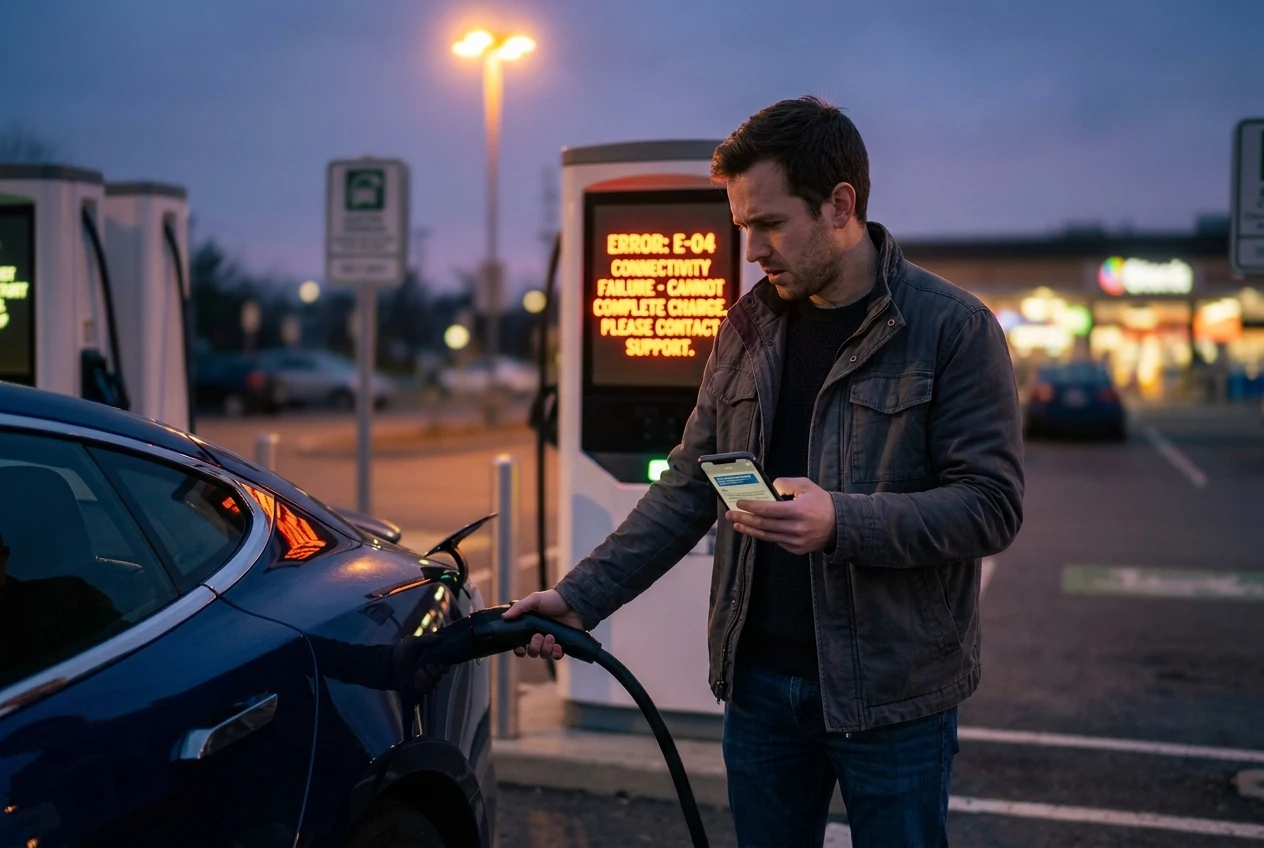
Charge point operators have a number to point at: 99% charger uptime. Enera has a different number: 29% of charges still fail. The dead sessions sit in a part of the network the dashboard does not see.
The cause, Enera argues, is that the industry has very limited visibility into why sessions fail in the first place. Customer support is often routed through outsourced call centres, which makes it hard for operators to capture or analyse the patterns behind the failures. The metric the operator reports and the session the driver experiences sit on opposite sides of a wall. A network that reads 99% on the dashboard can still be the network where charge after charge leaves a driver without a session.
The gap between the dashboard and the driver is structural, not new. EV adoption is still growing, and Enera is built to close the gap. The product it sells is the AI recovery layer.
Enera’s Recovery Layer for the Plug
Enera’s platform combines three streams into a single operational view: driver support interactions, telemetry from the charging session, and backend system logs. A single failed charge session leaves a trail across all three, and operators usually see only one of them. The platform’s job is to put the whole trail in one place. Stitched together, those streams show the operator what the dashboard alone cannot.
The Control Room, the company’s network-facing product, listens across every channel a driver uses to ask for help, from calls and emails to WhatsApp. It turns that noise into structured, actionable insights the operator can act on. The product integrates with popular CRM, ticketing, and charge point management systems through APIs and webhooks, and Enera’s Control Room and failure mode catalog is published on the company’s site.
The platform also lets operators deploy AI support agents that work the same channels back. An agent can troubleshoot a failed session, monitor the network in real time, and intervene before a small failure turns into a stranded driver. It runs without storing personally identifiable information, and 100% of the data is hosted in the EU, the company says. The L1 work is run as a managed service, with the operator’s team focused on L2 and operations, and the product as a whole is the AI recovery layer the company pitches.
The catalog of failure modes the platform catches reads like a working list of every place a charge session can die. The table below is a sample, drawn from Enera’s own documentation.
| Common failure mode (per Enera) | What goes wrong |
|---|---|
| Authentication or RFID issue | Card, fob, or session ID not accepted |
| Cable stuck after charge | Connector fails to release from the vehicle |
| ISO 15118 negotiation fails | Plug & Charge handshake breaks down |
| Card declined or 3D Secure timeout | Payment leg fails before the session starts |
| Bay blocked by ICE car | A non-EV occupies the stall |
| Firmware crash | Charger software faults mid-session |
| Session stuck “Preparing” | Charger never transitions to active charging |
| Network down at site | Backhaul drops during the session |
A $2M Round and a First Out-of-US Bet
Lakehouse Ventures, the US-based early-stage firm, led the round. The Enera deal is the firm’s first investment outside the United States. The syndicate also includes Divergent Capital, Masia, and a group of angel investors whose experience spans mobility and technology. (Norrsken Barcelona, the incubator backing Enera, announced the round on its own feed.)
Enera sits in the early stage of commercialisation. Founded in 2025 and registered in London, the company has pilots underway with leading UK charge point operators and intends to put the fresh capital behind scaling those pilots and opening up the rest of Europe. It is also pushing its AI platform deeper into driver support, network monitoring, and operational insight (Lakehouse Ventures’ firm thesis and portfolio gives the investor’s own framing).
- $2 million raised in this round
- First non-US deal for lead investor Lakehouse Ventures
- 2025: Enera’s founding year
- London, UK: Enera’s registered office
- UK pilots already underway with leading charge point operators
Why AI Support Is Heading Into the Physical World
Most of the venture capital that has flowed into AI customer support over the last two years has gone into asset-light businesses. Enera is one of the first teams to take the same playbook into infrastructure that is asset-heavy and distributed. The difference, the company argues, is that the stakes are higher and the integrations are harder. The opportunity, in Neamonitis’s framing, is to take the same playbook into a much larger category.
AI customer support has been one of the most well-funded categories of the last two years, but almost all of that capital has gone into asset-light industries. Enera is one of the first teams we have seen credibly take this technology into asset-heavy infrastructure, where the stakes are higher and the integrations are harder. We are excited to back Nicholas, Arnaldo, and the team as they prove it out in EV charging and open up a much larger opportunity from there.
John Neamonitis, founder and general partner of Lakehouse Ventures, made the case in a statement covered by FoundersToday. The fund’s bet is that charging is the entry point into a much larger category of asset-heavy infrastructure with the same shape of problem. The same statement frames Enera as one of the first teams the firm has seen take AI customer support into that category.
Enera plans to start with EV charging and then expand. The longer game is to apply the same AI recovery layer to any infrastructure where the person standing at the broken unit is not an engineer.
The Driver’s View at the Charger
For the driver, the failure usually shows up as a small, specific problem at the plug. The dashboard reads 99% uptime, the driver is stranded. The experience is granular, and the failure is silent on the operator’s side.
Operators can’t see where their experience is breaking down, and users carry the cost. We are building the AI recovery layer for that entire category of infrastructure.
Nicholas Marquardt, co-founder and CEO of Enera, framed the round in a statement to Tech.eu. The cash will accelerate pilots already underway with leading UK charge point operators, then carry the same product into the rest of Europe.
The AI agent is the first responder on the channel the driver actually uses. It picks up a call, an email, or a WhatsApp message, checks the live status of the charger and the session, and walks the driver through a fix. If the issue is on the network side, the agent can restart the session or hand off to a human.
Enera describes the agent as L1 support, with the operator’s own team owning L2 and operations. The company positions the rollout as managed service, with operators keeping control of policy and tooling. New languages are added one at a time with end-to-end testing built into each release. The pitch, in Marquardt’s longer framing, is that EV charging is the entry point into a category of distributed, connected hardware.


Capital Clusters and the Dual Tracks of European Tech Finance

Microsoft Shrinks Windows 11 Memory for 8GB PCs

XRP Ledger Brings Back Bugged Features Fixed for Institutions

The Shards Trailer Turns Ellis Nightmare Into Murphy Glamour

WhatsApp Folder Hides Business Messages After Hours

Mova LiDAX Ultra 3000 AWD Cracks the Robot Mower Moat

Urban Arrow FamilyNext Turns Costco Runs Into Bike Trips

Reddit Builds Spoken Video Layer to Reclaim Its Own Viral Stories

Nuggit £5m Fund Treats YouTube Channels as Real Businesses

Galaxy Z Fold 8 Makes Foldables Daily Drivers but Drops Flex Mode

CLARITY Act Final Text Expected This Weekend as 60-Vote Hurdle Looms

Kalshi Loses Major NY Prediction Markets Ruling to Judge Torres

Fed Minutes Cite AI Demand as Inflation Risk, Put a 2026 Hike Back on the Map

Marker AI Writing Startup Lands $13M Seed Led by Index Ventures

Dota 2 Esports World Cup 2026: Spirit Defends $2M Title In Paris

Meta’s Muse Spark 1.1 Beats Rivals on Price, Trails on Coding

ARC Intelligence Closes €4M Seed Round in Roughly a Week

CS2 Premier Season 5 Lands With Cache and a C4 Damage Rework

Backrooms Returns to Theaters as the Everything Must Go Edition

Finto Picks Munich Over Silicon Valley After YC, Raises $3.4M
-
 FINANCE2 months ago
Zcash Patched a Double-Spend Bug as ZEC Climbed 5%
-
 ENTERTAINMENT2 months ago
Steam Summer Sale 2026 Locks In June 25 to July 9 Dates
-
 FINANCE4 weeks ago
CLARITY Act Final Text Expected This Weekend as 60-Vote Hurdle Looms
-
 NEWS3 months ago
Meta Adds AI Replies to Threads, But Users Can’t Block It
-
 ENTERTAINMENT2 months ago
‘Widow’s Bay’ Review: Apple TV’s Sleeper Horror-Comedy Earns Its Fog
-
 NEWS5 months ago
U.S. Navy Deploys Solar-Powered Lightfish Drone to Patrol Oceans
-
 NEWS8 months ago
FolderFresh Review: This Free Tool Automates Windows File Organizing
-
 FINANCE4 weeks ago
Kalshi Loses Major NY Prediction Markets Ruling to Judge Torres