
NEWS
Ulefone’s RugOne Xever 8 Hot-Swaps Its Battery Without Blacking Out
Ulefone’s RugOne Xever 8 rugged phone adds a hot-swap 4800mAh battery that keeps apps live, a 117 dB speaker, and Android 16, priced from $379.99.

Ulefone has launched the RugOne Xever 8, a $379.99 rugged Android phone whose 4,800mAh battery pops out without pausing the apps on screen. The Xever 8 ships with what RugOne calls Swappable Battery 2.0, a system that keeps the phone fully operational through a battery change, in a market where most smartphone makers have sealed their batteries shut for years. The 128GB model lists at $379.99, the 256GB at $409.99, and both are on sale now through RugOne’s official online store, AliExpress, Amazon, and Mercado Libre, per AndroidHeadlines.
The Hot-Swap Battery Stays Live Through the Swap
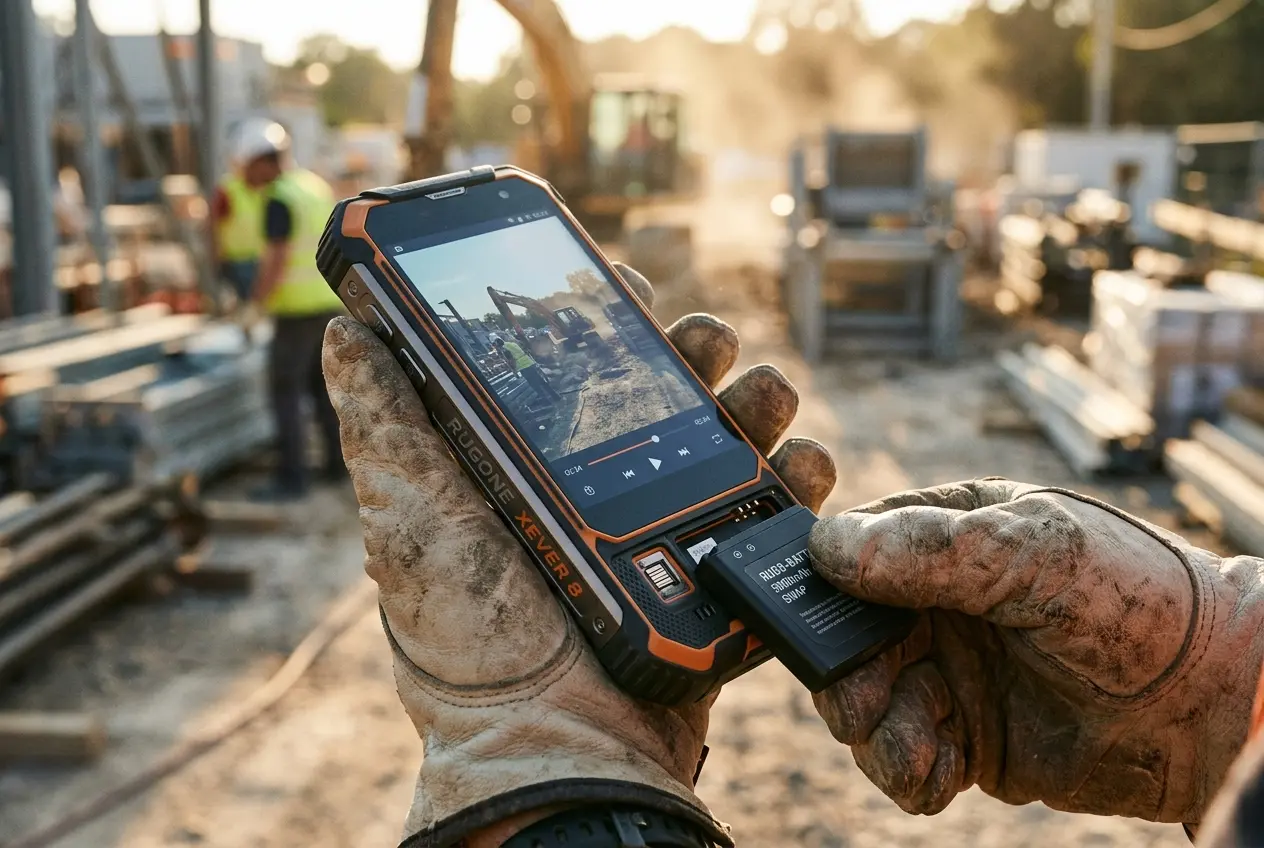
Swappable Battery 2.0 is the Xever 8’s pitch in one phrase, and it is engineered around the moment of the swap itself. Ulefone, in the release AndroidHeadlines covered, says the Xever 8 remains completely active during a battery change, so a user can keep talking, typing, streaming, or running a navigation app without losing progress. The earlier Xever 7 line offered a swappable battery, but the device got forced into a suspended, black-screen state that interrupted active work mid-swap, and the fix for that pause is the focus of the 2.0 system, not the swappable hardware itself.
Built around a 2-minute window, the new design gives a user 2 minutes to complete the swap with zero interruption, and after that the device enters a 60-second safety lockout to protect data, per the RugOne product page. To keep the battery seated under hard use, the company pairs an internal latch with the external cover latch, a setup it calls a Double-Latch Structure, and the cover, the latch, and the battery are all field-replaceable. The Xever 8 is also flagged as compliant with EU Eco-design rules for repairability.
The features RugOne lists for the swap window are short and specific, and they describe what the screen keeps doing through the change. The system supports live browsing through a swap, a mid-call battery change, and messaging apps that keep running, with the 2-minute window followed by the 60-second safety lockout, and the second 4,800mAh battery and the 4-in-1 Charging Station ship in the box so a fresh pack is always on hand.
- Live browsing through the swap
- Mid-call battery change
- Messaging apps keep running
- 2-minute swap window, then a 60-second safety lockout
What’s Built Around the Battery
The chipset is the MediaTek Helio G200, a 6nm octa-core part with two Cortex-A76 cores at 2.2 GHz and six Cortex-A55 cores at 2.0 GHz, paired with a Mali-G57 MC2 GPU, per the GSMArena spec sheet. RugOne lists 8GB of physical RAM on the device, and the company markets a further 8GB of dynamic RAM, bringing the advertised total to 16GB. Storage options are 128GB or 256GB on UFS 2.2, with a dedicated microSD card slot for expansion that sits separately from the SIM tray.
At launch, the device runs RugOne OS on top of Android 16, and the company guarantees 3 years of major Android OS upgrades, per the AndroidHeadlines coverage of the launch. The dual-SIM tray holds two Nano-SIM cards plus an eSIM, with two of the three active at a time, and the system does not include a 5G radio, which is one of the spec-sheet differences between the Xever 8 and the Xever 7 Pro. Detailed specs, dimensions, and battery figures are listed on the Xever 8 spec sheet on GSMArena.
The display is a 6.5-inch IPS LCD running at 120Hz with a 1080 x 2400 resolution and 680 nits of peak brightness, covered by Corning Gorilla Glass 3. The screen sits inside a body that measures 168 x 80 x 14mm.
On the durability side, the Xever 8 carries the IP68 and IP69K dust and water resistance ratings, plus the MIL-STD-810H drop standard. It is rated for a 2-meter, 30-minute dive, a 2-meter drop, and a 230-lumen dedicated TorchX flashlight is built into the chassis. The whole device weighs 320g, per the GSMArena spec sheet, and reverse charging at 10W means the Xever 8 can top up smaller devices on the trail, while wired charging tops out at 18W. Full feature and design details sit on the Xever 8 product page at RugOne.
The Xever 8 also ships with a slate of on-device AI features, including Circle to Search, Google Gemini integration, an AI assistant called Xiao Ku, Voice Call Summary, AI Translation, AI Calculator, and AI Writing Assistant, per the RugOne product page. Most run on the device rather than the cloud, though Voice Call Summary depends on third-party audio recording support, per RugOne, and the feature set mirrors the one in the Xever 7 Pro with the same Gemini build and Xiao Ku assistant.
A Speaker Designed to Out-Yell a Campsite
The speaker system is the Xever 8’s second headline feature. RugOne calls it the SonicX Super Speaker, and the company markets it for outdoor noise, from waterfall roar to a crowded campsite. The system is paired with a 3.5mm headphone jack and stereo output, per the GSMArena spec sheet, and the hardware is positioned for emergency use as much as for music, with RugOne branding it a Pro Party Speaker Performance built into a phone.
A proprietary SonicX algorithm runs real-time frequency analysis, pushing vocals forward, deepening bass, and widening the soundstage into a 360-degree image, per the RugOne product page. The drivers sit inside a 4.0cc total sound cavity in a dual setup, and the system is also sold for running, cycling, hiking, and camping. The numbers behind the pitch sit in the spec snapshot below.
- Max output: 117 dB
- Driver setup: 13 x 26mm + 14 x 20mm dual drivers
- Sound cavity: 4.0cc
- Loudness claim vs standard phone speaker: 2.6x (RugOne, emergency use)
Cameras Built to Read the Dark
The main camera is a 64MP unit built around the Sony IMX682 sensor with an f/1.9 lens, dual-LED flash, HDR, and panorama modes, per the RugOne product page. Video tops out at 1440p at 30fps, and the front camera is a 32MP shooter with an f/2.5 lens and 1080p video. The phone also ships with pinhole camera detection, which can spot a covert camera by its lens reflection.
Alongside the main camera sits a 20MP Night Vision Camera that uses integrated infrared lights to pull detail out of near-total darkness, and the night vision module pairs with an underwater shooting mode that complements the IP68 and IP69K rating. The dual-LED flash on the main module, the IR LEDs on the night vision module, and the 32MP selfie camera sit alongside one another on the back and front of the device, per the RugOne product page.
RugOne positions the camera stack for outdoor and security work, and the night vision module and the main 64MP sensor are aimed at use cases that go beyond the typical smartphone photo. The marketed use cases for the Xever 8’s camera stack are listed below.
- Wildlife observation
- Home and perimeter security
- Search and rescue support
- Professional vigil and documentation
- Underwater shooting
Two Storage Tiers and Their Prices
Ulefone has launched the Xever 8 in two configurations. The 8GB RAM and 128GB model costs $379.99, and the 8GB RAM and 256GB model costs $409.99, per AndroidHeadlines, and both SKUs ship with the same spec sheet outside of storage.
Both are available now through RugOne’s official online store, AliExpress, Amazon, and Mercado Libre, per AndroidHeadlines. The retail box includes a second 4,800mAh battery and the 4-in-1 Charging Station that pairs the device with its spare packs, and the Charging Station combines secure battery storage, battery charging, phone charging through pogo pins, and a hands-free device stand, per the RugOne product page. The two SKUs and their prices sit in the table below.
| Configuration | Storage | Price |
|---|---|---|
| 8GB RAM + 128GB storage | 128GB | $379.99 |
| 8GB RAM + 256GB storage | 256GB | $409.99 |
What the Xever 8 Changes from the Xever 7
The most direct predecessor is the RugOne Xever 7 Pro, which launched globally on November 11, 2025, starting at $659.99. The 7 Pro was the first phone in the RugOne line to carry the swappable battery concept, and its product page notes that the swap pauses apps while keeping background data intact, with a 180-second swap window. The Xever 8 keeps the swappable battery design and steps around that pause, and the spec differences between the two phones are listed in the table below.
| Spec | RugOne Xever 8 | RugOne Xever 7 Pro |
|---|---|---|
| Chipset | MediaTek Helio G200 (6nm) | MediaTek Dimensity 7025 (6nm) |
| RAM | 8GB (+ 8GB dynamic) | 12GB |
| Storage | 128GB / 256GB + microSD | 512GB + microSD |
| Display | 6.5-inch IPS LCD, 120Hz | 6.67-inch AMOLED, 120Hz |
| Battery | 4,800mAh, 18W wired | 5,550mAh, 33W wired |
| Network | 4G LTE | 5G |
| Hot-swap behavior | Apps stay live through the swap | Apps pause briefly, data preserved |
| Specialty camera | 20MP night vision + 64MP main | FLIR Lepton 3.5 thermal + 50MP OIS main |
| Starting price | $379.99 | $659.99 |
The 7 Pro is the higher tier of the lineup, and the Xever 8 trades down on most of those specs to reach its $379.99 starting price, with a 4,800mAh battery, 8GB of RAM, 128GB or 256GB of storage, a 6.5-inch IPS LCD at 120Hz, and 18W wired charging. The 7 Pro’s design and the Xever 7 series launch details are laid out in the Xever 7 Pro product page at RugOne and the Ulefone Xever 7 series launch announcement.
Compared to the 7 Pro, the Xever 8 ships without a 5G radio, an AMOLED panel, or a FLIR Lepton 3.5 thermal camera. Ulefone guarantees 3 years of major Android 16 OS upgrades on the Xever 8, starting with Android 16 and running through Android 19, per the company’s launch materials, and the Xever 8 ships in Black and Sand Dune, per GSMArena, while the 7 Pro is offered in Black and Beige.
Frequently Asked Questions
When was the Ulefone RugOne Xever 8 released?
The Xever 8 was announced and released in May 2026, per the GSMArena spec sheet. It is on sale now through RugOne’s official online store, AliExpress, Amazon, and Mercado Libre, per AndroidHeadlines.
How much does the Xever 8 cost?
The 8GB / 128GB model is $379.99, and the 8GB / 256GB model is $409.99, per AndroidHeadlines. Both SKUs ship with a second 4,800mAh battery and a 4-in-1 Charging Station in the box, per the RugOne product page, and reverse charging at 10W is supported through the USB-C port, per the GSMArena spec sheet.
What is Swappable Battery 2.0?
Swappable Battery 2.0 is the Xever 8’s hot-swap system, designed to keep apps running through a battery change. The system gives users a 2-minute swap window before a 60-second safety lockout kicks in, per RugOne, and a Double-Latch Structure pairs an internal latch with the external cover latch.
Where can I buy the Xever 8?
The Xever 8 is available through RugOne’s official online store, AliExpress, Amazon, and Mercado Libre, per AndroidHeadlines. The 4-in-1 Charging Station and an extra 4,800mAh battery ship in the box, per the RugOne product page, and the Charging Station combines battery storage, battery charging, phone charging, and a hands-free device stand.
How is the Xever 8 different from the Xever 7?
The Xever 8 keeps the swappable battery concept from the Xever 7 line, but the 2.0 system removes the suspended black-screen state that the Xever 7 forced during a swap. The Xever 8 is also smaller and lower-priced than the Xever 7 Pro, which launched at $659.99 in November 2025.


Orbio Closes $21M From Dawn Capital to Scale AI Frontline Agents

Honda’s Electric Trial Bike Lands in the Top Five at TrialGP Japan

GTA 6’s November Launch Is Reshaping the 2026 Game Calendar

Qorelo Lands $3.5M Seed to Tackle SAP’s 2027 Migration Crunch

Italian Edtech Sirius Game Raises €1.3M to Scale Primary School Play

Bestie Bite Raises €1.5M to Take AI Video Reviews to the US

European Tech’s €2.8B Week Came With a US Acquirer Twist
Rainn Wilson Calls Out Media’s Double Standard on Platner

OnePlus N6 Confirmed for June 30 India Launch as First N-Series Phone

Munich Court: Google Liable for False Answers in AI Overviews

Zcash Patched a Double-Spend Bug as ZEC Climbed 5%

Steam Summer Sale 2026 Locks In June 25 to July 9 Dates

‘Widow’s Bay’ Review: Apple TV’s Sleeper Horror-Comedy Earns Its Fog

Amazon Scraps Its Stargate Revival After a 20-Week Writers Room

Citigroup Says ETF Outflows Drove Bitcoin’s Crash, Not Strategy’s Sale

Coinbase Invests in Ethena, ENA Jumps 10% on Open-Market Buy

CLARITY Act Floor Vote Likely Shifts to August, Lummis Says

Gigaton Lands $26M to Replace Heavy Industry’s Control Stack

London AI Lab Inherent Raises $50m to Reinvent Science
Quobly’s €115M Bet to Scale Silicon Quantum Computing
-
FINANCE2 weeks ago
Zcash Patched a Double-Spend Bug as ZEC Climbed 5%
-
ENTERTAINMENT2 weeks ago
Steam Summer Sale 2026 Locks In June 25 to July 9 Dates
-
 NEWS1 month ago
Meta Adds AI Replies to Threads, But Users Can’t Block It
-
ENTERTAINMENT4 weeks ago
‘Widow’s Bay’ Review: Apple TV’s Sleeper Horror-Comedy Earns Its Fog
-
ENTERTAINMENT2 weeks ago
Amazon Scraps Its Stargate Revival After a 20-Week Writers Room
-
FINANCE2 weeks ago
Citigroup Says ETF Outflows Drove Bitcoin’s Crash, Not Strategy’s Sale
-
FINANCE2 weeks ago
Coinbase Invests in Ethena, ENA Jumps 10% on Open-Market Buy
-
FINANCE2 weeks ago
CLARITY Act Floor Vote Likely Shifts to August, Lummis Says