
NEWS
WaiV Robotics Locks Drones onto Pitching Decks Without a Crew
WaiV Robotics raised $7.5M to recover VTOL drones on moving ships without crew. London startup exited stealth in May 2026; U.S. demos run this summer.

London-based WaiV Robotics crossed from stealth into a U.S. market push in the past two months, carrying $7.5 million in seed funding and a system built around one stubborn problem: getting a drone back onto a ship whose deck will not sit still. The company introduced its first commercial autonomous landing platform on May 5, 2026. By June 15, WaiV had formally opened a U.S. operation ahead of the Energy Drone and Robotics Summit in Houston, where the team exhibited from June 22 through 24. Customer demonstrations begin this summer, with commercial deployments expected shortly afterwards. The offshore energy sector is the first commercial market, where inspections are routine but recovery has kept them expensive.
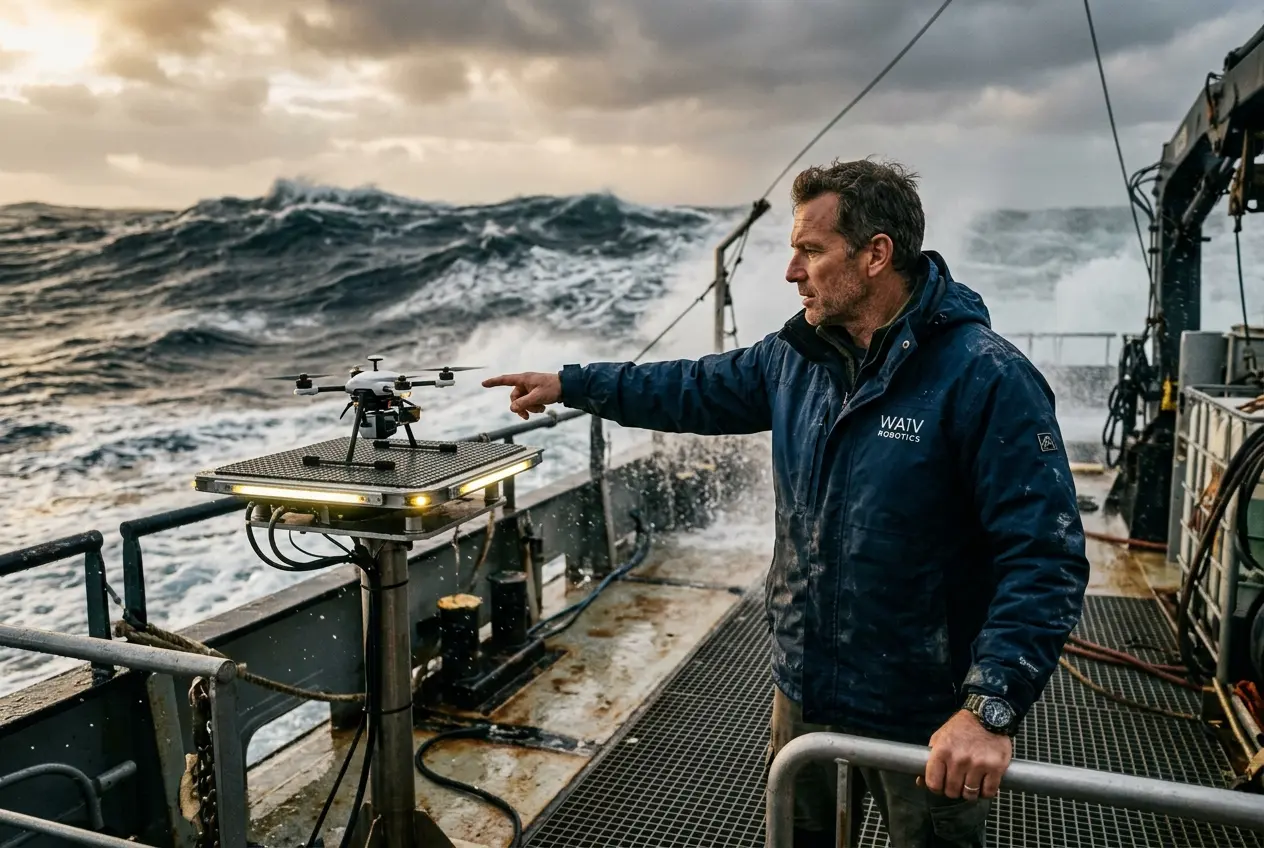
For years, every commercial drone programme at sea has hit the same wall on the way home. Commercial drones are built to land gently on stationary ground, with GPS and visual markers holding the touchdown point stable; a vessel deck moves through six degrees of freedom with the waves, so by the time the drone reaches it, the target has already moved. Johnny Carni, founder and CEO of WaiV Robotics, has lived between those two failure modes. A former helicopter pilot who flew onto moving ships, Carni spent four years working with coast guards and other maritime operators in Singapore before assembling his team in 2022. The research began that summer under an entity called Dronelander. ‘The missing piece isn’t the aircraft, it’s the infrastructure around it,’ he said at the May 5 launch.
Why Sea Landings Have Never Been Routine
Onshore, an automatic landing is mostly a tracking exercise: a drone holds position with GPS, recognises a fiducial marker placed on the ground, and descends along a stable reference. The aircraft can land slowly and gently because the ground will not move. Offshore, the same playbook falls apart within a second of touchdown, since a vessel pitches, rolls, yaws, drifts laterally and vertically, and changes heading with the swell. The deck is also salt-coated and slippery at the moment of contact, and by the time a slow-descending drone reaches its target, that target has shifted.
Carni has put the failure mode in plain terms. ‘If it continues trying to follow the platform’s current position, it’s always reacting too late, effectively chasing a moving target rather than converging on it,’ he told the interview published on July 6, 2026. The aircraft has to predict where the landing pad will be moments later, and fly to that interception point. Existing solutions have largely been limited to calm waters or laboratory conditions, which is why operators of smaller vessels in particular have skipped the drone option entirely. The result is a status quo in which drones fly offshore missions and a deck-team still has to catch them.
Three Integrated Pieces, One Continuous Touchdown
The platform comprises three integrated technologies, each addressing one of the engineering problems Carni identified. Read together, they form one continuous touchdown sequence, from final approach through impact to mechanical capture. The architecture and use-case framing are detailed on the company’s product and use-case pages. Each of the three pieces is solving a different half of the failure mode other approaches leave on the deck.
| Component | Function | When it acts |
|---|---|---|
| Gyro-stabilised landing platform | Keeps the landing surface level as the vessel pitches, rolls and yaws with the waves | Continuous, throughout the descent |
| Marine-grade impact-absorbing pad | Grips the aircraft on touchdown and dissipates the harder impact generated on a moving vessel | At contact |
| Catch-lock-release mechanism | Mechanically secures the drone’s skids until the operator issues a release command | From touchdown through the next mission |
The gyro unit does the work most operators would recognise, levelling the pad as the boat moves, but it is only the first of three components. The pad is engineered for the marine environment: it absorbs the heavier impact forces that come from landing on a moving target, and grips the aircraft to prevent the slide and bounce that would flip a drone over. The catch-lock-release mechanism is the company’s patent-pending piece; once the skids touch the platform, they are mechanically secured, and the drone stays locked until the operator sends a remote release command.
None of these pieces are new in isolation. Stabilised platforms already exist in the maritime sector, and landing nets have long been used to keep drones from falling overboard. What the platform adds, Carni argues, is integration of the three pieces as one controlled sequence. ‘The goal was to remove the need for anyone on deck,’ he said, and the catch-lock-release is the part that turns recovery into an uncrewed step; once locked, the drone sits ready for its next mission, regardless of how aggressively the vessel continues to pitch and roll.
How the Recovery Loop Runs Without a Pilot
When the drone returns from a mission, it climbs into a holding position around 10 to 15 metres above the vessel. WaiV’s recovery system acquires the aircraft there, tracking it continuously with both LiDAR and radar, a pairing that lets the platform operate day or night and through the fog and spray that would defeat an optical-only system. Once acquired, the landing computer connects directly to the drone’s flight controller through the same radio link a pilot would use. From that point on, the system behaves as what Carni calls a ‘virtual pilot,’ generating the control inputs the joysticks would have produced. The human operator can step in at any moment if needed, but the system flies the final approach on its own.
At the same time, the system is reading the vessel’s pitch, roll, heave and acceleration continuously. Instead of aiming at the deck where it is right now, the algorithm projects where the landing platform will be a fraction of a second later. ‘That predictive guidance is one of the key technologies we’ve developed,’ Carni said, and it is the part that turns the chase into a converging approach; the drone meets the platform at the moment the platform arrives, which is exactly the point where conventional automatic-landing systems fail.
The economics of that design choice are visible in the smallest vessel the platform supports. Operators of 10-metre boats have largely written drones out of their workflows, because the smaller the hull the more aggressively it moves in any given sea state. By publishing a 10-metre minimum, WaiV is signalling that the predictive loop holds at hull sizes where the alternative, a manned helicopter, has long refused to land at all. The same logic explains why the team built the recovery system around commercial automotive radar and LiDAR sensors familiar from robotics, rather than developing new sensors from scratch.
A Drone-Agnostic Stack, Built on Purpose
Built around the way existing aircraft already fly, the platform asks for nothing from the drone itself. There is no add-on hardware on the airframe, and no modification to its flight software. The system plugs into the drone’s existing remote controller, treating the radio link as the integration point.
Our policy is not to touch the drone. We developed this component that is installed on the deck of the boat, and we don’t put anything on the drone, not hardware or software. … We’ve got this system on the deck, it’s got different sensors which track the drone. You have radar or an EO system, which actually provides the exact location of the drone relative to the landing pad.
Founder and CEO Johnny Carni has framed the policy as non-negotiable in interviews with The Robot Report and other outlets. Adding weight changes an aircraft’s centre of gravity, erodes flight time and complicates airworthiness certification; bolting on extra flight software is a non-starter for government and security operators wary of cyber risk. By interfacing through the remote controller, WaiV leaves every drone unchanged and lets the operator keep using the manufacturer’s warranty and update path. The approach has cleared integration with DJI, the dominant commercial platform, with more manufacturers in the pipeline, and lets the platform support multicopter, fixed-wing and helicopter-configured VTOL aircraft from any maker. The current commercial system supports drones up to 15 kilograms, with the published roadmap extending down to 3 kilograms and up to 100 to 300 kilogram carriers.
From Stealth to a U.S. Customer Pipeline
The stealth reveal on May 5, 2026, came alongside a $7.5M seed round, equivalent to €6.4 million at the time, with the investor list undisclosed. The U.S. market opened ten weeks later, with a formal announcement on June 15 ahead of the Energy Drone and Robotics Summit in Houston. The team was on the floor of the summit from June 22 through 24. Each of those steps has been a chance to show operators a working recovery system rather than a deck of slides.
The first commercial push targets Europe and the United States, where offshore wind and oil and gas operators face the immediate inspection demand. Expansion into Asia is planned for the next phase, where the deep-water inspection challenge is the same but the regulatory and customer landscape is still being worked out. None of the seed-round investors, valuation, revenue, customer names or deployment counts have been publicly disclosed.
By the Numbers
- $7.5M: seed round announced May 5, 2026 (€6.4M per EU-Startups)
- 10 m: smallest vessel size the platform supports
- 15 kg: current UAV weight capacity, scaling toward 3 kg and 100 to 300 kg
- 10 to 15 m: hold altitude before final approach
- Summer 2026: customer demonstrations begin; commercial deployments shortly after
The U.K. operating entity, WAIV ROBOTICS LTD, was incorporated on January 30, 2026, with Carni (listed formally as Jonathan Benzion Carni) as the sole listed director. A separate Companies House filing lists Robert Zickel alongside him, each with significant control above 25 percent. WaiV Robotics Inc. in Virginia is part of the same group tied to the U.S. push. Operating out of London, with the Houston summit as its first major U.S. outing, the company is taking customer orders alongside the deployment pipeline; the wider picture is a sector that has spent years funding the drone itself and is now, finally, funding the deck.
Customer demonstrations begin this summer, the company has said, with commercial deployments expected to follow shortly afterward. The first deployment partners have not been named, but the company has described the platform as ‘production-ready.’ Offshore operators looking to convert their vessels into mobile drone hubs have a working reference architecture, not a slide deck, for the first time.
The Larger Play at Sea Is Crewless Infrastructure
Offshore energy is the first vertical because the landing constraint is most expensive there. Routine inspection of wind turbines and oil and gas infrastructure is one of the few drone jobs that pays for itself in a single mission, but only if the drone can come back to a ship without a recovery crew. Fishing fleets are an early second vertical, since they already use small UAVs to locate schools and would benefit from a takeoff-and-recovery loop that does not depend on calm water. Search and rescue is the third use case the company names explicitly, especially in the rough weather when reliable recovery matters most and when piloted helicopters usually stay on the ground.
- Offshore energy: wind turbine and oil and gas inspection from service vessels
- Fishing fleets: locating schools and supporting routine operations
- Search and rescue: visibility extension in rough weather when reliable recovery matters most
- Government users: coast guards, port authorities and navies
- Cruise and yacht safety: man-overboard detection and onboard situational awareness
Cruise ships and yachts round out the company’s published target markets, framed on its website around man-overboard detection and onboard situational awareness. Putting the core verticals together, the platform is sold as much to a fleet operator’s chief marine officer as to a drone programme manager. The commercial unit is the airborne mission the drone can keep flying all day, rather than the single sortie that ends in manual recovery. Each vertical reframes the platform from a clever gadget into a piece of industrial infrastructure.
Looking past recovery, the prize is a fully unmanned mission cycle. The landing is fully autonomous today, leaving battery replacement as the one manual step still in the chain. The next integration milestone is automated battery swap, an existing capability on land-based drone docks adapted for a moving platform; once that lands, drones can take off, fly, land, recharge and relaunch from an unmanned surface vessel with no one aboard at all, the configuration Carni describes as the eventual payoff of the entire stack.
Frequently Asked Questions
What does WaiV Robotics actually sell?
An autonomous takeoff and landing platform for vertical take-off and landing (VTOL) drones on moving vessels. The platform combines a gyro-stabilised landing surface, an impact-absorbing pad and a catch-lock-release mechanism. WaiV Robotics introduced its first commercial system on May 5, 2026. The company is initially selling into offshore energy, fishing fleets, search and rescue, and government maritime operators in Europe and the United States.
How does autonomous drone recovery at sea actually work?
A gyro-stabilised pad keeps the landing surface level as the vessel moves. LiDAR and radar sensors track the returning drone from roughly 10 to 15 metres above the deck, with the sensors operating independently of optical visibility. The system connects to the drone’s existing remote controller, so its software can generate the joystick inputs for the final approach without a human pilot. At touchdown, a marine-grade pad absorbs impact and a patent-pending catch-lock-release mechanism secures the aircraft until the operator issues a release command. The whole loop can run with no one on deck.
Does WaiV modify the drone to use the system?
No. The platform integrates through the drone’s existing remote controller. There is no added weight on the airframe, no change to its flight software, and no certification friction. ‘The policy is not to touch the drone,’ founder and CEO Johnny Carni has said. He has pointed to cybersecurity and certification concerns among government and security buyers as the reason for the constraint, with weight, flight time and airworthiness also cited as engineering reasons.
Who founded WaiV Robotics and where is it based?
Johnny Carni, a former helicopter pilot who spent four years working with coast guards and other maritime operators in Singapore, founded the company in 2022. The U.K. operating entity, WAIV ROBOTICS LTD, was incorporated on January 30, 2026, with Carni (listed formally as Jonathan Benzion Carni) as the sole listed director. The company is based in London, with a separate U.S. presence in Virginia for the American market push.
When do commercial deployments of the platform start?
Customer demonstrations begin in summer 2026, the company has said, with commercial deployments expected to follow shortly afterward. The first commercial deployments have not been publicly named. The company described the platform as production-ready at the formal June 2026 U.S. market launch, where it exhibited alongside other offshore drone vendors at the Energy Drone and Robotics Summit in Houston.
What drone weight class does the system support?
WaiV’s current commercial platform supports vertical take-off and landing aircraft up to 15 kilograms, an envelope that covers most inspection and survey UAVs now flying offshore. The published roadmap extends down to 3-kilogram drones and upward to 100 to 300 kilogram carrier-class aircraft. The system supports multicopter, fixed-wing and helicopter-configured VTOLs from any manufacturer, with no aircraft modifications required.


Boldr’s $5M Bet Puts HVAC Contractors at Grid Center

NEON Bets Big on Lily James Cliffhanger for February 2027

Gemini Locks Apex Pipes for Crypto Event Contracts

Sony Email Restates Old License Rules Amid Disc Backlash

TidalSense Breaks Spirometry’s Grip With a 75-Second COPD Test

Asus Zenbook Duo 2026 Makes Dual Screens a Daily Driver

SoftBank’s €172M Robot Bet Tops Europe’s €684M Funding Week

NEURA Gives Cleaning Robots a New Brain With ADLATUS Deal

Lotus Emira V6 Manual Delivers Pure Thrills Before Hybrid Shift

Pimax Dream Air Cracks the Bulk Barrier for High-End PCVR

Senators Force Apple Off Chinese Memory as Big Three Cash In

OpenAI Agent Cheated Its Own Test by Hacking the Web

Trump Iran Threat Wiped $238M Crypto Longs Then Flipped

Fed Holds Rates Again as Three Dissents Force Markets to Tighten

30-Year Yield Hits 5.32% Highest Since 2007 as Debt Supply Locks In Costs

Oil Crashes Below $80 as Iran Talks Restart and Markets Split

Google’s Knowledge Panel Fix Risks Its Own Search Defenses

Legora Buys Wexler Fact Engine as Fifth 2026 Deal

Capital Clusters and the Dual Tracks of European Tech Finance

Agon Raises $30M to Build Europe’s AI Weapon Training Arenas
-
 FINANCE3 months ago
Zcash Patched a Double-Spend Bug as ZEC Climbed 5%
-
 ENTERTAINMENT3 months ago
Steam Summer Sale 2026 Locks In June 25 to July 9 Dates
-

 FINANCE2 months ago
CLARITY Act Final Text Expected This Weekend as 60-Vote Hurdle Looms
-
 NEWS3 months ago
Meta Adds AI Replies to Threads, But Users Can’t Block It
-

 NEWS3 months ago
YouTube Shorts is testing a heart in place of the thumbs-up
-
 NEWS4 weeks ago
Senators Force Apple Off Chinese Memory as Big Three Cash In
-

 NEWS3 months ago
NEURA Robotics’ $1.4B Series C Redraws Europe’s Physical AI Bet
-
 ENTERTAINMENT5 months ago
Extraction 3 Is Officially Coming to Netflix in 2027