
NEWS
France’s Minehunters Join Hormuz Multinational Coalition
France sent two minehunters and two frigates to the Strait of Hormuz as part of a multinational clearance mission following the US-Iran interim deal.

Late on Friday, French President Emmanuel Macron confirmed that France has deployed two minehunters, two frigates, and a maritime patrol aircraft to the Strait of Hormuz. The dispatch marks the first French asset inside a multinational clearance mission that has moved from months of European reluctance into active formation over the past week. Macron’s late-Friday Hormuz deployment post on X framed the move as a contribution to the full resumption of navigation in the waterway.
The dispatch follows a US-Iran memorandum of understanding signed on June 17, which Macron described as an important step forward for regional stability. France’s largest surface asset, the aircraft carrier Charles de Gaulle, will return to its home port in Toulon, leaving the minehunters and their frigate escorts as France’s standing presence in the waterway. The wider mission brings together more than 40 nations under UK-France planning, with political backing reaffirmed in a Berlin joint statement from France, Germany, Italy, Poland, and the United Kingdom.
These assets are ready to contribute, alongside our partners, to the full resumption of navigation and to ensure the safety of traffic in the Strait of Hormuz.
What France Just Sent to Hormuz
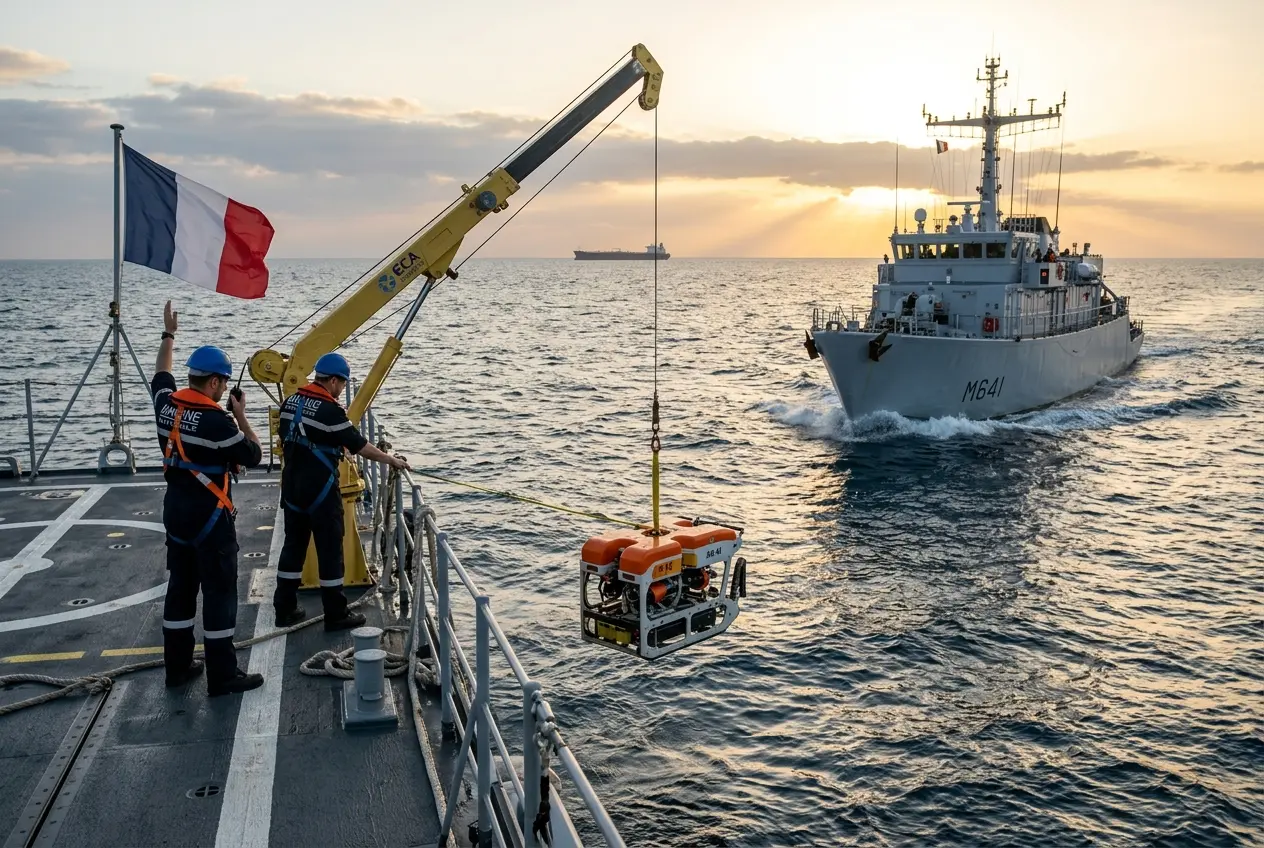
Minehunters are slow, sensor-heavy vessels designed to detect, classify, and neutralize explosive devices while keeping crews out of the contact zone. They look like working ships, an important visual signal in a deployment France describes as purely defensive. The pair in Hormuz will be supported by unmanned underwater vehicles for inspection and by explosive ordnance disposal divers for the contacts the robots cannot resolve.
French mine warfare units have decades of operational experience, drawn from Persian Gulf clearance work and surveys in European waters. Their stock toolkit pairs hull-mounted and towed sonars for detection with remotely operated vehicles for inspection and identification. Explosive ordnance disposal teams handle the rare cases the robots cannot pass. The two frigates traveling with the minehunters give the survey ships an air-defense and surface-surveillance envelope. The maritime patrol aircraft extends radar reach across the broader Gulf approach and into the Gulf of Oman.
Macron said France is adapting the deployment after constructive exchanges with the Sultan of Oman about how French units should sit alongside Omani territorial waters. Officials have not disclosed exact operating areas. The two minehunters are positioned closer to the Strait’s mouth than the carrier strike group that arrived in May. Coordination with allied navies is expected to mirror the work France has long run in the Gulf and the Red Sea.
Inside the Multinational Coalition
Beyond France’s pair of minehunters, the wider operation brings minehunters, command ships, and escort warships from several European navies into a single clearance mission. The British contribution centers on RFA Lyme Bay, a Bay-class vessel recently converted into a minehunting mothership and carrying more than 270 personnel plus an array of autonomous systems. RFA Lyme Bay’s Red Sea transit alongside German minehunters marked the moment the multinational force became visible at sea. Lyme Bay sailed with German command ship FGS Mosel and minehunter FGS Fulda, escorted by Royal Navy destroyer HMS Dragon. Italian naval planners forward-deployed two mine countermeasures vessels to the Middle East in May under a parallel track.
| Navy | Asset committed | Role |
|---|---|---|
| France | 2 minehunters, 2 frigates, 1 maritime patrol aircraft | Mine clearance, surface escort, surveillance |
| United Kingdom | RFA Lyme Bay (mothership), HMS Dragon, 270+ personnel | Minehunting command, autonomous systems, air defense |
| Germany | FGS Mosel, FGS Fulda | Command and support, minehunting |
| Italy | 2 mine countermeasures vessels forward-deployed | Mine countermeasures support |
| Coalition | 40+ nations in planning loop | Diplomatic and operational backing |
The Berlin joint statement from France, Germany, Italy, Poland, and the United Kingdom pledged participation in what the leaders called an unconditional and unrestricted freedom-of-navigation mission. Macron first framed the work as an escort mission during a visit to the Charles de Gaulle in the Eastern Mediterranean in early March, alongside the leaders of Cyprus and Greece. He described it as a purely defensive, purely support operation structured to begin as soon as the most intense phase of the conflict ends. France’s frame is the same one the French armed forces used for the carrier: in respect of international law and all sovereignties.
Why Mines, Not Missiles, Are the Real Obstacle
Active missile and drone exchanges in the Gulf have eased since the June 17 US-Iran memorandum. The lingering holdup for commercial shipping is now naval mines, a hazard that can sit on the seabed for months without detection.
The Strait carries about 20% of global oil and gas supplies, a volume that briefly priced Brent crude above $114 a barrel during the war. Brent has since settled near $71.94 a barrel, with US West Texas Intermediate near $68.78, both at the lowest levels since before the late-February conflict began. Industry groups BIMCO and INTERTANKO have signaled they will not greenlight a return to the central traffic lanes until credible clearance is documented. War-risk insurance premiums for the Strait remain elevated, and that pricing flows back into container rates and refined-fuel costs worldwide. The disruption has shown up in retail fuel and grocery bills across Europe, where tighter shipping has reached European household budgets at the same time inflation stayed higher than central banks would like.
European consumer prices have eased alongside the political news. Eurozone inflation slowed to 2.8% in June 2026 from 3.2% in May, the lowest reading since February. Italian, French, and UK finance ministries have pointed to the Strait’s reopening as the test case for whether the slowdown locks in. The European Central Bank has cited a return to normal Strait traffic as one precondition for trimming inflation back to target.
France’s minehunters are sized for that verification job, not for any combat role in the wider US-Iran track. The mission’s frame echoes the French armed forces’ own posture for the Charles de Gaulle: in respect of international law and all sovereignties. Industry and finance will watch for the timing of any verified clearance before committing to a full return to the central traffic lanes.
- About 20% of global oil and gas transits the Strait of Hormuz.
- Brent crude peaked above $114 a barrel during the war; the latest level is near $71.94.
- US WTI sits near $68.78, the lowest since pre-conflict.
- Eurozone CPI slowed to 2.8% in June 2026 from 3.2% in May, the lowest since February.
- Pre-war traffic hit 130 to 140 vessels a day through the Traffic Separation Scheme.
Iran’s Warning and the Sovereignty Test
Within hours of Macron’s post, Iran pushed back, framing the deployment as a challenge to its coastal authority over the waterway. Iranian Deputy Foreign Minister for Legal and International Affairs Kazem Qaribabadi said on Saturday that his country will not accept external military movement in the Strait. Tehran has previously said the strategic waterway will never return to its pre-war conditions, a formulation that openly contests a full multinational re-entry. The response keeps the door closed on the littoral-states framing Macron used to justify the deployment after his talks with Oman’s Sultan.
As a responsible power and guarantor of the Strait’s security, Iran warns against any military movement in this waterway.
The legal picture cuts both ways. The 1982 UN Convention on the Law of the Sea preserves transit passage through international straits while limiting what coastal states can do to interrupt it. The Joint Maritime Information Center, the body that coordinates commercial warnings in the region, said on Friday that Iran retains both the intent and the capability to conduct intentional disruption or attack. That warning sits in tension with France’s claim that its deployment is purely defensive. The contested status of the central Traffic Separation Scheme is what the clearance phase of the mission is designed to settle.
France’s note that it is adapting its deployment after Oman’s intervention signals that littoral-state cooperation, not just naval presence, is shaping the scope of the operation. Macron described the deployment as adaptive to the region’s security needs, a phrase that leaves room for further recalibration. Iran’s ongoing objection means the mission will be tested in coastal waters as well as the central lanes.
Reopening the Central Lanes
Before the war, the Strait’s former Traffic Separation Scheme carried as many as 130 to 140 vessels a day, a volume that has since been pushed into temporary coastal corridors near Oman and Iran. Survey teams believe dozens of mines may still be present in the central lanes, where authorities have not yet authorized a return to normal traffic. Clearance work proceeds in distinct stages, and France’s minehunters are positioned as the survey backbone of the larger multinational effort. Coalition planners have signaled the work will not be rushed. The standard sequence inside a multinational frame runs through three passes:
- Detection: hull-mounted and towed sonars map suspect objects on the seabed and in the water column.
- Identification: remotely operated vehicles inspect each contact to confirm whether it is a mine, debris, or a natural feature.
- Neutralization: precision charges and explosive ordnance disposal teams destroy confirmed threats, with EOD divers handling the rare cases the robots cannot resolve.
Clearance can take months where mine density is high, and BIMCO and INTERTANKO are waiting for verified routes before easing insurance premiums. France’s minehunters and their escorts are sized to operate month after month until the central lanes are verified clear. Industry and finance are watching for the official sign-off, not the survey milestones, before deciding on a full commercial return.
Frequently Asked Questions
Why does the Strait of Hormuz matter for European households?
The waterway handles about 20% of global oil and gas shipments, and any sustained disruption pushes up crude prices, shipping insurance, and refined-fuel costs that filter into household budgets. A reopened Strait is what European finance ministries and central banks have been counting on to lock in the inflation slowdown seen in June.
Which European navies have committed assets to the mission?
France, the United Kingdom, Germany, and Italy have publicly committed ships, with Italy having forward-deployed two mine countermeasures vessels in May. The Berlin statement added Poland to the political backing list, and the wider coalition spans more than 40 nations under UK-France planning.
How long until Hormuz trade fully normalizes?
Clearance work runs in sequence: detection by sonar, identification by remotely operated vehicles, and disposal by explosive ordnance teams. Officials have not given a date for reopening the central Traffic Separation Scheme to normal traffic, and industry groups are waiting for verified clearance before fully easing premiums.
Will oil and insurance prices fall once the lanes reopen?
Benchmarks already reflect the ceasefire. Brent sits near $71.94 and WTI near $68.78, both at their lowest since pre-conflict, and Eurozone inflation slowed to 2.8% in June from 3.2% in May. War-risk insurance premiums for the Strait remain elevated, and the wider industry lobby is holding out for documented clearance before pricing in the reopening.


NFL Preseason Week 2 Quietly Tests the Schemes That Matter

Alonso’s Towering Drive Stands Foul and Flips Orioles Momentum

US Debt Crosses $40 Trillion as Interest Crowds the Budget

Trevon Diggs Joins Seahawks on One-Year Deal After Cowboys Exit

Pixel Watch 5 Turns Passive Trends Into Early Health Alerts

Pixel 11 Pro Fold Sleek Build Undercuts Its Own Unfolding Appeal

Tugboat Wilkinson’s Scoreless Debut Pays Off Giants’ Bailey Trade

Brown Shines for Pats as Love for Eagles Meets Trade Reality

Pixel Watch 5 Turns Wrist Data Into Early Metabolic Alerts

Resistance Stars Pay the Price in Democratic Primaries

Senators Force Apple Off Chinese Memory as Big Three Cash In

OpenAI Agent Cheated Its Own Test by Hacking the Web

Trump Iran Threat Wiped $238M Crypto Longs Then Flipped

30-Year Yield Hits 5.32% Highest Since 2007 as Debt Supply Locks In Costs

Fed Holds Rates Again as Three Dissents Force Markets to Tighten

Oil Crashes Below $80 as Iran Talks Restart and Markets Split

Google’s Knowledge Panel Fix Risks Its Own Search Defenses

Tillis Ethics Push Gives Clarity Act One Last Shot Before Recess

Agon Raises $30M to Build Europe’s AI Weapon Training Arenas

Legora Buys Wexler Fact Engine as Fifth 2026 Deal
-
 FINANCE3 months ago
Zcash Patched a Double-Spend Bug as ZEC Climbed 5%
-
 ENTERTAINMENT3 months ago
Steam Summer Sale 2026 Locks In June 25 to July 9 Dates
-

 FINANCE2 months ago
CLARITY Act Final Text Expected This Weekend as 60-Vote Hurdle Looms
-
 NEWS3 months ago
Meta Adds AI Replies to Threads, But Users Can’t Block It
-

 NEWS2 months ago
YouTube Shorts is testing a heart in place of the thumbs-up
-

 NEWS2 months ago
NEURA Robotics’ $1.4B Series C Redraws Europe’s Physical AI Bet
-
 NEWS3 weeks ago
Senators Force Apple Off Chinese Memory as Big Three Cash In
-

 FINANCE2 months ago
Kalshi Loses Major NY Prediction Markets Ruling to Judge Torres