
NEWS
Meta’s Muse Image Lets Anyone Use Your Instagram Photos for AI
Meta’s Muse Image lets users tag a public Instagram profile into an AI prompt. No notification. No retrospective deletion. The opt-out is buried in settings.

Meta’s new Muse Image AI model lets any user tag a public Instagram handle into a prompt and produce a fresh image built from that account’s photos, and the feature is on by default for every adult whose profile is not locked. The model launched in the United States on July 7 inside the Meta AI app, on Instagram Stories, and in WhatsApp chats in a handful of other countries. The opt-out toggle exists, but it sits several menus deep, and Meta’s own help center says users will not be notified when their content has been used.
The hands-off default flips the usual assumption about a public account, which used to mean visible to everyone, not remixable by anyone. Anyone who knows a username can now build a custom poster, an invite, or a meme using the face and photos of that account, and the subject hears nothing.
How a Public Profile Becomes AI Fodder
Meta unveiled Muse Image on Tuesday, July 7, calling it the first image model from Meta Superintelligence Labs, the AI unit the company built after hiring Alexandr Wang away from Scale AI in 2025. The internal project name was Mango, and Muse Image is now free for everyday creation inside the Meta AI app, with a subscription plan kicking in for heavier use. In the United States, the model also powers more than 30 new AI effects inside Instagram Stories, and it can generate images directly inside WhatsApp chats in limited countries. Facebook and Messenger are next on the list.
The headline change is a single input field, the kind a user types a request into. Anyone in the Meta AI app can now type something like “make an invite for my friend @username” and the model will pull the public photos of that handle and remix them into a new image. Meta’s own post on the rollout describes the mechanic plainly, noting that “tagging a username lets Meta AI use public photos to build a visual that’s ready to post” and that users have “an easy setting to turn this feature off at any time,” a setting that is off by default. The full post is on the rollout post on the @-mention Instagram feature.
Muse Image is the same engine behind a wider set of tools Meta is pushing across its apps, including room redesigns that pull real products from Facebook Marketplace, the ability to cleanly erase a photobomber from the background of a snapshot, and posters that weave in working QR codes. Alexandr Wang, the head of Superintelligence Labs, has called the model “agentic” because it works alongside Meta’s separate Muse Spark large language model, “to reason through your prompt, search the web, and plan before it generates.” The Stories side of the rollout alone ships 30 new AI effects powered by the same system, with more countries and more surfaces planned next.
Private Accounts Are the Only Default Opt-Out
Meta’s default exclusion group is small. If a profile is set to private, Instagram respects that setting, and Muse Image cannot pull from it. Mashable’s walkthrough of the system is the cleanest read on what the AI does in that case: “Instagram respects that privacy setting as Muse Image requires access to Instagram account’s public photos in order for the tool to generate AI images,” the outlet explained.
When a user tries to type @username into a prompt for an account that is private, Muse Image pushes back, telling the prompt author it cannot use that handle’s likeness. So the only automatic opt-out Meta ships is the one most public-account holders have already declined to take. The full breakdown of how the private-account fallback works is in how a private Instagram account blocks the remix, but the short version is that the user who wants full protection has to lock the account down, or stay on top of every individual AI surface Meta ships.
The Three Toggles That Switch the Remix Off
For public profiles, the only path is a manual toggle, and Meta has not made it easy to find. The rollout shipped without the toggle surfacing on every account on day one. When WIRED checked a personal public account on Tuesday afternoon, the afternoon of the launch, the settings had not yet been updated to include the new labels. The toggle is meant to show up gradually as the rollout expands through the United States before other countries.
To find the opt-out:
- Open the Instagram app and go to your profile page.
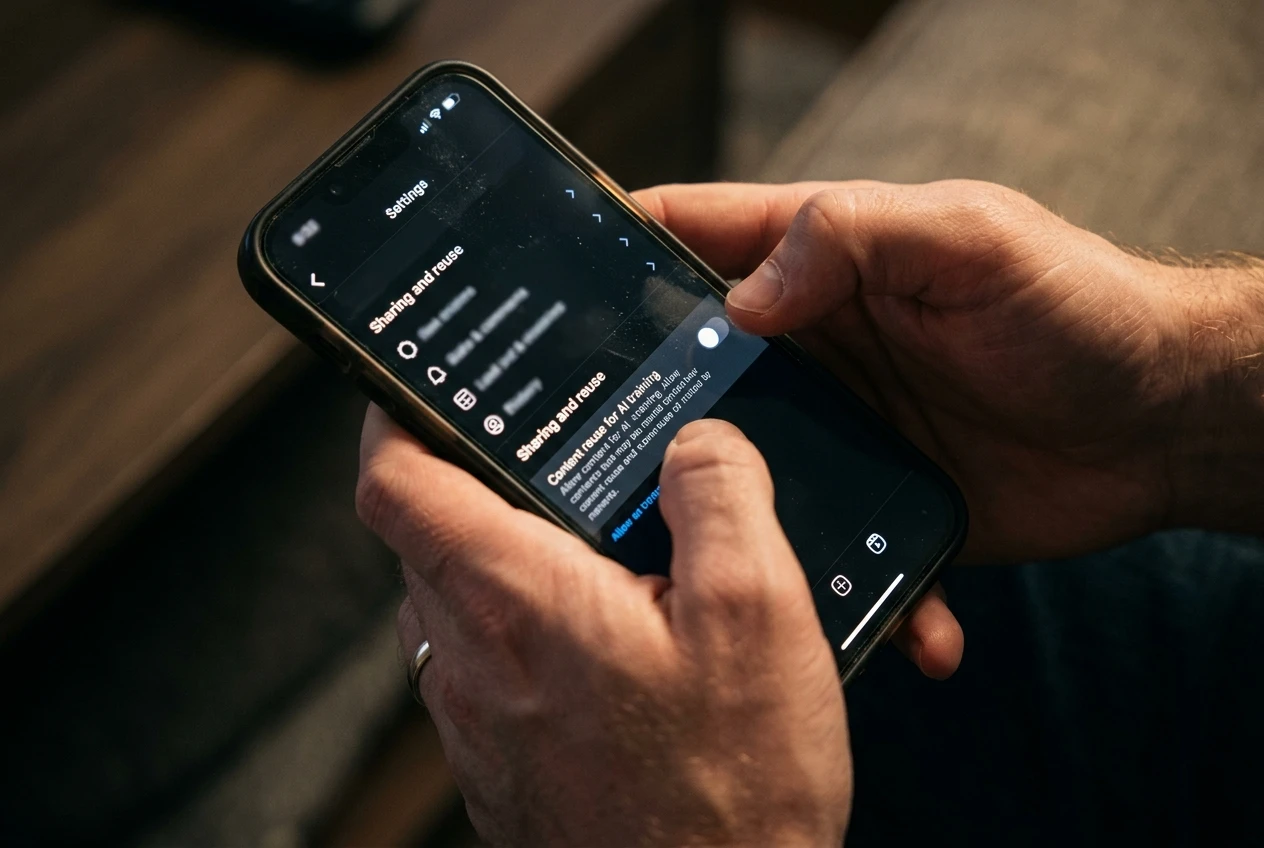
- Tap the three-line menu in the top-right corner of the profile, then scroll to “Sharing and reuse” under the “How others can interact with you” section.
- Locate the section labeled “Allow people to use your content on Instagram and with AI features on Meta” and switch off both the Posts toggle and the Reels toggle.
If those words are not in the menu yet, Meta has not finished deploying the rollout to that account.
The toggle label is exact. Per the opt-out toggle wording and the help center language, the section sits under the Sharing and reuse tab and reads “Allow people to use your content on Instagram and with AI features on Meta,” with two switches attached: one for Posts, one for Reels. Instagram’s own help center states that “people may be able to create content with your Instagram content using AI features at Meta” whenever an account is left on the default settings.
Users should expect the toggle to be missing on day one and to materialize over the coming days as Meta pushes the rollout out. Treat it as an active chore. The fact that Meta’s settings menus have already been a target, as in the earlier Instagram account hijack through an AI support bot, is a reminder that buried settings pages are not where users naturally look for safety tools.
What Turning It Off Will Not Get Back
The opt-out is silent and forward-only. There is no retroactive cleanup, and there is no way to know when, or how many times, an account was already remixed before the toggle was flipped.
Three limits govern the switch:
- No notification. Instagram’s own help center confirms that users will not be told when an AI remix is built from their photos.
- No deletion. Toggling off only blocks future generations, per Meta’s policy; images already created remain in circulation.
- No audit trail. There is no log of who tried to remix the account before the switch was thrown, and no contact path for the subject of an existing image.
The practical effect is that an adult public-account holder who flips the switch today has stopped the bleeding but has not recovered anything that was already taken.
Watchdogs and an Advocacy Group Call It a Failure
The backlash arrived almost immediately. A reporter at the BBC ran the tool on herself, asking it to make it look like she was driving, and Muse Image returned a usable image on the first try. Privacy International told the BBC the rollout is “the latest sign AI companies see people’s images and data as raw material to be exploited,” and quoted users on X warning that pulling real users into generated photos without explicit consent is “a privacy landmine waiting to detonate.” The full first-look test of the @-mention mechanic is in a reporter’s first test of the @-mention remix feature.
In the United States, Public Citizen, the consumer advocacy nonprofit, was the loudest critic. Its director of federal AI governance and technology policy, J.B. Branch, issued a written statement that lays out the group’s core objection.
Meta has once again chosen the creepiest possible path. People should not wake up to discover their face has become raw material for someone else’s AI experiment. This is another invasion of consumers’ privacy. Instead of asking for meaningful consent, Meta quietly defaults users into the system and buries the opt-out in account settings.
The statement, issued the day after the launch, was signed by J.B. Branch, Public Citizen’s director of federal AI governance and technology policy. Read the full advocacy group’s written statement on the opt-in default.
In the United Kingdom, Foxglove, a tech justice nonprofit, took the same line. Its advocacy director, Donald Campbell, told the BBC that there has already been a “catalogue of harms from non-consensual AI-altered images on social platforms just in the past year,” and that “it is hard to see why Mark Zuckerberg thinks facilitating yet more of this creepy image manipulation is a good idea.” Foxglove’s intervention lands alongside Ofcom’s existing investigation into Grok on X for non-consensual AI-altered images of real people, two threads of UK regulatory pressure on the same underlying problem.
Why Default-Opt-Ins Keep Coming Back to Meta
Muse Image is the latest in a longer line of Meta products where the user is the raw material and the company is the customer. Malwarebytes’ coverage puts it bluntly: “Public Instagram photos were already being harvested by attackers to create deepfakes for identity verification fraud. Giving people an official way to generate AI images based on public profiles lowers the barrier to creating synthetic images that could be used for impersonation, scams, or other abuse.”
The historical anchor is the Cambridge Analytica affair, where Cambridge Analytica improperly harvested data from tens of millions of Facebook users, without their knowledge, to build voter-targeting profiles ahead of the 2016 U.S. election. Meta paid a then-record $5 billion FTC settlement in 2019 over the episode, the largest fine the Federal Trade Commission had ever imposed on a tech company. The pattern then was broad use of personal data unless users actively turned it off, exactly the design Muse Image has now extended to faces.
Meta’s facial-recognition system is the closer parallel. The company shut down its facial-recognition system in 2021 amid lawsuits and regulatory pressure over its collection of biometric data, a tool that had automatically recognized people in photos and videos for years. Muse Image does not match a name to a face the way the old system did, but it ends in a similar place, with biometric likenesses of real people built from personal data, and the user as the source material rather than the customer. The wider AI-data environment is moving in the opposite direction by default; how AI crawlers will be blocked by default from September shows the same cycle playing out in the training-data market.
Whether Meta’s framing, that people “may be able to create content with your Instagram content using AI features at Meta,” satisfies data-protection regulators in the EU is the open question. Meta relies on the “legitimate interests” legal basis under GDPR to train its AI on European user data, a position NOYB and other privacy groups have already challenged. For now, a public-account holder who does not want their face handed over as raw material has to find the toggle, flip both switches, and trust that no one has already built what they cannot take back.
Frequently Asked Questions
Will Instagram notify me if someone uses my photos in Muse Image?
No. Instagram’s help center states that users “will not be notified about content created using AI features at Meta,” and Meta has shipped no separate alert for remixes built through the @-mention workflow.
Does opting out delete AI images already made from my photos?
No. The opt-out is forward-only. AI remixes created before the toggle was flipped remain on Meta’s servers and continue to circulate, and there is no in-app tool to list or remove them.
Are private accounts excluded?
Yes. Muse Image requires access to public photos, so a private profile cannot be tagged into a remix. The tool tells the prompt author it cannot use the account when they try to @-mention it.
Is Muse Image free?
Everyday creation in the Meta AI app is free. Heavier or commercial use sits behind a Meta subscription plan, per Meta’s July 7 announcement post.


Replit Opens Its London Office Inside an AI Crowd

Straight Circle Trailer Lands Without a U.S. Date

Anemo Labs Bets £700,000 on an AI Sense of Smell

Nintendo Prices the Zelda 40th Switch 2 at $519

Copilot Capital Buys the Autopilot Already Running 90 GW

Ground A Raises €9.1 Million for a Pallet Laser

Gibney’s Musk Film Opens in Venice Without Its Subject

Torvalds Blames AI for a Full-Fat Linux 7.3-rc2

Dexter Returns Sharper, Older, and Stuck Between Killers

Meta’s Muse Agent Can Spend Before the Privacy Lock

Walter’s TWG Insists No Fraud as Insurer Probes Force Cleanup

30-Year Yield Hits 5.32% Highest Since 2007 as Debt Supply Locks In Costs

PCE Stays at 3.7% as Gas and Tariffs Outrun Coming Revisions

Evernorth S-4 Clears Path for Active XRP Treasury on Nasdaq

Astute’s $1.2M bet makes B2B creator deals feed AI discovery

Strategy Parks $1.59B Cash While Bitcoin Stack Stays Flat

CLARITY Act Cloture Opens a Door Ethics Still Blocks

Instinct Hits $2.5 Billion as AI Agent Access Sparks Trust Fights

Oracle’s 2.8 GW Bloom Deal Exposes the AI Power Bypass

AI data centers win as RAM kits jump nearly 500 percent
-
 FINANCE3 months ago
Zcash Patched a Double-Spend Bug as ZEC Climbed 5%
-
 ENTERTAINMENT3 months ago
Steam Summer Sale 2026 Locks In June 25 to July 9 Dates
-

 FINANCE2 months ago
CLARITY Act Final Text Expected This Weekend as 60-Vote Hurdle Looms
-
 NEWS4 months ago
Meta Adds AI Replies to Threads, But Users Can’t Block It
-
 ENTERTAINMENT5 months ago
Extraction 3 Is Officially Coming to Netflix in 2027
-

 NEWS3 months ago
YouTube Shorts is testing a heart in place of the thumbs-up
-

 NEWS1 month ago
Senators Force Apple Off Chinese Memory as Big Three Cash In
-

 NEWS3 months ago
NEURA Robotics’ $1.4B Series C Redraws Europe’s Physical AI Bet