
FINANCE
GENIUS Act Turns One as Trump’s Own Stablecoin Clouds the Clarity Act
Stablecoins hit $315 billion in the GENIUS Act’s first year, but the fastest grower was Trump’s own USD1, now the reason the Clarity Act is stuck.

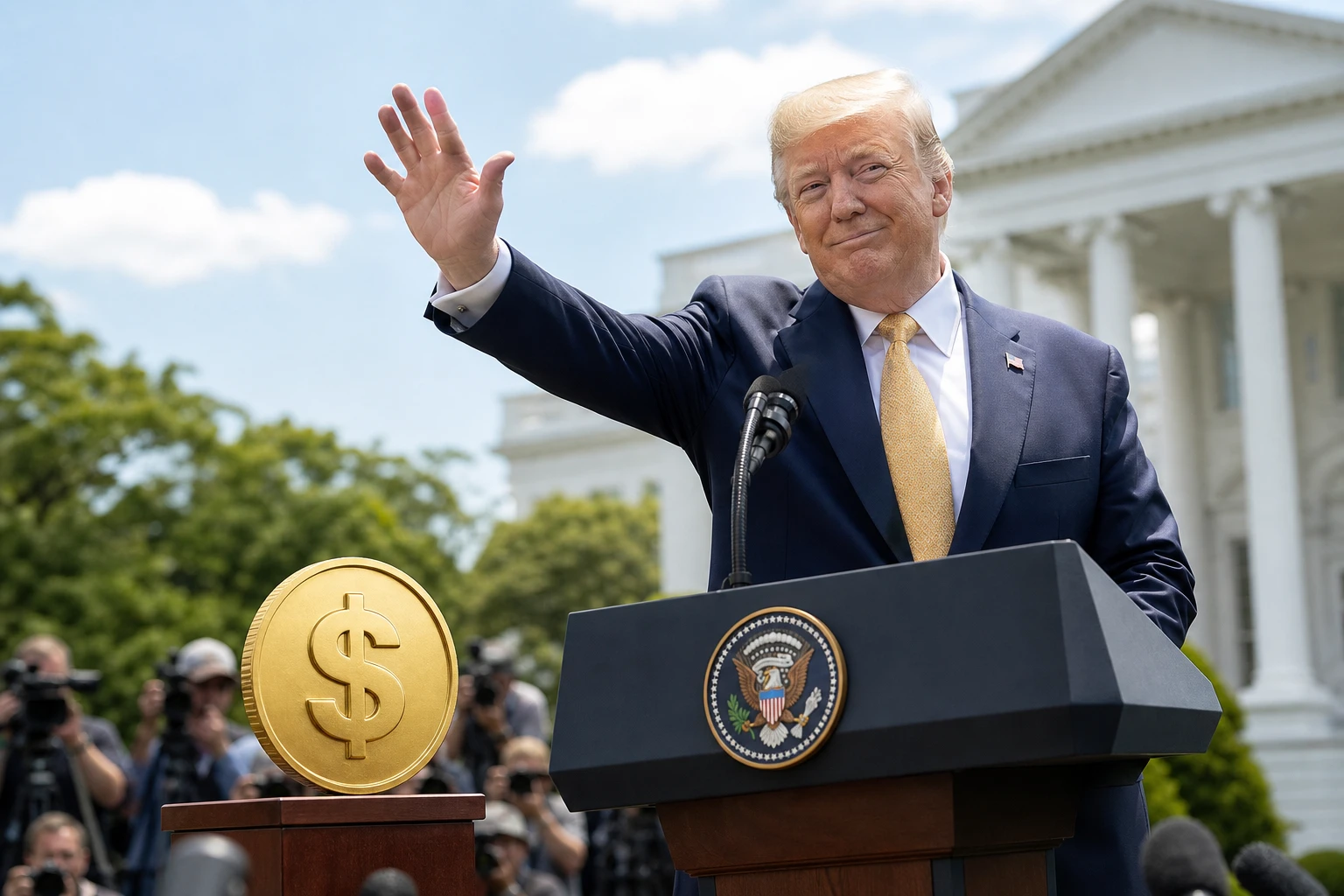
Stablecoins went from $260 billion to roughly $315 billion in the twelve months since President Donald Trump signed the GENIUS Act, a jump of more than 20% that turned a niche crypto product into infrastructure that banks, PayPal and Visa now build around. But the law’s most politically loaded beneficiary is not Circle or Tether. It is USD1, the stablecoin issued by the president’s own family business, which grew nearly twice as fast.
That overlap between the law Trump signed and the coin his family profits from has become the exact reason Washington cannot finish the job. The CLARITY Act, the broader market structure bill the industry says it needs next, is stuck in the Senate over ethics language written specifically to address the president’s crypto income. The two bills were supposed to arrive together. One year later, only one of them is law.
A $50 Billion Year For Digital Dollars
The GENIUS Act, formally the Guiding and Establishing National Innovation for U.S. Stablecoins Act, passed with 68 to 30 support in the Senate and 308 to 122 in the House before Trump signed it on July 18, 2025. It requires payment stablecoins to hold one to one reserves in cash or short term Treasuries, with monthly disclosures and anti money laundering controls.
A year on, the total stablecoin market sits at about $315 billion, according to DeFiLlama data cited by industry trackers, with Tether’s USDT still holding roughly 59% of that supply and Circle’s USDC around 24%. Circle, the issuer of USDC, called the law a milestone that “sets consistent standards for reserve backing, transparency, and consumer protections.”
The rulebook is not finished. Congress gave regulators one year to write implementing rules, a deadline that fell on July 18, 2026, the same week public comment periods on customer identification and sanctions compliance remain open through August 21. Nellie Liang, a Brookings Institution senior fellow, put it plainly: “While the GENIUS Act clarifies much, financial regulators must now write rules.” The Federal Reserve’s own research note flagged a separate concern: opacity from vertically integrated issuers could make it harder to spot financial stability risks as the sector scales.
Circle And A Trump Stablecoin Chase The Same Charter
While Washington drafts, the industry has not waited. On July 10, 2026, Circle announced it had won final approval from the OCC to open a national trust bank, to be called Circle National Trust, arriving eight days before the GENIUS Act’s rulemaking deadline. Circle’s stock jumped more than 12% on the news. Chief executive Jeremy Allaire said federal oversight of the trust bank “unlocks a new phase of adoption, where leading financial institutions can build on public blockchains with clarity and confidence.”
Circle first applied in June 2025 and received conditional approval that December alongside Ripple, Paxos, BitGo and Fidelity Digital Assets, detailed in the OCC’s conditional approval order. Before any of them, Anchorage Digital Bank had been the only crypto native firm holding a national trust charter, since 2021. Tether chose not to seek its own charter at all, instead launching a new dollar token called USAT in January 2026 through Anchorage as issuer, with Cantor Fitzgerald as reserve custodian.
A fourth applicant is working through the same pipeline: WLTC Holdings, a subsidiary of World Liberty Financial, the Trump family’s crypto venture, applied to the OCC in January 2026 for a national trust charter covering the issuance, redemption and custody of its own stablecoin, USD1. A decision has not been announced.
Where The Three Largest Stablecoins Stand
| Stablecoin | Circulating Supply | Market Share | Federal Charter Status |
|---|---|---|---|
| USDT (Tether) | ~$184 billion | ~59% | No charter of its own; new USAT token issued via Anchorage Digital Bank |
| USDC (Circle) | ~$73 billion | ~24% | Final OCC approval, July 10, 2026 (Circle National Trust) |
| USD1 (World Liberty Financial) | ~$4.6 billion | ~1.5% | Applied January 2026 via WLTC Holdings; pending |
The gap in scale is enormous. But USD1 is not competing on scale. It is competing on proximity to power, and that is precisely what has turned the GENIUS Act’s sequel into a fight over one family’s finances.
The Trump Family Built Its Own Digital Dollar
World Liberty Financial launched in September 2024, co founded by Trump’s sons Eric and Donald Jr. alongside Zach and Alex Witkoff, sons of U.S. envoy Steve Witkoff. Trump holds the title of co founder emeritus. In March 2025 the venture launched USD1, a dollar backed token custodied by BitGo Trust Company.
USD1’s circulating supply climbed from $3.3 billion on January 1, 2026 to about $4.6 billion by mid year, a near 40% jump in six months, faster than the overall stablecoin market’s 20% climb across the full year since GENIUS Act’s signing. Independent trackers called it the fastest growing fiat backed stablecoin of the period.
The token’s biggest boost came early: an Abu Dhabi backed firm used $2 billion in USD1 to help fund a stake in the crypto exchange Binance in 2025, a deal that drew criticism from government ethics experts. Binance’s co founder, Changpeng Zhao, was later pardoned by Trump for financial crimes; Trump has denied any link between the two events. More recently, USD1 turned up in a very different setting: World Liberty Financial paid $250,000 in fighter bonuses in the token at a UFC event held on the White House South Lawn.
Warren Ties Clarity’s Fate To A $1.4 Billion Filing
Trump’s 2025 financial disclosure, released this summer, listed $1.4 billion in crypto related income out of roughly $2.2 billion in total earnings. World Liberty Financial token sales accounted for more than $500 million of it, according to CBS News, with another $196 million from an equity sale tied to Stablecoin Holdco LLC, a WLF affiliated entity.
That filing is now the center of the CLARITY Act fight. Sen. Elizabeth Warren, a Massachusetts Democrat, wrote to Senate leadership on July 13 demanding ethics guardrails and cited the $1.4 billion figure directly in her letter.
The crypto legislation heading to the Senate floor must prevent the president, vice president, senior administration officials, members of Congress, and their families from profiting off the crypto industry.
Warren said that in a statement addressing the bill’s outstanding provisions. Trump has rejected the conflict of interest framing outright, telling reporters after the disclosure’s release, “You know why I’m profiting, because the stock market’s going up, everybody’s profiting.”
Where Washington Splits On Crypto Ethics
- Sen. Elizabeth Warren and allies including Sens. Kirsten Gillibrand, Chris Murphy and Jeff Merkley say a floor vote requires enforceable language barring officials, and their families, from profiting off crypto policy they help write.
- The White House rejects the premise entirely, arguing the president’s gains reflect a broader market rally rather than any policy favor, and has opposed provisions aimed at his personal holdings.
- Legal scholars writing on the Duke Law Financial Regulation Blog, along with the Bank Policy Institute, separately argue the OCC’s national trust charters for crypto firms rest on shaky legal footing regardless of who holds them, calling the approvals “illegal, dangerous, and likely to end in bailouts.”
A conflict of interest amendment from Sen. Chris Van Hollen failed 11 to 13 in the Banking Committee in May. When Senate Republicans released a merged draft combining the Banking and Agriculture Committee texts in mid July, it omitted ethics language entirely, prompting Murphy, Van Hollen and Merkley to hold a press conference formally opposing the bill.
Two Senate Weeks Left Before Recess
The Digital Asset Market Clarity Act, formally H.R. 3633, passed the House 294 to 134 back on July 17, 2025, one day before Trump signed the GENIUS Act, during what Washington nicknamed Crypto Week. The Senate Banking Committee advanced its version 15 to 9 on May 14, 2026, with only Sens. Ruben Gallego and Angela Alsobrooks crossing party lines, and both have said their committee votes do not guarantee floor support. The bill has sat on the Senate’s legislative calendar since June 1 without a scheduled floor date.
Three disputes remain unresolved beyond ethics:
- Section 604, which would shield non custodial software developers from money transmitter rules, opposed by groups including the National District Attorneys’ Association as a risk to criminal investigations.
- Stablecoin yield, where Coinbase earns roughly $1.35 billion a year in USDC rewards revenue that banking groups argue skirts the GENIUS Act’s ban on issuer paid interest.
- Ethics language, the sticking point tied directly to the president’s disclosed income.
Passage still needs 60 votes in a chamber split 53 to 47 Republican, meaning at least seven Democrats. Brian Gardner, Stifel’s chief Washington policy strategist, wrote that the bill “probably needs to get through the Senate by the end of July” or its odds will worsen substantially. Galaxy Research puts 2026 passage odds at roughly 50-50. Polymarket traders had it closer to 34% and falling.
What Happens If The Senate Misses Its August Deadline?
Missing the recess deadline would not kill the CLARITY Act outright, but it would push the bill into a crowded fall session squeezed by midterm campaigning, and several analysts expect the realistic window to then shift into next year. Sen. Cynthia Lummis has warned that a miss could delay market structure legislation for years or force a full restart once the current Congress ends in January 2027.
Without it, the line between SEC and CFTC jurisdiction over most digital assets stays undefined, decided case by case through enforcement rather than statute. Two Senate floor windows remain before the August 7 recess: this week, and the week of July 27.
Frequently Asked Questions
What Is The Difference Between The GENIUS Act And The CLARITY Act?
The GENIUS Act only covers payment stablecoins, setting reserve, disclosure and licensing rules for tokens like USDC and USDT. The CLARITY Act is broader market structure legislation that would decide whether other digital assets fall under SEC or CFTC jurisdiction, covering exchanges, brokers and token offerings well beyond stablecoins.
Does The GENIUS Act Ban Stablecoin Yield?
Yes. It bars issuers from paying interest or yield directly to stablecoin holders. That ban is part of why the CLARITY Act’s yield language is contested, since some platforms offer rewards for holding stablecoins through means banking groups say function like interest in practice.
Which Federal Agencies Regulate Stablecoins Under The GENIUS Act?
The Treasury Department, Federal Reserve, FDIC and OCC share oversight depending on whether an issuer is a bank, a nonbank trust company or a state licensed entity, and all four were still finalizing implementing rules as of the law’s one year deadline.
Is USD1 Backed The Same Way As USDC Or USDT?
USD1 follows a similar structure, holding cash and short term Treasuries through custodian BitGo Trust Company. Unlike Circle, World Liberty Financial does not yet have a finalized federal bank charter for USD1; its subsidiary WLTC Holdings applied to the OCC in January 2026 and is still awaiting a decision.
When Does The Senate Vote On The Clarity Act Next?
Senate leadership has pointed to two remaining floor windows before the scheduled August 7 recess: the week of July 20 and the week of July 27. Missing both would likely push any vote into the fall.


Replit Opens Its London Office Inside an AI Crowd

Straight Circle Trailer Lands Without a U.S. Date

Anemo Labs Bets £700,000 on an AI Sense of Smell

Nintendo Prices the Zelda 40th Switch 2 at $519

Copilot Capital Buys the Autopilot Already Running 90 GW

Ground A Raises €9.1 Million for a Pallet Laser

Gibney’s Musk Film Opens in Venice Without Its Subject

Torvalds Blames AI for a Full-Fat Linux 7.3-rc2

Dexter Returns Sharper, Older, and Stuck Between Killers

Meta’s Muse Agent Can Spend Before the Privacy Lock

Walter’s TWG Insists No Fraud as Insurer Probes Force Cleanup

30-Year Yield Hits 5.32% Highest Since 2007 as Debt Supply Locks In Costs

PCE Stays at 3.7% as Gas and Tariffs Outrun Coming Revisions

Evernorth S-4 Clears Path for Active XRP Treasury on Nasdaq

Astute’s $1.2M bet makes B2B creator deals feed AI discovery

Strategy Parks $1.59B Cash While Bitcoin Stack Stays Flat

Instinct Hits $2.5 Billion as AI Agent Access Sparks Trust Fights

CLARITY Act Cloture Opens a Door Ethics Still Blocks

Oracle’s 2.8 GW Bloom Deal Exposes the AI Power Bypass

Space Mirror Demo Revives 1993 Russian Night-Light Test
-
 FINANCE3 months ago
Zcash Patched a Double-Spend Bug as ZEC Climbed 5%
-
 ENTERTAINMENT3 months ago
Steam Summer Sale 2026 Locks In June 25 to July 9 Dates
-

 FINANCE2 months ago
CLARITY Act Final Text Expected This Weekend as 60-Vote Hurdle Looms
-
 NEWS4 months ago
Meta Adds AI Replies to Threads, But Users Can’t Block It
-
 ENTERTAINMENT5 months ago
Extraction 3 Is Officially Coming to Netflix in 2027
-

 NEWS3 months ago
YouTube Shorts is testing a heart in place of the thumbs-up
-

 NEWS1 month ago
Senators Force Apple Off Chinese Memory as Big Three Cash In
-

 NEWS3 months ago
NEURA Robotics’ $1.4B Series C Redraws Europe’s Physical AI Bet