
NEWS
Anthropic Bet $1.5 Billion to Dodge a $75 Billion Verdict
Anthropic’s record settlement caps its book piracy bill, but the same pirated library now anchors a $3 billion music lawsuit still in court.

U.S. District Judge Araceli Martínez-Olguín granted final approval Monday to Anthropic’s $1.5 billion settlement with authors and publishers, the largest copyright payout in American legal history. The deal resolves claims that the Amazon and Alphabet backed AI company pirated more than 500,000 books to train its Claude chatbot.
Anthropic settled rather than face a trial that legal analysts pegged at up to $75 billion in statutory damages. The pirated library at the center of that math is now the evidence behind a separate $3 billion lawsuit from music publishers that has nothing to do with Monday’s deal.
The Settlement’s Fine Print, By the Numbers
The case, Bartz v. Anthropic, was filed in August 2024 by novelist Andrea Bartz along with authors Charles Graeber and Kirk Wallace Johnson. It accused Anthropic of downloading pirated copies of their work to train Claude rather than licensing it.
- $1.5 billion total fund, covering more than 500,000 books and other registered works.
- $3,000 to $3,100 paid per work, with more than 91% of eligible rightsholders already filing claims.
- $101 million in attorney fees approved, cut down from a $187.5 million request, roughly 7% of the fund.
- $50,000 awarded to each named plaintiff, plus $18 million to the settlement administrator.
Anthropic is also required to permanently destroy the pirated files it accumulated. The company cannot rebuild the same shadow library it used to train Claude’s earlier models.
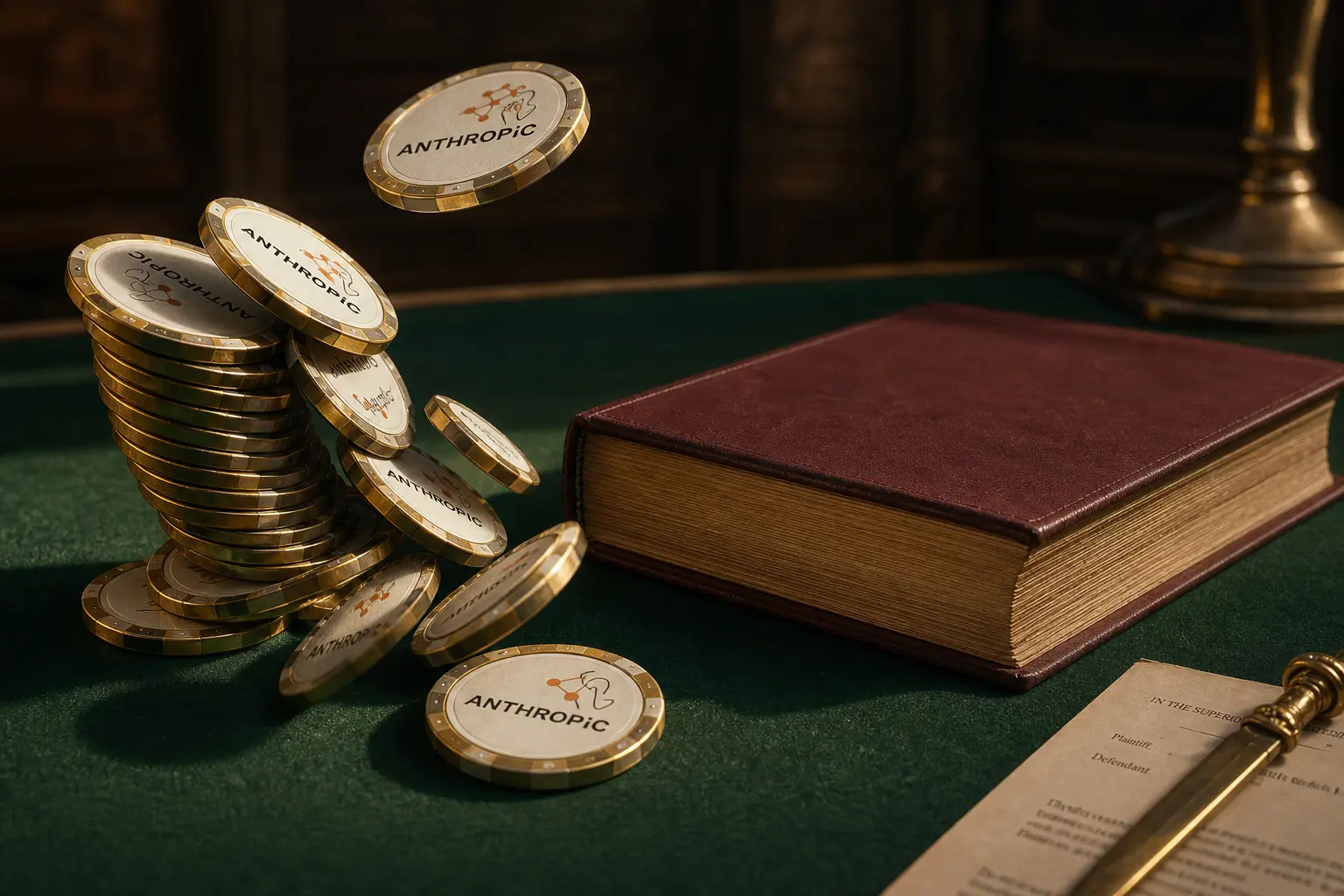
The $75 Billion Verdict Anthropic Never Risked
The settlement follows a split ruling handed down in 2025 by then presiding Judge William Alsup, who has since retired. Alsup found that training Claude on legally acquired books was fair use. He drew a hard line at how Anthropic built its dataset.
Court records describe Anthropic downloading more than 7 million pirated book copies from shadow libraries including Library Genesis and Pirate Library Mirror. Alsup ruled that piracy, unlike training itself, was not shielded by fair use, and sent the question of damages toward a trial.
We will have a trial on the pirated copies used to create Anthropic’s central library and the resulting damages, actual or statutory, including for willfulness.
That was Alsup, in the ruling that set up the settlement talks. Under federal law, willful copyright infringement carries statutory damages of up to $150,000 per work, with $750 as the common floor for ordinary infringement. Applied across roughly 500,000 registered works, that ceiling put Anthropic’s theoretical exposure near $75 billion. A trial to set the actual number was scheduled for December 2025, and Anthropic settled before it began.
Judge Martínez-Olguín defended the size of the deal directly, writing that the settlement provides meaningful relief to the Settlement Class given the reasonable range of Class Members’ possible recoveries, especially since further litigation would likely be complex, expensive, lengthy, and risky.
She noted the roughly $3,000 per-work figure is four times the statutory minimum for ordinary infringement, the most common outcome in copyright cases, of $750.
Why Some Authors Say the Deal Still Shortchanges Them
Not every class member signed on happily. Some argued in court filings that a trial could have won them far more than $3,000 a book. Others objected to how much of the fund was headed to lawyers rather than writers.
The fee number moved twice. Attorneys initially sought 20%, or $300 million, then lowered their own ask to $187.5 million before Judge Martínez-Olguín cut it again to about $101 million. She overruled the size objections outright, writing that complaints about the settlement’s scale were not grounded in a realistic assessment of the overall risks and rewards of a trial.
An attorney representing four objectors, James H. Bartolomei III of the Duncan Firm, asked the court to reopen the opt-out window after key settlement documents were posted to the case website later than expected. The judge declined. In the end, only 350 authors out of hundreds of thousands of class members opted out before the deadline to pursue their own lawsuits.
The Authors Guild has said the per-book amount feels paltry given the scale of the alleged theft, and it flagged a detail many writers may not realize: roughly half of that $3,000 often goes to the publisher rather than the author, depending on the original book contract.
The Same Pirated Files Are Funding a New $3 Billion Fight
Monday’s ruling only closes the book claims. It does nothing for a separate case brought by the music industry over the same downloaded library.
Universal Music Group, Concord Music Group and ABKCO first sued Anthropic in October 2023 over Claude’s use of song lyrics. In January 2026, the same publishers filed a second, far larger suit, seeking more than $3 billion over more than 20,000 songs, this time naming CEO Dario Amodei and co-founder Benjamin Mann individually. The new complaint leans on evidence uncovered during discovery in the Bartz case, alleging Anthropic used BitTorrent to pull sheet music and lyrics, including songs like Sweet Caroline, out of the same pirate libraries at the heart of the book settlement.
In a filing seeking summary judgment, the publishers argued, the evidence in this case is overwhelming.
| Case | Court | Status | Financial Outcome |
|---|---|---|---|
| Bartz v. Anthropic (books) | N.D. Cal., Judge Martínez-Olguín | Final approval, July 20, 2026 | $1.5 billion, about $3,000 per work |
| Kadrey v. Meta (books) | N.D. Cal., Judge Chhabria | Summary judgment for Meta, June 2025 | $0, no damages trial |
| Concord/UMG/ABKCO v. Anthropic (songs) | N.D. Cal. | Active, second suit filed January 2026 | $3 billion sought, unresolved |
| Google, OpenAI, Midjourney suits | Multiple courts, including New York | Pending | Unresolved, no binding precedent from Bartz |
Why Did Meta Pay Nothing for the Same Piracy Claim?
Meta faced almost identical allegations, pirated books from shadow libraries funneled into AI training, and walked away paying nothing. A different judge, a different theory of the case, and a gap in the evidence made the difference.
In Kadrey v. Meta, authors including Richard Kadrey, Sarah Silverman and Christopher Golden accused Meta of pulling their books from shadow libraries such as Z-Library and Library Genesis to train its LLaMA models. Meta had acquired at least 666 copies of the plaintiffs’ books that way, according to the Authors Guild. In June 2025, Judge Vince Chhabria granted Meta summary judgment on fair use.
The legal distinction mattered. Unlike Alsup in the Anthropic case, the Kadrey court did not separate the sourcing method from the training use, treating the whole process as one transformative act. Meta won largely because the plaintiffs could not produce enough evidence that Meta’s copying had actually harmed the market for their books, not because the court blessed piracy outright. The Authors Guild called it a technical win, not a verdict on the underlying law.
The Electronic Frontier Foundation had urged the court to reject a piracy carve-out from fair use analysis, warning that treating BitTorrent downloads as automatically disqualifying could unravel AI training defenses far beyond this one case. Even in victory, Chhabria signaled the fight isn’t over everywhere: he suggested future plaintiffs with sharper evidence of market harm could still win.
The Industry’s Reckoning Is Just Getting Started
Alsup’s fair use finding and Martínez-Olguín’s approval only bind the Northern District of California. Suits against Google, OpenAI and Midjourney are moving through other courts under different judges, some of them in New York, with no obligation to follow San Francisco’s lead.
The pattern is showing up well beyond books and songs. OpenAI recently shut down its Sora video tool and walked away from a prospective $1 billion deal with Disney amid friction over how AI models use protected characters and footage. SAG-AFTRA, the actors’ union, separately condemned a viral AI-generated fight video depicting Tom Cruise and Brad Pitt, another flashpoint over AI systems using real creative material without permission.
Anthropic keeps the fair use ruling it wanted for training. It also keeps a bill for how it built its library, a music case that draws directly on that same evidence, and a legal template that the next AI defendant to reach a jury may not get to use.
Frequently Asked Questions
How much money will individual authors actually receive?
Court filings set the per-work payment at roughly $3,000 to $3,100, but the Authors Guild has noted that around half of that typically goes to the publisher rather than the author, depending on the original book contract, so many writers will see a smaller check than the headline figure suggests.
Can an author who missed the opt-out deadline still sue Anthropic separately?
No. Judge Martínez-Olguín refused to reopen the window even after an attorney representing four objectors argued that key settlement documents had been posted late. Only the 350 authors who filed before the original cutoff kept the right to pursue their own lawsuits.
Why are music publishers still fighting Anthropic after this settlement?
The book settlement does not cover song lyrics or sheet music. Music publishers have pointed to the scale of AI-generated audio as part of their urgency, citing a Deezer study that found more than 60,000 AI-generated tracks were being submitted to the platform daily by January 2026, accounting for roughly 3% of total streams.
Is training AI on books now legal everywhere in the United States?
Not necessarily. Judge Alsup’s fair use finding binds courts only in the Northern District of California. Separate lawsuits against Google, OpenAI and Midjourney are proceeding before different judges, including a federal court in New York that owes no deference to California’s ruling at all.


Veridue Raises $4 Million to Speed Energy Deal Diligence

Healey Adds a £150m Rung for Northern Scale-Ups

Ten Deals Took Most of Europe’s August Tech Money

Holmes Hired Fielder to Film Her Last Days

Molten Bets £100m of Plc Cash on Late-Stage Tech

Garlinghouse Cited Dutch Gold, and London Got the Bars

byFounders Bets $4.3 Million on Fluencify After $2M ARR

Alpha Gang Puts A-List Stars on a Zellner Wager

Angel Bets a Recut PG-13 Chase on Ritchson and Wilson

Flex IT and T1A Combine to Own Corporate Device Supply

Walter’s TWG Insists No Fraud as Insurer Probes Force Cleanup

30-Year Yield Hits 5.32% Highest Since 2007 as Debt Supply Locks In Costs

PCE Stays at 3.7% as Gas and Tariffs Outrun Coming Revisions

Evernorth S-4 Clears Path for Active XRP Treasury on Nasdaq

Astute’s $1.2M bet makes B2B creator deals feed AI discovery

Strategy Parks $1.59B Cash While Bitcoin Stack Stays Flat

Instinct Hits $2.5 Billion as AI Agent Access Sparks Trust Fights

Oracle’s 2.8 GW Bloom Deal Exposes the AI Power Bypass

CLARITY Act Cloture Opens a Door Ethics Still Blocks

Amber’s €7M locks Mittelstand knowledge inside Europe
-
 FINANCE3 months ago
Zcash Patched a Double-Spend Bug as ZEC Climbed 5%
-
 ENTERTAINMENT3 months ago
Steam Summer Sale 2026 Locks In June 25 to July 9 Dates
-

 FINANCE2 months ago
CLARITY Act Final Text Expected This Weekend as 60-Vote Hurdle Looms
-
 NEWS4 months ago
Meta Adds AI Replies to Threads, But Users Can’t Block It
-
 ENTERTAINMENT5 months ago
Extraction 3 Is Officially Coming to Netflix in 2027
-

 NEWS3 months ago
YouTube Shorts is testing a heart in place of the thumbs-up
-

 NEWS1 month ago
Senators Force Apple Off Chinese Memory as Big Three Cash In
-

 NEWS3 months ago
NEURA Robotics’ $1.4B Series C Redraws Europe’s Physical AI Bet