
NEWS
Samsung’s $799 Book6 Undercuts Itself, Not the MacBook Neo
Samsung’s new Galaxy Book6 starts at $799 with a 25-hour battery claim, but it ships a 350-nit screen and misses Copilot+.

Samsung on September 1 added a 14-inch Galaxy Book6 that starts at $799 and claims 25 hours of battery. It is a Windows laptop for school, documents, calls, and streaming.
It runs Intel Core 3 or Core 5 Series 3 chips, not the Core Ultra parts in the costlier Book6, and it still costs more than Apple’s MacBook Neo.
Samsung’s New Book6 Undercuts the $1,050 One
The awkward part of the launch is the name. Samsung already sells a Galaxy Book6 that went on sale in the United States on March 11 at $1,049.99, with a Pro from $1,599.99 and an Ultra from $2,449.99, all on Intel Core Ultra Series 3 silicon. This new 14-inch box is starting at $799 with 25-hour battery talk, the same family look, and a $251 cut against that March floor.
Mincheol Lee, head of the Galaxy Ecosystems Business Team at Samsung Electronics, framed the SKU as a wider door into the same product line.
With the new Galaxy Book6, we wanted to make the Galaxy Book experience available for more people. At a more accessible price, it brings together the everyday essentials users value, including dependable performance, long-lasting battery life, connected Galaxy experiences, and Galaxy Book6’s design DNA, giving users confidence that lasts beyond the purchase.
Mincheol Lee, EVP, Head of Galaxy Ecosystems Business Team, Samsung Electronics
Apple put the MacBook Neo on sale in March at $599, or $499 for schools. After June 25, memory costs pushed the 256GB Neo to $699, which still leaves Samsung’s new floor $100 higher. The Book6 can be configured with 16GB of LPDDR5X and up to 1TB of SSD, which the Neo cannot match, because Apple soldered 8GB in and stopped at 512GB.
THREE MACHINES AT THE SAME DESK
| Laptop | Start price | Chip line | NPU | RAM |
|---|---|---|---|---|
| Galaxy Book6 (Sept. 1) | $799 | Intel Core 3 / Core 5 Series 3 | Up to 15 TOPS | 8GB or 16GB |
| Galaxy Book6 (March) | $1,049.99 | Intel Core Ultra Series 3 | Up to 49 TOPS | 16GB and up |
| MacBook Neo | $599 at launch | Apple A18 Pro | 16-core Neural Engine | 8GB, no upgrade |
Buyers who already learned the March Book6 as a Copilot+ machine will now meet a cheaper lid with the same name and a much smaller AI chip. That is a catalog problem as much as a spec sheet.
The 25-Hour Claim Rests on a 61.2Wh Pack
Samsung rates the pack at 61.2Wh typical and says the laptop lasts up to 25 hours on a charge, with a 45W USB-C brick that restores about 33% in 30 minutes. Either of the two USB-C ports can take that charger. The March vanilla Book6 already used a 61.20Wh cell and 45W charging, so the new hours are not coming from a bigger tank.
THE BATTERY PITCH ON PAPER
- Samsung’s number: Up to 25 hours from the 61.2Wh pack, with no public breakdown of video versus web versus calls.
- Apple’s number: Up to 16 hours of video, or 11 hours of wireless web, from a 36.5Wh cell.
- Intel’s own Wildcat Lake test: 18.5 hours of 1080p Netflix, 12.5 hours of office work, and 9.6 hours of Zoom on a 59Wh reference box with a Core 7 350.
- The footnote: Samsung’s cited note describes typical watt-hour capacity under IEC 61960 lab rules, then warns that life varies with network use and habits.
Scale Intel’s Netflix run by the extra 2.2Wh and you land near 19 hours, not 25. Apple’s 16-hour video claim also does more work per watt-hour than Samsung’s headline. Until a reviewer loops a video at a stated brightness, the 25-hour line is a marketing ceiling, not a measured workday.
A Dimmer 14-Inch Screen Than the MacBook Neo
Samsung fitted a 14-inch 16:10 LCD at 1,920 x 1,200 with a 350-nit peak and an anti-glare coat. The extra inch and the taller page help documents and browser tabs. The panel is still a long way from Apple’s 13-inch Liquid Retina display at 500 nits, which runs 2,408 x 1,506 and 219 pixels per inch.
That 13-inch screen is the same one that defined the MacBook Neo at its launch price, and it remains brighter and denser than this 14-inch LCD. Samsung’s chassis is 15.7mm thick and 1.35kg; the Neo is 12.7mm and 1.23kg. You carry a little more laptop to get a little more glass, and you lose outdoor brightness in the trade.
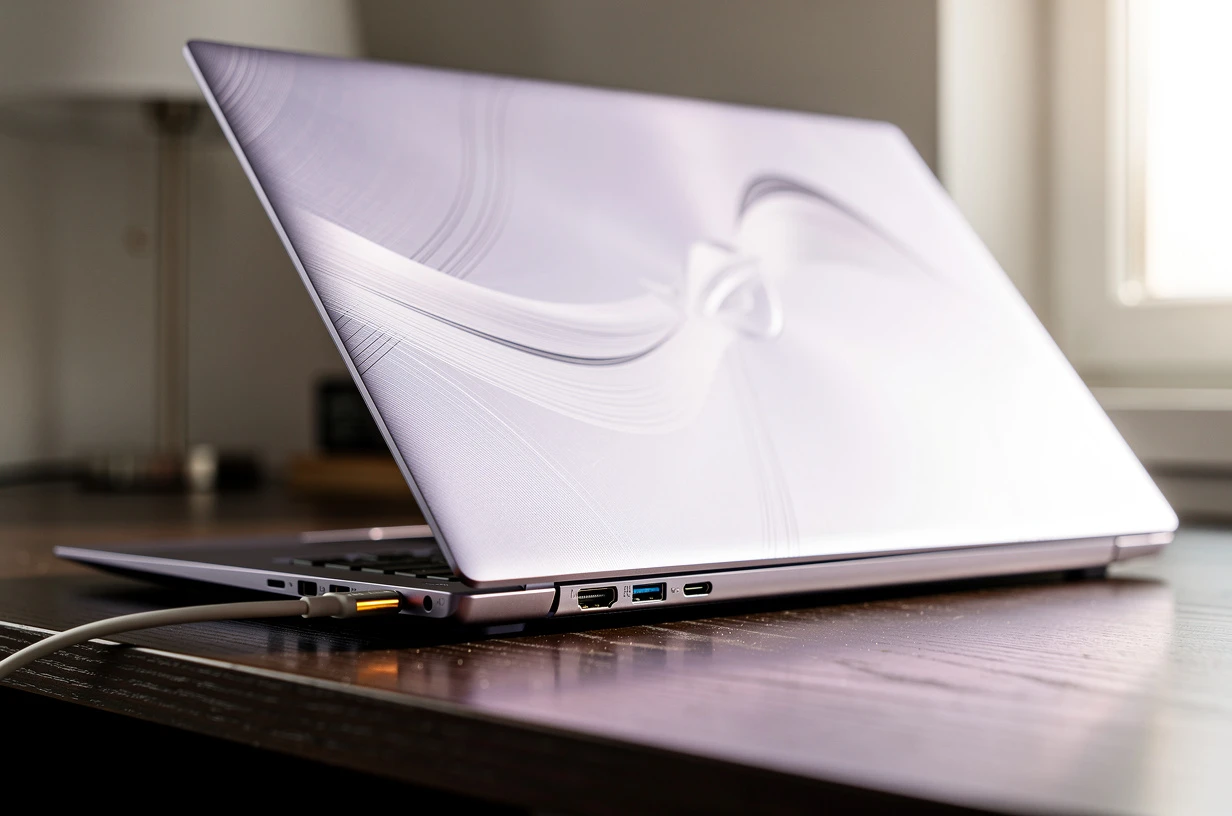
Violet Silver is new to Galaxy Book, with Gray as the second paint. A centered lid logo keeps the family look. The webcam is a 2MP 1080p unit, and the stereo speakers are 2W each with Dolby Atmos. Fine for calls. Not the reason you pick it over a sharper, lighter Mac.
HDMI, USB-A and the Dongle Samsung Skipped
This is the one place the $799 machine is plainly more useful than Apple’s cheap Mac. The Neo ships two USB-C ports (one of them USB 2) and a headphone jack. Samsung kept the jack and then added the connectors people still trip over in classrooms and meeting rooms.
WHAT THE LEFT EDGE STILL CARRIES
- Two USB-C ports: Same functions on both, and either one can take the 45W charger.
- USB-A: Full-size, so an older mouse, webcam, or flash drive skips an adapter.
- HDMI 1.4: A classroom projector or monitor up to 4K at 30Hz, no dongle.
- 3.5mm jack: Wired headphones without a USB adapter in the bag.
HDMI 1.4 at 4K30 is not a fancy video output, and Samsung does not list Thunderbolt. For a student who still plugs into a hallway display, the physical ports beat a prettier 13-inch panel that needs a hub. That is the honest reason this laptop exists, and it is a better reason than the battery slogan.
Why the $799 Book6 Is Not a Copilot+ PC
Intel launched Core Series 3, the Wildcat Lake family, on April 16 for value laptops and listed more than 70 designs from Acer, ASUS, Dell, HP, Lenovo, MSI, Samsung, and others. The Core 5 315 uses two P-cores and four low-power E-cores, a 4.4GHz P-core turbo, and a 15-35W envelope. The Core 3 304 drops to one P-core and five cores in total, with a weaker 1-Xe GPU. Both carry an NPU at up to 15 TOPS.
Microsoft’s Copilot+ class needs an NPU capable of 40+ TOPS plus 16GB of RAM and a 256GB drive. This Book6 fails the TOPS floor even in the 16GB build, so Recall, Click to Do, and live-caption translation stay off the menu. Samsung instead ships its own Galaxy AI: AI Select and AI Cut Out on screen content, plus Note Assist, which summarizes Samsung Notes text between 200 and 4,000 characters and needs a Samsung account and an internet link.
Joseph Broderick, a technical marketing engineer at Intel, sold Series 3 on modern radios the Book6 does not fully use.
With the all-new Series 3 processor family, you get the latest connectivity features including Thunderbolt 4, Wi-Fi 7 and Bluetooth 6 technologies, along with an extremely capable NPU and GPU for everyday users.
Joseph Broderick, technical marketing engineer, Intel, Computex note
Samsung’s spec sheet lists Wi-Fi 6E (2×2) and Bluetooth 5.4, not the Thunderbolt 4, Wi-Fi 7 and Bluetooth 6 Intel put on the silicon. The chip can do more than this chassis exposes. Phone owners still get Quick Share, Storage Share, Multi Control, Second Screen on supported Galaxy Tabs, Nearby Devices, and Link to Windows, which is the actual software extra versus a Mac.
8GB of Memory and a Keyboard With No Lights
The $799 configuration is 8GB of LPDDR5X and a 256GB SSD. Samsung will sell 16GB and 512GB or 1TB, depending on the market. Eight gigabytes under Windows 11 Home or Pro 25H2 is a tight fit once a browser, a docs tab, and a video call are open at once, which is why the 16GB build is the one that makes sense if you are staying in Windows. The Neo also ships 8GB, but it cannot be upgraded either, and macOS is less hungry at that size.
Samsung’s own spec calls the keyboard a Pro keyboard and then spells out non-backlit. Night flights and dim lecture halls get a dark row of keys. The trackpad is a clickpad, not the haptic pad on the costlier Book6 Pro and Ultra. There is a Linux image, console only, which is a footnote for hobbyists rather than a second desktop. None of those cuts is shocking at $799. They sit poorly next to a 25-hour claim and Galaxy AI slides, because the machine is a ports-and-price SKU wearing the flagship family’s clothes.
U.S. Shoppers Wait Until October 5
Samsung says the laptop is in select markets now, with more countries later, and that colors, storage, and features will vary. U.S. buyers are pointed to Samsung.com and Amazon from October 5, in Gray or Violet Silver. European storefronts have already posted Core 5 machines around £800 and €850. A Belgian list puts 8GB/256GB at €850, 8GB/512GB at €1,000, and 16GB/512GB at €1,200, with no Core 3 option. Samsung’s UK store has been showing Core 5 8/256GB and 8/512GB builds. Several countries still have no date, which is the practical limit on any Neo comparison.
HOW THIS $799 SKU ARRIVED
- January 6, 2026: Samsung shows Galaxy Book6, Book6 Pro, and Book6 Ultra at CES on Intel Core Ultra Series 3 chips.
- March 11, 2026: Those Panther Lake models go on sale in the U.S., with the vanilla Book6 from $1,049.99, the same week Apple’s Neo lands at $599.
- April 16, 2026: Intel launches Core Series 3 for value laptops and names Samsung among the partners with 70-plus designs in the pipeline.
- September 1, 2026: Samsung announces the 14-inch $799 Book6 on Core 3 and Core 5 chips, with Galaxy AI and the 25-hour claim.
- October 5, 2026: U.S. sales are set to open on Samsung.com and Amazon.
Until those U.S. units ship, the 25-hour figure, the Core 3 versus Core 5 gap, and the 8GB Windows build are still paper specs. The ports are already the part of the pitch that does not need a lab.


British Business Bank’s Zinc Fund Will Mint 80 Startups

Philips Hue IFA Gear Opens TVs and Gates the Hub

Souk Raises $1.6 Million for Its AI Partner Manager

Anthropic Bets on Cheaper Cache for Claude Fable 5.1

Food Processors Back Backbone’s €4 Million Quality Round

Scosche Bets IFA Shoppers Will Buy Fewer Charging Bricks

ELO Bets Sentinel XR Gaming Glasses at IFA Berlin

ShiftCam SuperZoom Lenses Bet on a 350mm Phone Gap

Clooney Defends Ruffalo’s Speech While Collecting Venice’s Lion

Jungheinrich Is the Sole Backer of Uplift’s €100M Fund

30-Year Yield Hits 5.32% Highest Since 2007 as Debt Supply Locks In Costs

Walter’s TWG Insists No Fraud as Insurer Probes Force Cleanup

Astute’s $1.2M bet makes B2B creator deals feed AI discovery

Strategy Parks $1.59B Cash While Bitcoin Stack Stays Flat

PCE Stays at 3.7% as Gas and Tariffs Outrun Coming Revisions

SpaceX Stock Rebound Tests Real Demand Before Huge Unlock

The 20% Savings Ideal Meets a 2.7% Reality Check

Amber’s €7M locks Mittelstand knowledge inside Europe

Monzo chair Gary Hoffman exits after board revolt fallout

Nvidia’s $16,000 RTX Pro 6000 Turns Local AI Into a Luxury
-
 FINANCE3 months ago
Zcash Patched a Double-Spend Bug as ZEC Climbed 5%
-
 ENTERTAINMENT3 months ago
Steam Summer Sale 2026 Locks In June 25 to July 9 Dates
-

 FINANCE2 months ago
CLARITY Act Final Text Expected This Weekend as 60-Vote Hurdle Looms
-
 NEWS4 months ago
Meta Adds AI Replies to Threads, But Users Can’t Block It
-

 NEWS3 months ago
YouTube Shorts is testing a heart in place of the thumbs-up
-

 NEWS1 month ago
Senators Force Apple Off Chinese Memory as Big Three Cash In
-

 NEWS3 months ago
NEURA Robotics’ $1.4B Series C Redraws Europe’s Physical AI Bet
-
 ENTERTAINMENT5 months ago
Extraction 3 Is Officially Coming to Netflix in 2027