
NEWS
Food Processors Back Backbone’s €4 Million Quality Round
Agristo and Darta join Pitchdrive on Backbone’s €4 million round as Belgian food plants still run IFS and BRCGS work through spreadsheets and email.

Backbone has raised €4 million in pre-seed funding, with frozen-food groups Agristo and Darta joining a round that Pitchdrive led the €4 million round for. PROfounders Capital, Passion Capital and existing investor 100IN also participated, as the Brussels software company tries to pull food quality work off spreadsheets, shared documents and email.
The processors on that cap table already live the filing problem the product claims to fix, and Pitchdrive already backed this founding team once, in legal tech.
Frozen-Fry Giants Put Money in the Spreadsheet Problem
Agristo makes frozen potato products for retailers and foodservice. Darta packs frozen vegetables, fruit, herbs and convenience foods. Both are West Flanders family groups that grew from local plants into export machines, which means supplier files, lab results and customer specs now cross several countries and several departments.
Agristo is adding a fourth fry line at Wielsbeke, a project the company says should bring about 50 jobs, and it has broken ground on its first U.S. plant in Grand Forks, North Dakota. Darta, started in Ardooie in 1988 by Jean-Pierre De Backere and Johan Talpe, now runs sites in England, Portugal and Italy. Co-CEO Steve De Backere has described that spread as a weather hedge as much as a sales plan: if a harvest fails in one region, another plant can cover.
Those are not typical angel names on a two-year-old software shop. They are the kind of buyers who already sit through IFS, BRCGS and FSSC 22000 audits, and who already know what happens when a certificate expires in someone’s inbox.
TWO PROCESSORS ON THE CAP TABLE
| Company | Core products | Scale | Recent figures |
|---|---|---|---|
| Agristo | Frozen potato products | 979 people; plants in Belgium, the Netherlands and India, plus builds in France and North Dakota | €956 million in 2022 sales; €210 million profit in 2023, up from €76 million the year before |
| Darta | Frozen vegetables, fruit, herbs, convenience | More than 1,000 people | 270,000 tonnes a year, from 20,000 tonnes when it started |
A quality miss at that volume is not a paperwork annoyance. Backbone’s founders put the bill for poor quality at up to 15% of food-sector revenue, reputational damage not included, and they argue the damage is usually a pile of small mismatches caught too late rather than one dramatic failure.
Why a Recipe Change Still Ties Up Four Teams
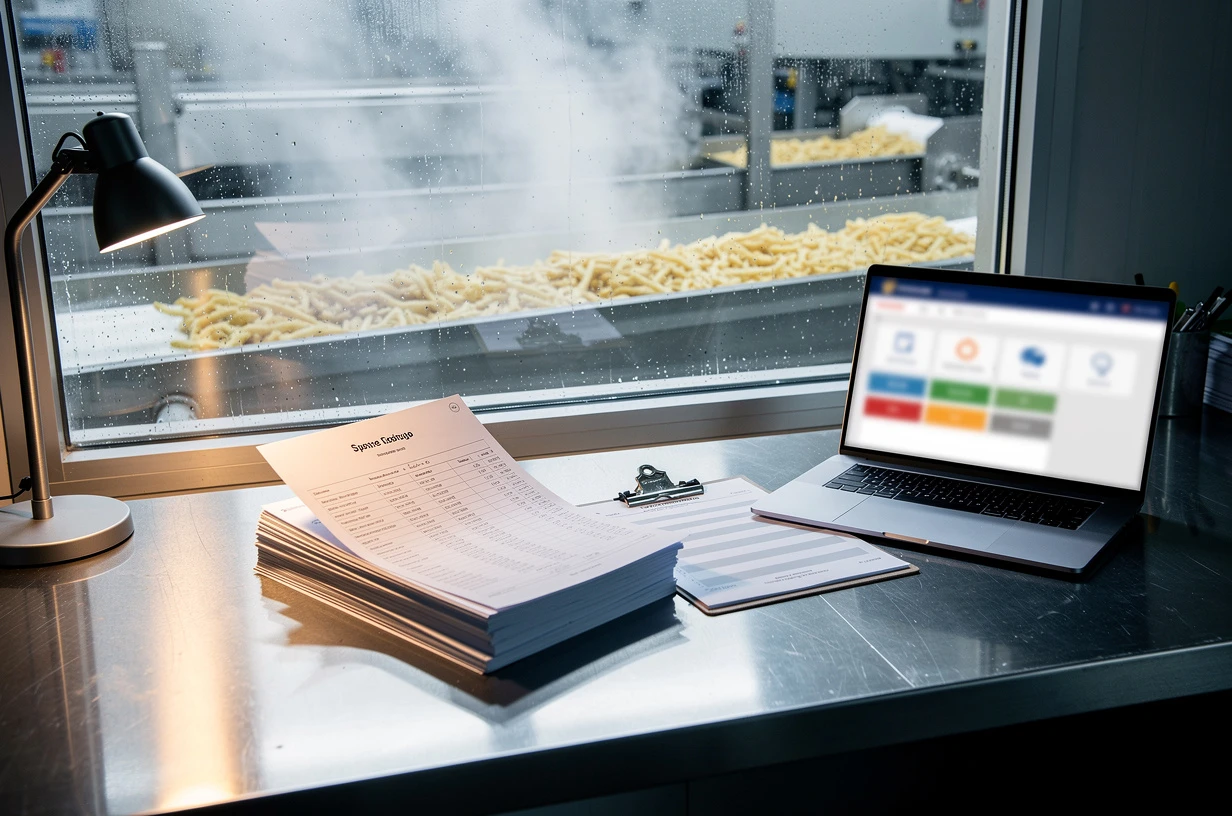
Inside a food plant, quality data rarely lives in one place. Purchasing holds supplier packs. Research and development holds recipes. Labs hold test results. Quality holds the rules from regulators and from retailers. Introduce a new supplier or change a recipe, and each group has to check the others by hand.
Louis Opsomer, a Backbone co-founder, put it this way when the company described the round: a food firm already has the data it needs, but the data points are not talking to each other. The company’s own site promises 70% less time on admin if that stitching works. That is a vendor claim, not an audited plant result, and it is the claim the new money has to prove.
WHERE THE FILE ACTUALLY SITS
- Purchasing: Supplier approvals, certificates and incoming specs sit with buyers who are not the people who will face the auditor.
- Research and development: A recipe change can alter allergens, claims and test plans, yet the update often starts in a separate document tree.
- The laboratory: Results arrive as PDFs, emails or LIMS exports that someone has to match to the current spec by eye.
- Quality: Retailer requirements and IFS, BRCGS or FSSC clauses live with a small team that still chases the other three groups over email.
Siska Lannoo, who co-founded the company with Opsomer and Julien Steel, has compared that mess to an airport without a control tower: supplier files, lab results and internal documents never form one picture. Early customers named when the product went live include salt maker Zoutman, plus Greenway, Azingro and Euromeat, spanning ingredients, plant-based food and meat.
Pitchdrive Recycles the Henchman Bet Into Food
Opsomer and Lannoo met at Showpad, the Belgian sales software company, while she helped the London office scale and he did the same in San Francisco. They later joined the management team at Henchman, the Ghent legal-tech firm that built drafting tools on top of document stores. Opsomer ran data-security compliance there. Steel came in as the third Backbone founder with a product background.
LexisNexis completed its acquisition of Henchman on 22 July 2024. The legal publisher said the Ghent company had 170-plus legal and corporate customers. Pitchdrive had been Henchman’s lead on start capital. 100IN, the fund of Henchman co-founders Gilles Mattelin and Jorn Vanysacker, then wrote Backbone’s first cheque while the food product was still being built.
FROM LEGAL FILES TO FOOD FILES
- 2020: Henchman is founded in Ghent to mine contract clause libraries for lawyers.
- 22 July 2024: LexisNexis closes the Henchman purchase and folds the drafting tools into its legal AI stack.
- October 2025: Opsomer, Lannoo and Steel found Backbone AI BV at Avenue Louise 304 in Brussels, aimed at food and feed quality files instead of legal ones.
- April 2026: The platform is live at several plants, with 100IN’s earlier backing before the product was live already on the cap table.
- June 2026: Pitchdrive closes Fund IV at €60 million, pitched at AI-native European teams.
- 3 September 2026: Pitchdrive leads the €4 million Backbone round, with the two food processors and the London funds joining 100IN.
The pattern is not subtle. Henchman sold software that read messy professional documents and put the useful bits in front of the person who had to act. Backbone is the same bet with certificates, specs and lab PDFs. Pitchdrive is taking it again. So are people who used to own Henchman shares.
The Software Maps Files to IFS and BRCGS
Backbone’s site says the product reads incoming documents, including unstructured ones, and maps them to BRCGS, IFS and FSSC 22000 as well as a plant’s own rules, then keeps mapping as those rules change. On top of that layer it is building agents that track supplier certificates, check lab results and incoming files against current specs, and log incidents. A dashboard is meant to show quality teams and managers what is still open.
Those three schemes are the private tickets most European retailers still demand. IFS Food Version 8 has been the mandatory audit version since 1 January 2024. BRCGS Food Safety sits at Issue 9. FSSC 22000 runs on an ISO 22000 base plus extra scheme rules. They are close in outcome and different in how often someone shows up with a clipboard.
HOW OFTEN THE AUDITOR COMES BACK
| Scheme | Home base | How the cycle runs |
|---|---|---|
| BRCGS Food Safety Issue 9 | United Kingdom | Audit every 6 or 12 months, depending on the last grade |
| IFS Food Version 8 | Germany and France | Audit every 12 months |
| FSSC 22000 | Netherlands foundation | Recertification every third year, with yearly surveillance visits |
Kiwa’s comparison of GFSI programmes is blunt on that audit frequency of the main GFSI schemes: BRCGS can come twice a year after a weak grade, IFS is annual, and FSSC stretches the certificate while still visiting. For a quality manager, that calendar is why expired supplier files become findings. For Backbone, it is why certificate tracking is the first agent it talks about.
The company has already been in talks with standards bodies, BRCGS among them, and with Microsoft on Copilot-style hooks. Those were described as work in progress in April. The new round’s use of funds still lists partnerships with international certification bodies and with ERP implementation partners as work to do, not work done.
Kraft Heinz’s Quality Chief Calls the Certificate a Ticket
Opsomer has been arguing that plants still treat a certificate as the quality system. In his telling, a certificate is a snapshot, and Backbone is trying to surface risk between audits rather than after them. Campbell Mitchell, head of food safety and compliance at Kraft Heinz, said the same thing in plainer language on Backbone’s own 2026 quality report, which also carried views from people at Mars and Barilla.
There is this perception of quality as just control and compliance. And compliance is good enough. People are happy when they get their certificate. That’s all they want. I always say the certificate is the ticket to enter the race; it’s not the award that you get at the end of the race. So people need to really go beyond that baseline, once you’ve got the fundamentals right.
Campbell Mitchell, Head of Food Safety and Compliance, Kraft Heinz, Backbone State of Quality Expert Report 2026
That line is why a fry group and a frozen-veg group writing cheques is more interesting than another AI slide. If the certificate is the ticket to enter the race, then the software that watches the race between audits is what a plant with 979 people and a new U.S. line actually needs, or it is expensive shelfware. The round does not settle which.
A food company today has all the data it needs to make better quality decisions, but the different data points aren’t talking to each other. We build an intelligence layer that connects those dots, understands the context and puts it to work.
Louis Opsomer, co-founder, Backbone
Zoutman, Salt and a Missing Digital Cockpit
Zoutman, a salt maker that sells into food plants, is the customer Backbone has put on its own site in most detail. Its quality team handles customer questionnaires, certification packs, specs and cross-border rules, much of it repetitive and time-sensitive. The company said information is often scattered across systems and formats, which means duplicate work and a higher chance of error, and that its experts spend too much time searching, checking and revalidating instead of improving processes.
Zoutman said it picked Backbone because it wanted one place for QA files, automated compliance checks, and workflows from questionnaires through complaints and CAPA. That is the same sentence every QMS vendor wants. The difference, if there is one, is that Backbone is selling agents on top of the filing cabinet, and that two of Belgium’s heavier food processors just bought equity rather than only a seat.
Ghent already has another shop in this aisle. AuditQ, based at the Wintercircus, sells software that also names BRCGS, IFS and FSSC 22000, and it pitches an end to spreadsheet chaos for quality teams. Older platforms such as Safefood 360 have been in plants for years with HACCP modules, supplier approval and CAPA. Backbone is not walking into an empty category. It is walking into a category full of tools that still leave people in Excel, which is either a hole or a warning.
THE ROUND IN FOUR FIGURES
- Cheque size: €4 million, labelled pre-seed even after 100IN’s first money last year.


British Business Bank’s Zinc Fund Will Mint 80 Startups

Philips Hue IFA Gear Opens TVs and Gates the Hub

Souk Raises $1.6 Million for Its AI Partner Manager

Anthropic Bets on Cheaper Cache for Claude Fable 5.1

Food Processors Back Backbone’s €4 Million Quality Round

Scosche Bets IFA Shoppers Will Buy Fewer Charging Bricks

ELO Bets Sentinel XR Gaming Glasses at IFA Berlin

ShiftCam SuperZoom Lenses Bet on a 350mm Phone Gap

Clooney Defends Ruffalo’s Speech While Collecting Venice’s Lion

Jungheinrich Is the Sole Backer of Uplift’s €100M Fund

30-Year Yield Hits 5.32% Highest Since 2007 as Debt Supply Locks In Costs

Walter’s TWG Insists No Fraud as Insurer Probes Force Cleanup

Astute’s $1.2M bet makes B2B creator deals feed AI discovery

Strategy Parks $1.59B Cash While Bitcoin Stack Stays Flat

PCE Stays at 3.7% as Gas and Tariffs Outrun Coming Revisions

SpaceX Stock Rebound Tests Real Demand Before Huge Unlock

The 20% Savings Ideal Meets a 2.7% Reality Check

Amber’s €7M locks Mittelstand knowledge inside Europe

Monzo chair Gary Hoffman exits after board revolt fallout

Nvidia’s $16,000 RTX Pro 6000 Turns Local AI Into a Luxury
-
 FINANCE3 months ago
Zcash Patched a Double-Spend Bug as ZEC Climbed 5%
-
 ENTERTAINMENT3 months ago
Steam Summer Sale 2026 Locks In June 25 to July 9 Dates
-

 FINANCE2 months ago
CLARITY Act Final Text Expected This Weekend as 60-Vote Hurdle Looms
-
 NEWS4 months ago
Meta Adds AI Replies to Threads, But Users Can’t Block It
-

 NEWS3 months ago
YouTube Shorts is testing a heart in place of the thumbs-up
-

 NEWS1 month ago
Senators Force Apple Off Chinese Memory as Big Three Cash In
-

 NEWS3 months ago
NEURA Robotics’ $1.4B Series C Redraws Europe’s Physical AI Bet
-
 ENTERTAINMENT5 months ago
Extraction 3 Is Officially Coming to Netflix in 2027