
NEWS
RayNeo Bets Shoppers Will Buy Two Smart Glasses
RayNeo is selling a camera-free iO work pair and a GT Max cinema pair at IFA, a two-frame bet that one pair of smart glasses cannot do both jobs.

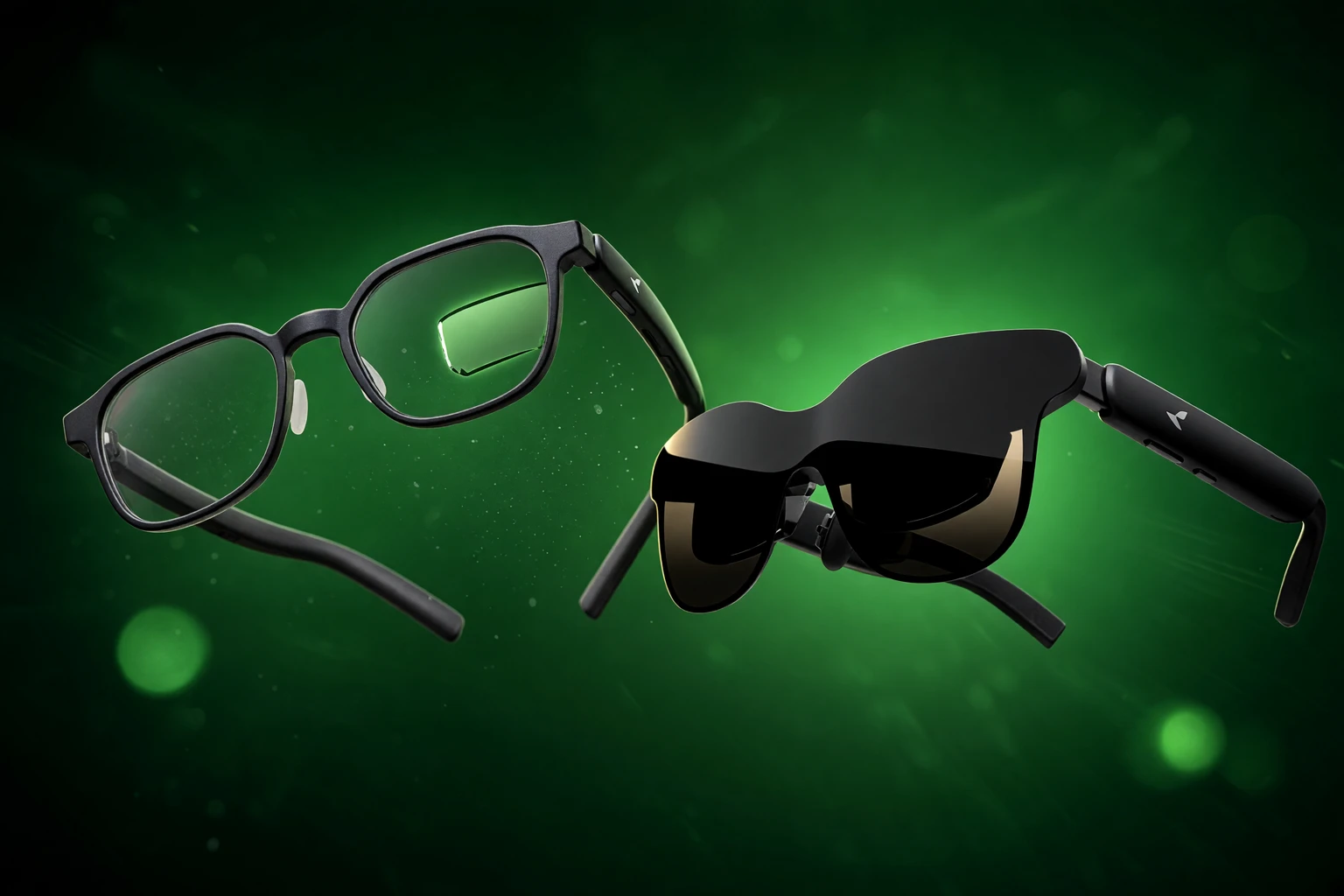
RayNeo started selling two new pairs of smart glasses on September 4, a camera-free work frame and a 307-inch travel cinema. The iO and GT Max are not one product with two colorways. They are separate checkouts, and both were named honorees of the IFA Innovation Awards during the Berlin show in Hall 21A.
The TCL-family brand is betting that the all-in-one smart glasses idea is the wrong sale. A meeting pair should not look like a spy cam, and a movie pair should not pretend to be office eyewear, even if that means paying twice.
Two Frames for Two Different Days
Retail sales opened on September 4 through RayNeo’s store and Amazon, covering 40 countries and regions. Demos run with the IFA 2026 show through September 8. Shipping has already started, so the split is no longer a concept board.
iO is a 33-gram Crown Panto frame with a monochrome green waveguide HUD. It is built for captions, a teleprompter line, navigation cues, and a voice assistant you trigger by saying “Hey, RayNeo.” GT Max is a 78-gram cinema headset with tandem MicroOLED panels, a 59-degree field of view, and a virtual screen that scales to 227, 267, or 307 inches.
RayNeo still sells a camera model. The X3 Pro still carries a 12MP camera and lists at $1,099, down from $1,299. None of the IFA pairs replace it. The new bet sits beside that flagship: a lighter AI frame with no lens on the world, and a fatter display frame that also ships without a camera.
Buying both at MSRP is $928 before a charging case, prescription inserts, or the Pocket TV Pro puck that unlocks Dolby Vision. The launch cut is $30 / €30 on each glasses SKU, which brings iO to $469, GT to $299, and GT Max to $399 for the opening window.
Why the iO Has No Camera
RayNeo left the camera off so the 33-gram iO can sit in a meeting without looking like a recorder on someone’s face. The HUD is a 23.5-degree Firefly Nano waveguide, rated at 1,300 nits at eye level, with 97% active display transparency and a claimed 33-inch floating text panel. It is a green glance display, not a color movie screen, which is the point of a work pair that other people are not supposed to notice.
The company markets privacy by design, with no camera, and says the product follows GDPR rules, with a temple status light when key features run. That is only half the recording story. iO still captures audio. A four-mic array and bone-conduction pickup feed Voice Memo, AI meeting minutes, and an all-day Lifelog timeline that turns speech into action items. The privacy claim is about video, not silence.
WHAT THE iO DOES ON THE FACE
- Assistant: RayNeo AI and Gemini 3.1 Flash Lite run free; ChatGPT, Claude, DeepSeek, Kimi, and Qwen sit behind a $9.99-a-month VIP plan.
- Language: Live translation covers 55 languages and 109 accents, with 40 languages tuned for on-lens captions and 100-plus languages for Voice Memo transcripts.
- Controls: A Smart Crown and head gestures keep taps off the table, and the Dashboard can show calendar, weather, and phone alerts without pulling a handset.
- Wear: AZ91D magnesium-aluminum with titanium temples, over 80% metal, Polar Night grey or Dune gold, IP54, and a 240mAh cell rated for up to two days of light use.
Early wearers in Japan have been testing whether that 1,300-nit green HUD holds up outdoors, which is the only test that matters for a work pair. If the text washes out on a sidewalk, the camera-free pitch dies on day one. If it stays readable, offices that already flinch at camera glasses have a new object to argue about: a frame that still listens.
Minus the camera, plus the privacy.
RayNeo, iO product page
The official pitch is that short. The hardware is longer. Lifelog is all-day audio capture with AI summaries, which is useful in a briefing and awkward in a two-party-consent state. A dedicated indicator is supposed to flag when those tools are on. That is a social signal, not a legal shield.
https://x.com/rayneo_global/status/2095546255871279511
307 Inches, 78 Grams, One Extra Box
GT Max is the other half of the wager, and it is the half that looks like a gadget demo. Dual 0.6-inch 5.5-generation tandem MicroOLED panels, 1,920 × 1,080 per eye, run at 120Hz in 2D. RayNeo’s Peacock Optical Engine 3.0 Max is listed as 29% thinner than a classic birdbath stack, which is how a 59-degree view fits in 78 grams. The 307-inch figure is the 115% scale setting. The native 100% mode is 267 inches, and 85% is 227 inches.
Sit on a sofa with that image pinned in front of you and the room does not turn into an IMAX wall. The picture behaves more like a very large TV that happens to travel with your head, which is still the thing frequent flyers have been buying display glasses to get. GT, the cheaper sibling, stays at 68 grams and 46 degrees, with 136 / 201 / 231-inch modes and a denser 49 pixels per degree against GT Max’s 38, because the Max view is simply wider.
Native Dolby Vision is not in the glasses alone. It arrives when GT or GT Max is paired with Pocket TV Pro, a Google TV stick RayNeo calls the first AR glasses system to play Dolby Vision this way. The puck uses a 6,500mAh battery for up to 5.5 hours, 3GB of RAM, 64GB of storage, and microSD expansion up to 2TB. The European store lists it at €219, marked available September 15, and already sold out there. It will not talk to other brands’ glasses. Older RayNeo Air 2 units and later Air models can use it for standard SDR, not Dolby Vision.
Our goal was simple. We wanted to create an audio experience that feels natural, balanced, and immersive, despite the challenges of an extremely small and lightweight form factor.
Anders, Global Head of Consumer Electronics, Bang & Olufsen, IFA 2026 launch
Both GT models use a racetrack quad-speaker array co-tuned by Bang & Olufsen, with Whisper Mode 2.0 so a cabin neighbor is not supposed to hear the film. RayNeo quotes 38% more speaker area, 5dB higher sensitivity, and six magnetic circuits. Zone 360 3DoF tracking on GT Max offers Steady, Pinned, and Follow modes for a train or a plane. Three physical IPD sizes (S under 64mm, M 64 to 67mm, L above 67mm) sit on GT Max; GT uses a fixed 64mm. Custom prescription inserts are listed for both.
A USB-C DisplayPort link is the daily path from a phone, a laptop, or a handheld. iPhone 15 and newer are named. HDMI gear such as a PlayStation needs a separate adapter. The cinema pair is still a tethered display first, with the puck as the battery and the streaming brain when you do not want to drain a phone.
A Price List That Adds Up Fast
RayNeo published standing MSRPs in its September 4 IFA release, then stacked a $30 / €30 launch discount on each glasses model. The table below uses those MSRPs as the lasting figures.
THE IFA PAIR AND THE PUCK
| Model | Job | Weight | View / screen | MSRP |
|---|---|---|---|---|
| RayNeo iO | Camera-free AI HUD | 33g | 23.5°, 33-inch text | $499 / €549 (standard case) |
| RayNeo GT | Portable media display | 68g | 46°, up to 231 in | $329 / €369 |
| RayNeo GT Max | Cinema display | 78g | 59°, up to 307 in | $429 / €489 |
| Pocket TV Pro | Google TV + Dolby Vision | n/a | 5.5 hours, 2TB max | €219 (from Sep 15) |
iO’s charging-case bundle is $549 / €599. Polar Night and Dune are the two iO finishes. GT Max also lists 1,200 nits of perceived brightness, a 200,000:1 contrast ratio, 98% DCI-P3, 145% sRGB, and 120Hz, with 3,840Hz hybrid dimming. Those cinema numbers do not transfer to iO, whose panel is a green waveguide, not a MicroOLED movie slab.
A full travel kit is therefore three objects: Max frames, a puck, and whatever phone or HDMI stick you already own. That is the hidden cost of refusing a single compromise pair. It is also how RayNeo keeps Air-series buyers in the family when they want a wider view without jumping to a $1,099 camera headset.
RayNeo Already Leads AR Glass Shipments
The split is easier to attempt when you already sell a lot of display-only glasses. Counterpoint Research ranked RayNeo No. 1 globally in AR glasses shipments for the first half of 2026, and the IFA brief cites a 23.7% share in the first quarter. IDC placed the company No. 1 in AR glasses shipments both globally and in China for the second quarter of 2026.
THE SHARE RAYNEO TOOK INTO IFA
- Q1 2026: 23.7% global AR glasses shipment share, Counterpoint, No. 1 worldwide.
- H1 2026: Counterpoint again ranked RayNeo first in global AR glasses shipments.
- Q2 2026: IDC ranked it first globally and in China for AR glasses shipments.
- Lineup: Air 2s through Air 4 Pro remain on sale as cheaper display glasses, from $159 for Air 2s up to a $299 Air 4 Pro list.
RayNeo is a Shenzhen brand inside the TCL family, and it backs TCL’s role as an Official Worldwide Olympic Partner. The Air series taught the company to sell a USB-C virtual monitor without a camera. GT Max is that idea with a wider optic, B&O tuning, and a Dolby path. iO is the new rung: an assistant that looks like ordinary metal glasses.
CEO Li Hongwei said earlier this year that AI glasses could have an “iPhone moment” in 2027 or 2028. The IFA pair is the product map for that wait. One SKU chases permission in offices. The other chases the person who already watches films on a plane. budget AR glasses that undercut cinema frames already sit under GT Max on price, so the Max has to win on field of view and the Dolby puck, not on being the cheap way into a virtual screen.
After the Courthouse Bans, a Camera-Free Pair
iO exists because camera glasses became a policy object, not only a gadget. Offices, stores, and courts spent 2026 writing rules around frames that can film a room while looking like eyewear. RayNeo’s answer is to ship the assistant without the lens, then keep audio tools behind a status light.
THE CAMERA BACKLASH iO WALKS INTO
- July 20, 2026: New York’s Unified Court System bans camera- and microphone-equipped eyewear from 1,240 courthouses, saying an LED cannot replace confiscation at the door.
- August 2026: U.S. Immigration and Customs Enforcement bars staff from wearing Meta smart glasses in federal workplaces, treating them like unauthorized body cameras.
- September 2, 2026: Meta says it has disabled cameras on thousands of its glasses after detecting LED tampering, a slice it describes as fewer than one in a thousand of units sold.
- September 4, 2026: RayNeo puts iO on sale as a 33-gram AI frame with no camera, while GT and GT Max also ship without one.
Apple teams have even floated camera-free prototypes in the same privacy climate, which tells you the empty hot-shoe is now a product feature. iO still records voices. A no-camera badge will not clear a no-recording floor. It will clear a no-video door, and that is the door RayNeo is selling.
The X3 Pro remains for buyers who want the 12MP module and a full-color MicroLED view, at more than double iO’s MSRP and more than double the weight (76 grams against 33). RayNeo is not abandoning cameras. It is isolating them in the expensive SKU so the IFA pair can walk into rooms the camera pair cannot.
Hall 21A Puts Both Pairs on the Floor
IFA is where the wager gets handled. Max Manausa, RayNeo’s North America marketing manager, ran GT Series demos with Dolby Vision playback and the B&O tune. River, head of industrial design, walked media through how a near-eye display sits in a 33-gram daily frame. Arkin Kol, vice president of commercial partnerships for Europe at Dolby Laboratories, used the booth to argue that Dolby Vision now belongs “on the go,” not only in a theater or a living room.
Perceived brightness on GT Max is 1,200 nits, with TÜV SÜD eye-comfort, low-blue-light, and flicker-free marks on the cinema line. iO’s 1,300 nits are for sunlight on green text. They are not comparable pictures. They are two answers to two lighting problems, which is the entire two-SKU argument in hardware form. other XR glasses on the IFA floor are chasing play sessions. RayNeo split the stand into a quiet HUD and a private theater instead.
Hall 21A keeps both pairs out through September 8. Pocket TV Pro follows on September 15. The glasses are already for sale. The open question is whether a buyer who wanted one magic frame will write two orders, then add a puck, to get a work HUD and a 307-inch seat on the same trip.
Frequently Asked Questions
Does the RayNeo iO Include a Camera?
No. iO ships with no camera module, a temple status light for active features, and an IP54 dust and water rating. RayNeo says system data is anonymized on-device before it leaves the glasses, and the frame is sold with a 1-year warranty plus 30-day free returns on official-store orders.
What Is the Difference Between RayNeo GT and GT Max?
GT Max uses the Peacock Optical Engine 3.0 Max and three IPD sizes, while GT uses a birdbath optic and a fixed 64mm IPD. Both quote 3,840Hz high-frequency dimming and Bang & Olufsen quad speakers; Max adds the Zone 360 chip with Steady, Pinned, and Follow modes for motion.
Do RayNeo GT Max Glasses Need the Pocket TV Pro?
No for basic video from a USB-C phone, laptop, or handheld. Yes for native Dolby Vision, which RayNeo ties to the Pocket TV Pro pairing. The puck is brand-locked, and Air 2 and later Air glasses can use it only for SDR playback, not Dolby Vision.
Which AI Models Work on RayNeo iO Glasses?
RayNeo AI and Gemini 3.1 Flash Lite are included at no extra charge. Unlimited access to ChatGPT, Claude, DeepSeek, Kimi, and Qwen is sold as a VIP plan at $9.99 a month in the United States, with the wake phrase “Hey, RayNeo” calling the on-lens assistant.
Can You Add Prescription Lenses to iO and GT Max?
Yes. iO takes custom lenses that RayNeo says can be bought with HSA/FSA funds in the U.S., and both GT models support official prescription inserts. Official-store buyers can also trade in an eligible device for 12% off iO, a deal that cannot be mixed with other offers.


Holland’s Franz Treats Kafka as a Prague Souvenir

Bad Bunny’s Super Bowl Show Now Rules the Live Variety Emmys

Liquid Pause Follows 4,000 Bitcoin Peg-Out With Keys Intact

HONOR’s Sold-Out Robot Phone Still Cannot Leave China

Ascentiz Bets Hikers Will Buy a €3,999 Modular Kit

GPT-6 Astra Passes Safety Tests With a Dimmer Audit Trail
Google Translate Keeps Running After Android Locks the Screen

RayNeo Bets Shoppers Will Buy Two Smart Glasses

RugOne’s Detachable Camera Phone Revives a Failed Modular Bet

Riot’s New Challenger Worlds Still Runs on Asia’s Clock

Walter’s TWG Insists No Fraud as Insurer Probes Force Cleanup

30-Year Yield Hits 5.32% Highest Since 2007 as Debt Supply Locks In Costs

Evernorth S-4 Clears Path for Active XRP Treasury on Nasdaq

PCE Stays at 3.7% as Gas and Tariffs Outrun Coming Revisions

Astute’s $1.2M bet makes B2B creator deals feed AI discovery

Strategy Parks $1.59B Cash While Bitcoin Stack Stays Flat

Instinct Hits $2.5 Billion as AI Agent Access Sparks Trust Fights

Amber’s €7M locks Mittelstand knowledge inside Europe

CLARITY Act Cloture Opens a Door Ethics Still Blocks

Monzo chair Gary Hoffman exits after board revolt fallout
-
 FINANCE3 months ago
Zcash Patched a Double-Spend Bug as ZEC Climbed 5%
-
 ENTERTAINMENT3 months ago
Steam Summer Sale 2026 Locks In June 25 to July 9 Dates
-

 FINANCE2 months ago
CLARITY Act Final Text Expected This Weekend as 60-Vote Hurdle Looms
-
 NEWS4 months ago
Meta Adds AI Replies to Threads, But Users Can’t Block It
-
 ENTERTAINMENT5 months ago
Extraction 3 Is Officially Coming to Netflix in 2027
-

 NEWS3 months ago
YouTube Shorts is testing a heart in place of the thumbs-up
-

 NEWS1 month ago
Senators Force Apple Off Chinese Memory as Big Three Cash In
-

 NEWS3 months ago
NEURA Robotics’ $1.4B Series C Redraws Europe’s Physical AI Bet