
NEWS
XReal xbx a01+ Cracks Open Budget AR Glasses
The X by XReal a01+ pairs a 62-gram frame and 1600-nit 147-inch virtual screen at $299, disrupting premium pricing and expanding portable theater access.

XReal’s xbx a01+ AR glasses put a 147-inch virtual screen, 1600-nit peak brightness and a 62-gram frame on sale for $299. The new X by XReal sub-brand strips 3DoF anchoring and electrochromic dimming so the pair can undercut the company’s own higher models and most rivals while staying light enough for multi-hour flights.
Reviewers who lived with the glasses for weeks report the same shift the SlashGear tester described: travel downtime and cramped seats suddenly support full desktop work or cinema sessions without opening a laptop. The compromise is real, yet the price and comfort combo is already rewriting who can own a personal big screen.
What the Specs Deliver
The a01+ uses dual Micro-OLED panels driven by a Pixelworks chip. Official numbers list a 50-degree field of view that equates to a 147-inch screen viewed from about four meters, native HDR10 support plus real-time AI SDR-to-HDR conversion, and up to 120 Hz refresh.
- 62 grams total with front plate attached (56 g without)
- 1600 nits peak brightness, usable outdoors
- TÜV Rheinland 5-star eye-comfort certification
- 0DoF spatial stabilization at 1000 Hz head tracking
Power and video arrive over a single USB-C DisplayPort cable. There is no onboard battery, so the host device supplies everything. Compatible sources include recent USB-C iPhones and iPads, DP-capable Android phones, Macs, PCs, Steam Deck and ROG Ally. Nintendo Switch needs a third-party dock.
Open-back speakers sit in the arms. They are usable for short sessions but tinny enough that most owners route audio to earbuds or headphones, especially on planes.
Price Cut Meets the Budget Arms Race
At $299 the a01+ matches the street price of the RayNeo Air 4 Pro and Viture Pro 2. PCMag called it the new entry-level champion after measuring higher brightness and a slightly wider field of view than those two. The same review noted 145 percent sRGB color coverage.
| Model | Price | Weight | Peak Nits | FOV | Tracking |
|---|---|---|---|---|---|
| X by XReal a01+ | $299 | 62 g | 1600 | 50° | 0DoF |
| Viture Pro 2 | $299 | ~62 g | 1600 | 50° | varies |
| RayNeo Air 4 Pro | $299 | ~75 g | 1200 | ~47° | more spatial |
| XReal One / 1S | $399-449 | 82-87 g | 700 | 52° | 3DoF |
XReal previously sat higher. The One series carried self-developed spatial chips and dimmable lenses at $450-plus. The a01+ deliberately drops those features to hit the weight and brightness records while clearing the psychological $300 barrier. Yanko Design noted the 20-gram savings over the One adds up across a long flight.
Counterpoint Research data for Q1 2026 showed the Birdbath/flat-prism segment still dominated by three names: RayNeo held 41 percent Birdbath share, Viture surged to 34 percent, and XREAL’s growth moderated. The xbx line is the company’s volume answer while it prepares an IPO.
How the Frame Feels on a Face
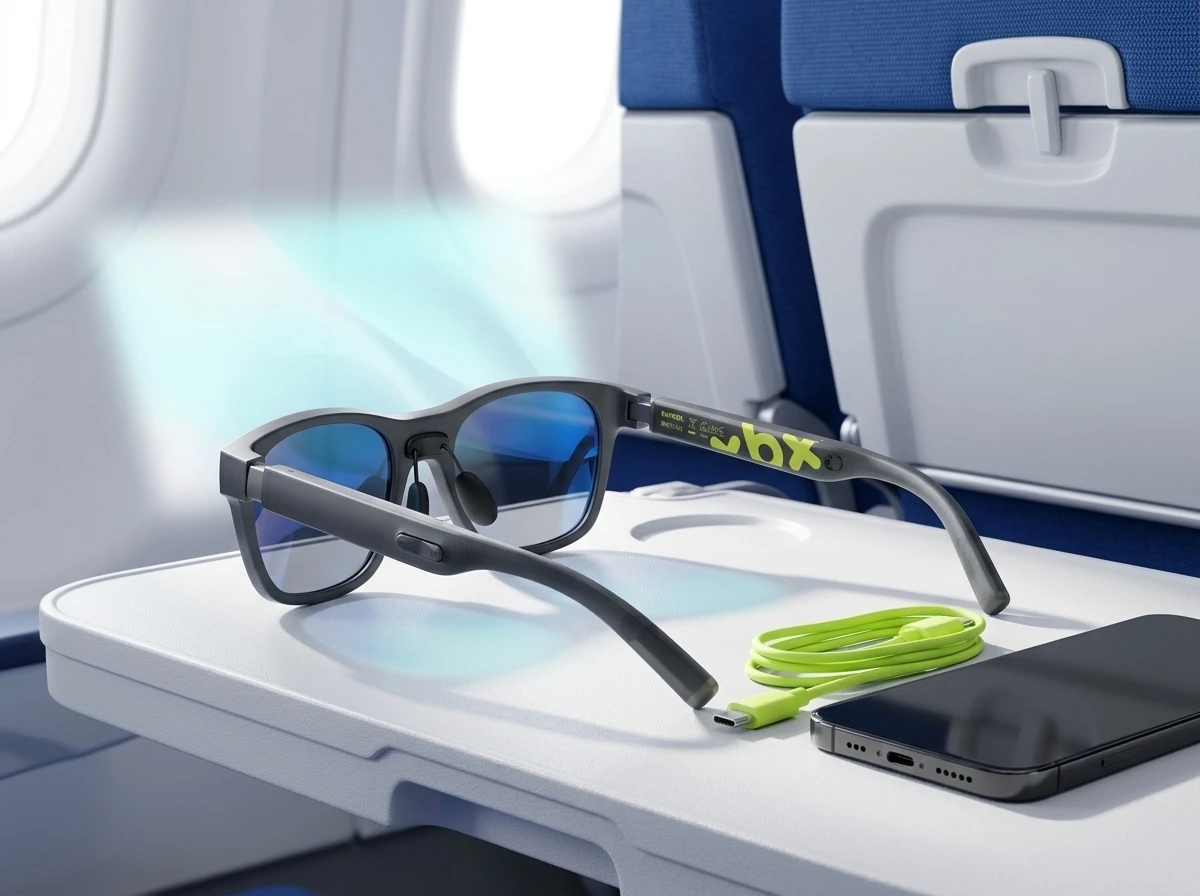
The sunglasses-style front plate sits farther forward than ordinary shades, so the look is not stealthy. Two plate styles ship: a dark immersive shield and a more open sunglass set. The plate pops off for style swaps. Arms carry a mode button (normal, eye-care, cinema) and a brightness rocker. The left arm ends in the canted USB-C port and the neon-yellow cable.
Kit contents stay simple:
- Glasses unit with three nose-pad sizes
- USB-C to USB-C cable
- Protective fabric case with silicone xbx logo
- Cleaning cloth and manual
Earpieces adjust vertically to level the image. Nose pads ride on a flexible wire. Prescription users can order inserts; XReal’s shop lists a complete service starting around $50 after discounts. The SlashGear tester found the minor prescription unnecessary after a short trial. Fit still decides whether the full 50-degree image stays centered or forces constant micro-adjustments on the nose.
Reviewers repeatedly cite the lightness as the feature that lets the glasses disappear during multi-hour sessions. Heat builds mildly against the temples but never becomes uncomfortable.
The Tradeoffs That Keep the Price Low
Stabilization is 0DoF only. The image floats and follows head motion rather than locking in world space the way the XReal One or Meta Quest systems can. The proprietary algorithm claims gimbal-smooth tracking at 1000 Hz with AI motion prediction, yet several testers leave it off because the correction can introduce mild warping or ghosting on fast action.
No electrochromic lenses means ambient light always leaks. A physical light shield is required for true blackout cinema. Speakers lack the depth of higher models tuned by Harman or Bose. And because the glasses draw power continuously, host battery life drops faster. One Gizmodo test drained an iPhone 17 from 100 percent to 87 percent in 45 minutes of high-brightness movie playback.
What We Know
- Fixed $299 launch price and 62 g / 1600-nit specs across official channels
- USB-C DP Alt Mode required for native one-cable use
- TÜV eye-care stack and three color modes are permanent hardware features
What’s Unconfirmed
- Long-term reliability of the plastic hinges under daily fold cycles
- Exact average current draw across different host devices
- Whether future firmware will add limited anchoring modes
These limits are the cost of the disruption. Higher XReal models keep 3DoF and dimming for buyers who need them. The a01+ bets that most first-time owners mainly want a bright private screen they can wear for hours without noticing the weight.
Where XReal Stands in the Wider Field
XREAL has led consumer AR display glasses sales for several years, yet annual volumes hovered near 13,000 units while Meta’s display-less Ray-Ban line shipped millions. Filing for a Hong Kong IPO in 2026 raised the pressure to grow the addressable market. The xbx sub-brand and $299 entry point are the visible response.
Parallel moves continue elsewhere. The Samsung Galaxy Glasses chip path and the Samsung glasses expected this fall show bigger platforms preparing their own wearable displays. Razer’s Project Motoko and other CES concepts keep adding AI layers. In that noise the a01+ stays focused on the simple job: a bright, light, cheap virtual monitor.
- 2022-2024 XREAL Air series builds the Birdbath base at higher prices
- 2025 One series adds spatial chip and raises ASP
- April 2026 Hong Kong IPO filing announced
- May-July 2026 xbx a01 / a01+ launches at $299 with record weight and brightness
- Q1 2026 data RayNeo and Viture close the volume gap in Birdbath while XREAL pivots downmarket
The pattern is clear. Premium features stay in the flagship line. Volume and first-time buyers move to the stripped, lighter, brighter xbx models.
Who Gains From the $299 Floor
Frequent flyers and train commuters gain first. A tennis-ball-weight pair that fits in a small case and turns any USB-C phone into a 147-inch private cinema removes the old excuse that AR glasses were too heavy or too expensive for casual use. Laptop-free productivity with a Bluetooth keyboard becomes practical in seats that never allowed a full machine.
Home users short on wall space gain a second living-room screen that packs away. Gamers on Steam Deck or ROG Ally gain a larger image without a hotel TV. The people who lose relative position are the previous mid-tier models that sat at $400-500 with lower brightness and higher weight; those now look expensive for the incremental features.
Viture and RayNeo still fight hard on audio, adjustability and spatial extras. Tom’s Guide preferred the Viture Pro 2 for diopter wheels and multi-point fit after a side-by-side week. PCMag still handed the a01+ the Editors’ Choice for pure picture quality and lightness at the price. The competition is healthy precisely because the floor dropped.
Everyday Wear Starts Looking Realistic
The a01+ does not invent new optics. It simply packages proven Micro-OLED panels, a custom display chip and careful plastics engineering into a package light and bright enough that the $299 tag feels justified rather than aspirational. Official pages list the 62g weight and 1600-nit peak brightness as category records for this form factor. The same storefront offers prescription lens insert options so corrective-vision users are not locked out.
Two months of real-world use in the SlashGear review and parallel tests from PCMag, Gizmodo and Tom’s Guide all converge on the same practical verdict: for movies, light productivity and portable gaming the glasses deliver. Spatial computing and perfect blackout remain upstairs. That split is the disruption working as designed.
Buyers who need the floating window only for flights and hotel rooms now have a clear $299 on-ramp. The rest of the market has to answer with equal lightness or equal brightness at the same number, or explain why their extra features are still worth the premium.
Frequently Asked Questions
How much do the XReal xbx a01+ glasses weigh?
They tip the scale at 62 grams with the front plate attached and 56 grams with the plate removed, roughly the weight of a tennis ball and lighter than most competing pairs in the same price band.
Do the a01+ glasses need their own battery?
No. They draw both power and video from the host device over a single USB-C cable, so runtime depends entirely on the phone, tablet or handheld you connect.
Can I use prescription lenses with the X by XReal a01+?
Yes. Magnetic or clip-in prescription inserts are sold separately through XReal’s store and partners; many users report clear full-screen focus once the correct diopter is fitted.
What devices work without adapters?
Recent USB-C iPhones and iPads, DP Alt Mode Android phones, Macs, Windows PCs, Steam Deck and ROG Ally connect natively; Nintendo Switch and older Lightning iPhones require a dock or adapter.
Is the virtual screen fixed in space or does it follow your head?
The a01+ offers only head-following 0DoF mode. The image stays centered in your view as you turn; true world-locked 3DoF anchoring is reserved for higher XReal models.


Evernorth S-4 Clears Path for Active XRP Treasury on Nasdaq

Pixel 11 App Crashes Echo Past Play Services Glitches

Comics Unleashed Rerun Edges Jelly Roll Kimmel in Key Demo

Anthropic’s $30 Trillion Pitch Meets Gates’ AI Job Warning

Galaxy S27 Pro Leak Puts a Compact Ultra in Reach

Google Messages Themes Restore What Samsung Switchers Lost

China Door Handle Recall Forces Global EV Redesign Beyond Tesla

Schwab Puts Solana Avalanche and Chainlink in 40 Million Accounts

Xbox Disc-to-Digital Locks Physical Libraries for Next Console Era

Meta’s $18 Billion Teen Deal Bets Rivals Must Match Limits

Senators Force Apple Off Chinese Memory as Big Three Cash In

OpenAI Agent Cheated Its Own Test by Hacking the Web

Trump Iran Threat Wiped $238M Crypto Longs Then Flipped

Fed Holds Rates Again as Three Dissents Force Markets to Tighten

30-Year Yield Hits 5.32% Highest Since 2007 as Debt Supply Locks In Costs

Oil Crashes Below $80 as Iran Talks Restart and Markets Split

Legora Buys Wexler Fact Engine as Fifth 2026 Deal

Agon Raises $30M to Build Europe’s AI Weapon Training Arenas

Tillis Ethics Push Gives Clarity Act One Last Shot Before Recess

Strategy Parks $1.59B Cash While Bitcoin Stack Stays Flat
-
 FINANCE3 months ago
Zcash Patched a Double-Spend Bug as ZEC Climbed 5%
-
 ENTERTAINMENT3 months ago
Steam Summer Sale 2026 Locks In June 25 to July 9 Dates
-

 FINANCE2 months ago
CLARITY Act Final Text Expected This Weekend as 60-Vote Hurdle Looms
-
 NEWS4 months ago
Meta Adds AI Replies to Threads, But Users Can’t Block It
-

 NEWS3 months ago
YouTube Shorts is testing a heart in place of the thumbs-up
-
 NEWS4 weeks ago
Senators Force Apple Off Chinese Memory as Big Three Cash In
-

 NEWS3 months ago
NEURA Robotics’ $1.4B Series C Redraws Europe’s Physical AI Bet
-
 ENTERTAINMENT5 months ago
Extraction 3 Is Officially Coming to Netflix in 2027