
NEWS
China Door Handle Recall Forces Global EV Redesign Beyond Tesla
Nearly 3 million Teslas and rivals face China’s largest recall over hidden handles that trap occupants after power loss, as a 2027 ban rewrites EV design rules.

China ordered its largest-ever auto recall on August 21, covering about 4.3 million vehicles because flush or retractable door handles can leave occupants and rescuers unable to open doors after a crash kills power. Tesla accounts for nearly 3 million of them.
Nine makers must add warning labels and, in some cases, software that drops the windows after a collision. The action sits ahead of a full ban on the designs from January 1, 2027.
The filings turn a styling choice into a compliance event. Flush handles sold the EV look. After power loss they also remove the obvious way out, which is why regulators moved from guidance to mandatory hardware rules.
Nearly 3 Million Teslas Lead the 4.3 Million Total
China’s State Administration for Market Regulation published filings that add up to roughly 4.27 million cars. Tesla’s share is 2,975,910 units of Model 3, Model Y, Model S and Model X, both Shanghai-built and imported. The campaign starts September 25.
Shanghai Model Y alone makes up 1,956,713 of that total. China-built Model 3 adds 973,156. Imports contribute another 46,000 across the three older models.
| Brand | Key Models | Vehicles |
|---|---|---|
| Tesla | Model 3/Y/S/X | 2,975,910 |
| Xiaomi | SU7 series | 390,435 |
| Leapmotor | C11, C01 | 371,200 |
| XPeng | G6, P7+, X9 | 264,842 |
| Zeekr (Geely) | 007, X | 92,658 |
| Others (Chery, Dongfeng, Arcfox, FAW) | Various | ~180,000 |
Xiaomi’s recall of 390,435 SU7s ranks second. Leapmotor follows with 371,200. Remedies stay modest for most.
- Warning labels or improved covers on the interior emergency mechanical releases so they stand out from matching trim.
- Over-the-air software that automatically lowers windows after detecting a crash, used by Tesla, Xiaomi and Zeekr.
- Chery will replace the covers on its emergency handles outright.
Tesla’s China-built volume dwarfs every domestic peer on the list. Model Y and Model 3 from Shanghai account for the bulk; the imported S and X slice is small by comparison yet still sits inside the same filing.
Tesla also filed a separate 2.74 million-vehicle recall on driver attention monitoring for its assisted-driving systems. The door-handle campaign is the one that dominates headlines.
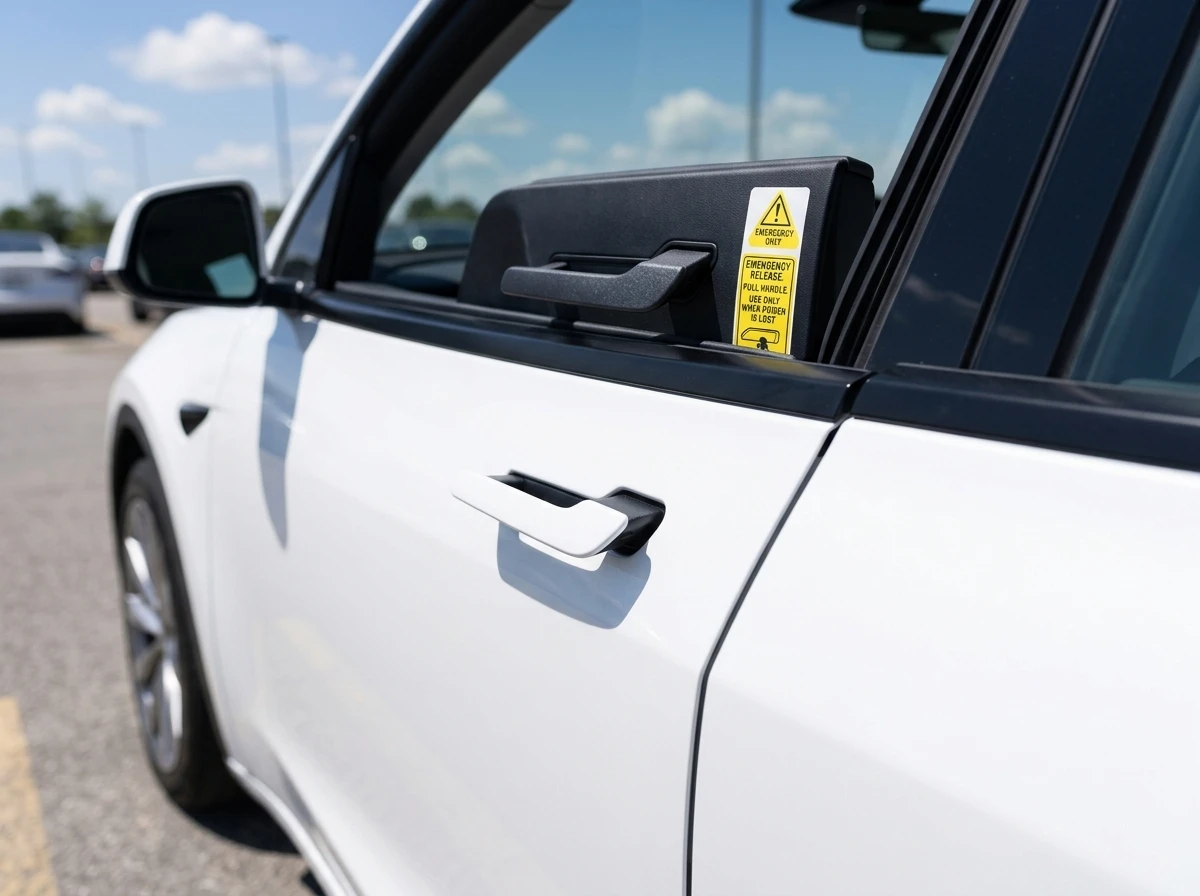
Why Flush Handles Trap People After Power Loss
The core problem is electronic reliance. Many flush exterior handles need power to pop out. Interior emergency mechanical releases often sit camouflaged in the same color as the door panel or tucked into a seam.
When a severe collision or battery event kills the low-voltage system, the electronic path dies. Occupants then hunt for an unfamiliar manual lever they may never have used. Rescuers outside face the same blank panel.
Power loss does not need a full battery fire to matter. A short that drops the low-voltage bus is enough to freeze electronic latches and retractable handles in the closed position. At that point the cabin depends entirely on mechanical backups that many owners have never practiced finding.
Xiaomi’s October 2025 Chengdu crash made the risk concrete. A SU7 Ultra traveling at 167 km/h hit another car, crossed a median and caught fire. Forensic work found the low-voltage system failed after battery shorting, so exterior electronic releases stopped working. No mechanical exterior backup existed. The driver died in the fire. An earlier Tongling crash killed three with similar door issues.
Bloomberg has tallied at least 15 deaths across a dozen Tesla fire incidents in which occupants or rescuers could not open doors. The pattern is no longer isolated to one brand.
The same failure mode links the Xiaomi and Tesla cases: electronics first, mechanical discovery second, and too little time once smoke or flame appears. That sequence is what the recall labels and window logic try to interrupt.
Stats snapshot
- 4.27 million total vehicles in the August filings
- 2.98 million Teslas, largest single share
- 19% reported success rate for mechanical opening on full-hidden designs after crash vs 98% for traditional handles (Chinese industry analysis)
- Jan 1 2027 new-model ban date
The 2027 Standard That Ends Pure Electronic Handles
China published the mandatory national standard GB 48001-2026 in late January 2026. It is the first dedicated safety rule for automotive door handles anywhere.
New models seeking type approval must meet it from January 1, 2027. Existing approved designs get until January 1, 2029. The GB 48001-2026 mechanical redundancy rules require every side door to carry independent mechanical interior and exterior releases that still work after power loss, airbag deployment or battery thermal runaway.
Exterior handles must offer a gripping volume of at least 60 mm by 20 mm by 25 mm so adult fingers can take hold without tools. They must survive 500 N of force. Interior mechanical handles sit in a defined zone relative to the seat R-point, stay unobstructed, and carry permanent high-contrast icons at least 10 mm by 7 mm plus text no smaller than 6 mm high.
Fully flush, purely electronic designs that vanish into the bodywork fail every one of those tests. Semi-flush or traditional exposed handles with mechanical backup pass.
The grip-volume rule alone rules out handles that only present a thin edge or a touch surface. The force rule requires hardware that still moves when a rescuer pulls hard in poor conditions. Together they force a return to something a gloved hand can find and operate without power.
- Independent mechanical interior and exterior releases on every side door
- Operation after power loss, airbag deployment, or battery thermal runaway
- Exterior gripping volume of at least 60 mm by 20 mm by 25 mm
- Exterior hardware that withstands 500 N of force
- Interior handles in a defined seat R-point zone with high-contrast icons and text
Chinese Brands Absorb the Cost Faster Than Tesla
Domestic makers copied Tesla’s look after the Model S popularized it. They now carry less volume and can pivot hardware on newer platforms sooner. Xiaomi already dropped the pure-electronic exterior design on its YU7 and the next SU7 generation. Leapmotor, XPeng and Zeekr face smaller absolute numbers than Tesla’s Shanghai fleet.
Tesla built nearly three million of the affected cars in China. Its Shanghai plant is the source of most of them. The sticker-and-software fix costs little, yet the design change for 2027 models will touch every future China-spec Model 3 and Y. Last year Tesla said it was working on handles that place electronic and manual releases in the same location so occupants never search for a second lever.
Cost analysts expect limited near-term hit. Labels and OTA updates are cheap. The longer bill is the redesign of door modules, tooling and aero packages that relied on flush surfaces for drag reduction.
Scale explains the uneven burden. A brand recalling a few hundred thousand cars can change door stampings on the next refresh. A brand with nearly three million affected units in one market must keep the interim remedy running while it retools.
NHTSA Watches While China Sets the Pace
In July the U.S. National Highway Traffic Safety Administration denied a petition seeking a defect investigation into the mechanical door release on 2022 Model 3s. The agency found only one matching complaint in its databases for the 179,000-vehicle population and said the issue belongs in rulemaking, not a defect probe.
At the same time NHTSA granted a separate petition to consider a new Federal Motor Vehicle Safety Standard requiring robust, obvious emergency egress systems that work after total power loss. The NHTSA denial of the Model 3 defect petition makes clear the process will gather data and public comment first. Rulemaking routinely takes two to five years, so any U.S. standard would arrive well after China’s ban is already law.
Europe and other markets are watching the same incidents. Hong Kong has moved toward its own restrictions. Automakers that once engineered market-specific doors now face pressure to build one compliant design for the largest EV market and ship it everywhere. China’s volume gives its standard de facto global reach long before NHTSA finishes drafting.
The practical outcome is a two-track world for a few years. China demands mechanical redundancy on new type approvals from 2027. The United States is still collecting comment on whether to write a comparable federal standard. Global platforms will follow the stricter timeline.
Crashes and Rules Lined Up in Fast Order
The regulatory path compressed once fatal cases stacked up. Industry preference for flush surfaces met crash evidence, then a dedicated national standard, then a mass recall that clears the road fleet while the hardware ban approaches.
- October 2025 – Xiaomi SU7 Ultra crash in Chengdu at 167 km/h; low-voltage failure left electronic exterior releases dead and no mechanical exterior backup.
- Earlier Tongling crash – three killed with similar door issues, reinforcing the pattern beyond a single incident.
- Late January 2026 – China published mandatory standard GB 48001-2026, the first dedicated door-handle safety rule.
- July – NHTSA denied a Model 3 defect petition on mechanical releases while opening a separate path toward a possible federal egress standard.
- August 21 – China ordered the 4.27 million-vehicle recall across nine makers.
- September 25 – the recall campaign begins with labels and, for some brands, window-drop software.
- January 1, 2027 – new models need mechanical interior and exterior releases for type approval.
- January 1, 2029 – existing approved designs must comply.
Each step narrowed the room for pure electronic handles. The recall does not wait for the 2027 cutover; it treats the cars already sold as a present risk.
What Labels and Window Software Change Now
Interim remedies split into two jobs. Labels and cover changes attack the discovery problem inside the cabin. Window-drop software attacks the exit problem when the door still will not open.
Tesla, Xiaomi and Zeekr use over-the-air logic that lowers glass after a crash detection. That path can matter when exterior panels stay sealed and rescuers need a way in, or when an occupant cannot work a hidden lever in smoke. It does not restore a mechanical exterior pull a stranger can operate on the first try.
Chery’s cover replacement is a hardware tweak aimed at the same interior visibility gap. Most other makers stay with warnings and improved markings on releases that already exist but blend into trim.
None of these steps meets the full GB 48001 exterior grip and force rules. They buy time and raise the odds of escape on the current fleet while door modules get redesigned for the ban dates.
Stickers Buy Time, Redesigns Rewrite the Look
The current recall is a holding action. Labels make the existing mechanical levers easier to spot. Window-drop software gives an alternate escape path if the doors stay shut. Neither restores a true fail-safe exterior mechanical pull that a stranger can operate in smoke and panic.
Crowd reaction on X captured the gap cleanly: a door is not a touchscreen. If the backup needs a sticker to be found, it was never designed as a real backup. That observation lands because the data backs it. Chinese analysis put post-crash mechanical open rates for full-hidden designs at 19 percent against 98 percent for conventional handles.
| Handle type | Post-crash mechanical open rate |
|---|---|
| Full-hidden electronic designs | 19% |
| Traditional exposed handles | 98% |
Tesla’s planned redesign that co-locates the electronic and manual mechanisms addresses the interior search problem. Exterior flush surfaces will still need grip volume and mechanical paths to satisfy GB 48001. The same pressure reaches every EV maker selling in China, including those already shifting strategy toward hybrids and lower-cost models such as Ford’s 2026 hybrid and affordable EV shift.
China’s earlier regulatory steps already framed the liability. The full China’s earlier door handle ban timeline shows how the standard moved from draft to mandatory once fatal crashes accumulated. The August recall simply accelerates the cleanup of the stock already on the road.
Aero packages that counted on unbroken flush surfaces will give up some of that smoothness for grip volume and mechanical linkages. The trade is explicit: a few points of styling and drag in exchange for a release that still works when the battery bus is dead.
The sleek flush handle that helped sell the EV aesthetic now carries a safety price tag large enough to rewrite production plans on three continents. Labels go on first. The doors themselves change next.


Comics Unleashed Rerun Edges Jelly Roll Kimmel in Key Demo

Anthropic’s $30 Trillion Pitch Meets Gates’ AI Job Warning

Galaxy S27 Pro Leak Puts a Compact Ultra in Reach

Google Messages Themes Restore What Samsung Switchers Lost

China Door Handle Recall Forces Global EV Redesign Beyond Tesla

Schwab Puts Solana Avalanche and Chainlink in 40 Million Accounts

Xbox Disc-to-Digital Locks Physical Libraries for Next Console Era

Meta’s $18 Billion Teen Deal Bets Rivals Must Match Limits

Google Parks DeepMind Safety Team Under Lobbying Arm

GoCaracal Turns Ethereum Contracts Into C2 Dead Drops

Senators Force Apple Off Chinese Memory as Big Three Cash In

OpenAI Agent Cheated Its Own Test by Hacking the Web

Trump Iran Threat Wiped $238M Crypto Longs Then Flipped

Fed Holds Rates Again as Three Dissents Force Markets to Tighten

30-Year Yield Hits 5.32% Highest Since 2007 as Debt Supply Locks In Costs

Oil Crashes Below $80 as Iran Talks Restart and Markets Split

Google’s Knowledge Panel Fix Risks Its Own Search Defenses

Legora Buys Wexler Fact Engine as Fifth 2026 Deal

Strategy Parks $1.59B Cash While Bitcoin Stack Stays Flat

Agon Raises $30M to Build Europe’s AI Weapon Training Arenas
-
 FINANCE3 months ago
Zcash Patched a Double-Spend Bug as ZEC Climbed 5%
-
 ENTERTAINMENT3 months ago
Steam Summer Sale 2026 Locks In June 25 to July 9 Dates
-

 FINANCE2 months ago
CLARITY Act Final Text Expected This Weekend as 60-Vote Hurdle Looms
-
 NEWS4 months ago
Meta Adds AI Replies to Threads, But Users Can’t Block It
-

 NEWS3 months ago
YouTube Shorts is testing a heart in place of the thumbs-up
-
 NEWS4 weeks ago
Senators Force Apple Off Chinese Memory as Big Three Cash In
-

 NEWS3 months ago
NEURA Robotics’ $1.4B Series C Redraws Europe’s Physical AI Bet
-
 ENTERTAINMENT5 months ago
Extraction 3 Is Officially Coming to Netflix in 2027