
ENTERTAINMENT
Chile Bets The Meltdown on Oscars Amid Funding Cuts
Manuela Martelli’s Andes mystery becomes Chile’s Oscar entry just as the audiovisual fund shrinks 64 percent.

Chile’s Film Academy has chosen Manuela Martelli’s The Meltdown as the country’s official entry for Best International Feature at the 99th Academy Awards. The 108-minute Andes mystery, which premiered in Un Certain Regard at Cannes in May, opens in Chilean theaters on September 3.
The pick arrives with a second layer already attached. Half the films submitted for consideration were directed by women for the first time, and academy president Gabriel Díaz used the announcement to press the new government for stronger public support after deep cuts to film funding.
That dual message, artistic and political, framed the August 26 reveal. The academy both crowned a festival title and used the moment to argue that Chilean cinema still delivers under strain.
Academy Votes 51 for Martelli’s Mystery
The Chilean Film Academy announced the selection on August 26. El Deshielo, the Spanish title, took 51 votes in a field of ten titles. Juan Pablo Sallato’s Hangar Rojo finished second with 43. A total of 134 votes were cast, a 67.3 percent turnout.
The margin was clear without being a runaway. Eight votes separated first from second in a ten-film field, enough to settle the race while leaving the runner-up a visible share of academy support.
Díaz said the days of watching national premieres showed an industry modernizing. “For the first time in history, half of the submitted films were directed by women, which speaks to an industry that is modernizing and evolving healthily,” he said. All the contenders had received state support and most were international co-productions.
- 51 votes for The Meltdown
- 43 votes for Hangar Rojo
- 67.3 percent academy participation
- Half of submitted films directed by women
Martelli, whose Chile ’76 debuted in Directors’ Fortnight in 2022, called the selection recognition for the whole team. “We will do everything in our power to represent our community and our country in the best possible way,” she said.
The gender split among submissions gave the vote a marker beyond any single title. For the academy, the shortlist itself became evidence of a pipeline shift already under way.
Public Money Shrinks as Films Multiply
The announcement came weeks after Chile’s Audiovisual Investment Support Fund was cut by 64 percent, from 540 million pesos to 192 million for 2027. The broader culture funds were roughly halved. The Ministry of Cultures, Arts and Heritage faces a 9 percent budget reduction under President José Antonio Kast, who took office in March.
| Budget line | Change |
|---|---|
| Audiovisual Investment Support Fund | Cut 64 percent (540 million to 192 million pesos) |
| Broader culture funds | Roughly halved |
| Ministry of Cultures, Arts and Heritage | 9 percent reduction |
Díaz thanked the Council of Arts and the Audiovisual Industry and called on the ministry to keep backing the sector “by strengthening the Audiovisual Fund, without censorship or prejudice.” Producer Alejandra García of Ronda Cine noted the multiplier effect of co-productions on the wider economy.
The Oscar submission therefore functions as more than awards positioning. It is a public demonstration that Chilean cinema continues to deliver festival titles and international partnerships even as domestic public money contracts.
State support still underwrote every contender in the academy vote. The contradiction is plain: the same public system that helped generate the ten-title field now faces a sharply smaller envelope for the year ahead.
A Nine-Year-Old Walks the 1992 Thaw
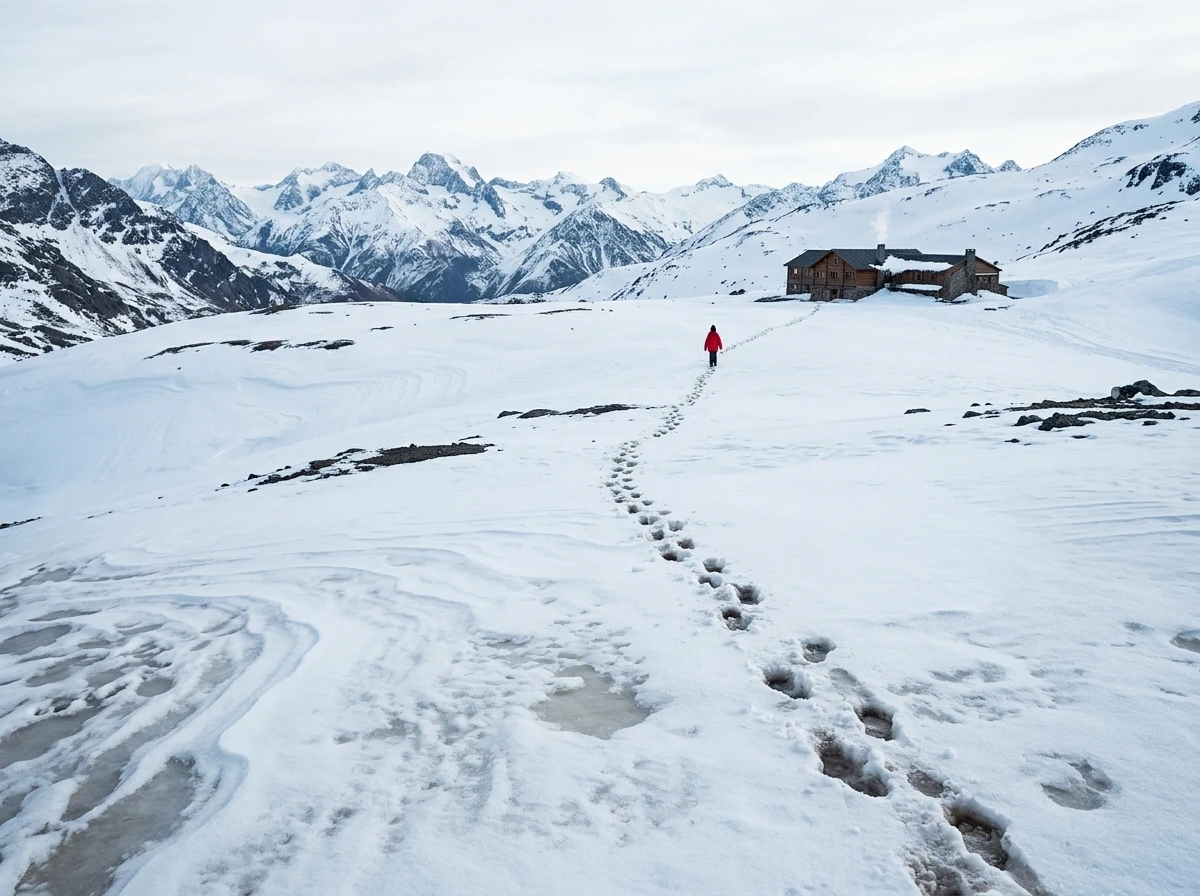
Set in 1992, two years after the end of Augusto Pinochet’s rule, the film follows nine-year-old Inés, played by newcomer Maya O’Rourke. Her parents are away at the Seville Expo presenting Chile’s economic miracle; she stays at her grandparents’ remote hotel near an Andean ski resort.
Inés befriends Hanna, a German teenager training as a competitive skier and chafing against a regimented life. When Hanna vanishes, her mother Lina (Saskia Rosendahl) recruits Inés as translator. The search exposes loyalties, silences and echoes of the disappearances that marked the dictatorship years. Cast includes Jakub Gierszał, Paulina Urrutia and Mauricio Pešutić.
The premise turns on a double absence. Parents chase a national showcase abroad while a child is left to read the silences at home, and a missing skier pulls those silences into the open.
Martelli has said her interest lies in history through characters and emotions rather than capital-H events. She was herself nine in 1992. “It was interesting to overlap the transition of a kid and the transition of a country and the world as well,” she told The Hollywood Reporter earlier this year. The film is the second part of a planned trilogy on late-20th-century Chile.
That personal overlap shapes the point of view. A child translator becomes the audience’s guide through adult evasions, and the Andean hotel becomes the stage where private mystery and public memory meet.
Snow That Refused to Arrive
Production tested the team. García listed the obstacles: snow that would not arrive, an eight-year-old lead, dogs, an international cast and a large budget that had to be raised. “Getting the film made was not easy. We never gave up,” she said.
Martelli described the shoot as “quite an adventure, a ‘little Fitzcarraldo of the Andes.’” Cinematography is by Benjamín Echazarreta, editing by Yibrán Asuad, music by Mariá Portugal. The Chilean-American-Spanish-Mexican co-production involves Ronda Cine, Cinema Inutile, Wood Producciones, Elástica Films, Piano and Fundación Río. Les Films du Losange handles international sales.
- Snow delays and high-altitude logistics
- Child performer working in Spanish and English
- International cast and dog sequences
- Multi-country financing for a period snowbound set
Mubi acquired Latin American streaming rights and plans a campaign focused on Mexico, Brazil and Argentina after the San Sebastián screening.
The same cross-border web that financed the shoot now carries the film toward audiences. Sales, streaming and festival slots turn a difficult Andes production into a circulating title rather than a one-market release.
Cannes Called It Haunted
The Meltdown world-premiered in Un Certain Regard on May 14. It is the first fiction feature by a Chilean woman director in that section. Critical response was largely admiring if not uniformly ecstatic.
Confused connections, parental proxies, colonial histories, Martelli interweaves these narrative strands with skill and artistry. Through the mystery of one person’s fate, a young hero awakens to certain ground rules and discovers a haunted place.
Sheri Linden, The Hollywood Reporter
The same THR review called it haunted and haunting. Variety found the allegory elegant yet less resonant than Chile ’76. Screen Daily praised the child’s loss of innocence as allegory for the post-Pinochet reckoning and noted the mounting disquiet. Spanish critic Alejandro G. Calvo singled out the Erice-tinged childhood gaze and the political metaphor that “fits perfectly” inside the ghostly snow.
O’Rourke’s performance drew consistent praise as watchful and un-cutesy. Martelli called her “a real warrior” for working in snow and two languages.
Across outlets the shared notes were atmosphere, the child’s gaze and the political undertow. Disagreement centered on how strongly the allegory lands beside Martelli’s prior work, not on whether the film carried a charge.
How Co-Productions Carry the Load
Most of the academy’s ten contenders were international co-productions, and The Meltdown fits that pattern in full. Chilean, American, Spanish and Mexican partners shared the risk on a period shoot that needed snow, a bilingual child lead and a large cast.
García’s point about the multiplier effect lands here. When domestic public money contracts, foreign partners, sales agents and streamers become the practical route from a finished print to paying audiences.
- Ronda Cine and fellow producers across four countries
- Les Films du Losange on international sales
- Mubi on Latin American streaming rights
- Kino Lorber on U.S. theatrical and downstream editions
The academy vote itself rested on films that had already drawn state support. The next cycle will test whether co-production can keep filling the gap as the Audiovisual Fund and culture budgets shrink.
Chile’s Two Prior International Bets
Chile has two previous nominations in the category and one win. Pablo Larraín’s No was nominated for the 85th Academy Awards. Sebastián Lelio’s A Fantastic Woman won for the 90th, becoming the country’s first victory. The full record of national submissions stretches back decades and shows a steady output of festival titles.
| Ceremony | Film | Director | Result |
|---|---|---|---|
| 85th (2013) | No | Pablo Larraín | Nominated |
| 90th (2018) | A Fantastic Woman | Sebastián Lelio | Won |
| 99th (2027) | The Meltdown | Manuela Martelli | Submitted |
Readers can consult Chile’s full list of past submissions for the complete sequence. The Meltdown now joins that short competitive history.
Martelli’s entry also extends a recent festival path. Chile ’76 reached Directors’ Fortnight; The Meltdown reached Un Certain Regard. The trilogy plan places both films inside a longer project on late-20th-century Chile rather than as isolated awards bids.
From September Screens to March 14
The film opens in Chile on September 3. It screens in San Sebastián’s Horizontes Latinos section the same month. French theatrical release is already under way. Kino Lorber U.S. theatrical plans call for an early 2027 release followed by digital, educational and home-video editions. The company previously handled Chile ’76 and secured Martelli a Directors Guild of America nomination for first-time feature.
- September 3, 2026, Chilean theatrical opening
- September 2026, San Sebastián Horizontes Latinos
- December 15, 2026, Academy shortlist of 15
- January 21, 2027, Five nominees announced
- March 14, 2027, 99th Academy Awards ceremony
Kino Lorber acquisitions vice president Karoliina Dwyer said the company is “delighted to collaborate again with Manuela Martelli,” whose earlier film succeeded with both critics and audiences in the United States. The distributor will mount the awards campaign required to reach Academy voters.
Whether The Meltdown reaches the shortlist will depend on the strength of that campaign and the crowded field of other national submissions. For Chilean cinema the selection already stands as evidence that the work continues, women directors are taking half the slots, and co-productions still multiply even when the public fund contracts. The film itself keeps asking what thaws and what stays buried under the snow of 1992.


Dolly Parton’s $450 Million Fortune Keeps Working After Her Death

SpaceX’s $60B Cursor Buy Immediately Costs It OpenAI Models

Rays Forever Home Wins County Vote as College and Taxpayers Carry the Load

Apple TV Hits $14.99 as Sports and Hits Bill Comes Due

Swift Telescopes Restart as Orbit Drop Accelerates

Oracle’s 2.8 GW Bloom Deal Exposes the AI Power Bypass

Galaxy S26 Beta 7 Ports Fold 8 AI as Stable Nears

Walmart Pays $50 Million to Close Federal Opioid Pharmacy Case

Space Mirror Demo Revives 1993 Russian Night-Light Test

Measles Death Dispute Deepens Distrust in Pennsylvania Outbreak

Senators Force Apple Off Chinese Memory as Big Three Cash In

Trump Iran Threat Wiped $238M Crypto Longs Then Flipped

30-Year Yield Hits 5.32% Highest Since 2007 as Debt Supply Locks In Costs

Oil Crashes Below $80 as Iran Talks Restart and Markets Split

Strategy Parks $1.59B Cash While Bitcoin Stack Stays Flat

Astute’s $1.2M bet makes B2B creator deals feed AI discovery

Capital Clusters and the Dual Tracks of European Tech Finance

SpaceX Stock Rebound Tests Real Demand Before Huge Unlock

BlackRock Turns Cash Empire Into Stablecoin Reserve Rails

The 20% Savings Ideal Meets a 2.7% Reality Check
-
 FINANCE3 months ago
Zcash Patched a Double-Spend Bug as ZEC Climbed 5%
-
 ENTERTAINMENT3 months ago
Steam Summer Sale 2026 Locks In June 25 to July 9 Dates
-

 FINANCE2 months ago
CLARITY Act Final Text Expected This Weekend as 60-Vote Hurdle Looms
-
 NEWS4 months ago
Meta Adds AI Replies to Threads, But Users Can’t Block It
-

 NEWS3 months ago
YouTube Shorts is testing a heart in place of the thumbs-up
-
 NEWS4 weeks ago
Senators Force Apple Off Chinese Memory as Big Three Cash In
-

 NEWS3 months ago
NEURA Robotics’ $1.4B Series C Redraws Europe’s Physical AI Bet
-
 ENTERTAINMENT5 months ago
Extraction 3 Is Officially Coming to Netflix in 2027