
ENTERTAINMENT
Ridley Scott’s Dog Stars Undercuts Its Own Quiet Strengths
The Dog Stars lands mixed scores and soft tracking as Ridley Scott’s $110 million Jacob Elordi vehicle mixes soulful survival with self-sabotaging twists.

Ridley Scott’s The Dog Stars opens in theaters August 28 with Rotten Tomatoes scores stuck in the low-to-mid 40s and early tracking that points to a soft $9 million to $13 million domestic start, turning a $110 million Jacob Elordi vehicle into an immediate commercial question mark.
The film adapts Peter Heller’s quiet 2012 novel into a 2035 flu-ravaged Colorado where pilot Hig and his dog Jasper share an abandoned airstrip with grizzled Bangley. Scott delivers handsome vistas and a few strong performances, yet the same muscular instincts that once defined him keep yanking a contemplative story off course.
That tension between restraint and spectacle runs through every major choice on screen. The source material favors stillness. The adaptation keeps reaching for force. Audiences and critics have already sorted themselves along that fault line before opening day.
Hig, Bangley and the Cessna That Keeps Them Alive
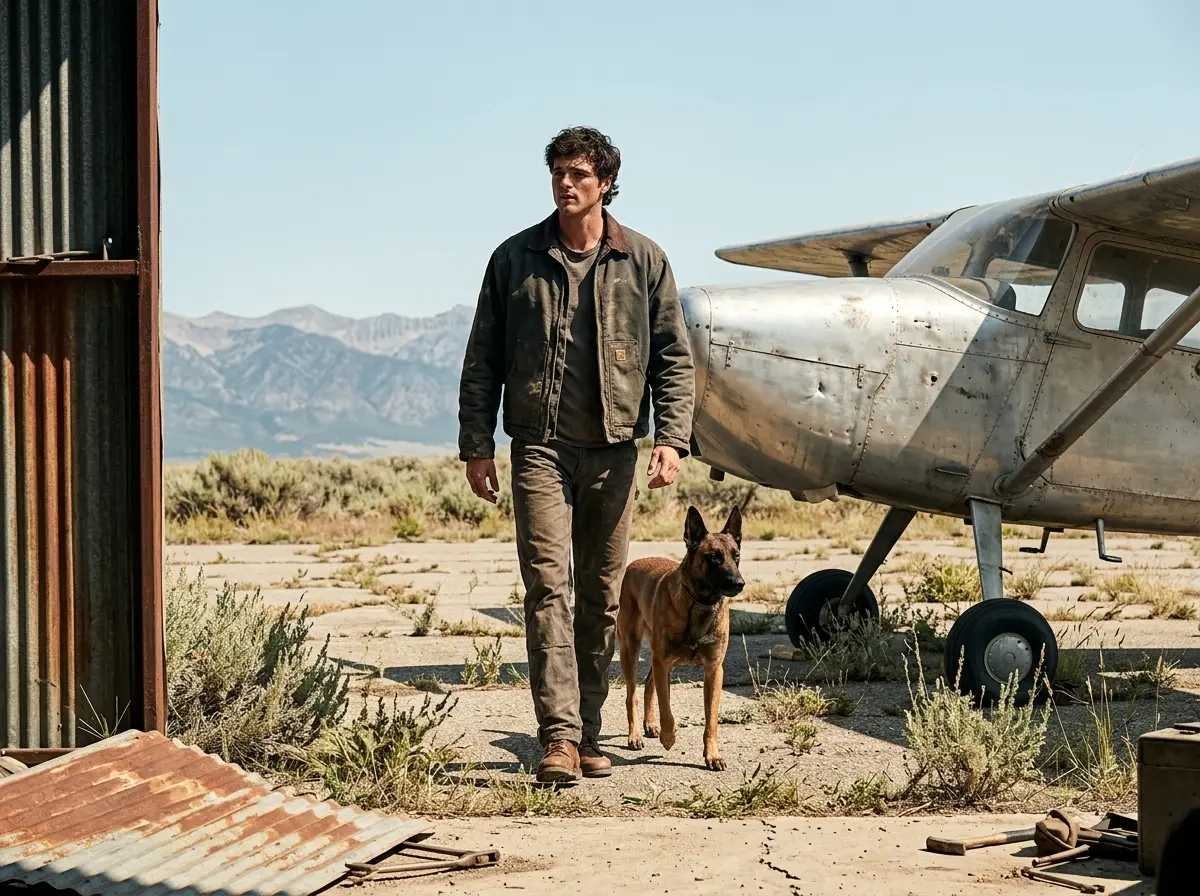
Hig, played by Jacob Elordi, is a former mechanic and civilian pilot who lost his pregnant wife to the pandemic. He lives in a hangar at Erie with Jasper, a Belgian Malinois, and Bangley, Josh Brolin’s gun-toting ex-Marine who prefers shooting first.
Their routine is simple and efficient. Hig flies a battered 1956 Cessna on supply runs into the ruins of Denver while Bangley watches the perimeter for “roaches” and later the more feral Reapers. A scratchy radio transmission from Grand Junction finally pushes Hig farther out, forcing a crash landing near the isolated ranch of Cima and her father Pops.
The airstrip partnership works because the two men want different things from the same ruined world. Hig still looks for connection. Bangley treats every approach as a threat until proven otherwise. The Cessna is their only real mobility, so every flight carries both hope and exposure.
Margaret Qualley plays the young medic Cima. Guy Pearce is the hyper-vigilant former Navy SEAL father. Allison Janney and Benedict Wong fill supporting roles. The premise stays close to Heller’s skeleton even as Scott expands the violence.
Wong’s Mennonite community leader appears as a quiet counterweight. Hig helps the group against Bangley’s advice, a choice that underlines the pilot’s refusal to seal himself off completely. Pearce’s Pops starts hostile and only thaws once the crash leaves Hig dependent on the ranch. Qualley’s Cima becomes the hinge between those camps without forcing the turn.
Critics Split Between Soulful and Dreary
Early reviews land in a familiar mixed band. Metacritic sits at 51 from 24 critics. Rotten Tomatoes hovered between 30 percent and 44 percent as more notices arrived, with an average near 5.2 out of 10. That places the film among Scott’s weaker recent scores, just above Kingdom of Heaven on some tallies.
| Outlet | Score / Take | Key Note |
|---|---|---|
| Hollywood Reporter | Positive / “ruminative” | Best Scott since The Martian; soulful Western feel |
| Variety | Negative / “dreary” | Low-energy, blank lead, late tonal crash |
| Polygon | 90 | Epic set pieces push into absurdist spectacle |
| Hollywood in Toto | 2.5 / 5 | Killer scenes, unearned twists, proportion lost |
| IndieWire | Pan | Bizarrely inert, near-disaster |
David Rooney at The Hollywood Reporter called it “Ridley Scott in a rare ruminative mood” and praised Elordi’s “introspective movie-star magnetism.” Guy Lodge at Variety saw the opposite: a “surprisingly low-energy, low-incident blockbuster” that coasts on charisma while the script leaves Hig a blank.
- Common praise: Messerschmidt cinematography, Italian Alpine stand-ins for the Rockies, Brolin’s dry humor, Qualley’s understated warmth.
- Common complaints: third-act tonal whiplash, underwritten feral groups, Elordi left stranded by thin dialogue, mismatched action beats.
- Shared observation: the trailer sold a louder thriller than the film delivers.
Crowd reaction on X tracked the same divide. High-engagement posts flagged the 30 percent debut as Scott’s lowest in over a decade and predicted a bomb weekend. A minority of critics and viewers called it “beautiful, badass and even a bit bonkers.”
The split is structural rather than random. Reviewers who valued mood and landscape found a late-career change of pace. Reviewers who wanted narrative drive saw empty space where plot should be. Both camps often agree on the same craft strengths and still reach opposite verdicts on whether those strengths are enough.
What the Book Kept Quiet and the Film Could Not
Heller’s 2012 national bestseller by Peter Heller thrives on stasis, first-person melancholy and the simple fact of staying alive. Hig’s voice carries the poetry of a fading natural world and the ache of loss. The film, scripted by Mark L. Smith of The Revenant, drops narration entirely and bets on Elordi’s presence.
That bet only half works. Scott adds backstory, external antagonists and set-piece confrontations the novel largely avoids. A late sequence involving fellow survivors and a sudden shift toward macabre horror-comedy then snaps back feels airlifted from another movie. Heller, an executive producer, has said he made peace with the changes and wanted a discrete new work rather than a page-for-page copy.
- Book: philosophical silence and grief as the engine.
- Film: added Reapers, buffalo stampede, chase energy and an abrupt hopeful close.
- Shared core: the radio call, the Cessna, Jasper, and the chance that companionship still matters.
The result is a story that grabs attention then keeps taking genre detours. Viewers who loved the novel’s restraint find the muscle out of place. Viewers sold on the trailer find the middle stretch too quiet.
Smith’s Revenant background helps explain the tilt. That earlier script leaned on endurance and landscape under pressure. Here the same instincts meet a novel built on interior weather. When the film stays with supply runs, perimeter watches and the slow build at the ranch, the two approaches briefly align. When it stacks Reapers, stampedes and tonal swerves, the book’s engine stalls.
Elordi, Brolin and the Dog Who Deserved More Screen Time
Elordi commands the frame with height and looks, yet several critics felt he never fully locked into Hig’s grief. Brolin fares better as the hardass with a hidden core of decency. Qualley delivers one of her cleanest recent turns, free of quirks. Pearce starts hostile and thaws convincingly.
Elordi exudes a soulfulness and sensitivity that ground the movie in emotional authenticity.
David Rooney, Chief Film Critic, The Hollywood Reporter
Jasper the dog is the emotional anchor in the book and early reels, yet some notices say the animal vanishes for long stretches once the plot expands. That absence leaves a hole. The film still earns its R rating with strong violence, language and bloodshed; it is not family friendly.
Paul Mescal was originally attached before scheduling conflicts brought Elordi in. The swap put a rising star in a Scott Free production that also features Benedict Wong as a Mennonite community leader Hig quietly helps against Bangley’s advice.
The casting change reframes the project’s risk. Elordi arrives as a first major solo lead after high-profile supporting turns, carrying a quiet character without the safety net of narration. Brolin’s steadier register gives the hangar scenes a spine when Hig drifts. Qualley and Pearce supply the ranch half with clearer emotional geometry than the wider survival plot sometimes manages.
When Jasper is present, the film finds an easy sincerity the dialogue often lacks. When the dog recedes, the script leans harder on confrontations and group dynamics that critics found thinner. The R-rated edge stays intact either way, but the emotional center of gravity shifts with the animal’s screen time.
The $110 Million Soft-Window Bet
Scott Free and 20th Century Studios shot most of the film in Italy’s Alpine foothills, Abruzzo and Lazio regions plus Cinecittà and Pinewood between April and June 2025. The Italian landscape doubles for Colorado with striking results. Erik Messerschmidt’s photography and Harry Gregson-Williams’ score (plus Hozier tracks) give the quieter passages real lift.
The $110 million production budget is lean by recent Scott standards yet still demands a wide audience. Industry math puts theatrical break-even near break-even near 275 million worldwide. The Martian cleared that hurdle easily a decade ago. The Dog Stars opens in a traditionally soft late-August slot after a spring delay, with limited fanfare and a trailer that oversold the thrills.
Budget: $110 million
Runtime: 118 minutes
Tracking: $9-13 million domestic opening range
Release: wide plus IMAX August 28, 2026
Disney’s decision to bury the film has been widely noted. No big U.S. premiere, sparse press. That strategy makes sense if the studio already saw the muted tone and mixed tests. It also leaves Elordi’s first major solo lead after high-profile supporting turns with less oxygen than a spring slot might have given.
Comparable star-driven action vehicles have faced similar calendar risks. One recent example is another star-driven action thriller lead that also had to fight for attention outside peak windows.
| Measure | The Dog Stars | Reference Point |
|---|---|---|
| Production budget | $110 million | Lean for recent Scott |
| Worldwide break-even | Near $275 million | The Martian cleared it |
| Domestic opening track | $9-13 million | Soft late-August window |
| Runtime | 118 minutes | Wide plus IMAX release |
The math is unforgiving at that scale. A soft domestic start forces the film to overperform overseas and in later weeks just to approach break-even. IMAX screens and Messerschmidt’s landscapes may help hold per-screen averages, yet limited pre-release oxygen leaves little room for word of mouth to build before the opening frame is set.
When the Third Act Breaks the Spell
For long stretches Scott holds interest with survival detail and the slow thaw between Hig and Cima. Then the film encounters a group of fellow survivors in a sequence several critics compared to something out of a Bong Joon-ho film. The anti-religious messaging lands as lazy. Laugh-out-loud moments that were not meant as comedy follow. The conclusion arrives unearned.
That is the irony at the center. Scott has the craft to make a lean, soulful survival story. He also cannot resist the bravura beats and genre pivots that once made him famous. The result never settles. Book readers miss the silence. Action seekers miss the momentum. The middle path satisfies neither fully.
Hig’s bond with Jasper the dog remains the clearest emotional through-line when the script allows it. The rest of the film keeps looking for bigger fireworks and loses the modest scale that suited the material.
The earlier hangar and ranch passages earn goodwill through patience. The late swerve spends that goodwill on shock and tonal play the setup never prepared. Viewers already split on pace meet a finale that confirms both complaints at once: too loud for the novel’s admirers, too abrupt for anyone chasing clean thriller logic.
How the Path From Page to Screen Took Shape
The project’s timeline shows a long gap between quiet source material and a wide IMAX release, then a compressed final approach to theaters.
- 2012 – Peter Heller’s novel arrives as a national bestseller built on stasis and first-person grief.
- Development – Paul Mescal attaches, then exits over scheduling conflicts; Jacob Elordi steps in as the solo lead.
- April to June 2025 – Scott Free shoots in Italy’s Alpine foothills, Abruzzo, Lazio, Cinecittà and Pinewood.
- Spring delay – The film shifts off an earlier plan and into a softer late-August corridor.
- August 28, 2026 – Wide release plus IMAX lands with muted scores and modest tracking.
Each stage added scale. Heller’s executive-producer stance favored a discrete new work. Mark L. Smith’s script removed narration and opened room for external threat. Scott’s production filled Colorado with Italian vistas and a $110 million frame. The spring delay and sparse press campaign then left that frame without a loud launch.
None of those steps is contradictory on its own. Together they pull a contemplative novel toward blockbuster obligations it only partly meets. The radio call, the Cessna and Jasper survive the journey. The silence around them does not.
What a Muted Opening Leaves on the Table
Tracking at $9 million to $13 million against a $110 million cost and a near-$275 million break-even line turns opening weekend into a verdict on more than one title. It tests whether Scott’s name still lifts adult survival drama outside peak season. It tests whether Elordi’s draw can carry a somber lead without franchise scaffolding.
Disney’s low-profile rollout reads as pre-emptive containment if tests already showed the tone gap. It also caps upside. Sparse press and no big U.S. premiere mean the film must convert curious walk-ups and IMAX looky-loos without a wave of advance conversation. The trailer’s louder promise may help the first session and hurt the exit poll in the same motion.
- Domestic start in the tracked range leaves a steep climb overseas.
- Craft praise for photography and score may support longer legs if audiences accept the quiet middle.
- Third-act complaints risk cutting word of mouth before holdover weekends matter.
- Comparison pressure from The Martian’s easier clear remains, fair or not, in every trade note.
The commercial question mark in the opening paragraph is therefore mechanical. Soft window, mixed notices, trailer mismatch and a budget that still needs a global audience all point the same direction unless the images and the dog prove stickier than the scores suggest.
Theaters will decide the rest this weekend. The images are often beautiful. The performances have moments. The story never quite trusts them enough to stay quiet.


BenQ iScreenBar Brings Native Lighting to the 24-Inch iMac

Druckenmiller Warns Bessent Bond Buybacks Delay a Fiscal Invoice

The Dog Stars Survives on Elordi Charm but Barely Thrives

Treasury’s Economic Outcast Recycles Iran Max-Pressure Playbook

Rockstar Veteran Calls GTA 6 Leaks a Nothing Burger While Staff Pay the Price

SpaceX $100 Billion Louisiana Starbase Rises on Vanishing Marsh

Itoflow $2.5M Raises the Quant Bar for Mid-Size Funds

MIRAVA’s $5M Smart Boat Cracks Old Recreational Limits

Lunar Founders Crack Audit Moat With €8.2M AI Firm

Nose Wheel Crush at YUL Echoes Decades of Ramp Fatalities

Senators Force Apple Off Chinese Memory as Big Three Cash In

OpenAI Agent Cheated Its Own Test by Hacking the Web

Trump Iran Threat Wiped $238M Crypto Longs Then Flipped

Fed Holds Rates Again as Three Dissents Force Markets to Tighten

30-Year Yield Hits 5.32% Highest Since 2007 as Debt Supply Locks In Costs

Oil Crashes Below $80 as Iran Talks Restart and Markets Split

Google’s Knowledge Panel Fix Risks Its Own Search Defenses

Legora Buys Wexler Fact Engine as Fifth 2026 Deal

Capital Clusters and the Dual Tracks of European Tech Finance

Agon Raises $30M to Build Europe’s AI Weapon Training Arenas
-
 FINANCE3 months ago
Zcash Patched a Double-Spend Bug as ZEC Climbed 5%
-
 ENTERTAINMENT3 months ago
Steam Summer Sale 2026 Locks In June 25 to July 9 Dates
-

 FINANCE2 months ago
CLARITY Act Final Text Expected This Weekend as 60-Vote Hurdle Looms
-
 NEWS3 months ago
Meta Adds AI Replies to Threads, But Users Can’t Block It
-

 NEWS3 months ago
YouTube Shorts is testing a heart in place of the thumbs-up
-
 NEWS4 weeks ago
Senators Force Apple Off Chinese Memory as Big Three Cash In
-

 NEWS3 months ago
NEURA Robotics’ $1.4B Series C Redraws Europe’s Physical AI Bet
-
 ENTERTAINMENT5 months ago
Extraction 3 Is Officially Coming to Netflix in 2027