
NEWS
Itoflow’s $2.5M Agents Encode a Fund’s Own Process
Itoflow’s $2.5 million Balderton pre-seed turns a fund’s own research process into overnight agents with audit logs, human gates, and an unsolved map problem.

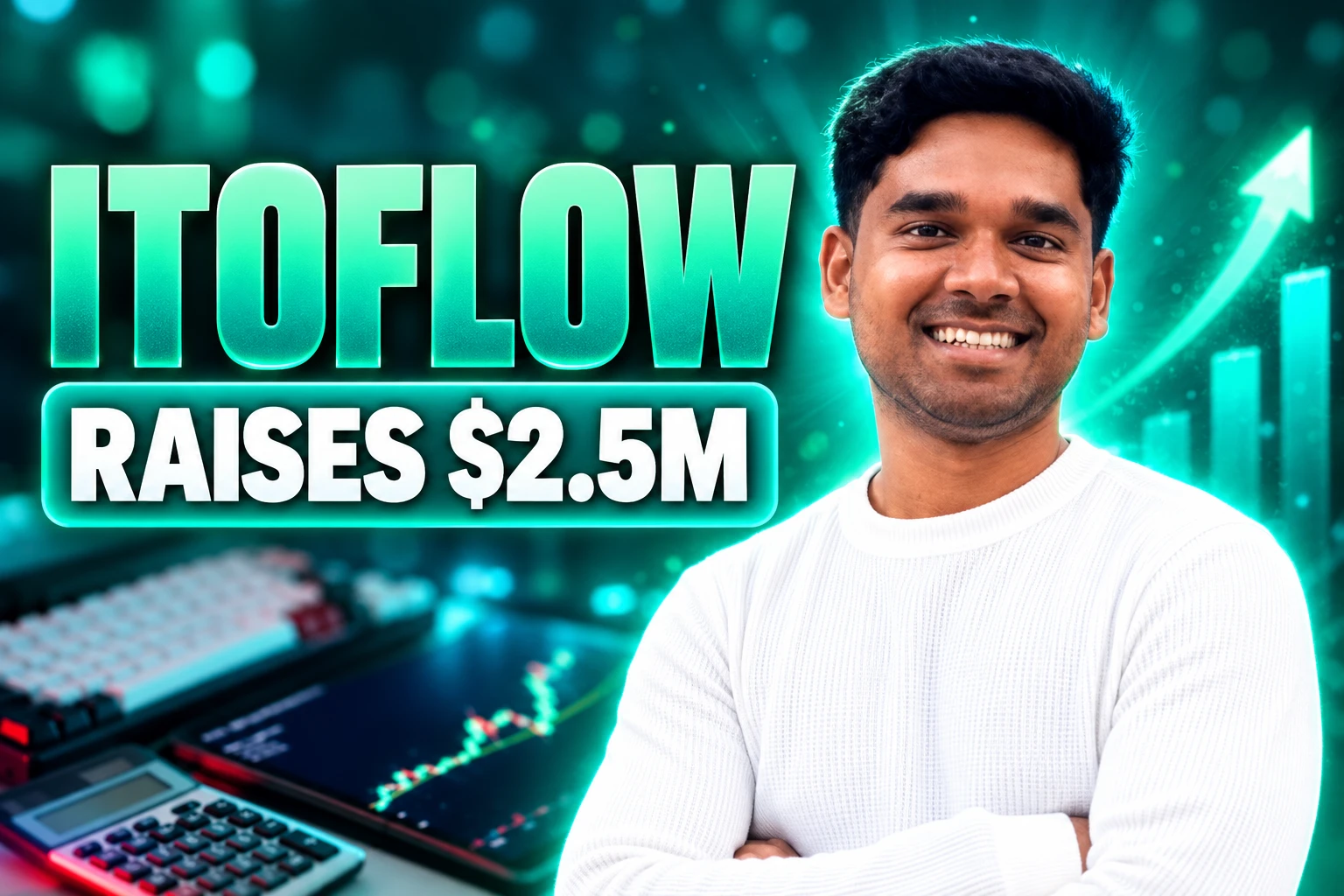
Itoflow raised $2.5 million in pre-seed funding on August 25, 2026, to copy each investment team’s own process into agents that run overnight. Balderton Capital led the London round, with Cleo founder Barney Hussey-Yeo among the angels, and the sterling figure on the same cheque is £1.8 million.
The product does not ship a house view of markets. It turns a desk’s existing approach, typed in plain English, into governed workflows that research, backtest and watch books across equities, bonds, ETFs, commodities and digital assets. That is a labour story, a compliance story and a still-open research problem, not only a software sale.
Three IIT Graduates and a Lesson From Tower
Aditya Jha, co-founder and chief executive, spent nine years as a quantitative researcher at JPMorgan, RBC and Tower Research Capital, where he was business head for mid-frequency trading. He co-founded Itoflow in 2026 with Abinash Meher and Dibya Jyoti Roy. Balderton’s announcement describes three Indian Institute of Technology graduates whose wider team built large-scale systems at Apple, Google and Microsoft and also did quant work at JPMorgan.
Jha’s pitch is not that Tower was slow. It is that even there, standing up a new team still burned calendar time that a boutique fund cannot buy.
One thing that struck me at Tower was how long it could still take a new team to become fully productive. Depending on the strategy, it could take six to eighteen months to assemble the data, research pipelines, backtesting, monitoring and execution infrastructure they needed, and this was at one of the most sophisticated quantitative firms in the world.
Aditya Jha, co-founder and CEO, Itoflow
Sivesh Sukumar, a principal at Balderton, said the most sophisticated firms spend years building the systems and research teams needed to test ideas, manage risk and respond as markets change. He said Jha’s group is changing the cost of that model and giving more firms systematic tools that were previously too expensive and complex to build. The new money is meant to expand engineering and quantitative research, speed up the product, and pay for commercial and regulatory work.
What the Agents Do After a Mandate Is Typed
In current pilots, a team writes its investment approach, risk limits and review criteria in plain English. Itoflow’s agents then run quantitative research and backtesting, watch portfolios, and flag material changes with supporting evidence. Customers set which actions and thresholds need a person to approve, and institutions can install the stack inside their own environment so strategy and data never leave the building.
The public site calls this the agent stack for investing: a research harness, always-on cloud agents, and the plumbing to keep them working while the desk is asleep. A free plan includes $30 of AI usage per month. Access from Codex, Claude and other outside agents is listed as coming soon.
THE ITOFLOW STACK
- Agents: Systems built for quantitative research, with their own memory, workspace and tools, plus review agents that challenge plans, methods and final work.
- Data: Cross-asset market data, filings, quantitative methods, reusable research code and machine-learning pipelines.
- Infrastructure: Durable context, event-triggered runs, and saved work and decision records kept available for auditing.
- Execution: Global, cross-asset, 24/7 broker connectivity, still bounded by the human-approval gates each client sets.
Itoflow also publishes a company benchmark, BuySideBench, that scores its own harness at 0.689 on a configuration it labels GPT-5.6-Luna with extra-high reasoning, against 0.349 for Codex and 0.306 for Claude Code. Those figures are Itoflow’s, not an independent league table, and they are the first public specimen of how the firm wants the stack judged.
Jha told interviewers the company has three live pilots, one of them monitoring about $3 billion in assets, and more than 260 platform sign-ups. Near-term work, he said, is converting the enterprise pipeline behind those three pilots rather than chasing the self-serve tail.
The Research Bench Does Not Have to Grow
Balderton’s note is blunt about the labour math. The agents are meant to let teams research more names and watch more portfolios while applying the same process, without building a much larger quantitative research function. For a hedge fund or family office that cannot staff a Tower-style platform team, that is the sale.
The hidden cost sits on the other side of the same ledger. If overnight agents absorb the grind of data assembly, backtests and watchlists, the next junior hire is harder to justify, and the firm’s edge lives more in the written mandate than in a person who happens to be at the desk. That is the same pressure behind the quant bar for mid-size funds, only now the output is a decision record rather than another seat in research.
Jha has been clear that self-improving agents, systems that learn which approaches still hold up, spot new signals and notice when an edge has decayed, are a long-term research goal, not the thing shipping in the pilots. The product on the table copies the process you already have. It does not yet replace the person who decides the process is stale.
FINRA’s 2026 Report Puts Agents Under Supervision
The round’s “regulatory work” line is not filler. On December 9, 2025, FINRA published its 2026 Annual Regulatory Oversight Report with a new section on generative AI and, for the first time, a dedicated discussion of AI agents. Existing rules still apply. Using these tools can implicate supervision, communications, recordkeeping and fair dealing, including obligations when using generative AI that FINRA already spelled out for large language models.
The report defines AI agents as systems that can autonomously perform and complete tasks on behalf of a user, plan, decide and act without predefined rules. It lists the risks that follow: agents acting without human validation, acting beyond intended authority, multi-step reasoning that is hard to trace, mishandling of sensitive data, weak domain knowledge, and poorly designed rewards that push the agent toward the wrong objective. Hallucinations and bias still apply.
WHAT FINRA TOLD FIRMS TO WEIGH
- Access and data: How to monitor agent system access and data handling.
- Human gates: Where to put human in the loop oversight protocols.
- Decision logs: How to track agent actions and decisions.
- Guardrails: How to limit or restrict agent behaviours, actions or decisions.
FINRA Rule 3110 still requires a supervisory system reasonably designed for the firm’s business. If a member relies on generative tools inside that system, its policies may need to consider the integrity, reliability and accuracy of the model. Itoflow’s human-approval thresholds, on-site install option and stored decision records sit directly on those points. They do not move legal responsibility off the firm that runs the agent.
The company is also in talks with exchanges, brokerages and financial-data providers. If those talks turn into pipes, the overnight agent does not only sit on a fund’s laptop. It sits on someone else’s market data, order routing and recordkeeping stack, which is exactly the vendor-supervision problem already familiar under older outsourcing notices.
A $2.5 Million Round Versus Much Larger Rivals
Wall Street already pays for AI that reads filings, drafts memos and sits beside bankers. Itoflow is trying to occupy a narrower slot: take the mandate a portfolio team already uses, keep it, and run it continuously. That is a different job from document grids or pitch-book production, and it is being funded at a very different scale.
HOW THE CHEQUES COMPARE
| Company | Capital | Core job |
|---|---|---|
| Itoflow | $2.5 million pre-seed, 2026 | Encode a client’s own mandate into research, backtest and monitor agents |
| Boosted.ai | $61 million total | Agentic coworker for investment workflows, trained on how users already work |
| Hebbia | $161 million total | Document-scale research across filings, deal files and transcripts |
| Rogo | $160 million Series D, April 2026 | Agent production of banking memos, models and deal work |
Boosted.ai, founded in 2017, is the closer cousin: an agentic coworker for portfolio work, not a filing reader. Hebbia and Rogo have raised the kind of capital that buys sales teams, data licences and multi-year compute. Itoflow is still arguing that a from-scratch agent stack, plus Jha’s years on a trading desk, can outrun that spend in a slice of the market those firms are not built to serve.
Hussey-Yeo’s cheque is a consumer-finance vote for the same control idea, written from the other end of the industry.
Building Cleo has taught me that financial AI only works when it’s intuitive, trustworthy and keeps people in control. Itoflow gets that. It gives investment teams sophisticated tools without asking them to give up their own process or judgment.
Barney Hussey-Yeo, founder and CEO, Cleo
The Map Still Cannot Say When It Is Wrong
On September 3, 2026, Vacslav Glukhov, an engineer writing from Itoflow, put the unsolved job in public. Systematic investing, he wrote, runs on a state-action map once that map is built. Discretionary managers keep an unstated model in their heads and can change it when the facts move. Neither approach obviously wins after adjusting for market beta, a finding AQR has published more than once, and discretionary books have looked stronger in sudden regime shifts.
The sharper a quantitative optimum, he argued, the faster it fails in production. The question he asked is the one the $2.5 million round cannot yet close: can an agent know when to follow a validated state-action map, and when the world has changed enough that the map itself must be questioned and amended?
That is the catch inside the sales story. A desk that types its process into governed agents gets a night shift, a paper trail and a more even application of last quarter’s rules. It also freezes those rules in software that will keep firing until a person, or a later model, says the terrain has moved. Jha’s long-term research goal, self-improving agents that notice a decayed edge, is the attempted fix. He has said it is not the current product.
Until that research lands, the overnight agent is a faithful clerk with a log file. The person who still has to wake up when the map is wrong remains the same person who wrote the mandate in the first place.
Disclaimer: This article is news reporting and analysis of a company funding round and a research product, and it is for information only. It is not investment advice, a solicitation, or a recommendation to subscribe to Itoflow or to buy or sell any security or digital asset. Anyone who manages client money, or who plans to put AI agents inside a research or trading process, should speak with a licensed investment adviser and a qualified compliance or legal professional before changing controls, recordkeeping or approval gates. Product details, pilot figures and regulatory guidance reflect the company and regulator materials drawn on here and can change as pilots convert to contracts.

UPI MDR Delay Hands Traders the Calendar After Paytm Falls

Google Messages Builds Nine In-Chat Games After Samsung’s Exit

Anthropic’s $100 Million Academy Trains the Firms That Bill Both Sides

Toyota’s Electric C-HR Leaves the Cheap Twin to Subaru

Markets Bet the Fed Skips October After Hawkish Minutes

The Orchard Bug Forced Zcash to Open an Empty Pool

The $5.99 Game That Won Steam’s 2026 Summer Sale

Don Lee Joins Hemsworth as Extraction 3 Starts Shooting

YouTube Shorts Retires Dislikes and Swaps Likes for Hearts

NEURA Robotics Is Spending Its $1.4B on a Machine Stack
-
 NEWS4 months ago
The Orchard Bug Forced Zcash to Open an Empty Pool
-
 GAMING4 months ago
The $5.99 Game That Won Steam’s 2026 Summer Sale
-
 ENTERTAINMENT6 months ago
Don Lee Joins Hemsworth as Extraction 3 Starts Shooting
-
 NEWS4 months ago
YouTube Shorts Retires Dislikes and Swaps Likes for Hearts
-
 NEWS4 months ago
NEURA Robotics Is Spending Its $1.4B on a Machine Stack
-

 AUTO6 months ago
Kawasaki Bets the New Z1100 Against Its Own Supercharger
-
 BUSINESS5 months ago
Norway’s Export Bank Backs Nscale’s $790 Million Narvik Loan
-

 GAMING4 months ago
Game of Thrones Dragonfire Follows Boston’s Conquest Playbook