
NEWS
MIRAVA Wagers $5 Million on a Follow-Me Dayboat
MIRAVA takes a $5 million 7.9-metre follow-me boat to Cannes, betting Europe will buy autonomy while the skipper still carries the legal risk.

MIRAVA rolled a 7.9-metre smart boat into the Cannes Yachting Festival on a $5 million angel round, selling auto-dock, a follow-me band, and a stern that splits off as a tender. The show runs 8-13 September 2026 across the Vieux Port and Port Canto, with more than 700 boats and about 150 world premieres. The wager is that a Shenzhen company can sell a new kind of dayboat in a harbour still built around skippers, slips, and insurance.
Docking software is no longer a lab trick. The harder test is whether Europe will buy a whole hull around it, and who pays when the software kisses a piling.
A 7.9-Metre Hull in a 700-Boat Harbour
The 49th Cannes Yachting Festival opened on 8 September 2026 under new director Constance Brément. She told visitors the industry is not about owning a big, expensive boat that goes very fast. MIRAVA’s stand is POWER132, among the dayboats, not beside the steel that defines the photographs.
Azimut used the same week to show a 143.8-foot Grande 44M and said seven hulls had sold before the first one hit the water. MIRAVA is asking the same crowd to look at a platform about 26 feet long, with room for eight, and treat software as the luxury.
CANNES 2026 IN FOUR FIGURES
- Show window: 8-13 September 2026, six days across the Vieux Port and Port Canto.
- Fleet on site: more than 700 boats and more than 680 exhibitors.
- Premieres: around 150 world debuts, from dayboats to superyachts.
- Dayboat dock: 180 motorboats up to 12-13 metres in the power marina.
That last number is the one that matters for MIRAVA. The Power Boat Marina at Port Canto is built for hulls in this size band, which is where docking nerves, family days, and insurance clauses actually live. A 7.9-metre boat does not need to beat a 44-metre flagship. It needs to look like the boat a first-time owner would trust in a crowded fairway.
What the 7.9-Metre Platform Ships
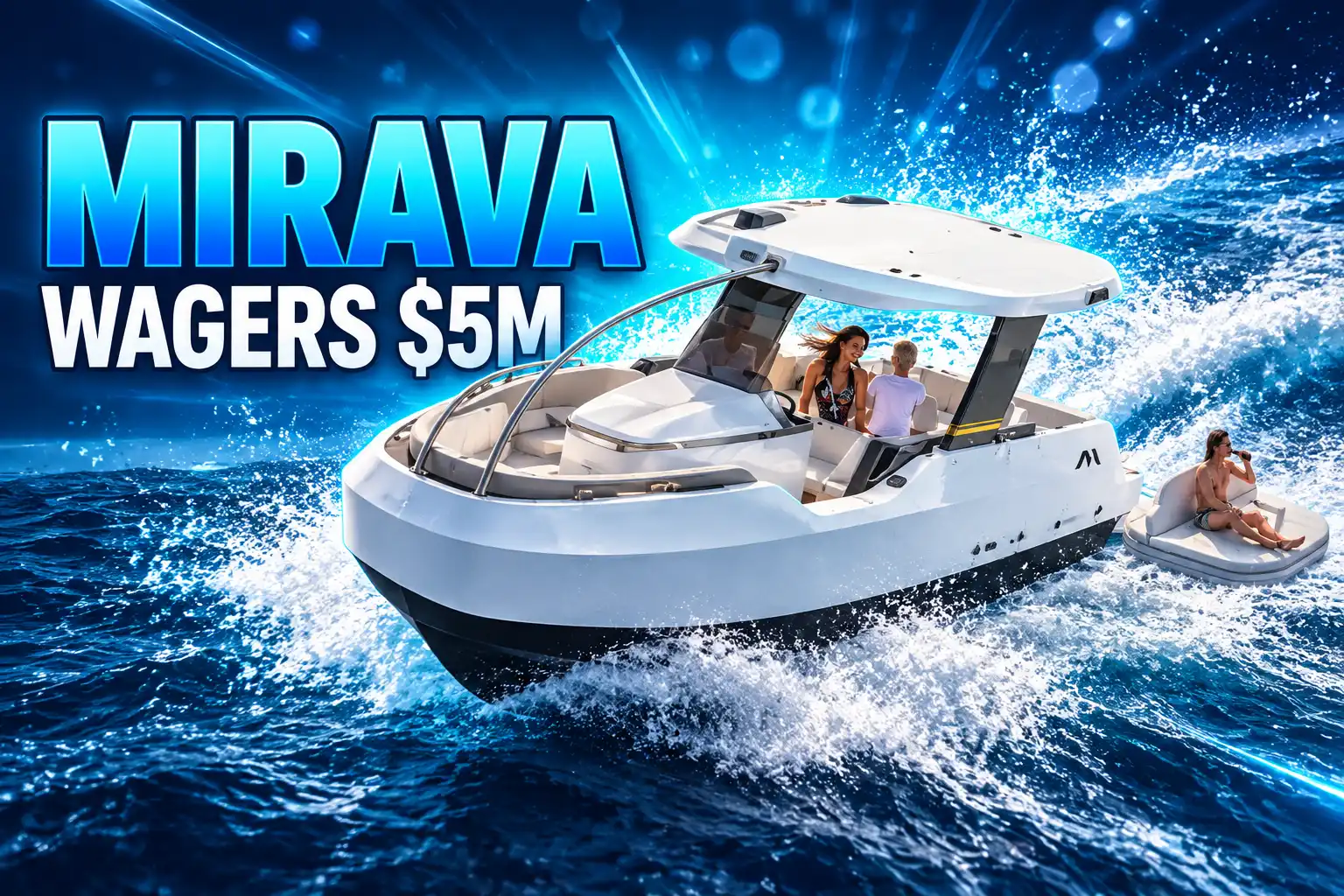
The company’s own product page lists a 7.9-metre hull and twin powertrains on the same FRP platform, 2.44 metres across, with a private restroom, a convertible backrest, and a recreation platform that can flip and then detach. The slogan on the site is “Where Freedom Follows.”
Electric and petrol share the cabin and the beam. They do not share the day you get out of them.
TWO POWERTRAINS, ONE HULL
| Spec | Electric | Petrol |
|---|---|---|
| Material | FRP | FRP |
| Length overall | 7.9 m | 7.9 m |
| Beam | 2.44 m | 2.44 m |
| People | 8 | 8 |
| Peak power | 150 hp | 250 hp |
| Energy | 100 kWh battery | 380 L fuel tank |
| Top speed | 20 knots | 30 knots |
Product materials put electric cruising at up to 11 hours, with a charge from 10 to 80 percent in about an hour. The petrol boat is the one you take when the next marina charger is a rumour. MIRAVA is not pretending Europe has finished that argument.
The software list on the homepage is docking and undocking, navigation help, dynamic positioning, a safety system, and intelligent following. Designers Arman Fissette and Emanuele Bomboi, with past work around Feadship, Oceanco, Sinot, Wajer, FCA Group, and Maggiora-Viotti, were hired to keep that stack under a quiet skin. The company says the point is not more screens. It is fewer jobs that steal the afternoon.
https://www.youtube.com/watch?v=Sh_TUKUPCQU
Auto-Dock Is Already on Boston Whaler Consoles
If the pitch is “the boat parks itself,” MIRAVA is late to a fight Brunswick already picked. The world’s largest recreational boat company has been showing AutoCaptain under its Simrad brand, a camera-led system that docks and undocks and handles tight moves. Chief executive David Foulkes put it in one line: “Press a button, and the boat will dock itself.”
AutoCaptain uses six stereo cameras around the hull, feeds an NVIDIA box, and is meant to work in a slip the software has never mapped. HD Hyundai’s Avikus unit has been selling a similar camera suite, Neuboat, into OEM helms. Joystick docking from Mercury, Volvo Penta, and Yamaha already sits on a lot of premium transoms. MIRAVA is not inventing the fear of a crosswind in a marina. It is bundling a version of the cure into a new boat and calling that a category.
THREE WAYS TO BUY A SOFTER DOCKING
| Offer | What you buy | Follow-me band | Split stern |
|---|---|---|---|
| MIRAVA | A new 7.9 m boat | Yes | Yes |
| Simrad AutoCaptain | A system on an existing hull | No | No |
| Avikus Neuboat | An OEM helm package | No | No |
The table is the bet. Brunswick can drop auto-dock onto Boston Whaler buyers who already have dealers, parts, and a surveyor who knows the brand. MIRAVA has to sell the hull, the software, and the service network in one pass, from a Shenzhen base, with angel money. Public talk about autodock still sounds like a consumer wish list, while the real cash in unmanned boats has gone to military craft. MIRAVA is trying to sell the family version of that fantasy.
Who Pays When Software Hits the Piling?
The International Maritime Organization adopted a MASS Code in May 2026 for ships that can be steered with little or no crew. The code took effect on 1 July 2026. It is written for cargo ships under SOLAS Chapter I, generally the large ones on international voyages, and it is not mandatory yet. The roadmap aims for a binding version, with expected adoption by 1 July 2030 and entry into force on 1 January 2032.
A 7.9-metre family boat is not that ship. IMO still drew the line that will follow the feature down-market: the master retains overall responsibility for the ship at all times, even if that person is not on board.
This landmark achievement positions IMO at the forefront of regulating emerging technologies, demonstrating the Organization’s ability to anticipate and shape the future of shipping. It represents a major step forward, enabling innovation while ensuring that safety, accountability and the human element remain at the core of maritime operations.
Arsenio Dominguez, Secretary-General, International Maritime Organization
P&I clubs have started opening pooling talk for autonomous commercial ships. Recreational cover is slower, and marina contracts still ask for a named skipper. If a follow-me band holds station beside a swimmer and a jet ski cuts the gap, the software vendor will not be the first name on the claim. The person who took the boat out will.
That is the stakeholder the Cannes brochures skip. Dealers can demo a quiet dock. Insurers will price the years after the demo. Until a surveyor, a club, and a harbour master treat auto-dock as a lower risk, MIRAVA is selling a feeling that the policy has not endorsed.
The Follow-Me Band and the Split Stern
The piece Brunswick does not ship is the one MIRAVA keeps putting in the first paragraph. A smart band is meant to let the boat know who is aboard, and to follow a swimmer, paddle-boarder, or diver at a set distance so the helm is not a taxi back to the beach. Dynamic positioning is the same idea at rest: hold the spot while people swim.
The physical trick is the stern. In normal mode the aft is a lounge. In separation mode a section comes off as a tender. The company is selling one garage space that can be a cruiser before lunch and a swim platform after it, without a second trailer in the driveway.
WHAT THE BOAT IS SUPPOSED TO TAKE OFF YOUR HANDS
- Docking: Come in and leave a slip with the software on the throttles.
- Station keeping: Hold position while the crew is in the water.
- Following: Stay near a person wearing the band during a swim or paddle.
- The stern: Reconfigure the aft, then split a tender off the same hull.
- Geofence: Set a virtual fence so the boat stays inside a chosen patch of water.
None of that removes the need for a competent person. It changes when that person has to stare at the bow. Families who now hire a skipper for the last 20 metres of every trip are the buyers this layout is built for. So are owners who want one boat for fishing, friends, and a quiet night, and do not want a second specialised hull.
$5 Million Has to Fund a Factory Start
MIRAVA’s 1 September 2026 release, issued from Shenzhen, said a $5 million angel round would pay for more product work, small-batch production, and customer deliveries. Dealroom logged the same round as €4.2 million. Three years of development sit behind the hull on the stand. The company says the navigation stack has more than 50,000 nautical miles of operational data and is installed across more than 1,500 boats, a fleet claim that points to earlier commercial systems rather than this leisure model alone.
Angel money at that size can tool a short run of 7.9-metre boats. It cannot copy Brunswick’s dealer map, or absorb a bad first season of warranty work in Croatia, the Balearics, and the Côte d’Azur at once. A Hong Kong company named Mirava Water Sport Technology Co., Limited, with the Chinese name 香港夢舟遊艇智能科技有限公司, was incorporated on 26 November 2025. The funding note still plants the operating story in Shenzhen.
THE PATH OFF THE STAND
- 2023 to 2026: Spends three years on the first smart-boat platform.
- 1 September 2026: Raises $5 million in angel funding for small-batch production.
- 8-13 September 2026: Shows the boat at Cannes, Port Canto, stand POWER132.
- 23-31 January 2027: Plans a second European showing at boot Düsseldorf.
WHAT WE KNOW
- The money: $5 million angel, earmarked for development, a short production run, and deliveries.
- The hardware: One 7.9 m FRP platform, electric or petrol, eight people, modular stern.
- The claim: Docking help, dynamic positioning, and a wearable follow mode as standard.
WHAT IS UNCONFIRMED
- Price: No public sticker for either powertrain.
- Deliveries: No named first customers or a firm hand-over month.
- Cover: No published insurer view on follow-me use around swimmers.
Without a price, Cannes is a taste, not a market. Without a delivery calendar, the 1,500-boat data set is a pedigree, not a service shop in Antibes.
boot Düsseldorf Comes in Late January
Cannes closes on 13 September 2026. The next date MIRAVA has put on paper is boot Düsseldorf, which Messe Düsseldorf has set for 23 to 31 January 2027. That indoor show runs nine days, with about 1,500 exhibitors and more than 200,000 visitors in a normal year, and it is where northern dealers write winter orders.
If the follow-me band works in a January hall demo, it still has to work in a cross-shore breeze with a child in the water. If the split stern looks clever under the Port Canto lights, it still has to latch, charge, and come home as one boat. The $5 million round buys the chance to find that out on a short production run, not the right to rewrite recreational boating before the skipper, the insurer, and the incumbent docking stack have had their say.
The hull on stand POWER132 is real, the round is real, and the legal duty on the person who took the boat out has not moved. That is the bet, stated in feet and dollars, with the next exam already dated.

UPI MDR Delay Hands Traders the Calendar After Paytm Falls

Google Messages Builds Nine In-Chat Games After Samsung’s Exit

Anthropic’s $100 Million Academy Trains the Firms That Bill Both Sides

Toyota’s Electric C-HR Leaves the Cheap Twin to Subaru

Markets Bet the Fed Skips October After Hawkish Minutes

The Orchard Bug Forced Zcash to Open an Empty Pool

The $5.99 Game That Won Steam’s 2026 Summer Sale

Don Lee Joins Hemsworth as Extraction 3 Starts Shooting

YouTube Shorts Retires Dislikes and Swaps Likes for Hearts

NEURA Robotics Is Spending Its $1.4B on a Machine Stack
-
 NEWS4 months ago
The Orchard Bug Forced Zcash to Open an Empty Pool
-
 GAMING4 months ago
The $5.99 Game That Won Steam’s 2026 Summer Sale
-
 ENTERTAINMENT6 months ago
Don Lee Joins Hemsworth as Extraction 3 Starts Shooting
-
 NEWS4 months ago
YouTube Shorts Retires Dislikes and Swaps Likes for Hearts
-
 NEWS4 months ago
NEURA Robotics Is Spending Its $1.4B on a Machine Stack
-
 AUTO6 months ago
Kawasaki Bets the New Z1100 Against Its Own Supercharger
-

 BUSINESS5 months ago
Norway’s Export Bank Backs Nscale’s $790 Million Narvik Loan
-

 GAMING4 months ago
Game of Thrones Dragonfire Follows Boston’s Conquest Playbook