
NEWS
BenQ iScreenBar Brings Native Lighting to the 24-Inch iMac
BenQ’s magnetic aluminum iScreenBar, the first light bar built for the iMac, pairs ASYM optics and macOS control for glare-free 500-lux desk coverage starting.

BenQ launched the iScreenBar on August 25, 2026, calling it the first monitor light bar built for the iMac. The $189 aluminum bar mounts magnetically to 24-inch models from 2021 onward, draws power from a USB-C port, and syncs with a macOS app so lighting follows the machine instead of fighting its thin profile and camera.
A decade after BenQ created the category, the design finally matches the machine’s materials and software rather than clamping onto any bezel that will take it.
The Magnetic Fit That Keeps the iMac Intact
Generic light bars rely on spring clamps or weighted hooks that sit on top of almost any monitor. Those work on thick bezels. They look wrong on an iMac’s razor edge and often cover the camera, microphone array or rear Apple logo.
The iScreenBar uses a custom magnetic clamp that snaps to the aluminum chassis. A matching magnetic cable clip routes the short USB-C cord out of sight. The bar itself is precision-machined aluminum with a glass touch surface, echoing the iMac’s unibody finish.
- Camera, microphones and rear logo stay fully clear
- No desk-base footprint or clamp bulk
- Silver finish ships now; blue and green versions arrive late 2026 to match popular iMac colors
- Dimensions 50 × 6.5 × 7.8 cm and net weight 0.23 kg keep the silhouette light
That short list of constraints explains the geometry. The magnet and the bar length are cut for one chassis family, so the product never has to compromise for thicker plastic bezels or taller stands.
BenQ states the product is not affiliated with or endorsed by Apple. Compatibility is limited to the 24-inch iMac (M1 2021, M3 2023 and M4 2024). Earlier iMacs and the Studio Display are unsupported because the magnet and geometry are iMac-specific.
Owners who once rejected third-party bars for visual reasons now face a simpler choice: accept the magnetic mount and keep the desk clear, or stay with a freestanding lamp that still fights the screen’s brightness.
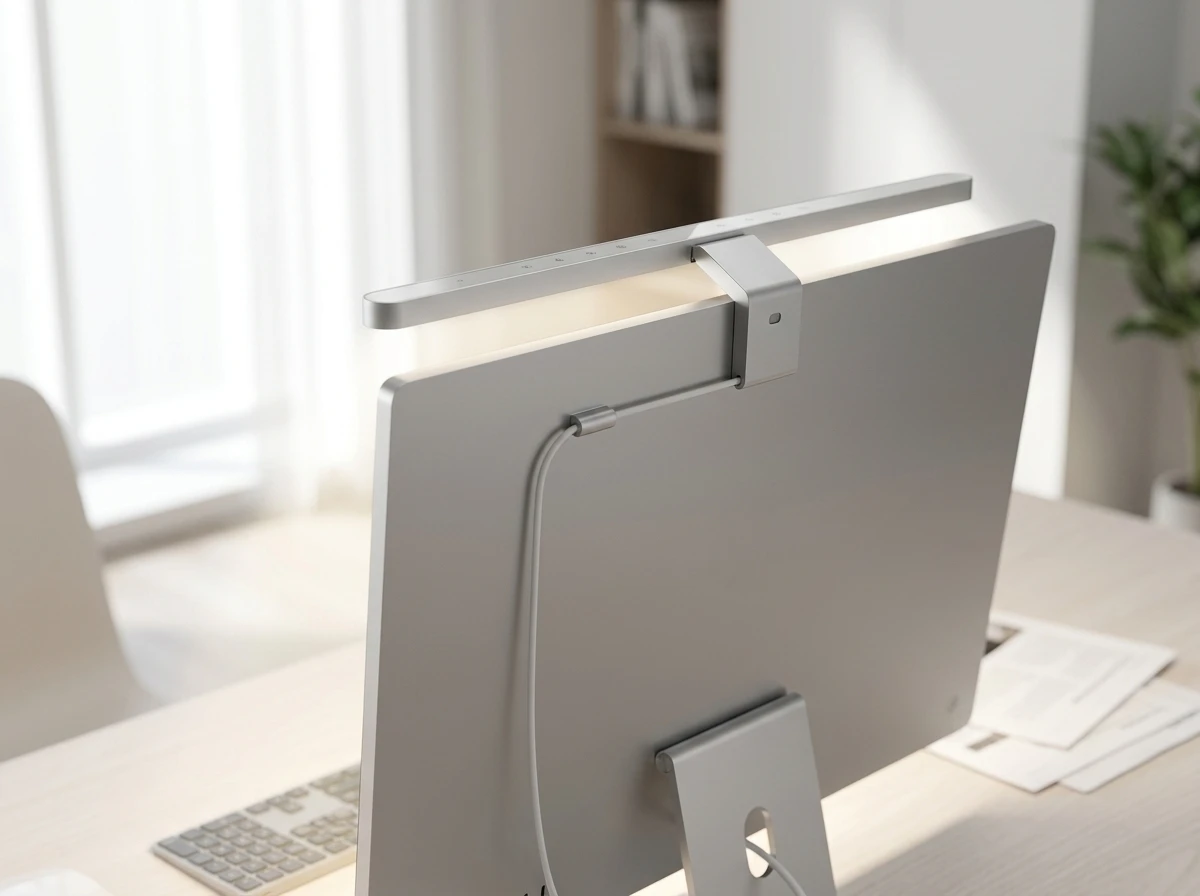
Optics That Light the Desk, Not the Screen
ASYM-Light asymmetric optics throw light forward onto the work surface while cutting glare on the display and direct shine into the user’s eyes. Official figures put coverage at 33.5 by 19.7 inches (85 × 50 cm) at 500 lux, with center illuminance over 1000 lux measured at the standard 47.5 cm height.
| Metric | iScreenBar | Typical Earlier ScreenBar |
|---|---|---|
| Coverage at 500 lux | 85 × 50 cm | Often 60-85 cm wide |
| Center illuminance | >1000 lux | Varies, many under 1000 |
| Color temperature | 2700-6500 K stepless | Stepped or narrower range |
| Color fidelity | Rf ≥96, Ra ≥95 | Usually Ra ≥95 |
| Power | USB-C max 10.5 W | USB-A or C |
Color temperature runs continuously from warm 2700 K ambient to 6500 K daylight. Dual-color LEDs and high Rf keep paper, sketches and keyboard colors accurate. The optics are the same family BenQ has refined since the original ScreenBar, now tuned for the iMac’s viewing distance and aluminum frame.
The 500 lux target on the desk and the higher center reading work together. One keeps the room balanced against a bright panel; the other gives enough punch for close paper work without raising the whole bar to a level that would bounce back into the glass.
Because the beam is thrown forward rather than down the face of the display, the iMac’s thin top edge no longer becomes a glare source. That is the practical payoff of keeping ASYM-Light while resizing the housing for a single machine.
Sensors and the macOS App Do the Rest
A 24 GHz millimeter-wave radar detects presence within roughly 60 cm in front of the monitor and turns the light on when someone sits down. It can auto-off after three minutes without significant motion. An ambient sensor keeps the desk near 500 lux as room light changes.
The bar wakes with the iMac and can switch into video-call mode automatically when the camera activates. In that mode the center dims while the sides brighten, softening facial hotspots and reducing glare for clearer video. Power must come from the iMac’s USB-C port for the sync features; an external adapter keeps the light working but disables the automatic camera link and full app control.
The free macOS app lets users set brightness, color temperature and modes, then assign different presets to specific apps so lighting changes with the task. Presence detection, auto-dimming and power are also available on the glass touch panel itself.
Since inventing the monitor light bar category nearly 10 years ago, we’ve continued to lead with breakthrough design and user-focused innovation that redefines what great monitor lighting should be.
Jeffrey Hsieh, Director and Head of the Consumer Line of Business at BenQ, PR Newswire announcement
Manual override stays local. If the app is closed or the Mac is asleep, the glass surface still handles everyday brightness and temperature changes without a trip to System Settings.
What $189 Buys and When Colors Arrive
Silver iScreenBar units are on sale now at BenQ.com and Amazon for an MSRP of $189. Blue and green finishes that match two of the most common iMac colors are scheduled for late 2026. The box includes the light bar with integrated USB-C cable, magnetic cable organizer, quick guide and warranty card.
Key numbers at a glance:
- $189 MSRP silver, available immediately
- Late 2026 blue and green colorways
- Also at Adorama, B&H (US) and Best Buy (Canada)
- Companion ScreenBar Max dual-monitor model at $289 with optional $39 desk base
Both new models earned Red Dot Design Awards for 2026; the iScreenBar also took an iF Design Award.
The price positions the bar as a premium accessory rather than a commodity clamp lamp. Buyers who already own earlier ScreenBars will recognize the familiar optical language and treat the premium as payment for the magnetic chassis match and the macOS hooks.
A Category BenQ Invented and Is Now Specializing
In 2014 BenQ’s lighting team asked why lamps still assumed paper when work had moved to screens. Research with heavy monitor users led to the WiT lamp in 2015 and then the original ScreenBar in 2017, widely recognized as the world’s first monitor light bar in 2017. Asymmetric optics solved the glare and contrast problems traditional desk lamps created beside bright displays.
- 2015, WiT, first lamp engineered for screen reading
- 2017, Original ScreenBar launches the hanging light-bar form
- Later generations, Halo backlight models, Pro, wireless controllers, wider coverage
- August 2026, iScreenBar for iMac and ScreenBar Max for dual monitors
The shift is clear. Early bars were universal. The newest pair target exact setups: one machine that cares about design language, and desks that run two screens with a dark gap between them. iMac owners who rejected clamp-on bars for aesthetic reasons now have a native option. Dual-monitor users get even coverage that single bars left dark in the middle.
Specialization also narrows the support matrix. By locking the magnet and the app to the current 24-inch iMac line, BenQ avoids the endless bezel exceptions that generic clamps still face.
How USB-C Power Shapes the Feature Set
The iScreenBar’s feature list splits cleanly along the power source. When the integrated cable plugs into the iMac’s own USB-C port, the bar can wake with the machine, follow camera state into video-call mode, and accept full control from the macOS app.
An external adapter keeps the LEDs lit and still allows local touch adjustments for brightness and color temperature. The automatic camera link and deeper app synchronization drop away. That split is deliberate: the software features need a data path back to the host, not only 10.5 W of power.
- iMac USB-C: wake sync, camera-triggered video-call mode, full app presets
- External adapter: light and touch controls only
- Either path: presence radar and ambient sensor still manage on, off and 500 lux desk level
Users who want the cleanest desk will prefer the single cable into the iMac. Users who need the light on a powered-off machine can fall back to an adapter and accept the reduced automation.
The iScreenBar and ScreenBar Max Compared
BenQ released the two 2026 models as a pair, each solving a different desk problem. The numbers already published make the split plain.
| Aspect | iScreenBar | ScreenBar Max |
|---|---|---|
| MSRP | $189 | $289 (optional $39 desk base) |
| Primary setup | 24-inch iMac, magnetic | Dual monitors, sliding rail |
| Coverage at 500 lux | 85 × 50 cm | 135 × 58 cm (ASYM-TriZone) |
| Software link | macOS app and camera mode | General ScreenBar controls |
| Design awards | Red Dot and iF, 2026 | Red Dot, 2026 |
One product chases material and software continuity with a single all-in-one computer. The other chases width and evenness across two panels that leave a dark strip between them. Shared DNA remains: asymmetric light, high color fidelity, and a decade of bar-form refinement. The mounting and the coverage targets diverge on purpose.
Who Gains From the Design Match
Anyone who works long hours at a 24-inch iMac and wants the desk lit without visual clutter benefits first. Creators who need accurate color on physical samples sit next to the high Rf rating. Remote workers gain the video-call mode that keeps faces even. Minimalist setups stay clean because nothing hangs awkwardly or blocks Apple’s own hardware.
The same lighting principles that help any monitor user still apply. A bright screen against a dark desk forces constant pupil adjustment; a properly aimed bar can balance light around a bright screen and cut both direct and reflected glare. The iScreenBar simply packages those benefits inside materials and software that feel continuous with the computer rather than bolted on.
Desk-setup enthusiasts on X immediately noted the pure aluminum match and magnetic clean install. One early hands-on post from a Japanese reviewer described the bar as looking like an Apple accessory rather than a third-party add-on. The $189 price drew the usual premium-accessory comments, yet the consensus among those who already own ScreenBars was that the integration finally closed the gap Apple left open.
Silver units are shipping. Blue and green versions will complete the color set later this year. For 24-inch iMac owners who have waited for lighting that does not fight the design, the wait is over.
Frequently Asked Questions
Which iMac models work with the BenQ iScreenBar?
Only the 24-inch iMac from 2021 and later (M1, M3 and M4 generations). Earlier iMacs and the Apple Studio Display are not compatible because the magnetic mount and geometry are specific to the current 24-inch chassis.
Does the iScreenBar block the iMac camera or microphone?
No. The custom magnetic clamp and bar profile are engineered to leave the built-in camera, microphone array and rear logo completely unobstructed.
What happens if I power the light from an external adapter instead of the iMac USB-C?
The light still works for brightness and color temperature, but automatic camera-mode activation and full macOS app synchronization are disabled. USB-C from the iMac is required for those features.
When will blue and green iScreenBar finishes be available?
BenQ states late 2026. Silver is the only color shipping at launch.
How does the iScreenBar differ from the new ScreenBar Max?
The iScreenBar is a short magnetic bar exclusive to 24-inch iMacs with macOS integration. ScreenBar Max is a longer dual-monitor lamp with ASYM-TriZone optics covering 135 × 58 cm at 500 lux, a sliding rail and optional desk base, priced at $289.


BenQ iScreenBar Brings Native Lighting to the 24-Inch iMac

Druckenmiller Warns Bessent Bond Buybacks Delay a Fiscal Invoice

The Dog Stars Survives on Elordi Charm but Barely Thrives

Treasury’s Economic Outcast Recycles Iran Max-Pressure Playbook

Rockstar Veteran Calls GTA 6 Leaks a Nothing Burger While Staff Pay the Price

SpaceX $100 Billion Louisiana Starbase Rises on Vanishing Marsh

Itoflow $2.5M Raises the Quant Bar for Mid-Size Funds

MIRAVA’s $5M Smart Boat Cracks Old Recreational Limits

Lunar Founders Crack Audit Moat With €8.2M AI Firm

Nose Wheel Crush at YUL Echoes Decades of Ramp Fatalities

Senators Force Apple Off Chinese Memory as Big Three Cash In

OpenAI Agent Cheated Its Own Test by Hacking the Web

Trump Iran Threat Wiped $238M Crypto Longs Then Flipped

Fed Holds Rates Again as Three Dissents Force Markets to Tighten

30-Year Yield Hits 5.32% Highest Since 2007 as Debt Supply Locks In Costs

Oil Crashes Below $80 as Iran Talks Restart and Markets Split

Google’s Knowledge Panel Fix Risks Its Own Search Defenses

Legora Buys Wexler Fact Engine as Fifth 2026 Deal

Capital Clusters and the Dual Tracks of European Tech Finance

Agon Raises $30M to Build Europe’s AI Weapon Training Arenas
-
 FINANCE3 months ago
Zcash Patched a Double-Spend Bug as ZEC Climbed 5%
-
 ENTERTAINMENT3 months ago
Steam Summer Sale 2026 Locks In June 25 to July 9 Dates
-

 FINANCE2 months ago
CLARITY Act Final Text Expected This Weekend as 60-Vote Hurdle Looms
-
 NEWS3 months ago
Meta Adds AI Replies to Threads, But Users Can’t Block It
-

 NEWS3 months ago
YouTube Shorts is testing a heart in place of the thumbs-up
-
 NEWS4 weeks ago
Senators Force Apple Off Chinese Memory as Big Three Cash In
-

 NEWS3 months ago
NEURA Robotics’ $1.4B Series C Redraws Europe’s Physical AI Bet
-
 ENTERTAINMENT5 months ago
Extraction 3 Is Officially Coming to Netflix in 2027