
NEWS
Meta’s Teen Time Limits Come With a Built-In Rival Discount
Meta will pay states up to $18 billion and lock teens to two hours a day on Facebook and Instagram, but $5 billion hinges on TikTok and YouTube matching the rules.

Meta Platforms ended its federal multistate trial over teen social media harm on August 26 with a consent judgment that locks under-18 users into a default two-hour daily cap on Facebook and Instagram, nighttime blocks, and a slate of feature bans while agreeing to pay states up to roughly $18 billion over ten years. California Attorney General Rob Bonta and a bipartisan coalition announced the deal; Judge Yvonne Gonzalez Rogers of the Northern District of California approved it the same afternoon. Meta shares rose about 1 percent after an early jump, while Snap fell more than 8 percent.
The cash and the tighter rules both carry a built-in catch that turns the win into something less clean than the headlines suggest.
How the Money Moves
Meta described the package as an approximately $18 billion payment distributed in annual installments across a decade. Participating states receive about 70 percent, or $12.7 billion, guaranteed. The remaining 30 percent, about $5.3 billion, is released only if YouTube and TikTok each implement a one-hour daily limit, night mode and age-assurance measures and each pay a matching sum. Half the held-back money tracks YouTube; half tracks TikTok. Meta expects to book a roughly $10 billion legal expense in the third quarter of 2026 that had not been in prior guidance.
State announcements often cite $17.1 billion. That figure folds in more than $459 million resolving older Cambridge Analytica-related claims that ran alongside the child-safety case. Texas stayed outside the main group and struck its own separate Texas deal worth over $1 billion. California stands to take $1.5 billion to $2.2 billion, earmarked in the agreement for youth mental-health remediation though the legislature and governor will decide final uses. New York is in line for up to about $1.15 billion. Washington AG Nick Brown called the overall package the largest state consumer settlement outside Big Tobacco.
| Slice | Amount | Condition |
|---|---|---|
| Guaranteed to participating states | ~$12.7 billion | Paid over 10 years |
| Contingent remainder | ~$5.3 billion | YouTube + TikTok match limits and pay |
| Texas separate | Over $1 billion | Independent deal |
| Cambridge Analytica add-on | ~$459 million | Included in some $17.1B tallies |
| Meta Q3 legal charge | ~$10 billion | Accrual, not previously guided |
Meta still denies liability. The consent judgment resolves the claims without a jury finding of wrongdoing.
The Default Locks Teens Will Face
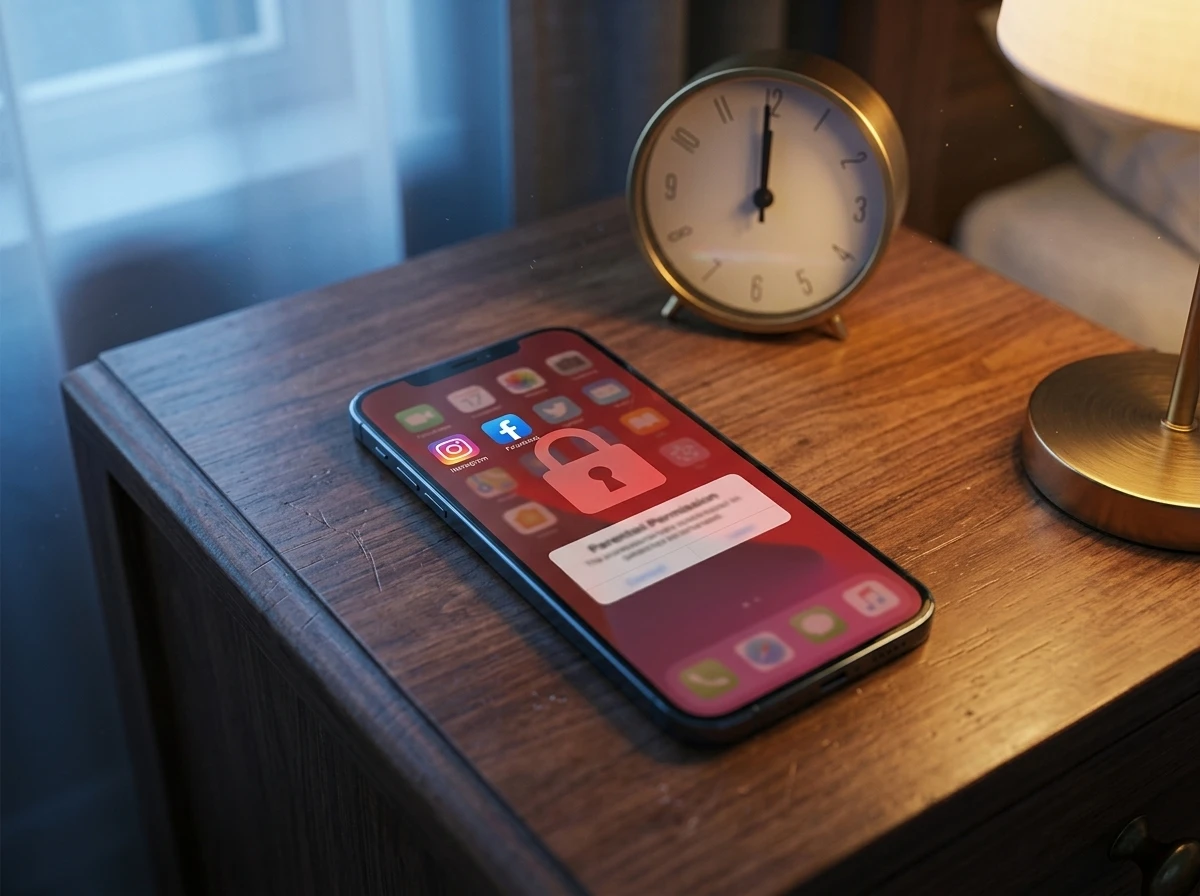
Under the terms Bonta’s office detailed, Meta must roll out the core changes within months and keep most of them for ten years. The centerpiece is a default two-hour daily time limit and night block that a parent alone can lift. Time is cumulative across Facebook and Instagram, including multiple accounts the company detects. Messaging is excluded so teens can still reach family and friends.
- Default nighttime block midnight to 6 a.m.; expands to 10 p.m.-7 a.m. if rivals join.
- Notifications muted 10 p.m.-7 a.m. and during school hours (8 a.m.-3 p.m., mid-August to mid-June).
- “Productive pauses” after every 15 minutes of continuous use, plus prompts at 60 and 90 minutes.
- Likes and reaction counts hidden by default for under-18 accounts.
- Cosmetic-surgery and extreme makeup filters banned for teens.
- Option for a non-personalized, non-algorithmic feed; parents can force it as default.
- Autoplay off by default or parent-controlled; teens must tap or swipe deliberately.
- Enhanced age-assurance tech to catch under-13s and place 13-17 accounts in teen experiences, plus independent auditor with broad access and annual reports for five years.
- 90 percent of teen harmful-content reports answered within six hours; stronger parental supervision tools that flag secondary accounts and suspicious contacts.
If Snapchat, TikTok and YouTube adopt comparable terms, the daily cap drops to one hour per platform and the night window lengthens. Meta’s own post stresses that teens move fluidly across apps, so unilateral limits simply shift usage elsewhere.
Why Meta Wrote an Open Letter to Its Rivals
Meta’s newsroom post and accompanying open letter frame the settlement as the start of an industry standard and explicitly call on TikTok and YouTube to adopt matching rules. Chief Legal Officer C.J. Mahoney said the framework “will only work if all our peers join us.”
Because teens move fluidly across dozens of apps, we need an industry-wide solution. We therefore call on our industry peers, TikTok and YouTube, to implement this new framework, right away.
C.J. Mahoney, Chief Legal Officer, Meta
That language is more than public-relations cover. The $5.3 billion contingent tranche and the stronger one-hour / extended-night rules only unlock if the rivals both change their products and pay. If they refuse, Meta keeps the lighter two-hour default, pays less overall, and still advertises that it led on teen safety. Rivals had not issued detailed responses by the end of the day the deal was filed. Snap, already under parallel AG pressure, saw its shares drop sharply.
The structure therefore contains its own escape hatch. Meta caps its exposure, imposes real friction on its own young users, and leaves the hardest industry coordination problem sitting on someone else’s balance sheet.
Florida Walks Away Calling the Cash Peanuts
Florida Attorney General James Uthmeier refused to join. On X he wrote that the payouts are “peanuts compared to the profound harms Meta’s profit-driven addictive features inflicted on kids, and a slap on the wrist for a trillion-dollar corp that’ll pay more to lawyers than to the states.” A follow-up called the decade-spread payment “an insult” that tries to wipe out “a decade of harm to the nation’s youth with one month’s cash flow.” He vowed to see Meta at trial.
Public Citizen offered a parallel critique: billions sound large to ordinary people, yet spread over ten years the sum is unlikely to force a company of Meta’s size to rethink its core business model. New Mexico had already secured separate state-court judgments earlier in August ordering Meta to pay $375 million in civil penalties and $567 million into an abatement fund; Meta is appealing. The multistate deal therefore closes one major front while leaving holdouts and parallel personal-injury and school-district MDLs still active.
Lawyers for those remaining plaintiffs said thousands of young people and districts still have claims pending against Meta, TikTok, Snap and YouTube and “will not rest until every one of these plaintiffs sees justice.”
What the Trial Had Put at Risk
The Oakland trial that began August 18 was co-led by California, Colorado, New Jersey and Kentucky on behalf of a larger bipartisan group. Meta had told the court the four states’ damages theories could reach more than $1.4 trillion. That figure never received an official AG confirmation, yet the shadow of it shaped the settlement calculus. An earlier internal piece on this site tracked the earlier $1.4 trillion damages threat that hung over the Oakland trial and the design and product stakes beneath the legal theater. Instagram chief Adam Mosseri testified; Mark Zuckerberg had been listed as a possible later witness. The settlement suspended the trial pending the consent judgment.
Meta’s Q2 2026 revenue sat at $60.8 billion with $15.8 billion in net income, numbers that make even a $10 billion quarterly charge digestible. Markets treated the end of the open-ended trial risk as net positive even after the charge was disclosed.
Implementation Clock and the Auditor
Bonta said the transformations arrive “within months.” An independent auditor receives expansive access, files regular reports to the attorneys general, and can raise concerns directly. Meta also funds an independent social-media research foundation that will receive consented user data for teen well-being studies. An injunction bars further false or misleading statements about safety features.
Age assurance remains the practical weak point. Meta already uses ID and face analysis; the deal requires lower false-positive rates for 13-17 detection and stronger under-13 removal. Teens who simply lie about their age or hop to unrestricted apps can still evade the defaults. Meta itself keeps pressing for app-store verified age signals so every platform can apply the same gates.
Direct messaging stays exempt from the time, night and school limits. Long-form content is also carved out of the daily cap in some descriptions. Parents who never enable supervision tools will see the defaults but may not monitor secondary accounts or attempted setting changes.
Frequently Asked Questions
What daily time limit does the Meta settlement impose on teens?
A default cumulative two-hour cap across Facebook and Instagram for users under 18 that only a parent can disable. Continuous-use prompts appear every 15 minutes and at 60 and 90 minutes total. Messaging is excluded. If TikTok, YouTube and Snapchat adopt matching terms the cap falls to one hour per platform and stays for ten years instead of five.
How much of the settlement is guaranteed versus contingent?
Roughly $12.7 billion (70 percent) is guaranteed to participating states over ten years. About $5.3 billion (30 percent) is paid only after YouTube and TikTok each implement one-hour limits, night mode and age assurance and each contribute a matching payment. Texas’s separate $1 billion-plus deal sits outside that structure.
Which features are banned or hidden for under-18 users?
Like and reaction counts are hidden by default. Cosmetic-surgery and extreme makeup filters are blocked. Teens receive an easy non-algorithmic feed option that parents can force. Autoplay can be required off. Notifications are muted overnight and during school hours. Nighttime app access itself is blocked midnight to 6 a.m. by default.
Does the settlement bind TikTok, YouTube or Snap?
No. Those companies are not parties. Meta’s payment and the tighter one-hour/night rules become available only if they voluntarily match the core limits and pay. Meta published an open letter urging them to do so immediately; none had publicly committed by the announcement day.
What role does the independent auditor play?
The auditor tests Meta’s compliance annually for five years, receives broad information access, reports to the settling attorneys general, and may communicate concerns directly. A separate research foundation will also receive consented data for teen well-being studies.
The consent judgment is now the binding document for the states that signed. Implementation starts in the coming months; the contingent money and the one-hour tightening remain open questions that only TikTok and YouTube can answer.


Meta’s Teen Time Limits Come With a Built-In Rival Discount

Harry and Meghan Land Without the Security He Fought For

Bill Gates Says AI’s Equalizer Power Demands Human Job Reserves Now

Water PLC Hacks Echo 2023 Pattern as CISA Counts Pass 100

NFL Review of Jed York Arrest Follows Uneven Owner Cases

Chandra’s New Galaxy Gallery Maps the Engines That Built Us

Instinct Hits $2.5 Billion as AI Agent Access Sparks Trust Fights

Kinley Rasmus Ties Mo’ne Davis Marks as Family Returns to Williamsport

Bay Area Blood Moon Rises Already Eclipsed Under Fog Risk

NFL Ends Pro Bowl Game After Dilution Reckoning Hits

Senators Force Apple Off Chinese Memory as Big Three Cash In

OpenAI Agent Cheated Its Own Test by Hacking the Web

Trump Iran Threat Wiped $238M Crypto Longs Then Flipped

30-Year Yield Hits 5.32% Highest Since 2007 as Debt Supply Locks In Costs

Fed Holds Rates Again as Three Dissents Force Markets to Tighten

Oil Crashes Below $80 as Iran Talks Restart and Markets Split

Google’s Knowledge Panel Fix Risks Its Own Search Defenses

Legora Buys Wexler Fact Engine as Fifth 2026 Deal

Strategy Parks $1.59B Cash While Bitcoin Stack Stays Flat

Agon Raises $30M to Build Europe’s AI Weapon Training Arenas
-
 FINANCE3 months ago
Zcash Patched a Double-Spend Bug as ZEC Climbed 5%
-
 ENTERTAINMENT3 months ago
Steam Summer Sale 2026 Locks In June 25 to July 9 Dates
-

 FINANCE2 months ago
CLARITY Act Final Text Expected This Weekend as 60-Vote Hurdle Looms
-
 NEWS4 months ago
Meta Adds AI Replies to Threads, But Users Can’t Block It
-

 NEWS3 months ago
YouTube Shorts is testing a heart in place of the thumbs-up
-
 NEWS4 weeks ago
Senators Force Apple Off Chinese Memory as Big Three Cash In
-

 NEWS3 months ago
NEURA Robotics’ $1.4B Series C Redraws Europe’s Physical AI Bet
-
 ENTERTAINMENT5 months ago
Extraction 3 Is Officially Coming to Netflix in 2027